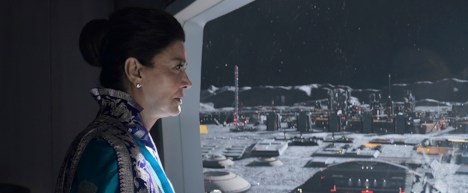
I published a new In the Frame piece at The Escapist this evening. Since I binged The Expanse and since the season finale is out this week, I figured it was worth taking a look at the show in comparison to Game of Thrones.
From its launch, The Expanse has been likened and compared to Game of Thrones. Part of this is simply down to the show being an epic within a familiar genre framework, but there is something to the comparison. While the comparison might be somewhat obvious and straightforward, it is also informative: not only in the ways that The Expanse evokes Game of Thrones, but the ways in which The Expanse differs from Game of Thrones.
You can read the piece here, or click the picture below.
With a slew of Marvel Studios productions coming to Disney+ over the next six months, The Escapist has launched a weekly show discussing these series. I’ll be joining the wonderful Jack Packard and the fantastic KC Nwosu to break down WandaVision, Falcon and the Winter Soldier and Loki as they come out.
This week, we take a look at the fourth episode of WandaVision, particularly the pointed metatext, the question of “checkbox” storytelling and the question of how best to pace a story being told like this.
I published a new column at The Escapist this evening. Since I binged The Expanse and since the season finale is out this week, I figured it was worth taking a look at the show as one of the defining television series of the past ten years.
Every generation gets a science-fiction show that reflects its particular anxieties. The Expanse is a show that engages aggressively with the concerns of the moment. It is a show about fragmentation, about nationalism, about inequality, about exploitation and about power. In the same way that Star Trek spoke to the uncertainty and tumult of the sixties, and Battlestar Galactica spoke to the nightmare of the War on Terror, The Expanse resonates with a world still coming to terms with the aftermath of the Great Recession.
You can read the piece here, or click the picture below.
Hosted by Andrew Quinn and Darren Mooney and with special guests Jason Coyle and Ronan Doyle, This Just In is a subset of The 250 podcast, looking at notable new arrivals on the list of the 250 best movies of all-time, as voted for by Internet Movie Database Users.
This time, Emir Kusturica’s Dom za vešanje.
Perhan lives a simple life in a gypsy community outside of Skopje. He dreams of marrying Azra, but his social standing is not high enough. Events conspire to take Perhan away from his community, embarking on a trip to Italy with local legend Ahmed and with the promise of a new and prosperous life waiting for him. Inevitably, Perhan discovers that this life is not what was promised, and faces the possibility that he might also be something different than he expected himself to be.
At time of recording, it was ranked the 220th best movie of all time on the Internet Movie Database.
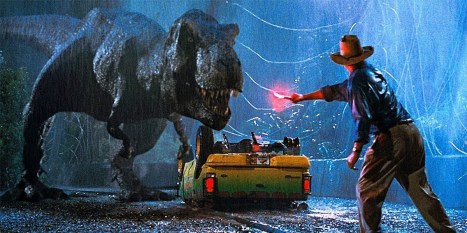
I published a new In the Frame piece at The Escapist this evening. For no reason other than because I watched it this week, I took a look at Jurassic Park and how it feels strangely prophetic.
Jurassic Park is many things: a cautionary tale about science run amok, about mankind’s hubris, about dads. However, watched decades later, it stands out as a cautionary tale about the kind of movie that it is. Jurassic Park is one of the best blockbusters ever made, but it was also a game-changer. It seemed to herald a revolution in computer-generated imagery that fundamentally altered the blockbuster landscape. In that sense, the film’s anxiety about the unforeseen consequences of these sorts of innovations, and of bringing the past to life again, have aged very well.
You can read the piece here, or click the picture below.
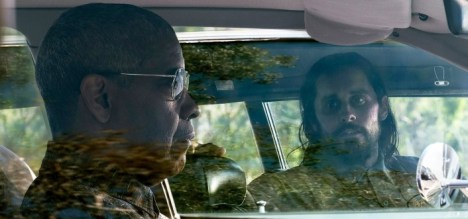
The Little Things was reportedly written by John Lee Hancock in the mid-nineties, and it shows.
The film is largely set against the backdrop of October 1990. There frequent reminders that this is effectively a period piece. During the opening sequence, one potential serial killer victim sings along with Roam from the B-52s on her car stereo. Another victim has a pink flyer for No Doubt pinned up on her fridge and a poster for The Lost Boys hanging in her living area. There are repeated references to how Richard Ramirez, “the Night Stalker”, still lingers in the living memory of the Los Angeles Police Department.
A new release window.
However, The Little Things feels like a period piece in some more fundamental ways. Most obviously, there’s the fact that The Little Things exists as a star vehicle, its cast including Oscar winners Denzel Washington and Jared Leto, along with Oscar nominee Rami Malek. The film is not based on any existing intellectual property, even if it is highly derivative in other ways. More than that, it harks back to the serial killer boom of mid-nineties cinema, when big studio films were dominated by procedural thrillers and forensic meditation.
The Little Things is neither an exemplar nor a deconstruction of the genre, but instead a straightforward reminder of its tropes and conventions seemingly cobbled together to construct something close to the statistical mean. The common refrain with a film like The Little Things is to suggest that this is the kind of film that they don’t make any more. The more worrying thought is that The Little Things seems to illustrate why.
The reactions to Malcolm and Marie have been divided, to the say the least.
On one extreme, some critics have been quick to laud Sam Levinson’s black-and-white character study as a surprise late addition to the awards race, a bracing old-fashioned character drama anchored in two compelling performances that interrogates a relationship that never seems certain whether it will implode or explode. It is the kind of film that invites comparisons to works like Who’s Afraid of Virginia Woolf?, The Boys in the Band or even something like Autumn Sonata: characters trapped in a confined space, with the drama ready to boil over.
On the other extreme, critics have been quick to argue that Malcolm and Marie is an indulgent mess anchored in a grossly unlikeable and shallow protagonist that never digs beneath the skin of its central characters. More than that, Levinson seems to use the film as an opportunity to work through his own issues as a promising (and privileged) young filmmaker who feels like he has not necessarily been given the critical respect that he deserves. Malcolm and Marie is a series of self-serious monologues delivered in the aesthetic of a (very pretty) Calvin Klein commercial.
As ever, the truth lies somewhere between these two extremes.
The Sound of Snow my favourite episode of the third season of Millennium, serving as a nice epilogue to the second season finale The Fourth Horseman and The Time is Now. It is an episode that is largely about grief and moving on, about coming to terms with loss and about working through it. In some ways, it feels like a necessary story for the third season of Millennium as a whole, and it is only a shame that it takes half a season for the show to reach the point where it can tell this story.
As ever, you can listen directly to the episode here, subscribe to the podcast here, or click the link below.
So, as I have mentioned before, I am launching a new video series as a companion piece to In the Frame at The Escapist. The video will typically launch with the Monday article, and be released on the magazine’s YouTube channel the following week. This is kinda cool, because we’re helping relaunch the magazine’s film channel – so if you can throw a subscription our way, it would mean a lot.
This week, I take a look at the power fantasy of the Marvel Cinematic Universe. With Captain America: Civil War, the MCU becomes a study in power without any responsibility.
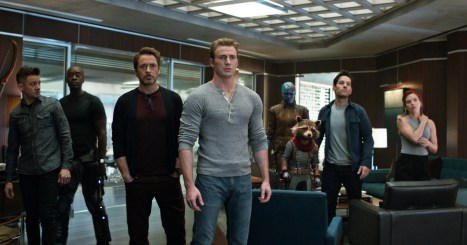
I published a new In the Frame piece at The Escapist this evening. Last week, there were rumours that Chris Evans might be returning to the Marvel Cinematic Universe, following his departure in Avengers: Endgame.
This is interesting, because it potentially undermines one of the more interesting facets of the Marvel Cinematic Universe going forward. Comic books are largely shaped and defined by nostalgia, with beloved characters filling familiar roles in perpetuity, with any major change to the status quo eventually rolling back to the default. In contrast, a cinematic universe operates by different constraints: actors move on, age out and even die. This would force a long-form shared universe to evolve in a way that comics haven’t had to. This is a good thing, as evolution is necessary.
You can read the piece here, or click the picture below.




















 the m0vie blog