• Following Us

  • Categories

  • Check out the Archives


  • Awards & Nominations

Non-Review Review: The Remains of the Day

It’s a sad truth that Emma Thompson and Anthony Hopkins are rarely handed roles that allow them to demonstrate their true abilities. The Remains of the Day is an absolutely stunning period drama from Merchant Ivory (which sounds far more impressive than any functional “combination of last names” really should). It’s a rather beautiful look at the classically romantic British character, but also an absolutely scathing attack upon it. It’s a brilliant examination of the inherent tragedy of the stereotypical British detachment, the capacity to maintain emotional distance in order to endure whatever life has to offer. Mister Stevens is the quintessential English butler, but he’s also one of the most tragic central characters I think I’ve seen in quite some time.

All that Remains...

Continue reading

Tintin: The Crab With the Golden Claws (Review)

In the lead-up to the release of The Adventures of Tintin: The Secret of the Unicorn, I’m going to be taking a look at Hergé’s celebrated comic book character, from his humble beginnings through to the incomplete post-modern finale. I hope you enjoy the ride.

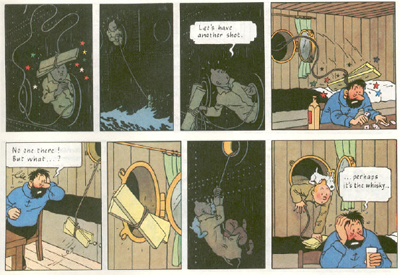
The Crab With the Golden Claws is the first of three Tintin stories that were used as the basis of Steven Spielberg’s upcoming The Adventures of Tintin: The Secret of the Unicorn (the other two being, obviously, The Secret of the Unicorn and its sequel, Red Rackham’s Treasure). The Crab With the Golden Claws was originally written during the Nazi occupation of Belgium, when Hergé feared that his then on-going storyline The Land of Black Gold would have proved too politically charged for the country’s new governing force. So the adventure was essentially written as filler, a bit of light entertainment to take the minds of his headers as far away from the political reality as possible. And it certainly succeeds as one of the lighter and brisker adventures in the series, with one major addition to the franchise’s mythos in the form of Captain Archibald Haddock.

This could be the start of a beautiful friendship...

Continue reading

Tintin: King Ottokar’s Sceptre (Review)

In the lead-up to the release of The Adventures of Tintin: The Secret of the Unicorn, I’m going to be taking a look at Hergé’s celebrated comic book character, from his humble beginnings through to the incomplete post-modern finale. I hope you enjoy the ride.

It’s amazing what you can miss in enjoying your favourite stories as a child. For me, at the tender age of seven or eight, King Ottokar’s Sceptre was a thrilling tale of palace intrigue with a rather wonderful locked-room mystery at it heart. Returning to it now, it feels like quite a bit more. This is the first time, reading a Tintin book, that it feels part of a particular place or time. Even the possibly-Nazi agent from The Black Island was cast ambiguously enough that the story could have been set at any time in the relatively recent past, but King Ottokar’s Sceptre is something quite a bit different, capturing the sense of fear in Europe on the eve of warfare.

A locked room mystery...

Continue reading

Non-Review Review: Cyrus

Cyrus is a film that it’s hard to work up passion about in either direction. That’s not necessarily a bad thing, to be entirely honest – I don’t actively dislike it or anything like that. It’s just an honest reflection on this attempt to merge the indie “mumblecore” sensibilities with more conventional mainstream movie-making. It’s funny in places, and features a great cast, but it ultimately feels far too self-assured, and more like it’s comfortable with its indie-movie clichés, rather than trying to tell its own story.

Family dysFUNction...

Continue reading

Tintin: The Black Island (Review)

In the lead-up to the release of The Adventures of Tintin: The Secret of the Unicorn, I’m going to be taking a look at Hergé’s celebrated comic book character, from his humble beginnings through to the incomplete post-modern finale. I hope you enjoy the ride.

The Black Island is a fun piece of pulp fiction, which wonderfully feels like Hergé was drawing on whatever pop culture reference was closest to hand at the time. In a way, this strange blend of influences mixes to produce a cocktail that fits surprisingly well against this instalment’s British background. It also features some of Hergé’s strongest artwork, in my own very humble opinion. It might lack the sort historical and political context that defined The Broken Ear and The Blue Lotus, but it’s still a more-than-worthy entry in the series.

Well, don't they have egg on their faces...

Continue reading

Steve Jobs & Pixar…

A lot of people have already written a lot of very thoughtful and inspiring pieces about Steve Jobs, and what the inventor means to the world. Technology experts, heads of industry, world leaders, columnists, celebrities… everybody seems to have an opinion or an anecdote about the man who made Apple possible. I honestly don’t feel like there’s too much I can add to a conversation occurring all over the world about a man who revolutionised what we thought was possible in terms of media and connectivity through the iPhone and countless other innovations. Still, I can’t help but think of Pixar when I think of Jobs, and I think the animation studio stands as a testament to one of his innate abilities, one that was just as important as his drive for new ideas and his insights into technology: Jobs had that unique ability to spot and judge potential from a distance, and I think it would be unfair not to consider Pixar when discussing the inventor’s legacy.

Continue reading

5% Solution: Why the Oscars’ New First-Preference Rule is a Step in the Wrong Direction…

We’re officially out of the summer blockbuster season, which might lead you to believe that it was time for us film folk to have a bit of a rest. After all, we’ve been yammering on about “box office this” and “3D that” for quite some time now, and it makes sense we’d use the lull to compose ourselves. Of course, we can’t – it’s time to start Oscar-speculating. Because I’m situated in Ireland, there’s no point in me putting together a list of potential nominees, as it would just involve plagiarising countless individuals far more informed than myself. However, I have been thinking quite a bit about the latest amendment to the Academy’s infamous “ten nominees” amendment to their Best Picture nomination process: whereby every nominee will now be required to have at least 5% of the first preference votes. The more I think about it, the more I don’t like it.

Not quite the gold standard anymore?

Continue reading

Tintin: The Broken Ear (Review)

In the lead-up to the release of The Adventures of Tintin: The Secret of the Unicorn, I’m going to be taking a look at Hergé’s celebrated comic book character, from his humble beginnings through to the incomplete post-modern finale. I hope you enjoy the ride.

The Broken Ear is a strange little Tintin story. On one hand, it begins as a sort of a mystery adventure, with an artifact stolen from a museum and then replaced the following night, a little note apologising for a childish prank. As seems to be the case in these kinds of stories, the authorities decide “no harm, no foul” and go on about their daily business, but our boy Tintin is not convinced. However, over the course of his investigation, the story develops into something a bit more substantial, allowing Hergé the opportunity to indulge some of his wonderfully broad political satire. It wouldn’t be among my favourite entries in the franchise, if only because I was too young to appreciate a lot of the commentary when I first read it.

Hergé doesn't go overboard...

Continue reading

Non-Review Review: The Three Musketeers (2011)

“Guilty pleasure.” That’s a phrase that feels strangely appropriate when referring to Paul W.S. Anderson’s The Three Musketeers. It’s silly and daft, and has two fairly fundamental flaws, on top of the cheesiness that’s going to divide audiences straight down the middle. However, despite these fairly central and hard-to-avoid problems, it also features a knowing self-awareness, an appealingly straight-forward approach to the fact that is so very silly, a (mostly) great cast and some rather wonderful steam-punk production design. It’s not going to appeal to everybody, but I actually warmed quite a bit to it.

Four of a kind?

Continue reading

Tintin: The Blue Lotus (Review)

In the lead-up to the release of The Adventures of Tintin: The Secret of the Unicorn, I’m going to be taking a look at Hergé’s celebrated comic book character, from his humble beginnings through to the incomplete post-modern finale. I hope you enjoy the ride.

The Blue Lotus is regarded as something of a turning point for Hergé’s boy reporter. The cartoonist, apparently urged by those close to him, decided that – rather than basing his depiction of China on a collection of pop culture stereotypes (as he had done in Tintin in America) – he would undertake a considerable amount of research in order to ensure that the story was as respectful and faithful to Chinese culture as might have been possible. Indeed, the Chinese boy who Tintin befriends, Chang Chong-Chen, is named in honour of one of the students who helped him in coming to understand the Far East.

East of Eden...

Continue reading