• Following Us

  • Categories

  • Check out the Archives


  • Awards & Nominations

Doctor Who: The Trial of a Time Lord – The Mysterious Planet (Review)

To celebrate the fiftieth anniversary of the longest-running science-fiction show in the world, I’ll be taking weekly looks at some of my own personal favourite stories and arcs, from the old and new series, with a view to encapsulating the sublime, the clever and the fiendishly odd of the BBC’s Doctor Who.

The Trial of a Time Lord originally aired in 1986.

Well, this is a charade.

– the Doctor gets the idea quickly enough

The Doctor had been off screens for eighteen months following Revelation of the Daleks. Michael Grade was desperately trying to cancel the show, and it only limped back to screen with a significantly reduced budget and much shorter run of episodes. The show length was also reverted back to its default value. This season would only run for fourteen half-hour episodes – what would become the set length for Doctor Who in the years to come. (Indeed, counting the Christmas Special, the revived series also runs to that length, albeit in forty-five minute episodes.)

By all accounts, the production on the infamous Trial of a Time Lord was a disaster for reasons natural and otherwise. Veteran writer Robert Holmes was to provide the opening and closing scripts, but passed away before his work on the finalé could be finished. Script editor Eric Saward and producer John Nathan-Turner clashed over the climax of the trial, prompting Saward to resign and Nathan-Turner to temporarily become script editor himself. Colin Baker couldn’t make sense of Mindwarp. The last episode of the season was written by two writers wrapping up from Holmes’ first part, but unable to examine his notes on how he planned to conclude it.

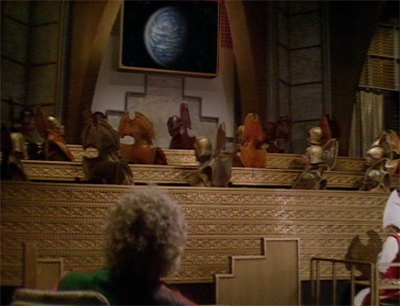
Believe me when I state that every last ounce of this behind-the-scenes friction was visible on-screen by the end of the year. Luckily enough, the show does a decent enough job concealing these approaching problems in the first story of the arc. That’s not to say that The Mysterious Planet is an unsung classic, merely to point out that it is at least unburdened by the seemingly real time collapse of Doctor Who.
Ah, it's a fourteen-week adventure about watching Doctor Who!

Ah, it’s a fourteen-week adventure about watching Doctor Who!

Continue reading

Non-Review Review: The Internship

When did Owen Wilson and Vince Vaughn get so old? The two rose to fame as part of the “frat pack” in the late nineties and the early part of the last decade, with The Internship serving as a reunion eight years after their collaborative effort in The Wedding Crashers. It’s interesting to look at how radically their screen personas have shifted. The Wedding Crashers positioned the two men as teenagers afraid to grow up, while The Internship joins them as two middle-aged men with life experience to share.

There’s a sense that something’s missing here, that we skipped a crucial step in the transition from rogue youngsters to hip uncles. The Internship doesn’t feel reckless or energetic. It feels safe and comfortable. If The Wedding Crashers saw the pair joyriding in a stolen Ferrari, The Internship feels more like a cruise in the family sedan.

A brand new day...

A brand new day…

Continue reading

Superman: The Man of Tomorrow Archives, Vol. 1 (Review/Retrospective)

To celebrate the release of Man of Steel this month, we’re going Superman mad. Check back daily for Superman-related reviews.

Silver Age comic books are, by their nature, different from modern comics. It’s more than just evolving social norms, or even shifting artistic sensibilities. There’s a massive world of difference between a fairly average comic written in the mid-sixties and a similarly average comic produced today. While I’d be reluctant to describe the comics contained in Superman: The Man of Tomorrow Archives, Vol. 1 as “great” or “brilliant”, they have a certain charm or novelty to them. They feel alien and unique, as if offering a raw and unrefined sample of a mood that Superman has been chasing for the past two or three decades.

While I don’t think Batman was as well-served by the sixties as he was by later decades, there’s a surreal innocence to these comics which speak to Superman as a character. These are the comics that probably inspired Richard Donner’s Superman film, and though artists like Al Plastino, Curt Swan or Dick Sprang might not have drawn a Superman who resembled Christopher Reeve, it’s very easy to imagine him fitting in among these stories quite easily.

The Silver standard?

The Silver standard?

Continue reading

Batman: The Brave and the Bold – Battle of the Superheroes (Review)

To celebrate the release of Man of Steel this month, we’re going Superman mad. Check back daily for Superman-related reviews.

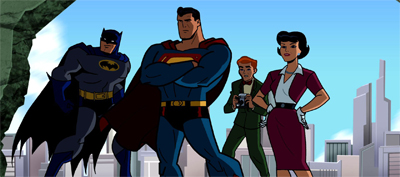
Batman and Superman. It’s a great combination, like cookies and cream or spaghetti and meatballs or… feel free to insert your own analogy here. The two characters are two of the oldest and most enduring superheroes, both owned by the same company. They also both embody two very different ideals. Batman is a pulp action hero in a silly outfit with gothic trappings, while Superman is an alien from another world dressed in primary colours. Pairing the two up to compare and contrast is great fun.

Battle of the Superheroes focuses on Batman and Superman as friends and colleagues, a portrayal which seems somewhat dated. After all, ever since Frank Miller wrote The Dark Knight Returns, the tendency has been to treat the pair as grudging allies rather than bosom buddies. Still, the Silver Age aesthetic of The Brave and the Bold suits this approach well, and it’s hard not to get swept up in the wry enthusiasm of it all.

Superhero team-up time...

Superhero team-up time…

Continue reading

Non-Review Review: Despicable Me 2

Despicable Me 2 doesn’t quite have the same charm as Despicable Me. It’s not that there’s any aspect of the production that is noticeably weaker, it’s just that the original film had a much stronger hook. The story of a supervillain who adopts three young girls as a means to an end, only to find himself coming to care for those kids, might seem a bit cliché (okay, it might sound a lot cliché), but it worked because the film had a solid emotional core.

Despicable Me 2 doesn’t have the same emotional core or stakes. There are subplots and character development (with the sequel going to a lot of effort to make sure almost every returning character has something to do), but the stakes don’t seem quite as high. It’s stunningly well-animated, it’s consistently funny and the cast are as charming as ever, but it just feels a tiny bit shallower than the first film.

You're hot and you're cold...

You’re hot and you’re cold…

Continue reading

Flashpoint: Project Superman (Review/Retrospective)

To celebrate the release of Man of Steel this month, we’re going Superman mad. Check back daily for Superman-related reviews.

I actually quite liked Flashpoint. I can accept that the event had its flaws. It was a less than ideal set up for a radical shift in the status quo and a significant proportion of its tie-ins were absolutely terrible, but these are problems that seem inherent to any big “universe-altering comic book event.” However, despite that, I liked the idea of viewing the DC universe “through a glass, darkly.” Seeing familiar, but distorted reflections of DC icons cast as terrifyingly cynical nineties anti-heroes.

By positing that any world inhabiting these grim anti-heroic substitutes was severely broken, Geoff Johns was able to reaffirm the idealism of the Silver Age. Contrasting DC’s stable of iconic heroes to their darkened reflections allows us to take stock of what is really essential to them as characters. Project Superman provides a glimpse at an alternate version of Superman, one raised under very different circumstances. It dares to ask what is the essential ingredient in making Superman the character we know and love.

It’s a deeply flawed three-issue story, and can’t measure up to Brian Azzarello’s superb Batman: Knight of Vengeance, but it’s still a fascinating look at what makes Superman into Superman.

A broken world...

A broken world…

Continue reading

Doctor Who – The Shakespeare Code (Review)

To celebrate the fiftieth anniversary of the longest-running science-fiction show in the world, I’ll be taking weekly looks at some of my own personal favourite stories and arcs, from the old and new series, with a view to encapsulating the sublime, the clever and the fiendishly odd of the BBC’s Doctor Who.

The Shakespeare Code originally aired in 2007.

Goodnight, Doctor.

Nighty night, Shakespeare.

– talk about your British icons

The Shakespeare Code is the third season’s opening trip into British nostalgia, a celebrity historical where the Doctor journeys back in time to meet a famous character and to deal with alien menaces masquerading as something altogether more sinister. This time, the Doctor and Martha travel back to meet William Shakespeare. It’s a little on the nose, but perhaps that’s not a bad thing. After all, teaming the Doctor up with Queen Victoria in Tooth and Claw did seem a little cynical when the show opened with a gag at the expense of Margaret Thatcher.

The rather safe and occasionally quite “postcard-y” portrayal of British history aside, The Shakespeare Code is more interesting as a rather novel form of arc-building for the show. “Saxon” was the arc word for the show’s third season, but restricted to those episodes set in the present. However, The Shakespeare Code winds up offering major thematic foreshadowing of the season ahead.

Where there's a Will...

Where there’s a Will…

Continue reading

Non-Review Review: Citadel

Citadel marks a promising feature-length directorial début from Ciaran Foy. It’s a very grimy and gritty horror, evoking the sort of trashy horror aesthetic of the seventies or eighties video scene. It’s unpleasant and nasty stuff, which is exactly what you’d expect from a horror film. On the other hand, it occasionally seems too nasty. Horror films, by virtue of their genre, often wind up feeling a little reactionary. Citadel is an urban horror film, reflecting the concerns and the nightmares of inner-city living, turning happy-slapping hoodies with ASBOs into literal monsters.

I got you, babe...

I got you, babe…

Continue reading

Superman: The Animated Series – Ghost in the Machine (Review)

To celebrate the release of Man of Steel this month, we’re going Superman mad. Check back daily for Superman-related reviews.

Ah, Lex Luthor. Luthor is, in the right hands, an absolutely fascinating character. The arrogant, ruthless, egocentric hero of his own story – the man who resents the world for not acknowledging his genius are recognising his boundless compassion. He’s a crusader against the alien threat that has lulled his city into a false sense of security, and he’s willing to make untold sacrifices in order to expose Superman as the menace that Luthor knows deep down that he is.

Well, not really. Luthor is a greedy and manipulative sociopath with delusions of grandeur and a ruthless streak a mile wide. However, there’s something quite intoxicating about the romantic mythology he’s created from himself. Ghost in the Machine is really the first time we’ve focused on a character taken in by that mythology, somebody won over by Luthor’s propaganda and his alpha male charisma.

Mercy Graves was never the break-out character that Harley Quinn was, but she’s another valuable addition to the DC universe made by Bruce Timm and the rest of DC animation. Ghost in the Machine is as much her story as Superman’s or Brainiac’s, as she finds herself caught in the middle.

Another day in the body shop...

Another day in the body shop…

Continue reading

Doctor Who: The Reign of Terror (Review)

To celebrate the fiftieth anniversary of the longest-running science-fiction show in the world, I’ll be taking weekly looks at some of my own personal favourite stories and arcs, from the old and new series, with a view to encapsulating the sublime, the clever and the fiendishly odd of the BBC’s Doctor Who.

The Reign of Terror originally aired in 1964.

Hush, child. Say your goodbyes and remember, we shall be leaving almost immediately

– the Doctor, about two minutes into the first part of a six parter

The Reign of Terror represents a fairly disappointing conclusion to a reasonably solid first season of Doctor Who. I won’t argue that the show’s first year can be ranked among the finest in the fifty-year history of the show, but I do think that the stories generally did quite a decent job of introducing the characters and concepts and setting them up so that they could support a lot more. It’s interesting to compare the title character introduced in An Unearthly Child to the version presented in The Sensorites.

While The Sensorites is still a story far too long and far too generic for its own good, it still feels like it solidifies a version of the character who – broadly speaking – resembles the Doctor we know and love. While I’d argue the Doctor was only absolutely solidified as a hero in The Dalek Invasion of Earth, there’s a very clear through-line from An Unearthly Child to The Sensorites which charts the evolution of the character. The Sensorites would make a decent (if unspectacular) place to end the first season.

Unfortunately, the first season continues on for one more episode. The Reign of Terror is just as over-long and just as padded out as The Sensorites, but it suffers because it feels like a massive step backwards in a season that has been very clearly moving forwards.

An animated sort...

An animated sort…

Continue reading