• Following Us

  • Categories

  • Check out the Archives


  • Awards & Nominations

Doctor Who: The Pyramid at the End of the World (Review)

The Pyramid at the End of the World is very much a Peter Harness script.

Much like Kill the Moon, The Zygon Invasion and The Zygon Inversion, the climax of the episode boils down to a set of characters in a contained set making an impossible moral choice in the abstract. Harness very much writes Doctor Who in the grand tradition of science-fiction allegory, the use of the show’s absurd framework to ask broad philosophical questions about the human condition in general and this political moment in particular. Harness is writing Doctor Who in the great political tradition of The Happiness Patrol.
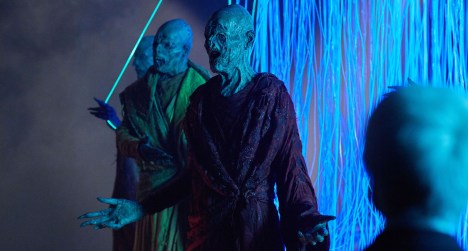
Without a thread of doubt.

Harness is a writer with his finger on the proverbial pulse. The Zygon Invasion and The Zygon Inversion were essentially metaphorical explorations of radicalisation and immigration, touching on two of the hot-button political issues of the season. The Pyramid at the End of the World essentially updates the root metaphor for the current climate. The Pyramid at the End of the World is essentially a story about what it takes for people to make truly unconscionable choices. At what point does an ordinary decent person consent to be governed by a monster?

This is very much in tune with the popular consciousness in 2016 and 2017. After all, the British public voted for Brexit largely in support of xenophobic platform that borrowed imagery from Nazi Germany. The American public elected a leader who believed that most Mexicans were rapists and that all women wanted him to sexually assault them. At what point do these objectively horrific ideas seem palatable to the average person? The Pyramid at the End of the World reaches the same answer as Harness’ other Doctor Who scripts: when people are very afraid.
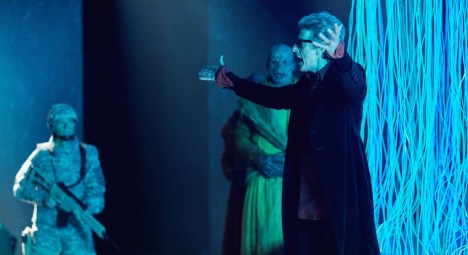
“Why didn’t you tell me you’d had fibre installed?”

Continue reading

30. Psycho (#34)

Hosted by Andrew Quinn and Darren Mooney, The 250 is a fortnightly trip through some of the best (and worst) movies ever made, as voted for by Internet Movie Database Users. New episodes are released every second Saturday at 6pm GMT, with the occasional bonus episode between them.

This time, Alfred Hitchcock’s Psycho.

Marion Crane has lived her life by the rules, until one day she takes a chance. Leaving town with $40,000 of her employer’s money, Marion embarks a journey westward into criminality. Along the way, she makes a stop at the Bate Motel.

At time of recording, it was ranked the 34th best movie of all time on the Internet Movie Database.

Continue reading

Star Trek: Voyager – Season 4 (Review)

The fourth season is probably the show’s best season.

Of course, that is arguably damning with faint praise. By any measure, the fourth is probably weaker than at least four seasons of Star Trek: The Next Generation and four seasons of Star Trek: Deep Space Nine. It is also weaker than the first two seasons of Star Trek or the final two seasons of Star Trek: Enterprise. In the grand scheme of things, that places the best season of Star Trek: Voyager around the franchise median. Somehow, this feels entirely appropriate.

The fourth season of Voyager has some of the show’s best episodes. As such, it also has some of the franchise’s best episodes. Scorpion, Part I and Scorpion, Part II are spectacular television, while Year of Hell, Part I and Year of Hell, Part II offer a glimpse of the show that Voyager could have been while also developing some of the series’ core themes. There are also truly great standalone episodes like Nemesis, Prey, and Living Witness. More than that, there is a lot of really fun storytelling as well, with lighter episodes like Concerning Flight and Message in a Bottle.

However, there is also an unevenness to the season. While there are arguably fewer truly terrible episodes than in the earlier seasons, there are a couple of true stinkers like Retrospect or Vis á Vis. More than that, there are quite a few disposable and dull episodes, stories quickly forgotten after the end credits. Stories like Scientific Method, Random Thoughts, Waking Moments, Unforgettable and Demon fail to make a lasting impression. They just fill up the season order adding very little beyond a familiar Star Trek beat sheet.

In some ways, this is the central tension of the fourth season, one reflected in the addition of Seven of Nine and the focus on Borg culture. The fourth season of Voyager is caught between mediocrity and brilliance, between being a perfectly serviceable mid-tier Star Trek show and being something a little more ambitious. The fourth season is a weird synthesis of generic Star Trek and something unique, reflecting the fusion of organic and mechanical that defines the Borg Collective.

The fourth season of Voyager ultimately retreats back to the comfort and safety offered by familiarity, but there are moments when it looks like the show might finally be ready to take flight. Unfortunately, it never really gets off the ground, but there is something heartwarming in the effort.

Continue reading

Non-Review Review: Baywatch

The most damning criticism of Baywatch is that it is actually a pretty decent Baywatch movie.

Of course, it is hard to define exactly what Baywatch is. The show ran for eleven seasons, launched a handful of spin-offs, built up an instant recognisable iconography. However, the most striking Baywatch was just how hazily the concept was defined. As imagined by Baywatch, the beach front was a tabula rasa, a canvas as blank as the sand dunes on the shore or the expressions on most of the cast’s faces. The beauty of Baywatch was in its lack of a distinct identity, its capacity to be almost anything that it wanted to be, albeit in the clumsiest and cheapest manner possible.

To Beaches, or Not To Beaches?

Baywatch was nominally a show about lifeguards, about beautiful people running in slow motion. However, it could also be a show about shark attacks, about drug smuggling, about wrestling matches, about illegal immigration, about mermaids, about possession. It could even launch a spin-off Baywatch Nights, about private investigators pursuing beach-themed crimes that evolved into a water-themed X-Files knock-off. Baywatch could be whatever the audience wanted it to be, and even sometimes what they needed it to be.

Baywatch was a mirror unto which anything could be projected, the most popular show in the world about the day-to-day adventures on Malibu Pier. Baywatch became a window into the popular consciousness, an abyss that gazed back. Many tried to decipher its mysteries, to account for its popularity. Was it as simple as the fact that very pretty people were running while wearing very little clothes? Did Baywatch speak to a deeper yearning in those landlocked countries where it proved so popular? Did Baywatch know the audience better than they knew themselves?

A versatile storytelling engine.

All of this is to say that Baywatch comes with a baked-in absurdity. It is so elastic a premise, and so ridiculous a concept, that it is pretty much immune to mockery. It is hard to imagine a joke about Baywatch that the show never embraced in earnest during its two-hundred-and-forty episode run. Baywatch is beyond parody as a pop culture object. It is a möbius strip of ridiculousness and earnestness, taking itself so seriously that it doubles back around into self-aware absurdity.

This is the biggest problem with Baywatch. It is a terrible parody of Baywatch, if only because the source material seems to exist in a realm where parody has been folded in on itself and presented as an entirely sincere beach-bound adventure.

Lost at sea.

Continue reading

Star Trek: Voyager – Hope and Fear (Review)

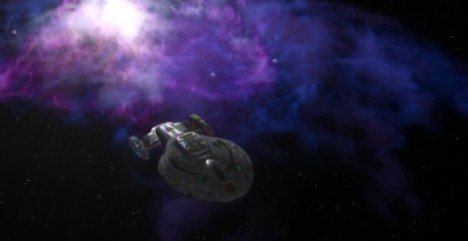
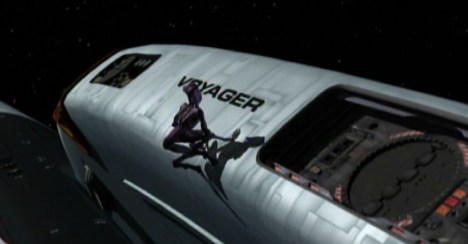
Hope and Fear is a reasonably solid conclusion to the fourth season of Star Trek: Voyager.

To be fair, the episode has a number of very clever ideas. There are a number of creative choices in Hope and Fear that feel entirely appropriate for the final episode of what has been a relatively strong season. Various concepts and ideas are brought back into play, from Janeway’s alliance with the Borg in Scorpion, Part II through to her conversion of Seven of Nine in The Gift and up to the secret coded message from Starfleet suggested in Hunters. It makes sense to bring all of these ideas back into play for the grand finale.

The fourth season comes to a head.

More than that, it makes sense to build the episode around the dynamic between Janeway and Seven. One of the recurring tensions in the fourth season, both behind the scenes and in front of the camera, has been the debate about the prominence of Seven of Nine. In the year since she was introduced, Seven has effectively become one of the three most important members of the cast. There is a credible argument to be made that she is the most important member of the cast, an anxiety played out in One. As such, it is logical to build Hope and Fear around Janeway and Seven.

At the same time, there is a certain clumsiness to the plotting of the episode. There is a very rushed quality to the story, which never really takes the time to develop or explore these big revelations and twists. Hope and Fear races towards its conclusion as if it has been sucked into quantum slipstream, a very disorienting and disjointed effect. Certain character arcs feel under-explored, and certain gaps in the plot logic are brushed aside. Hope and Fear feels like a story that deserved a bigger canvas.

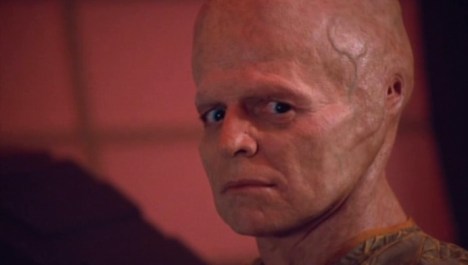
The hard cell.

Continue reading

Star Trek: Deep Space Nine – Profit and Lace (Review)

Profit and Lace is a disastrous misfire, a late-season catastrophe that many would consider to be the absolute nadir of Star Trek: Deep Space Nine. At best, it is an episode that belongs in conversation with Meridian, Prophet Motive, Let He Who Is Without Sin… and The Emperor’s New Cloak. It is a very bad piece of television. It could reasonably be argued that the toxicity of Profit and Lace is not even quarantined. The episode is so bad that it becomes a retroactive taint upon Deep Space Nine‘s attempts to develop and flesh out the Ferengi.

Some of the show’s best episodes focus on the Ferengi characters, like House of Quark or Family Business or Little Green Men or The Magnificent Ferengi, not to mention all manner of very solid stories like The Nagus or Bar Association or Body Parts. The writers on Deep Space Nine did a tremendous job developing and humanising the Ferengi, but the late one-two punch of Profit and Lace and The Emperor’s New Cloak erases all of that good will. Suddenly, the Ferengi are appearing in episodes as tone-deaf and ill-advised as The Last Outpost.

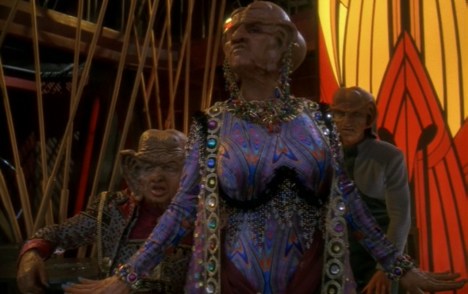
How Ishka got her groove back.

There are any number of reasons why Profit and Lace is so horrible. On a very basic level, it is a comedy episode that is simply not funny. The script is built around jokes that were already tired by the standards of fifties Hollywood, but refuses to do anything interesting or compelling with them. It is uncomfortably backwards-looking and regressive, its sexual politics feeling horribly outdated. The direction veers wildly between something approaching earnest world-building and broad slapstick, resulting a tonal mismatch that is toxic to the touch.

Profit and Lace is a stinker, by just about any measure.

A Quarky installment.

Continue reading

Non-Review Review: Pirates of the Caribbean – Salazar’s Revenge

Pirates of the Caribbean: Salavar’s Revenge is a strange beast, a conscious effort to refactor the Pirates of the Caribbean series into a more modern movie franchise.

On the surface, the appeal of Pirates of the Caribbean seems very simple. People like pirates, pirates have adventures. The period trappings, supernatural elements and exotic maritime setting add a sense of novelty to adventure. It is not rocket science. Indeed, the relative simplicity of the premise is part of the appeal, with the series tending to construct very straightforward narratives that provide a framework for set pieces and comedy action.

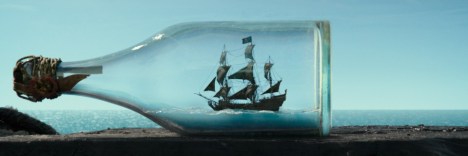
They should bottle Jack’s water.

It is very hard to imagine Pirates of the Caribbean having a “mythology” in the same way that many modern blockbuster franchises have a mythology. Audiences are not necessarily watching for character arcs or larger plot developments. Audiences are drawn in by the and the set pieces, with a healthy dose of Johnny Depp’s performance as Captain Jack Sparrow. There is a reason that Pirates of the Caribbean will always be a notch below The Lord of the Rings on Orlando Bloom’s filmography, because the series has never really aspired to “epic” heft.

There is a sense that Elizabeth Swan and Will Turner only appeared in the first three films so that they could be tied together to form a “trilogy”, with the two sequels hastily bolted on to an original film that was a runaway success story. Pirates of the Caribbean: On Stranger Tides was not diminished by the absence of Keira Knightley or Orlando Bloom, even if it ran into other structural problems related to making Jack Sparrow its primary character.

New Jack City.

As such, Salazar’s Revenge feels like a very strained attempt to rework the series to resemble modern blockbuster cinema. As with sequels like xXx III: The Return of Xander Cage and The Fate of the Furious, there is a conscious effort to appeal to nostalgia by roping in cast members from earlier installments to make token appears in order to cultivate a sense of continuity. Salazar’s Revenge attempts to create a broad “mythology” within the context of Pirates of the Caribbean, treating characters from the original film as fetish objects due to their continuity ties.

It is a very strange and unsettling creative direction for a series that would lend itself to a more episodic and playful approach, an attempt to add nostalgic weight to a franchise that cannot necessarily support it. Salazar’s Revenge buckles and suffocates under the demands of callbacks that nobody wanted and references to earlier events that are unlikely to have lodged in any viewer’s long-term memory. The result is disorienting and unsatisfying, despite some of the movie’s more endearing set pieces.

Pirates II, plus Pirates III, equals Pirates IIIII: Salazar’s Revenge.

Continue reading

Doctor Who: Extremis (Review)

I need to know what’s real and what’s not real.

Don’t we all.

“Book him, lads!”

“Death is an increasing problem,” reflects the voice over at the start of Extremis.

The first five episodes of the season had largely been about establishing the new cast dynamic. The Pilot, Smile and Thin Ice were an old school present-future-past triptych to start the year in introduce Bill. Knock Knock focused on Bill’s life outside the TARDIS. Oxygen marked the first episode to properly incorporate Nardole into the adventure. This was largely work setting up a dynamic that would carry across the season. However, the table has now been set.

It ain’t Oval ’til it’s Oval.

It makes sense that the season should turn its attention to the prospect of death at this point in the year. This will be the final season of Doctor Who to star Peter Capaldi. It will also be the last season produced by Steven Moffat. Extremis is the sixth episode of the twelve-episode season. It marks a point of transition for this final year, particularly positioned as the first episode in a mid-season pseudo-three-parter.

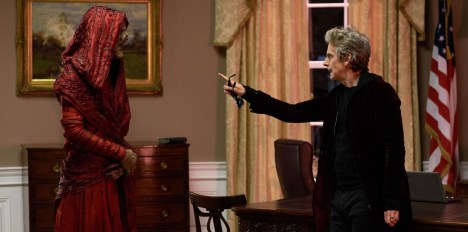
Death permeates Extremis, in a manner both literal and metaphorical. It is an episode in which the Doctor effectively commits suicide, along with many of the planet’s best and brightest, accepting his own uselessness in the context of the world around him. This primary plot is juxtaposed with a framing sequence in which the Doctor bears witness to the execution of Missy, a sequence that goes into great detail about just how difficult it must be to kill a Time Lord.

The light at the end.

Extremis is a very grim episode, in a manner that recalls Heaven Sent. Both are episodes built around the big twist that the audience is watching an iteration of the Doctor, rather than the definitive version of the Doctor himself. It is possible to contextualise this within the broader framework of the Moffat era, populated as it is by doppelgangers and counterpart Doctors; the ganger!Doctor from The Rebel Flesh and The Almost People, the Teselecta from The Wedding of River Song, even Clara at the end of Hell Bent.

However, the iterations of the Doctor in Heaven Sent and Extremis exist to ask their own particular question. These are episodes built around the challenge of what the Doctor does when he is confronted with a problem that he cannot solve, a trap that he cannot escape. In Heaven Sent, no single iteration of the Doctor can escape the clockwork prison. In Extremis, this iteration of the Doctor is actively helping the enemy. Neither is the “definitive” Doctor. What does the Doctor do when confronted with the idea that he is not “real”? He fights anyway.

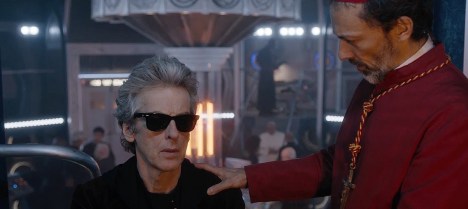
He hasn’t a prayer.

Continue reading

29. Inside Out (#128)

Do you ever look at someone and wonder, “What is going on inside their head?”

Hosted by Andrew Quinn and Darren Mooney, The 250 is a fortnightly trip through some of the best (and worst) movies ever made, as voted for by Internet Movie Database Users. New episodes are released every second Saturday at 6pm GMT, with the occasional bonus episode between them.

This time, Pete Docter’s Inside Out.

Featuring the anthropomorphised personalities of five distinct emotions, Inside Out invites its audience to step inside the mind of an eleven year girl and see how it ticks. Riley has just moved across the country with her family as her father takes on a new job, forcing “Joy” to work overtime to maintain her sunny disposition. However, as “Sadness” begins to creep in around the edges, maintaining that optimism may prove a challenge.

At time of recording, it was ranked the 128th best movie of all time on the Internet Movie Database.

podcast-insideout

Continue reading

Star Trek: Voyager – One (Review)

One is a solid episode.

Indeed, One is so solid that it is the rare episode of Star Trek: Voyager to be repurposed for Star Trek: Enterprise. The prequel series tended to borrow stock Star Trek plots, but it tended to borrow most heavily from Star Trek: The Next Generation and even Star Trek: Deep Space Nine; Oasis was Shadowplay, Vanishing Point was Realm of Fear, Dawn was Darmok. However, One would be reworked as Doctor’s Orders, another pseudo-horror bottle episode in which a member of the cast finds themselves driven insane by isolation.

Everything’s gone askew…

However, One has an in-built advantage over Doctor’s Orders, in that it is centred on a character who practically begs for this sort of treatment. Seven of Nine is effectively a reformed Borg drone. While Jean-Luc Picard was assimilated in The Best of Both Worlds, Part I and recovered in The Best of Both Worlds, Part II, and while Chakotay brushed up against a pseudo-collective in Unity, Seven of Nine is the first franchise regular to have spent the bulk of her life inside the Borg Collective. The nature of the Borg means that Seven is perfectly suited to a story about isolation.

One is a messy and clumsy episode in a number of ways, particularly in its drive for big action set pieces and tangible threats. In particular, the penultimate act of One feels awkward, as if the production team do not trust the audience to engage with a purer breed of psychological thriller. However, One leans very heavily on the character of Seven of Nine and on the performance of Jeri Ryan. Luckily, both character and actor are up to the task.

Voices in her head.

Continue reading