• Following Us

  • Categories

  • Check out the Archives


  • Awards & Nominations

48. Blade Runner 2049 – This Just In (#51)

Hosted by Andrew Quinn and Darren Mooney, and this week with special guest Jay Coyle, This Just In is a subset of The 250 podcast, looking at notable new arrivals on the list of the 250 best movies of all-time, as voted for by Internet Movie Database Users.

This time, Denis Villeneuve’s Blade Runner 2049.

Continue reading

Non-Review Review: Battle of the Sexes

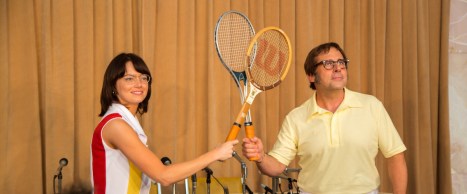
Battle of the Sexes is a well-produced and well-performed feel-good historical drama, one elevated by a strong sense of timeliness.

Battle of the Sexes is structurally a classic “historical buddy film”, a subgenre of the biopic that has become increasingly popular in recent years. The idea is to take a big historical event involving two important and opposed figures, and to build a narrative about that singular event following both characters on their collision course. Ron Howard is something of an expert with this particular biographical subgenre, having directed both Frost/Nixon and Rush, two very fine examples of the form.

Riggsed game.

Of course, there are plenty of films that still adopt the classic biopic format of documenting an extended portion of a single life. Recent films like The Founder or American Made come to mind, very traditional sweeping narratives that tended to pop up in awards nominations during the eighties and nineties. However, there is something to be said for the format of a tightly-focused two-hander, of a narrative built around two adversarial forces locked in some existential combat. It might look like sport, but it is always something more serious.

Battle of the Sexes is built around the historic tennis match played between Billie Jean King and Bobbie Riggs, but it is obviously about more than just a tennis match between a man and a woman. It evolves into a story about the symbolic weight of this match, of the culture that warps around it, of the dogma that it threatens to reinforce. Battle of the Sexes resonates surprisingly clearly, even more than thirty three years removed from its original context.

Causing quite a racket.

Continue reading

Non-Review Review: The Death of Stalin

The Death of Stalin is an ambitious tonal mishmash.

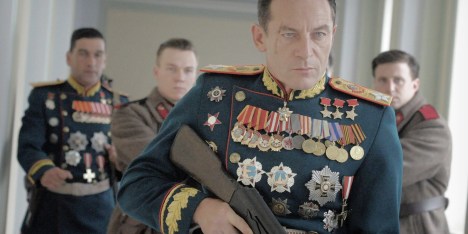
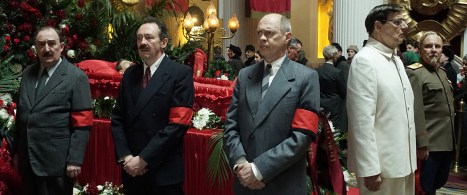
The Death of Stalin is funny and smart. It is a very well observed comedy of errors set against the backdrop of the power struggle that unfolds against the backdrop of the passing of the eponymous Soviet dictator. Officials, relatives and hangers-on all jockey for position, scrambling over one another to secure their place on top of the heap. “How can you scheme and run at the same time?” Lazar Kaganovich challenges Nikita Khrushchev at one point during the film, a line that sets the tone for the ensuing madcap chaos.

Fools Russia in.

However, The Death of Stalin struggles to find the right pitch for its political shenanigans. Based on historical events, The Death of Stalin juxtaposes the sly and transparent manoeuvrings of its central characters against depictions of real-life historical violence and brutality. The Death of Stalin is very candid about the collateral damage incurred by these sorts of regimes, as well it should be. The Death of Stalin would be wrong to gloss over the human cost of its political jousting. At the same time, these brutal beats undercut the movie’s broader slapstick comedic plotting.

The Death of Stalin is charming and endearing in places, but it struggles to find a proper tone. The Death of Stalin is at once too dark to work as a broad farce and too light to play as a pitch black comedy. The result is a movie that feels far too unbalanced and unhinged, with brilliant moments and great performances that never manage to find a consistent groove.

Sorry state of affairs.

Continue reading

47. The General (#151)

Hosted by Andrew Quinn and Darren Mooney, The 250 is a fortnightly trip through some of the best (and worst) movies ever made, as voted for by Internet Movie Database Users. New episodes are released every second Saturday at 6pm GMT, with the occasional bonus episode between them.

This time, Buster Keaton and Clyde Bruckman’s The General.

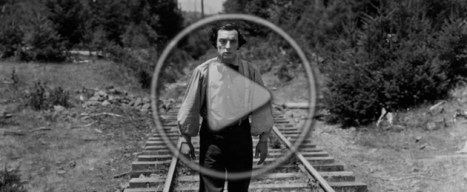
Johnny Gray is a train engineer working in the South during the Civil War, with two loves in his life; the southern belle Annabelle Lee and the train engine known as The General. When a group of Union spies abscond with both, Johnny finds himself an unlikely hero on a quest that takes him down train lines and across enemy lines.

At time of recording, it was ranked the 151st best movie of all time on the Internet Movie Database.

Continue reading

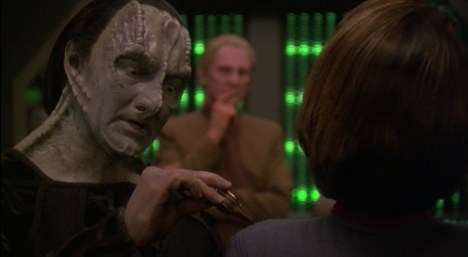
Star Trek: Deep Space Nine – Tacking Into the Wind (Review)

Tacking Into the Wind might just be the last truly great episode of Star Trek: Deep Space Nine.

Of course, there are some very good episodes lying ahead. However, none of them hum as perfectly as Tacking Into the Wind does. The Dogs of War is fantastically constructed and does pretty much everything that a penultimate episode of a long running series needs to do, but it largely feels like a prelude episode to the grand finale. What You Leave Behind is a powerful and emotive piece of television, and an effective conclusion to seven years of storytelling, but it suffers from some pacing issues and some poor storytelling choices in its second half.
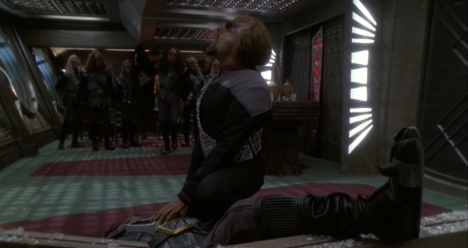
The end of an era.

However, Tacking Into the Wind is just brilliant. Deep Space Nine has produced more than its fair share of (relatively) standalone classic episodes: Duet, The WireThe Way of the Warrior, The Visitor, Trials and Tribble-ations, Far Beyond the Stars, In the Pale Moonlight. Even in the seventh season, there have been any number of episodes that work beautifully on their own terms: Treachery, Faith and the Great River, Once More Unto the Breach, The Siege of AR-558, Chimera. Even those tied into larger arcs like the Dominion War still worked as relatively standalone units of story.

However, Tacking Into the Wind is brilliant in a way that is very particular to this moment of Deep Space Nine. Perhaps the closest companion pieces are episodes like Call to Arms or Sacrifice of Angels, episodes that work well enough on their own terms, but become transcendental when approached as the culmination of long-running story threads that pay off months of storytelling decisions. Taking Into the Wind takes this approach and escalates it further. Taking Into the Wind is the culmination of a narrative that has been brewing for the better part of a decade.

Surviving by the skin of his teeth.

Tacking Into the Wind is an episode that could never have worked on Star Trek: The Next Generation or Star Trek: Voyager. It is too dependent on lingering narrative threads, on long-running arcs, on a grand and sweeping (and ironic) view of history. Tacking Into the Wind ties up the fate of the Klingon Empire, an institution that has been in decline since Heart of Glory and rotting from the inside out since Sins of the Father. It parallels that with a fundamental underlying shift in the Cardassian society introduced in The Wounded.

Tacking Into the Wind is an episode that could only possibly work as the pay off to serialised storytelling, and which demonstrates the power of a good dramatic pay-off almost a decade in the making. In many ways, Tacking Into the Wind is the perfect episode for this so-called “Final Chapter”, the perfect distillation of everything that the creative team have been trying to do with this ten-part sprawling epic.

Cloak of office.

Continue reading

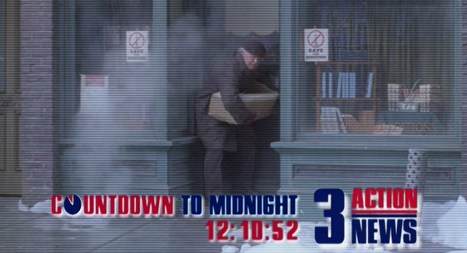
Star Trek: Voyager – 11:59 (Review)

The thing about experiments is that they don’t always work, but that doesn’t mean they should never be attempted.

Much like Someone to Watch Over Me, 11:59 represents a new departure for Star Trek: Voyager. It is an episode unlike any other episode in the run of series, unfolding primarily on early twenty-first (or, as one character wryly points out, maybe late twentieth) century Earth. As with Someone to Watch Over Me, there is a sense that 11:59‘s closest spiritual companion is an episode of Star Trek: Deep Space Nine. There are any number of superficial similarities between 11:59 and Far Beyond the Stars, another time-travel-to-close-to-modern-day-Earth-episode-without-the-time-travel.

Countdown.

Sadly, the experiment does not quite work out. Someone to Watch Over Me is one of the most charming episodes in the seven-season run of Voyager, while 11:59 is more than a little dull. Far Beyond the Stars is one of the most powerful and evocative episodes of Star Trek ever produced, while 11:59 is a competent piece of television that is almost immediately dated. For all that 11:59 represents a bold departure for Voyager, there is a sense that the episode has very little to actually say. It exists, but it never seems to exist for a particular reason. 11:59 is a frustrating piece of television.

However, none of this matters too much. Voyager has been such a safe and conservative show that any creative risk feels worthwhile, that any departure from the established template feels worth of celebration on those terms alone. 11:59 is an unsuccessful experiment, but it is an experiment nonetheless. For a series as risk-adverse as Voyager, that is remarkable.

“Time’s up.”

Continue reading

Star Trek: Deep Space Nine – When It Rains… (Review)

One of the interesting aspects of the final arc of Star Trek: Deep Space Nine is watching the series grapple with challenges that face a lot of later serialised television shows.

The massive ten-episode conclusion to Deep Space Nine is effectively equivalent to a full season of a highly serialised prestige television show like Game of Thrones, Westworld or The Leftovers. Of course, there are any number of obvious differences, from the need to structure episodes around commercial breaks or the dependency on clunky exposition or the fact that these ten episodes were following a production run of sixteen early episodes in the same production season.

Dukat does not react well to criticism of his role in this epic ten-episode arc.

Nevertheless, these ten episodes grapple with a lot of the difficulties in mapping out a single extended story across a large number of episodes. Deep Space Nine had launched its six season with an impressive six-episode arc that hung together almost perfectly, give or take Sons and Daughters. However, there were unique challenges in attempting that same narrative trick with ten episodes at the end of a production season.

A lot of these problems are pacing related. As with a lot of serialised shows, these ten episodes occasionally struggle to give each episode a unique identity. Strange Bedfellows is an episode that seems stuck between the sets of dramatic reveals either side of it, the weddings and alliances of ‘Til Death Do Us Part or the terror and revelation of The Changing Face of Evil. There is certainly an element of that to When It Rains…, which seems to spend most of its runtime lining up two major plot threads for resolution in the superlative Tacking Into the Wind.

A tailor-made solution.

However, there is also a sense that certain plot and character threads in this sprawling ten episode arc have not been properly mapped out and paced, that the writers have failed to shrewdly allocate their narrative real estate. The writers had enough of an idea where they were going with this arc that they were able to seed most of the important threads leading up to What You Leave Behind with Penumbra. However, the individual story threads were not all equally paced. Some could be sustained for nine more episodes. Others fizzled after four or five.

Not all of the narrative threads running through this extended arc of Deep Space Nine are equally impressive. Some of these story threads are clumsy and mistaken, running out of what little steam they had less than half-way through the extended run. So it is with the bizarre alliance between Dukat and Winn in service of the Pah-Wraiths.

The darkness in men’s hearts.

Continue reading

46. Ah-ga-ssi (The Handmaiden) – This Just In (#247)

Hosted by Andrew Quinn and Darren Mooney, and this week with special guests Grace Duffy and Graham Day, This Just In is a subset of The 250 podcast, looking at notable new arrivals on the list of the 250 best movies of all-time, as voted for by Internet Movie Database Users.

This time, Park Chan-Wook’s Ah-ga-ssi.

Continue reading

Star Trek: Discovery – Battle at the Binary Stars (Review)

In some ways, Star Trek: Discovery will always be overshadowed by what might have been.

It is not the first Star Trek series to face this particular hurdle. Both Star Trek: Voyager and Star Trek: Enterprise spent the majority of their runs in competition with phantom versions of themselves. Voyager was supposed to be a show about two rival crews, one a bunch of explorers and the other a group of terrorists, forced to work together when stranded alone on the other side of the galaxy. Enterprise was supposed to be a show about the building of the familiar Star Trek universe, a tale about how mankind got “from there to here”, to quote the theme music.

The great Star Trek Beyond.

Both series struggled to live up to that premise. Voyager abandoned any question of compromise and culture clash in Parallax, the very second episode of the series. For the rest of the show’s seven seasons, Captain Kathryn Janeway oversaw a fairly typical Starfleet crew on a fairly typical Star Trek mission, with rare nods to the original premise in episodes like Learning Curve, Alliances, Worst Case Scenario, Year of Hell, Part I and Year of Hell, Part II. Similarly, most of the first two seasons of Enterprise were stock Star Trek, even if the third and fourth seasons were a bit more ambitious.

In contrast, Discovery is competing against a slightly different shadow self. That shadow self appears in the opening credits of the show week after week, in the “created by” credit assigned to Bryan Fuller. Fuller departed early in the creative process of Discovery following disagreements with CBS, to the point that he identifies his most meaningful contributions to Discovery as Captain Philippa Georgiou and Commander Michael Burnham, one of whom is dead by the end of Battle at the Binary Stars.

No Khan do.

Indeed, Bryan Fuller’s contributions to Discovery really end with these two episodes. Fuller is credited on the script for The Vulcan Hello, along with producer Akiva Goldsman. Fuller is also credited with the story to Battle at the Binary Stars, even though the teleplay was written by replacement showrunners Gretchen J. Berg and Aaron Harberts. In some ways, then, it feels strangely appropriate that The Vulcan Hello and Battle at the Binary Stars serve as something of a self-contained prologue setting up the thirteen episodes that will follow.

The Vulcan Hello and Battle at the Binary Stars mark the end of Bryan Fuller’s short-lived Star Trek.

Empirical research.

Continue reading

Non-Review Review: Goodbye Christopher Robin

Goodbye Christopher Robin is largely a container for a set of impressive performances.

The most memorable aspects of this biopic are the three leading performances; Domhnall Gleeson as the writer himself, Margot Robbie as Daphne de Sélincourt and Kelly MacDonald as the nanny Olive. This triumvirate elevates the material to hand, fleshing out an overly broad and overly sentimental script through their ability to underplay moments. Gleeson, Robbie and MacDonald communicate their characters effectively through meaningful glances as much as overloaded dialogue.

Bear with me.

In some ways, Goodbye Christopher Robin suffers from a surplus of ambition. Written by Frank Cottrell-Boyce and Simon Vaughan, the film casts a very wide net, hoping to encapsulate decades in the lives of these characters. The result is that many of the film’s emotional arcs and beats feel truncated in the move to the next important event, which in turn leads the movie to amp up the sentimentality for maximum impact. There are moments where Goodbye Christopher Robin works perfectly, but there are more moments where it seems to fumble.

Goodbye Christopher Robin tries to cover too much ground. “That bear swallowed us whole,” Milne reflects towards the end of the story, but there is a sense that the script poses just as much danger.

“If we could sell these stories, we’d by Milne-aires.”

Continue reading