












If Relativity featured a time bomb, then Warhead focuses on a smart bomb.
Star Trek: Voyager is a fascinating television show. It is a television show very firmly rooted in the listlessness of the nineties, reflecting cultural anxieties and uncertainties; these millennial anxieties reflected in stories like 11:59. At the same time, it is also structured as something more overtly nostalgic than the other Star Trek spin-offs, a conscious throwback to the retro science-fiction of the forties and the fifties; this sensibility reflected in the nuclear parables of Jetrel or The Omega Directive, the infiltrator narratives of Cathexis or In the Flesh.
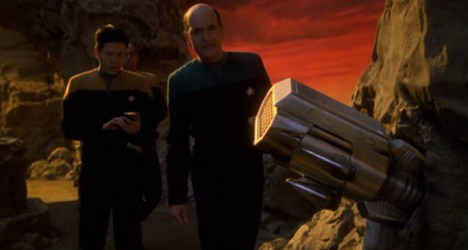
“Yes, that is a rocket in that pocket of rock, and yes it is happy to see us.”
In many ways, Warhead represents a perfect fusion of these two approaches. Warhead is a story that is strongly anchored in uncertainties about the legacy of the Second World War, the tale of a sentient weapon of mass destruction with the capacity to cause untold destruction that exists beyond the capacity of human reason. Warhead is also a philosophical parable about identity and determinism, a discussion about what it means to have a sense of self and whether an individual’s reality is shaped by their design and their programming.
The result is a strange hybrid story that captures two of the competing facets of Voyager in a single forty-five minute episode.

Explosive drama.
Filed under: Movies | Tagged: abstract, allegory, atomic bomb, existential, nuclear proliferation, nuclear weapons, philosophy, smart bombs, star trek, star trek: voyager, warfare | 2 Comments »










 the m0vie blog
Star Trek: Discovery – The Butcher’s Knife Cares Not for the Lamb’s Cry (Review)
The Butcher’s Knife Cares Not for the Lamb’s Cry represents another attempt to reconcile one of the central tensions of Star Trek: Discovery, the conflict that exists between the expectations of a Star Trek series and the demands of a piece of prestige television. It frequently feels like there is a tug of war between these two competing impulses within the series, and the production team are trying desperately to find the right balance between these two very different storytelling models.
Much like Context is for Kings, the basic story at the heart of The Butcher’s Knife Cares Not for the Lamb’s Cry is quintessential Star Trek plotting. The contours of the plot will be recognisable to any viewer with even a passing familiarity with the narrative structures and templates of the larger Star Trek franchise. At the same time, a lot of the episode’s finer details are more recognisable as the hallmarks of contemporary prestige television. The result is a piece of television that tells a very simplistic Star Trek in a manner that feels somewhat dissonant.
Hanging out with the Kol kids.
There is an awkwardness to The Butcher’s Knife Cares Not for the Lamb’s Cry, a sense that the creative team are still working out the proverbial kinks. Much like the engineering and science staff on the Discovery itself, the production team are creating something new and exciting, but something without a clear precedent or blueprint. Discovery often struggles to properly mix its constituent elements, some of its narrative choices feeling clumsy and others struggling to mesh with the story being told.
At the same time, like Context is for Kings before it, The Butcher’s Knife Cares Not for the Lamb’s Cry is an episode that exists primarily to reassure viewers that Discovery is still fundamentally Star Trek, no matter the production design or the prestige trappings. However, Discovery is investing so much time in proving that it is Star Trek, that it is still searching for its own clear voice.
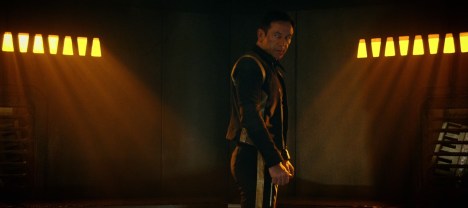
Resting uneasy.
Continue reading →
Filed under: Star Trek | Tagged: burnham, death, klingons, landry, Lorca, prestige television, social commentary, star trek, star trek: discovery, the devil in the dark | 5 Comments »