• Following Us

  • Categories

  • Check out the Archives


  • Awards & Nominations

New Escapist Column! On James Gunn’s Upcoming “The Suicide Squad”…

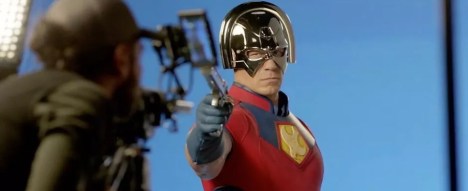
I published a new In the Frame piece at The Escapist earlier in the week. With DC’s Fandome event at the weekend, it seemed like a good time to take a look at one of their upcoming projects: James Gunn’s The Suicide Squad.

Gunn didn’t actually premiere too much material from The Suicide Squad, primarily unveiling the cast roster and screening some behind the scenes footage. However, the announcement was interesting, marking a clear delineation from David Ayer’s Suicide Squad. In these brief snippets, Gunn suggests an understanding of what has historically made the Suicide Squad such a compelling concept: its status the island of misfit toys in larger DC continuity.

You can read the piece here, or click the picture below.

New Escapist Column! On “Lovecraft Country” and Making Room in America’s Imaginary Spaces…

I published a new piece at The Escapist earlier today. Lovecraft Country premiered last week, an interesting exploration of a particular type of American weird fiction.

Lovecraft Country is a show that consciously blurs the line between America’s landscapes and its dreamscapes. In doing so, it touches on the psychological horror of generations of segregation of these spaces, exploring what it means for entire groups of people to have been excluding from these places real and imaginary. Lovecraft Country is about trying to navigate this terrain, and in doing so explores this familiar ground from a new angle.

You can read the piece here, or click the picture below.

196. The Terminator (#245)

Hosted by Andrew Quinn and Darren Mooney, and this week with special guests Joe Griffin and Emmet Kirwan, The 250 is a (mostly) weekly trip through some of the best (and worst) movies ever made, as voted for by Internet Movie Database Users.

This time, James Cameron’s The Terminator.

In 2029, Los Angeles is a burning hellhole. In 1984, it is not much better. In the dead of night, two soldiers from an apocalyptic future escape into the urban landscape. These mysterious veterans of a coming war make their way across the City of Angels, with only one name on their minds: Sarah Connor.

At time of recording, it was ranked 245th on the list of the best movies of all time on the Internet Movie Database.

Continue reading

Non-Review Review: TENET

NOTE: I live in Ireland. Our cinemas are open. Evidence suggests that it is (relatively) safe for people to attend the cinema if they take the necessary precautions. However, I am aware that it is not safe in every country to do so, and I also understand that many readers may not feel safe attending their local cinema even in areas where the evidence suggests it is safe. As this seems to be a hot-button issue with all theatrical releases during the pandemic – but with TENET in particular – it feels important to stress this outside the body of the review itself.

This should go without saying, but given the nature of the current pandemic it is worth repeating: No movie is worth risking your life for. If you feel – or if information from sources you trust suggest – that it is unsafe to go to the cinema, then please do not go. I loved this film. I will see it in cinemas again at least twice within the next week, because it is safe for me to do so. This review should not be taken as an endorsement that the reader should feel they have to (or are expected to) risk their lives to see this film. With that in mind, here is the review.

“Time isn’t the problem,” insists Neil early in TENET. Like a lot of things that the shady operator says over the course of the film, this is not exactly true.

There is a lot riding on TENET. Almost none of this was intended when the film was conceived and produced. As the first major theatrical release since the coronavirus pandemic, TENET effectively shoulders the burden of saving cinema – particularly with a death of major releases between now and Wonder Woman 1984 and with the planned release of Mulan on Disney+. It’s a lot of weight for a film like TENET to carry. Time will tell whether it can succeed or not, but it makes a valiant effort.

Shattering the release window.

TENET rises to this challenge in a couple of ways. Most obviously, TENET is quite simply a triumph of blockbuster filmmaking. Director Christopher Nolan has boasted about how much of the film was completed using in-camera effects and how carefully choreographed it all was. TENET is a movie that showcases the power of spectacle, whether in its delightfully complicated action sequences or even in Hoyte Van Hoytema’s breathtaking establishing shots. TENET is a movie that demands as big a screen as possible, reminding audiences of the scale of such filmmaking.

However, there’s more to it than that. TENET is a film that feels curiously attuned to this cultural moment. It is a film that deals with many of Nolan’s pet themes and obsessions, but in a way that feels very much in step with the modern moment. It’s hard to summarise TENET without spoiling the movie, without revealing too much in terms of plot mechanics or character motivations, but TENET is a film about the breakdown of time itself. It is a film about the collapse of chaos and effect, and a world in which the future and the past are a war over the present.

A career highlight?

It’s an ambitious film. Nolan’s movies are frequently driven by high-concepts and abstract ideas, and the director is remarkable in his ability to build crowd-pleasing blockbusters around concepts like time dilation in Inception and the theory of relativity in Interstellar. If anything, TENET seems to push that idea to breaking time. As Neil repeatedly points out over the course of the film, he has a degree in quantum physics and he struggles to make sense of the film’s internal logic. Perhaps the film’s protagonist (known simply as the Protagonist) sums it up best, “Woah.”

TENET is an interesting film from Nolan in a number of ways. The villainous Russian oligarch Andrei Sator is probably the director’s scuzziest character since Insomnia or Memento. The film itself is perhaps Nolan’s most emotionally repressed since The Prestige. These sensibilities are blended with his more modern high-concept blockbuster aesthetic, and flavoured with a surprising amount of self-awareness. The result is a heady cocktail that is occasionally overwhelming, but never unsatisfying.

Well, masks are recommended at cinema screenings.

Note: Warner Brothers have specifically requested that reviews avoid spoilers. As a result, this review will talk rather generally about TENET. However, if you want to see it completely unspoiled, it is perhaps best to just take our word for it: it is good. It is probably even the best film we’ve seen this year. That is a very short review.

Continue reading

New Escapist Column! On How “The Dark Knight Rises” Abolished Its Billionaire to Build a Better Batman…

I published a new In the Frame piece at The Escapist this evening. TENET reviews are dropping in under an hour, and DC Fandome is happening this weekend, so it seemed an appropriate time to take a look back at Christopher Nolan’s The Dark Knight Rises.

The Dark Knight Rises is a particularly interesting project in the current climate. It’s become common to criticise the idea of Batman as a billionaire who spends his fortune to dress up as a bat instead of actually using it to help the poor and impoverished of Gotham. In that context, The Dark Knight Rises is a work ahead of its time. It’s a story about how Bruce fails Gotham in his role as a billionaire, how maybe Batman shouldn’t be “a man from privilege” and a story in which Bruce donates his family home to the city’s “orphaned and at-risk youth.”

The Dark Knight Rises is the rare superhero story to posit an actual and meaningful ending for its protagonist, and The Dark Knight Rises argues that the only possible happy ending for Batman is for Bruce to lose his fortune and be declared dead, understanding that maybe the mantle of Batman should go to another person who is more keenly aware of what it means to live in Gotham. It’s a very clever and very insightful commentary on the Batman mythos, and one that has aged remarkably well.

You can read the piece here, or click the picture below.

New Escapist Column! On Ten Years of “Scott Pilgrim vs. the World”…

I published a new In the Frame piece at The Escapist this evening. Scott Pilgrim vs. the World turned ten years old this week, so it seemed an appropriate time to look back on the film.

Scott Pilgrim vs. the World is a fascinating study of a particular type of masculinity, and a particular way that young men relate to women. The film begins as an archetypal quest narrative, as the title character works his way through a series of “bosses” in the quest to earn the love of Ramona Flowers. However, Scott Pilgrim vs. the World quickly complicates that narrative, in a way that feels like a prescient commentary on the issues of masculine entitlement. However, it’s not as a simple as a movie ahead of it’s time. It’s a snapshot of a discussion in progress.

You can read the piece here, or click the picture below.

New Escapist Column! On “Nightcrawler” as a Metaphorical Vampire Movie…

I published a new piece at The Escapist earlier today. Nightcrawler is streaming on Netflix, so it seemed like a nice opportunity to revisit the film.

Nightcrawler is very obviously a loving homage to seventies American cinema, and a commentary on the scrambling at the margins of the post-recession economy. However, writer and director Dan Gilroy frames his story in such a way as to evoke classic vampire movies. At its core, Nightcrawler is the tale of a bloodthirsty parasite prowling the streets of Los Angeles at night, but there’s more to it than that. Nightcrawler is a biting satire and a gritty drama, but it also understands the horror of the situation that it depicts.

You can read the piece here, or click the picture below.

195. The Third Man (#177)

Hosted by Andrew Quinn and Darren Mooney, and this week with special guest Neasa Hardiman, The 250 is a (mostly) weekly trip through some of the best (and worst) movies ever made, as voted for by Internet Movie Database Users.

This time, Carol Reed’s The Third Man.

Holly Martins arrives in Vienna to visit his old friend Harry Lime. However, Holly quickly discovers that all is not what it seems. Harry apparently died in a freak traffic accident shortly before Harry arrived. As British officers start asking pointed questions about the dead man, Holly becomes increasingly anxious that something has gone very wrong.

At time of recording, it was ranked 177th on the list of the best movies of all time on the Internet Movie Database.

Continue reading

New Escapist Column! On “TRON: Legacy” as a Disney Princess Film for Boys…

I published a new In the Frame piece at The Escapist this evening. With news that Disney have commissioned another sequel to TRON, it felt like the right time to take a look back at the last attempt to revive the franchise in TRON: Legacy.

TRON: Legacy is a fascinating film, a product of a strange time at Disney – it was between the purchase of Marvel Entertainment and the release of The Avengers, and before the purchase of LucasFilm. So Disney was trying, with films like John Carter, The Lone Ranger and Tomorrowland to craft live action blockbusters that would appeal to young male audiences. Legacy was the earliest of these examples, perhaps the most successful and the most fascinating: in large part because it tried to translate what Disney did so well in animation into live action.

Legacy is effectively an effort to reimagine the classic animated princess story as a big tentpole blockbuster. It doesn’t entirely work, but the results are fascinating. You can read the piece here, or click the picture below.

Non-Review Review: Project Power

Project Power is an oddity, a strange clash of style and content that never quite aligns but results in some interesting chemistry.

The basic plot of Project Power is fairly straightforward. A mysterious designer drug known only as “power” has arrived on the streets of New Orleans. These pills cause the user to spontaneously manifest a random superpower for five minutes – that power can be awesome, mundane or fatal. It’s a basic set-up as these sorts of stories go, and its rooted in the tropes of the modern superhero genre: human experimentation, industrialised production. unchecked power fantasies.

The bitterest pill.

Project Power uses this central plot element to two competing ends. In terms of direction, the simple-yet-flexible set-up serves as a motivator for a variety of high-concept and high-energy action sequences as characters manifest strange abilities that inevitably alter the dynamics of one-on-one combat, allowing for impressive stunts and frantic violence. In terms of theme, Project Power uses this set-up as a metaphorical commentary on the War on Drugs and the historical exploitation of marginalised communities by those in… well, power.

These are two interesting angles, even if they are never explored as creatively as one might hope. Indeed, the two approaches make strange bedfollows, with Project Power feeling like a paranoid conspiracy thriller that movies with the hyper pacing of a modern direct-to-video action film. It doesn’t really work, but the cocktail is fascinating enough that it holds attention.

Power play.

Continue reading