• Following Us

  • Categories

  • Check out the Archives


  • Awards & Nominations

Watch! New Star Was – Episode VII: The Force Awakens Trailer!

The first trailer for Star Wars: Episode VII: The Force Awakens has arrived, checking a lot of the Star Wars boxes while – in true Abrams “mystery box” style – revealing very little of substance. It looks dynamic, faithful in design to the original trilogy, but also more modern than the prequels in style. Anyway, enough speculation! Check it out below!


Space: Above and Beyond – Dear Earth (Review)

This November (and a little of December), we’re taking a trip back in time to review the third season of The X-Files and the first (and only) season of Space: Above and Beyond.

In many respects, Dear Earth serves as a mirror to Toy Soldiers.

Both stories are based around familiar wartime story beats. Both are very sentimental hours of television. Both are firmly anchored in the idea that Space: Above and Beyond is largely about reworking the narratives of the Second World War for a futuristic outer space setting. There is a lot of overlap between Dear Earth and Toy Soldiers, with the episodes feeling like two peas in a pod. They both appeal to the same aspects of Space: Above and Beyond.

You've got mail...

You’ve got mail…

However, Dear Earth works a lot better than Toy Soldiers did. It is dealing with a similar collection of iconic imagery and ideas associated with the Second World War, touching on many of the same themes and ideas; it is just that the execution is considerably stronger. Dear Earth is a show that not only has a lot more charm than Toy Soldiers did, but a lot more humanity. It is an episode that does a lot to remind viewers why they have come to care for the show’s ensemble.

Dear Earth is a very well-made piece of television.

Astro-turf...

Astro-turf…

Continue reading

The X-Files (Topps) #13 – One Player Only (Review)

This November (and a little of December), we’re taking a trip back in time to review the third season of The X-Files and the first (and only) season of Space: Above and Beyond.

After a twelve-issue opening mega-arc of interconnected stories about conspiracies-within-conspiracies and wheels-within-wheels, author Stefan Petrucha and artist Charles Adlard step back a little bit to close out their run with a series of standalone stories. The four issues (and three stories) that make up the rest of their run on Topps’ X-Files comic stand alone. They are connected by themes and subtext, but very clearly stand apart from what came before. Indeed, they play out almost like a postscript to the main body of work, a series of smaller bite-sized chunks.

In that light, it is interesting that One Player Only feels – superficially, at least – a lot more in step with the television show. The early issues of the comic had seen Petrucha and Adlard creating their own supporting cast and their own conspiracy, so as to avoid stepping on the toes of the production company. The Cigarette-Smoking Man was largely reduced to a number of cameos, with Skinner popping up once or twice along the way.

Ghosts in the machines?

Ghosts in the machines?

Not only does One Player Only feature a guest appearance from supporting characters like Mr. X or yhe Lone Gunmen, it also harks back to the structure and format of the first season of the show. On the most basic of levels, One Player Only feels like a more cyberpunk take on Ghost in the Machine, right down to the fact that Mulder is drawn into a murder at a tech company by an acquaintance from his days in the Violent Crimes Division. At one point, Mulder and Scully stumble on a ransacked house, for Mulder to deadpan, “Hm. Nothing new.”

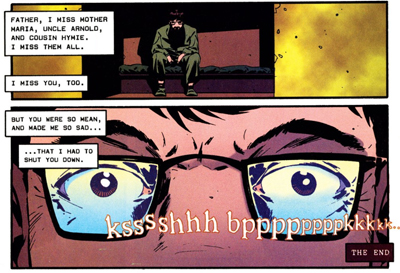
However, if one peels back the layers, One Player Only is a fascinating piece that sets the tone for Petrucha and Adlard’s last three issues on the series, while infusing the comic with a host of fascinating cyberpunk stylings and body horror that seem to call forward to William Gibson’s future writing for the show.
Coding out...

Coding out…

Continue reading

The X-Files – Pusher (Review)

This November (and a little of December), we’re taking a trip back in time to review the third season of The X-Files and the first (and only) season of Space: Above and Beyond.

Pusher is perhaps one of the most effective stand-alone “monster of the week” stories that the show ever did.

It is no wonder that the episode is frequently cited among the best episodes of The X-Files ever produced, but it is telling that it was identified by Slate as the perfect “gateway” episode of the show. If you want to give someone a taste of The X-Files without burdening them with continuity or back story, this is a good choice. It may not be the best episode that Vince Gilligan ever wrote, and it may not even be the best episode of the third season, but it is one the strongest demonstrations of what the show does on a weekly basis.

Mano a mano...

Mano a mano…

Pusher is the first episode that Vince Gilligan wrote after joining The X-Files writing staff. It is the only episode credited to Gilligan in the show’s third season. He had been offered a position on staff after turning in Soft Light at the end of the second season, but had hesitated before accepting the job. When he did accept the job, he came down with a dose of infectious mononucleosis. As a result, Gilligan only wrote one script for the third season, despite becoming one of the show’s most prolific writers.

Pusher is a pulpy delight, a spectacularly constructed standalone that perhaps points the way to Gilligan’s later work.

Gift of the gab...

Gift of the gab…

Continue reading

Space: Above and Beyond – Toy Soldiers (Review)

This November (and a little of December), we’re taking a trip back in time to review the third season of The X-Files and the first (and only) season of Space: Above and Beyond.

The Never No More and The Angriest Angel two-parter represented a moment when Space: Above and Beyond seemed to gel, when the show seemed to realise what it wanted to be and how it wanted to be about it. Written by showrunners Glen Morgan and James Wong, they presented a demonstration of just how well the show could work, and why it had been an absolutely ingenious idea to do the premise of “World War II… IN SPACE!”

So, naturally, Toy Soldiers shows up to demonstrate that we have yet to reach a point where we can do this consistently.

Oh, brother...

Oh, brother…

Continue reading

Non-Review Review: Horrible Bosses 2

Horrible Bosses 2 is a cluttered film. In many ways, it is handicapped by a reluctance to let go of what worked the first time around. As a result, the film seems to bring back just about every cast member it can, ensuring that everybody gets their own little arc and their own pay-offs. Two of the three original horrible bosses get extended subplots in the sequel, with an expanded role for another side character.

This leaves the film feeling a little crowded. The new additions to the cast seldom get room to breath. Horrible Bosses 2 brings in a rake of superb talent to fill out the supporting cast, but doesn’t have the time to do anything particularly interesting with them. Chris Pine makes the most significant impression, but Horrible Bosses 2 wastes  talent like Christoph Waltz and Jonathan Banks in fairly bland roles.

"I spot a sequel..."

“I spot a sequel…”

And yet, despite its problems managing space, Horrible Bosses 2 holds itself together. It’s a clumsy film, one that feels like it could have done with a script polish and some judicious editing at an early story phase, but it manages to hang a lot on the chemistry of its three leads. Even more than in the original film, Bateman, Sudeikis and Day find themselves playing archetypes rather than characters – but the fit rather comfortably into those archetypes.

Bateman, Sudeikis and Day spend a lot of Horrible Bosses 2 talking over one another – something that more than one character acknowledges over the course of the film. The result is a lot like the film itself; it’s often difficult to separate the important material from the background noise, but there’s also an underlying sense of fun that just about keeps everything ticking over.

"We've all seen Reservoir Dogs, right?"

“We’ve all seen Reservoir Dogs, right?”

Continue reading

The X-Files – Apocrypha (Review)

This November (and a little of December), we’re taking a trip back in time to review the third season of The X-Files and the first (and only) season of Space: Above and Beyond.

Eyes are a major recurring motif in Apocrypha.

To be fair, eyes were a frequently recurring motif throughout The X-Files. Rob Bowman managed a couple of beautiful shots of reflections and peeping in 731, for example. It makes sense that The X-Files should place such emphasis on eyes – it is a saga about truth and belief and faith, all of which must be explored through perception. “I want to believe,” Mulder’s iconic poster proclaims. As the cliché goes, seeing is believing.

Iconic Mulder/Scully pose!

Iconic Mulder/Scully pose!

That is definitely the case here, with Apocrypha built to a climax where both the audience and the characters are explicitly refused the opportunity to see key moments. Mulder and Scully are escorted out of the North Dakota silo before they can see anything incriminating. The audience doesn’t even get to see the space ship taking off. Even the death of Luis Cardinal takes place off-screen, with Mulder revealing it in a throwaway line in the show’s penultimate scene.

With all of this going on, it makes sense that so much of the imagery in Apocrypha should be built around eyes – with the black oil infection manifesting in its hosts’ eyes, the shooting of the silo as a giant eye staring into space, and even the design of the alien space ship evoking the Eye of Providence.

Up in the sky!

Up in the sky!

Continue reading

Non-Review Review: Woman in Black – Angel of Death

Horror sequels are notoriously difficult beasts. Much like comedy sequels, there’s the inevitable conflict between what the audience wants and what the audience has seen before. If you plan on replicating the jump scares too faithfully, why not watch the original? If you want to do something fresh, why bother sticking the name on the front? It is an interesting challenge facing film makers, and it’s something that shows. It is very hard to think of a horror sequel that competes on the same level as the original, let alone surpasses it.

Woman in Black: Angel of Death finds itself stuck in that trap. The original Woman in Black was very much a classic Hammer Horror film, a movie more about suggestion and scale than blood and guts. Never afraid to reinforce a jump scare with an orchestra string section, there was something quite endearing and old-fashioned about the way that Woman in Black conducted itself. It was an affectionate throwback to a style of horror largely forgotten in this day and age.

"Gee... I wonder what could possibly be in this creepy basement at this hour of the night..."

“Gee… I wonder what could possibly be in this creepy basement at this hour of the night…”

Given the success of Woman in Black, a sequel was inevitable. However, Angel of Death faces a lot of the issues that tend to plague horror sequels – cast attrition, a sense of familiarity, a sense that most of the best tricks have already been used. To be fair, Angel of Death holds itself together reasonably well for its first two acts. There are creaky moments, and a sense that the movie is trying to hit too many familiar notes. However, the script comes off the rails in the third act, as the film stops trying to imitate its predecessor and attempts to offer something new.

Sadly, the third act simply doesn’t work, bouncing between an air field and a supernatural hostage crisis. The result is that Angel of Death collapses in on itself – leading to the sense that this is a rather disappointing sequel.

Sadly, Chris deBurgh has yet to provide a theme song for the series. Maybe next time?

Sadly, Chris deBurgh has yet to provide a theme song for the series. Maybe next time?

Continue reading

Space: Above and Beyond – The Angriest Angel (Review)

This November (and a little of December), we’re taking a trip back in time to review the third season of The X-Files and the first (and only) season of Space: Above and Beyond.

Existentialism is something of a recurring theme in the work of Glen Morgan and James Wong.

It echoes through their work. Mulder’s choice of action ultimately serves to define him in One Breath, in contrast to the other more senior male characters in the narrative. The duo’s second script for Millennium, 5-2-6-6-6, opens with a quote from existentialist philosopher Jean Paul Sartre. Even the pair’s feature film work – The One and the Final Destination films – touch broadly on existentialist themes.

Pressed (up) on the issue...

Pressed (up) on the issue…

However, The Angriest Angel is perhaps the most candid of their scripts, with McQueen explicitly explaining how his actions are serving to define his identity. In his power-house opening monologue, McQueen describes these defining moments as make-or-break points. “Everyone, everyone in this life knows when the moment is before them. To turn away is simple. To ignore it assures survival. But it is an insult to life. Because there can be no redemption.”

This is perhaps the most elegant and effective summary of Morgan and Wong’s approach to character development. McQueen articulates it clearer than any of their characters, but the philosophy applies just as much to Scully in Beyond the Sea or Never Again as it does to Tyrius Cassius McQueen. Indeed, it would come to define their work on Millennium, with the second season repeatedly suggesting that the end of the world was as much a personal event as a massive social occurrence.

Slice of life...

Slice of life…

Continue reading

Watch! Jurassic World Trailer!

The trailer for Jurassic World has arrived. Apparently having learned nothing from the last three films, they finally opened the damned theme park. And that the fact that this time nature hasn’t killed anybody yet meant it was time to start making the dinosaurs even more deadly. We’re sure it’ll end well.

Check out the trailer below.