• Following Us

  • Categories

  • Check out the Archives


  • Awards & Nominations

17. Manchester by the Sea – This Just In (#178)

Hosted by Andrew Quinn and Darren Mooney, This Just In is a subset of the fortnightly The 250 podcast, looking at notable new arrivals on the list of the 250 best movies of all-time, as voted for by Internet Movie Database Users.

This time, Kenneth Lonergan’s Manchester by the Sea.

podcastmanchesterbythesea

Continue reading

Non-Review Review: The LEGO Batman Movie

“I have aged phenomenally,” Bruce Wayne confesses about half-an-hour into The LEGO Batman Movie.

He is not wrong. The LEGO Batman Movie is in many ways an overt celebration of the legacy of the Caped Crusader, the pop culture icon who remains one of the most recognisable figures in the world. Repeatedly over the course of the film, character reference Batman’s rich history, from the Joker’s confession that they have known each other for “seventy-eight years” or Alfred’s reference to “that weird [phase] in 1966” or even Barbara Gordon’s slideshow presentation that goes back to the cover of Detective Comics #27 and the forties film serial.

Holding it all together...

Holding it all together…

The framework of The LEGO Batman Movie allows the characters and the script to comment upon the Batman mythology. The script is crammed with references from the length and breadth of the character’s publication history, from “Bat shark repellent!” to particular costume styles to minor villains to musical cues to fourth-wall-breaking references to other media that has inspired various interpretations of the Caped Crusader. This allows The LEGO Batman Movie to be explicitly about Batman in a way that few Batman stories can be.

As such, The LEGO Batman Movie offers a very broad summary of the Batman mythology and characters, surveying decades of printed and screen material to reduce Batman to his most simply and essential qualities. The LEGO Batman Movie offers a very compelling portrait of Batman as a man so traumatised by loss that he never allowed himself to grow up, while somehow subconsciously cultivating a family around himself. For all the character’s lauded darkness, The LEGO Batman Movie celebrates the hope at the heart of that mythology.

Welcome to his man-cave.

Welcome to his man-cave.

Continue reading

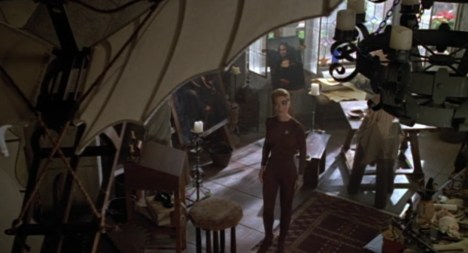
Star Trek: Voyager – Scientific Method (Review)

Scientific Method is in many ways the flip side of the coin to episodes like Nemesis, Distant Origin or Remember.

Nemesis, Distant Origin and Remember were effective demonstrations of Jeri Taylor’s approach to Star Trek: Voyager, a conscious effort to downplay the unique premise of the show in favour of pitching a more generic sort of Star Trek. With that in mind, Nemesis, Distant Origin and Remember constructed powerful allegories to examine pressing contemporary issues through the lens of science-fiction, resulting in episodes that represented one of the most defining aspects of the franchise: the sci-fi-tinged morality play.

Built into Voyager's DNA.

Built into Voyager’s DNA.

Not every example of this approach worked as well as those three episodes. Voyager began leaning into this more archetypal and generic Star Trek storytelling at the start of its third season, and the results were quite hit-and-miss. There were certainly brilliant examples in the seasons ahead, like Living Witness or Blink of an Eye. But not every allegory worked as well. Sometimes, the episodes were too didactic, like Critical Care or Repentance. Sometimes, the episodes were too generic, like The Chute. Sometimes, they were just ill-judged, as with Retrospect.

Scientific Method is a very bland and forgettable episode of Star Trek. It is not necessarily bad, but it is also not particularly memorable. In some ways, it demonstrates the limitations of the “generic Star Trek” approach to scripting for Voyager. Without a set of interesting and well-developed characters with strong dynamics in a series with a unique identity, an average episode can feel rather flat.

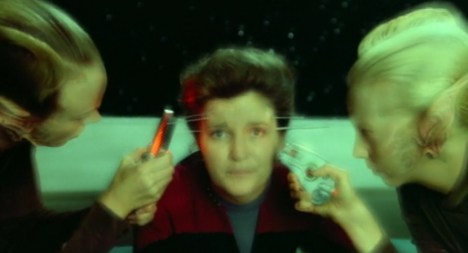
Give her head peace.

Give her head peace.

Continue reading

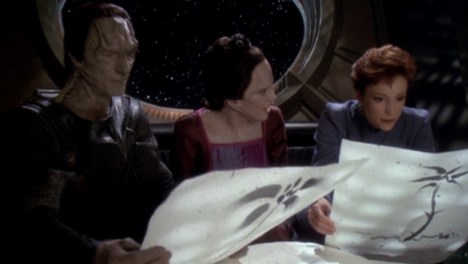
Star Trek: Deep Space Nine – Favour the Bold (Review)

With Favour the Bold, the writers begin winding down the ambitious six-episode arc that opens the sixth season of Star Trek: Deep Space Nine.

Indeed, Favour the Bold plays almost like the first part of a two-parter nestled at the end of the sprawling six-episode arc that opens the sixth season. At the end of the teaser, Sisko unveils his ambitious plan to Dax, boasting, “We’re going to retake Deep Space Nine.” It is the story that very clearly moves the arc that began with Call to Arms towards its conclusion, manoeuvring the series back towards the familiar status quo in which Captain Benjamin Sisko commands a lone Federation outpost near the distant planet of Bajor.

Point man.

Point man.

Favour the Bold is very much about lining up everything for the climax of the arc, moving the pieces into place so that that the dominoes can begin falling as early as possible in Sacrifice of Angels. However, the episode benefits from the fact that a lot of the heavy-lifting has already been done by this point in the arc. Behind the Lines already had Odo betray Kira, Rom get arrested and Damar figure out how best to dismantle those pesky self-replicating mines. That is already a lot of the table-setting for the arc’s epic conclusion, before Favour the Bold even begins.

As such, Favour the Bold has the luxury of beginning with a lot of its work already done and ending at the point where the action truly commences. The result is a surprisingly relaxed penultimate episode for this ambitious arc, one with the freedom to indulge in smaller character-driven scenes and the space in which to breathe.

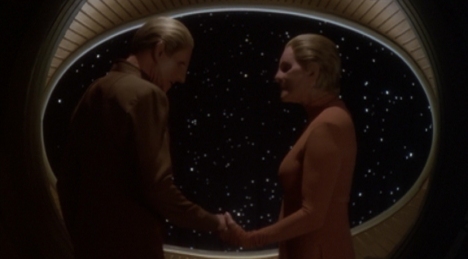
They just need some space.

They just need some space.

Continue reading

Star Trek: Deep Space Nine – Behind the Lines (Review)

Behind the Lines is an exemplary demonstration of Star Trek: Deep Space Nine‘s embrace of serialisation.

More than any other episode in the opening arc of the sixth season, Behind the Lines is an episode that exists in relation to the other episodes around it more than a self-contained unit of narrative. A Time to Stand set the tone for the final two seasons of the show, but its also featured a daring raid on a Dominion facility. Rocks and Shoals was about a ground conflict between Sisko and a Jem’Hadar platoon. Sons and Daughters was about Worf’s long-neglected relationship to Alexander. Favour the Bold and Sacrifice of Angels are an ambitious two-part finale.

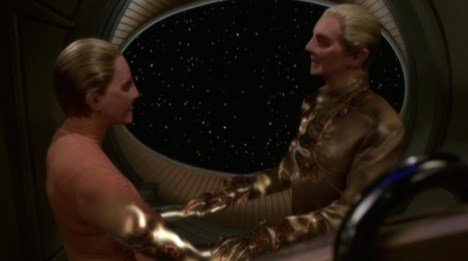
Meldmerising...

Meldmerising…

In contrast, Behind the Lines is very much about taking what has already been established and streamlining it in preparation for the bombastic conclusion to this story. Behind the Lines is the episode in which Kira uses her “new resistance” formed in Rocks and Shoals to actually do something, in which Damar finally figures out how to dismantle the minefield that went up in Call to Arms, and in which Odo betrays his friends and colleagues in pursuit of his own gratification. More than any of the episodes around it, Behind the Lines cannot really stand in isolation.

However, it is also a stunningly brilliant piece of storytelling and a reminder of just how skilfully the writing staff on Deep Space Nine had adapted to the demands of serialisation.

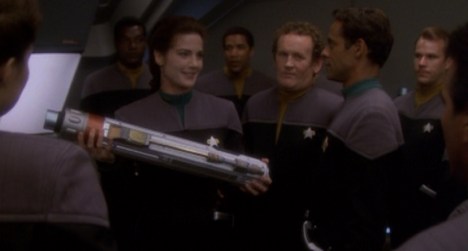
Terror cell.

Terror cell.

Continue reading

16. Hacksaw Ridge – This Just In (#102)

Hosted by Andrew Quinn and Darren Mooney, This Just In is a subset of the fortnightly The 250 podcast, looking at notable new arrivals on the list of the 250 best movies of all-time, as voted for by Internet Movie Database Users.

This time, Mel Gibson’s Hacksaw Ridge.

podcast-hacksawridge

Continue reading

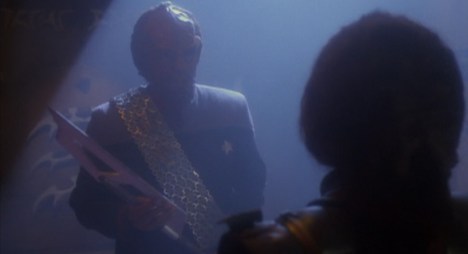
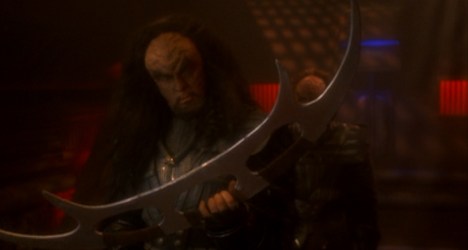
Star Trek: Deep Space Nine – Sons and Daughters (Review)

If A Time to Stand and Rocks and Shoals demonstrate the raw potential and ambition of the sixth season of Star Trek: Deep Space Nine, then Sons and Daughters demonstrate its shortcomings.

The fourth and fifth seasons of Deep Space Nine rank among the very best seasons of Star Trek every produced. These two seasons demonstrated a striking level of consistency. There were undoubtedly terrible episodes, like Shattered Mirror and The Muse in the fourth season or The Assignment and Let He Who Is Without Sin… However, these episodes tended to be quite concentrated. Even other episodes that didn’t quite work, like The Sword of Kahless, Sons of Mogh, A Simple Investigation or Ferengi Love Songs, were more bland than outright bad.

Let me be your father figure...

Let me be your father figure…

The sixth and seventh seasons of Deep Space Nine lack that consistency. They are even more ambitious than the two seasons directly prior, pushing harder in bolder new directions and resulting in brilliant television like Waltz, Far Beyond the Stars, In the Pale Moonlight, Treachery, Faith, and the Great River, The Siege of AR-558, It’s Only a Paper Moon, Chimera, Inter Arma Enim Silent Leges and Tacking Into the Wind. The sixth and seventh seasons of Deep Space Nine were breathtaking and highly enjoyable on their own terms.

In fact, there is a very credible argument for ranking the sixth and seventh seasons of Deep Space Nine among the best seasons of the franchise. They represent the last great narrative leap forward until the third season of Star Trek: Enterprise. These two seasons are driven by a desire to take risks and try new things, to make ambitious gambles knowing that they might not pay off. These are certainly virtues to be encouraged, even without that laundry list of spectacular television.

The lost art of parenting.

The lost art of parenting.

However, with that level of ambition, the sixth and seventh seasons were also much more variable in terms of quality. They contained a lot more misfires than the previous two seasons. This is not just the obvious high-profile failures like Profit and Lace or The Emperor’s New Cloak, but also a lot more episodes that disappoint without hitting quite that level of awfulness; One Little Ship, The Reckoning, Time’s Orphan, Prodigal Daughter, Field of Fire, Extreme Measures. There is a sense that the number of bad episodes increases noticeably.

Sons and Daughters is perhaps the first example of this trend. It is an episode that is not soul-destroying terrible, but it simply does not work in the way that it is intended to work. Sons and Daughters is not only the weakest episode of the six-episode opening arc, it is also the first episode to be written by David Weddle and Bradley Thompson as members of the series’ writing staff. The two facts might not be unrelated.

All (Mar)tok tok tok.

All (Mar)tok tok tok.

Continue reading

Non-Review Review: Denial

Denial is a vitally important story, albeit one told in a rather unimpressive manner.

Denial documents the libel case that David Irving took against Deborah Lipstadt upon the publication of her book Denying the Holocaust. In that book, Lipstadt accused Irving of being a Holocaust denier. Irving took offense at this, and attempted to sue her in the British courts. Under British law, the onus was placed on Lipstadt to prove that she was correct in her assessment. Essentially, the court case put the Holocaust itself on trial and served to interrogate the idea of objective truth in a postmodern age.

Suits you, sir.

Suits you, sir.

Obviously, Denial feels a lot more relevant now than it would have two years ago. In fact, it feels more relevant now than it did two months ago. Or two weeks. This is big weighty subject matter, dealing with an important issue in a very sensitive and delicate manner. It is in many the perfect focus for a prestige awards-season film. However, the problem is that film itself feels rather flat. Denial often feels like a made-for-television movie, clumsy and forced. It is a film aware of its own importance, but lacking its identity.

Denial feels very much like a missed opportunity.

Lecture notes.

Lecture notes.

Continue reading

Star Trek: Voyager – The Raven (Review)

Seven of Nine is something of a mixed blessing for Star Trek: Voyager.

In some respects, the character is a transparent ratings ploy designed to refocus media attention on and attract young male viewers to a television series facing major audience attrition. The series already has enough trouble serving the under-developed members of its ensemble like Chakotay, Tuvok and Kim. The arrival of Seven of Nine only compounds this issue, with the character serving as a focal point in five of the first six episodes of the fourth season. Seven of Nine is a very cynical addition to the cast, an awkward band aid applied to a patient with a chronic condition.

Enlightening.

Enlightening.

However, there is no denying that Seven of Nine works as a character. Even is early in the fourth season, Seven of Nine is more intriguing and compelling than most of the primary cast. As early as The Gift, Jeri Ryan demonstrated that she was one of the strongest members of the ensemble. Seven of Nine might be an awkward combination of the Spock and Data archetype with blatant fan service, but she already has a stronger character and a clearer arc than the vast majority of the regular cast. The production team know what they want from Seven, which is more than can be said of Chakotay, Tuvok or Kim.

Indeed, The Raven further solidifies the character’s purpose and arc in the larger context of Voyager. Indeed, The Raven very cleverly and very literalises Seven of Nine’s character arc, doing so in a way that integrates her into the larger broader themes of Voyager. With The Raven, Seven’s journey to reclaim her lost humanity is rendered as a literal homecoming. Like everybody else on the ship, Seven is ultimately trying to find her way back home.

"I shall become a bat... er... a human."

“I shall become a bat… er… a human.”

Continue reading

Star Trek: Deep Space Nine – Rocks and Shoals (Review)

The opening arc of the sixth season of Star Trek: Deep Space Nine is one of the most ambitious storytelling experiments in the history of Star Trek.

To be fair, it is not entirely unique. In some ways, it mirrors the storytelling arc that unfolded across Star Trek II: The Wrath of Khan, Star Trek III: The Search for Spock and Star Trek IV: The Voyage Home. Both Kirk and Sisko are separated from their home and from their first officer and from their iconic command, before eventually finding their way to reunite with both. Obviously, a three-film trilogy is distinct from a six-episode arc, even before talking about the tonal, thematic and plotting differences between those three iconic films.
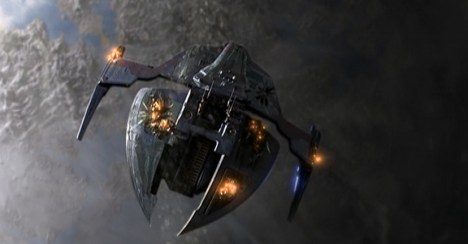
The Jem'Hadar warship that fell to Earth...

The Jem’Hadar warship that fell to Earth…

More than that, the success of the this arc would embolden the production team. They would attempt an even more audacious experiment to close out the seventh season of the series. The sixth season opened with six interconnected stories following the Cardassian reoccupation Terok Nor, building to Sisko’s retaking of the station. The seventh season pushes that even further, with a much more tightly integrated ten-episode arc that attempts to tell a single cohesive story. It is an even bolder creative decision than this arc, committing more strongly to the premise.

Ronald D. Moore’s departure from Star Trek: Voyager early in its sixth season would turn these experiments in serialisation into an evolutionary dead end for the franchise. It would be four years before Rick Berman and Brannon Braga would attempt to a tell a story on that scale. Indeed, faced with declining ratings and the spectre of cancellation, Star Trek: Enterprise attempted what was (on the surface at least) the even more ambitious attempt at a season-long arc across the entirety of the third season.
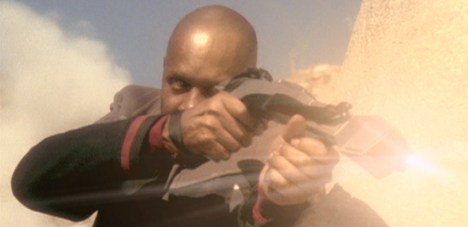
Winner takes it war...

Between a rock and a hard place.

Still, the six-episode arc that opens the sixth season of Deep Space Nine remains an impressive moment in the history of the franchise. Indeed, contrasted with the sprawling ten-episode arc that closes the series or the season-long arc on Enterprise, it could reasonably be argued that this six-episode stretch does a stronger job of balancing the integrity of individual episodes with the demands of the larger arc. These six episodes are all very strongly connected to one another, with a clear sense of story and character progression, but they also retain their own identities within that.

Rocks and Shoals might be the best example of this, an episode that delicately balances its own storytelling with the needs of the arc as a whole. Rocks and Shoals is at once a great episode in its own right and an essential part of a much larger story.
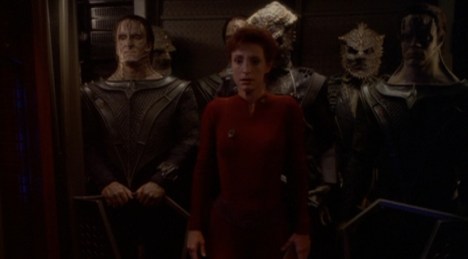
Express elevator to hell.

Express elevator to hell.

Continue reading