• Following Us

  • Categories

  • Check out the Archives


  • Awards & Nominations

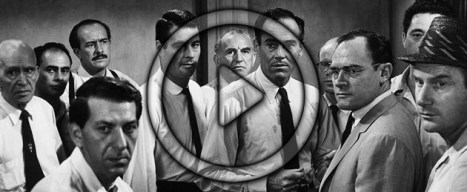
190. 12 Angry Men (#5)

Hosted by Andrew Quinn and Darren Mooney, and this week with special guests Donald Clarke and John Maguire, The 250 is a (mostly) weekly trip through some of the best (and worst) movies ever made, as voted for by Internet Movie Database Users.

This time, Sidney Lumet’s 12 Angry Men.

In New York, in the height of summer, twelve jurors assemble for what should be a simple open and shut case. Most of the jury assumes that they’ll be done within the hour. However, against all of that evidence and in spite of all of that expectation, one member of the group isn’t entirely convinced that the accused is guilty.

At time of recording, it was ranked 5th on the list of the best movies of all time on the Internet Movie Database.

Continue reading

New Escapist Column! On “The Old Guard” and Offering Easy Answers to Tough Problems…

I published a new In the Frame piece at Escapist Magazine this evening. The Old Guard was released on Netflix this evening, so it seemed a film that was worth discussing.

The Old Guard is essentially a film that exists half-way between a turn-of-the-millennium high-concept action film and a modern superhero blockbuster, and it doesn’t always split the difference in a particularly elegant way. This is a film that is about the importance of doing good in the world, even when the results aren’t quantifiable or apparent. However, it makes a rather clumsy and facile argument about that, lacking the strength or vision to make its point from first principles.

You can read the piece here, or click the picture below.

Non-Review Review: Greyhound

Greyhound is a tight and claustrophobic maritime thriller that knows pretty much exactly what it’s doing.

At its best, Greyhound capitalises not just on Tom Hanks as the patron saint of dads, boomers and the American cultural memory of the Second World War, but also as a time-displaced Jimmy Stewart. This makes a certain amount of sense. Despite the presence of character actors like Stephen Graham, Rob Morgan and Elizabeth Shue, Tom Hanks is the only star in Greyhound. The film remains tightly focused on Captain Ernest Krause, the commander assigned to protect a convoy of supplies crossing the Atlantic shortly after America’s entry into the Second World War.

It doesn’t exactly shatter expectations.

It makes sense that Greyhound should be tailored to Tom Hanks. Hanks wrote the screenplay, adapting it from C.S. Forrester’s The Good Shepherd. More than that, Hanks has demonstrated his strong interest in the history of American involvement in the Second World War with films like Saving Private Ryan and television series like Band of Brothers and The Pacific. As such, Greyhound feels like it fits perfectly within the actor’s wheelhouse.

This is an illustration of how effectively Greyhound works. Greyhound is a movie that knows what it needs to deliver, and sets about delivering that in the most efficient manner possible.

The old man and the sea.

Continue reading

“Doctor Who?” The Deconstructed Davison Doctor…

This week, I had the privilege of stopping by The Galactic Yo-Yo to talk a little bit about Doctor Who with the wonderful Molly Marsh. In preparation for the episode, I rewatched the bulk of the Peter Davison era for the first time in years. I talked about it on the podcast, which is worth your time. But I also thought it was worth jotting some of the thoughts down in more detail.

Rewatching the Peter Davison era of Doctor Who is a strange experience for a number of reasons, not all of which are good.

The Davison era arguably served as a point of transition. It existed in the negative space between two particularly memorable incarnations of the Time Lord. Tom Baker is justifiably considered the most important and influential actor to play the role. Notably, he was the only lead from the classic series to get a showcase scene in The Day of the Doctor. Despite Colin Baker’s protestations, this made a great deal of sense. For an entire generation of television viewers – not just Doctor Who fans – Tom Baker is the Doctor.
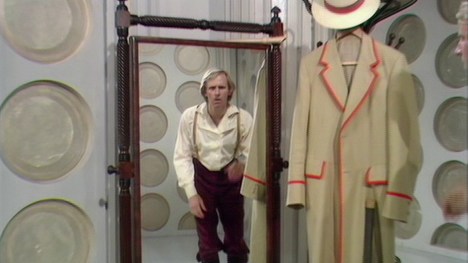
On the other extreme, Peter Davison was succeeded by Colin Baker. Whether rightly or wrongly, Colin Baker occupies a similarly important place in the mythos. With his garish costume and his string of terrible stories, Colin Baker was long the public face of the decline and decay of Doctor Who as a cultural institution. This isn’t entirely fair. The rot had set in considerably earlier than Baker’s arrival, and there’s a sense in which he suffered from terrible timing. Still, Colin Baker wound up serving as the face of the show’s hiatus and the embarrassing Doctor in Distress.

This puts Peter Davison in a strange position. He is caught between these two hugely important moments in the show’s history. However, he also arguably lacks a strong cohesive identity like other iconic iterations of the character. The Fifth Doctor is a markedly different character from the iterations around him, and Davison was subject to criticisms from fans that his interpretation of the title character was “bland” or “boring.” It’s arguable that the Sixth Doctor’s abrasive personality was a direct response to this perceived blandness.

However, in just under three full seasons in the role, Peter Davison left quite a mark on the Time Lord. His final story, The Caves of Androzani, is rightly regarded as one of the finest Doctor Who stories ever made. (Indeed, it is one of the rare stories to have topped polls of fandom.) More to the point, it’s notable that Davison would become a surprisingly strong influence on the revival series. Tom Baker got to occupy centre stage in The Day of the Doctor, but Davison returned first in Time Crash. The short served primarily as a love letter to Davison’s influence on the role.

There’s a lot of very fascinating stuff happening during Davison’s time in the role, most of seemingly happening by accident. The most striking thing about Davison’s tenure in the role is the recurring sense that he doesn’t quite fit. The Fifth Doctor often seems to struggle with the basic narrative conventions of Doctor Who, wrestling with the series’ core concepts and underlying assumptions. Over the course of Davison’s three seasons in the role, Doctor Who seems to ask what might happen if there were an iteration of the Doctor who wasn’t up to the task.

Continue reading

“There’s Nobody Left But You”: The Existential Horror at the Heart of White Heat…

Last weekend, on the podcast I co-host called The 250, we discussed James Cagney’s 1949 gangster classic White Heat, with the wonderful Carl Sweeney from The Movie Palace Podcast. I’ve been thinking a lot about the film since, and so had some thoughts I just wanted to jot down.

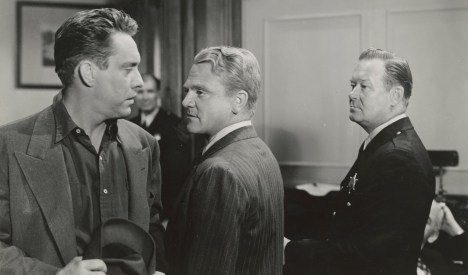
White Heat is a gangster film, starring James Cagney.

It’s frequently discussed in relation to The Public Enemy, which makes sense. Both White Heat and The Public Enemy are mid-century gangster films starring James Cagney. It also merits comparison to The Roaring Twenties, another gangster film starring James Cagney and directed by Raoul Walsh. There’s a tendency to lump these sorts of films together, to examine them as part of a greater whole. It certainly makes sense in this context. After all, a huge part of the appeal of White Heat at time of release derived from seeing James Cagney playing a gangster once again.

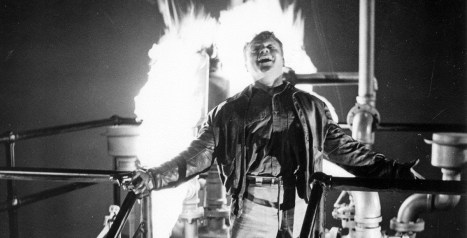
However, there’s something altogether stranger about White Heat. It isn’t a film that fits particularly comfortably into the gangster genre, despite the obvious trappings. James Cagney plays the role of Cody Jarrett, the leader of a vicious gang introduced conducting a train robbery and who go on to plot a chemical plant raid at the climax. There is all manner of betrayal and violence, backstabbing and revenging. There are cops in dogged pursuit of the criminals, while Cody demonstrates that nobody should underestimate him.

Still, there’s something simmering beneath the surface of White Heat. As much as the film follows the structures and conventions of a crime film, it plays more like a melancholy monster movie. It is a funereal salute to a mythic figure retreating into history, a horror story about an outdated evil lurking in the shadows, trying to navigate a world that no longer has a place for it.

Continue reading

New Podcast! Galactic Yo-yo – Peter Davison’s “Doctor Who”

I was very thrilled to be invited to guest on the Galactic Yo-yo podcast by the wonderful Molly Marsh, to discuss Doctor Who.

We’d talked a little bit about Doctor Who before the podcast, and I’d wanted to talk a little bit about classic Doctor Who, because I don’t always get a chance to delve into the classic series. Plus, with the recent blu ray collections, I’d been watching a bit of it. More than that, I’d been delving back into Peter Davison’s almost-three-seasons in the role and was quite impressed with the way in which the Fifth Doctor often seemed to be a protagonist trying desperately to stay on top of a show that was falling to pieces around him. So we talked a great deal about Peter Davison.

Anyway, it was a huge honour to be invited to the show, and I hope that you enjoy it and I didn’t embarrass myself. You can subscribe to the show here. You can listen to the episode here, or click the link below.

New Escapist Column! On “Predators” as a Film That Understands Its Own Limitations…

I published a new In the Frame piece at Escapist Magazine this evening. Predators is ten years old, so it seemed like an appropriate time to take a look back that second (and best) Predator sequel.

In hindsight, Predators is the rare movie that understands the limitations of its core premise. Fox spent decades trying to turn Predator into a franchise, but the sequels largely disappointed. A large part of this is down to the fact that Predator is a concept anchored in a particular time and place, without the timeless quality of a movie like Alien. In contrast to the other Predator sequels, Predators is a lean and modest machine. It never pushes its central concept too far, instead offering a pulpy and enjoyable b-movie. In doing so, it mostly works as a worthy successor.

You can read the piece here, or click the picture below.

Non-Review Review: Palm Springs

On the surface, Palm Springs is instantly recognisable as a genre-savvy update of the classic Groundhog Day template for the twenty-first century.

The basic plot finds two young adults – Nyles and Sarah – trapped living the same day over and over and over again. There is no escape from this nightmare, which finds the pair constantly reliving the wedding of Sarah’s sister Tala. As befitting the more modern media-literate approach to these sorts of stories, Palm Springs joins Nyles at a point where he has already been trapped in the loop for an extraordinarily long amount of time. He is already as familiar with the rules and limitations of this sort of narrative as any audience member who watched Groundhog Day on loop.

Making a splash.

This level of self-awareness in a story is potentially dangerous, encouraging ironic detachment. It’s very each for stories about these sorts of genre-savvy protagonists to feel more like plot devices than actual characters, particularly when operating within constructs that audiences only recognise from other films. “It’s one of those infinite time loop situations you might have heard of,” Nyles casually explains to Sarah early in the film. Sarah responds, aghast, “That I might have heard of?”

There are certainly moments when Palm Springs feels like it might be just a little too knowing and a little too arch, its own story too consciously framed in terms of familiar narrative devices. Most notably, even though the film is not directly named, one of the big emotional beats in Palm Springs seems to be lifted directly from Jurassic Park. Released the same year as Groundhog Day, it exists within the same nostalgic framework and was just as defining for an entire generation of movie-goers. Moments like that feel just a little bit too heavy-handed.

Some “him” time.

Continue reading

189. White Heat – w/ The Movie Palace – Independence Day 2020 (#—)

Hosted by Andrew Quinn and Darren Mooney, The 250 is a fortnightly trip through some of the best (and worst) movies ever made, as voted for by Internet Movie Database Users. New episodes are released Saturdays at 6pm GMT.

This week, a special crossover episode with The Movie Palace Podcast, a film podcast hosted by Carl Sweeney taking a look at the classics of Hollywood’s golden age. Carl suggested a crossover episode taking a look at the list, and particularly some of the classic movies listed on it.

So this week, Raoul Walsh’s White Heat.

Fleeing the authorities after a train robbery that resulted in two murders, Cody Jarrett latches on to an unconventional scheme to evade detection. Jarrett turns himself into the authorities for a crime he didn’t commit, earning a lesser sentence and putting him in the clear. However, things are changing rapidly for Cody, and the ground is very quickly shrinking out from under him.

At time of recording, it was not ranked on the list of the best movie of all time on the Internet Movie Database.

Continue reading

New Escapist Column! On “Hannibal” as the Perfect Adaptation…

I published a new In the Frame piece at Escapist Magazine this evening. With Hannibal premiering on Netflix and generating a host of new appraisals and discussions, connecting with a new generation of fans, I thought it might be worth looking at Bryna Fuller’s television masterpiece.

In an era dominated by recycled intellectual property, remakes and reboots, it would have been easy to be cynical about another adaptation of Thomas Harris’ seminal serial killer novels, particularly given how severely the film franchise had degenerated since the triumph of Silence of the Lambs. However, Bryan Fuller used Hannibal as a showcase for a particularly ambitious and inventive approach to adaptation, one that used an existing set of iconography in new and innovative ways. Hannibal was the perfect adaptation of a familiar property, breathing new life into it.

You can read the piece here, or click the picture below.