• Following Us

  • Categories

  • Check out the Archives


  • Awards & Nominations

Star Trek: Enterprise – Shadows of P’Jem (Review)

Next year, Star Trek is fifty years old. We have some special stuff planned for that, but – in the meantime – we’re reviewing all of Star Trek: Enterprise this year as something of a prequel to that anniversary. This January, we’re doing the first season. Check back daily for the latest review.

Shadows of P’Jem is a wonderful episode. It is, in many respects, the first true post-9/11 episode of Star Trek: Enterprise, and it is a surprisingly thoughtful one at that.

In many respects, Enterprise has already established itself as Star Trek for the George W. Bush era. Archer is the franchise’s first white American male lead character since Kirk, and his contempt for politics and thirst for action mirrors the popular image of George W. Bush – a dynamic man with no time for questions or hesitation. Even little touches – like the fact that officers drink beer rather than champagne, or the anti-intellectual contempt that Archer and Trip feel towards Vulcans – suggest a Star Trek show that is very much in line with Bush’s America.

Shadows on Coridan...

Shadows on Coridan…

However, Shadows of P’Jem was among the first episodes written after the events of 9/11, and it’s an episode that seems quite thoughtful and introspective. The franchise has often used the Federation as a stand-in for American values and ideals. Shadows of P’Jem twists this idea on its head, offering the future Federation members as stand-ins for various facets of American foreign policy.

Shadows of P’Jem is a considerate and reflective look at what Walter Nugent termed “the habits of empire”, a look at the cost and consequences of imperialism in a post-colonial age, and how those issues tend to fester.
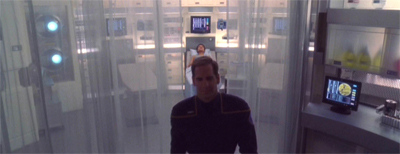
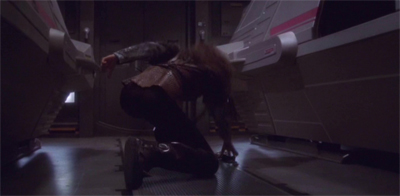
A night in sickbay...

A night in sickbay…

Continue reading

Enter the Jameson First Shot Film Competition!

The guys at Jameson passed on details of their Jameson First Shot competition a few weeks ago. Here are the details for any budding film makers around the world looking to enter for a chance to work with some top-notch talent.

Jameson is on the hunt for the globe’s most gifted, undiscovered filmmakers with compelling stories to tell. Simply write an original piece of work, with the final draft being no more than seven pages in length. The story should reveal, with lightness of touch, the epic that is to be found in everyday experiences.  Closing date for entries is 1st February 2015. More information on the rules, including length and theme, can be found at http://www.jamesonfirstshot.com/.

Last year’s short films starred Uma Thurman and one of the winners just sold his first full length script. It’s a great platform for budding screen writers and this year is the first time it has been open to Irish entrants. Check out two of last year’s winners.

Non-Review Review: Selma

Selma is a fascinating look at the Civil Rights Movement, and at the life and times of the Reverend Martin Luther King Junior.

Adopting the increasingly common approach of narrowing its focus to a rather tight sequence of events, Selma offers an interesting and insightful glimpse at the protest in Selma, Alabama – culminating in a planned march from Selma to Montgomery in March 1964. That was a pivotal moment for the Civil Rights struggle, as the cameras of the nation focused on the brutally wielded by local authorities against those marching peaceably. Selma focuses on that national moments as a vehicle to explore the Civil Rights movement as a whole.

selma3

To be fair, Selma does have its problems. There is a sense that the film is perhaps too concerned with the character of Lyndon B. Johnson, even ultimately affording him something of a heroic moment at the climax. The carefully-maintained period feel is undermined by the decision to dub Yesterday Was Hard On All Of Us by Fink over a crucial moment. In contrast, the period-specific (or close enough) songs by Otis Redding, the Impressions or Duane Eddy add context and texture to the film; the tracks by The Fink and Common (featuring John Legend) feel superficial.

However, these are minor problems. Selma features a tight script, solid direction and a host of fantastic central performances. Eschewing the sentimentality or softness associated with these sorts of prestige pictures, Selma deserves to be considered among the best of the awards season prestige pictures. Its diminished presence on Academy Awards ballots seems sadly telling.

selma1 Continue reading

Star Trek: Enterprise – Sleeping Dogs (Review)

Next year, Star Trek is fifty years old. We have some special stuff planned for that, but – in the meantime – we’re reviewing all of Star Trek: Enterprise this year as something of a prequel to that anniversary. This January, we’re doing the first season. Check back daily for the latest review.

There’s really very little to say about Sleeping Dogs. It’s not particularly good, it’s not particularly bad. Like Civilisation before it, it’s an episode of Star Trek constructed to a familiar formula. The ship in question answers a distress call from an alien ship. Our crew attempts a rescue mission, during which the away team end up stranded. Meanwhile, our captain tries to figure out how to communicate with an alien from a radically different culture, eventually coming to realise that he must address them on their terms.

These are all stock elements, and they are mixed into Sleeping Dogs with a minimum of fuss. The only real kink in Sleeping Dogs is that the aliens in question are Klingons. However, we’ve spent so much time with Klingons in the various other Star Trek spin-off shows that using them as a light seasoning in a fairly stock Star Trek plot doesn’t make for a particularly appetising combination.

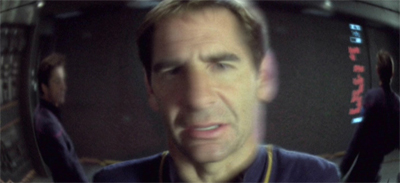
Again with the Klingons...

Again with the Klingons…

Continue reading

Star Trek: Enterprise – Dear Doctor (Review)

Next year, Star Trek is fifty years old. We have some special stuff planned for that, but – in the meantime – we’re reviewing all of Star Trek: Enterprise this year as something of a prequel to that anniversary. This January, we’re doing the first season. Check back daily for the latest review.

Dear Doctor is certainly the most ambitious episode from the first season of Star Trek: Enterprise, and also the most controversial.

The show’s first true “Prime Directive” episode, the show wrestles with the moral implications of “playing god”, attempting to justify the inevitable development of “Starfleet General Order Number One”, the rule prohibiting interference in the development of “less advanced” species. As such, there is almost an impossible amount of weight bearing down on Dear Doctor, as the show tries to explore the moral conundrums that result from contact with a less technologically advanced species.

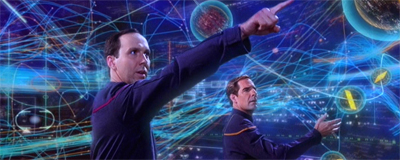
Stargazing...

Stargazing…

Dear Doctor is an episode that is deeply problematic. Indeed, it was a show that was so controversial and so divisive that UPN itself insisted on a change to the episode’s ending. It’s an episode that tends to provoke strong reactions, from both defenders and detractors. It inspires passion. It is not uncommon to find people who will rank the episode among the very best of Enterprise and the very worst of Enterprise.

While the show’s internal logic and conclusions are quite unsettling, Dear Doctor is a provocative and challenging hour of television. It is decidedly more ambitious than any of the episodes surrounding it, even other experimental shows like Breaking the Ice or Shuttlepod One. While it might not be the best episode of the first season, it is certainly the most breathakingly ambitious and engaging. And that must count for something.

There's trouble in its DNA...

There’s trouble in its DNA…

Continue reading

Star Trek: Enterprise – Silent Enemy (Review)

Next year, Star Trek is fifty years old. We have some special stuff planned for that, but – in the meantime – we’re reviewing all of Star Trek: Enterprise this year as something of a prequel to that anniversary. This January, we’re doing the first season. Check back daily for the latest review.

Silent Enemy is very much a game of two halves.

It’s an episode that suffers from the decision to incorporate two radically different plots into a single episode. In many respects, it’s a show that suffers from Star Trek: Enterprise‘s decidedly old-fashioned storytelling aesthetic: the sense that most hours of Star Trek need to have two plots running through them for pacing and structural reasons. This storytelling technique is a decidedly outdated approach to television, reflecting the narrative conservatism at play in the first season of the show.

We come in peace...

We come in peace…

Silent Enemy is built around two plots. The primary plot sees the ship coming into conflict with a bunch of strange predatory aliens who do not respond to attempts for contact, and who grow increasingly belligerent over the course of the episode. Archer and his crew find themselves facing an opponent far stronger and more aggressive than they are. It’s a pretty bleak, pretty heavy plotline. Inevitably, the show decided to pair it with something a bit more light-hearted, so we get Hoshi trying to figure out what Reed’s favourite food is that Chef can bake him a super-special birthday cake.

While the combination of plotlines isn’t the worst in the history of the franchise – the episode doesn’t feel like Frankenstein’s monster in the same way that Life Support does, for example – it’s still rather incongruous. Silent Enemy is an episode weakened by the decision to combine these two into a single story; the desire to offset the doom of the “Enterprise under siege” story with something a bit more easy-going and comedic.

Alien aliens...

Alien aliens…

Continue reading

Non-Review Review: The Kingsman

The creators of The Kingsman either really love or really hate the classic Roger Moore Bond films. Probably both.

Another creative collaboration between Matthew Vaughn, Jane Goldman and Mark Millar, The Kingsman is just as juvenile, crass and ultimately charming as Kick-Ass. There is a sense of mischievous and cheeky fun to this classic spy film homage. It is effectively an update of those seventies and eighties spy films with a more cynical and self-aware attitude. There is a sense that The Kingsman is simply more transparent than its inspirations in its infectiously juvenile and borderline offensive sensibilities.

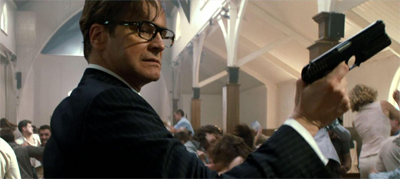
Sound and Firthy...

Sound and Firthy…

It is hard to tell how much of this homage is genuine nostalgic affection, and how much is witty subversion. The Kingsman is a spy film that not only uses outdated (and occasionally insensitive) spy movie tropes, it practically revels in them. Although the third act occasionally feels a little too mean-spirited in its riff on classic Bond sensibilities, The Kingsman has enough boundless energy and raw enthusiasm to keep the audience watching. The script is well-observed and the direction is tight. A superb central cast helps to anchor the film.

The Kingsman is an odd beast. It is that rare homage that seems quite likely to shock and offend many fans that otherwise share its nostalgic inclinations. However, those willing to be a bit more adventurous will find much to love in this updated spy caper.

Matthew Vaughn's fingerprints are all over this...

Matthew Vaughn’s fingerprints are all over this…

Continue reading

Star Trek: Enterprise – Cold Front (Review)

Next year, Star Trek is fifty years old. We have some special stuff planned for that, but – in the meantime – we’re reviewing all of Star Trek: Enterprise this year as something of a prequel to that anniversary. This January, we’re doing the first season. Check back daily for the latest review.

It is customary, these days, for television shows to map out their mythologies years in advance. Depending on when you ask him, executive producer Bryan Fuller boasts of having a six- or seven-year plan for Hannibal, despite the fact that the show spends each cancellation period on the bubble line for NBC. Indeed, the move away from the standard television pilot format means that shows are encouraged to have long-form plots and arcs mapped out.

However, that isn’t always the case. The X-Files was very much made up as it went along, with little real thought put into how the show’s sprawling alien mythology hung together beyond the immediate future. Even heavily serialised shows like Lost or 24 were plotted as they went along, with plans radically changing as the show evolved. Unlike film, where you (mostly) need a finished story before you start filming, television is a medium where you don’t really need an ending in mind as you begin telling the story.

There's a lot on the (time) line...

There’s a lot on the (time) line…

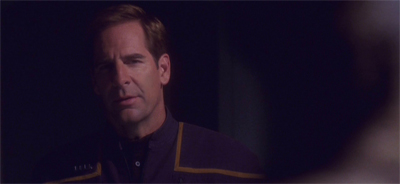
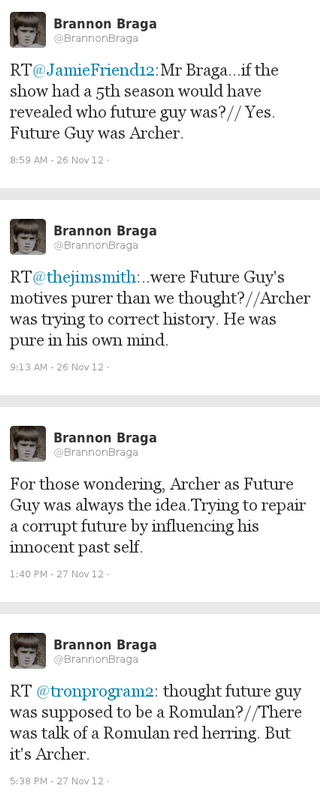
So it really shouldn’t be a surprise that Star Trek: Enterprise introduced the idea of the “Temporal Cold War” without any real idea of how the story was meant to develop or conclude. Although structured as something of a serialised arc among a (mostly) episodic couple of seasons, the Temporal Cold War is something that makes very little sense in the context of the show. Even years after the fact, the Temporal Cold War is a mystery, with Brannon Braga casually dropping the reveal that, well… Archer did it.

Of course, that plot development doesn’t make a lot of sense… but that’s par for the course. It is very hard to tie the various Enterprise time travel episodes together into a logical and cohesive narrative. Cold Front doesn’t even bother to answer questions immediately relevant to its own narrative, let alone hint at logical future developments for the series’ recurring time-travel plot line. It’s a story that seldom makes sense within individual episodes, let alone when they are strung together.

In space, all warriors are (temporal) cold warriors...

In space, all warriors are (temporal) cold warriors…

And yet, despite that, Cold Front is a pretty great episode. Part of that is down to the Temporal Cold War plot line, with Cold Front introducing a welcome sense of ambiguity to the conflict and selling the idea that Archer has wandered into something much larger than he can comprehend. On an otherwise quiet mission, Enterprise finds itself embroiled in a conflict between two forces that Archer does not fully understand, as if the ship and its crew have found themselves engaged on one front of a war in heaven.

However, Cold Front works just as well with the elements that exist outside the Temporal Cold War. As with Breaking the Ice, the episode plays like a regular day on board the Enterprise, as Archer and his crew find themselves welcoming religious pilgrims on board and making friendly first contact as they gather to watch some beautiful interstellar phenomenon. It’s an episode that draws attention to the quiet wonder and majesty of deep space exploration, elegantly and effectively.

Hang on in there...

Hang on in there…

Continue reading

Star Trek: Enterprise – Fortunate Son (Review)

Next year, Star Trek is fifty years old. We have some special stuff planned for that, but – in the meantime – we’re reviewing all of Star Trek: Enterprise this year as something of a prequel to that anniversary. This January, we’re doing the first season. Check back daily for the latest review.

Fortunate Son is a solid premise ruined by an overly simplistic execution.

One of the more interesting aspects of Star Trek: Enterprise is a chance to return to the pioneering spirit of the original Star Trek. It’s an excuse to imagine what the early years of humanity’s exploration of space must have looked like. More than any other spin-off except Star Trek: Deep Space Nine, this show lends itself to world-building and expansion. What does space look like before the Federation was established? How was it regulated before a gigantic conglomeration of space-faring races decided to impose their own laws and rules upon the spaceways?

Well, that sucked the air out of the room...

Well, that sucked the air out of the room…

Broken Bow made a big deal about how the Enterprise was the first human ship capable of travelling at warp five. In essence, it is the beginning of the Star Trek franchise as fans know it. The speed that engine brings and the distance the ship can cover serve as a gateway to the wider Star Trek universe. So, logically, if Enterprise is the first step in that direction, the ship must be emerging into a universe that looks radically different – a culture that is very distinct from that depicted on the other Star Trek spin-offs. With slower engines, fewer ships, less known about the universe, this should be an entirely different world.

Fortunate Son touches on this idea a little bit, throwing Archer into conflict with the crew of a long-haul space freighter over intergalactic piracy. The problem with the episode is that it feels very much like Archer is arguing from a position grounded in the Star Trek franchise as it is yet to develop, rather than the current status quo. In his debates with Ryan, Archer gets to be right for two contrived reasons: Ryan is written as an idiot; and Archer’s philosophy applies to the status quo of over five hundred other episodes.

Beaten to the punch...

Beaten to the punch…

Continue reading

Star Trek: Enterprise – Civilisation (Review)

Next year, Star Trek is fifty years old. We have some special stuff planned for that, but – in the meantime – we’re reviewing all of Star Trek: Enterprise this year as something of a prequel to that anniversary. This January, we’re doing the first season. Check back daily for the latest review.

After Breaking the Ice hinted at what Star Trek: Enterprise might become, Civilisation is an episode that nudges the show right back into its comfort zone. It’s an episode of Star Trek that feels like it could have been produced for Star Trek: The Next Generation or Star Trek: Voyager, with only a minimum amount of change to the script. However, what is strangest about Civilisation is the way that it feels like a rather direct throwback to the very classic Star Trek show, serving as a tale about our hot-blooded captain fighting evil imperialist adversaries and seducing sexy alien space babes.

Of course, there’s a sense that this sense of regression is exactly what the show is aspiring towards. After all, Archer was advertised as “Captain Kirk’s childhood hero”, and it makes sense for the show to play with the classic Star Trek tropes that are regarded so affectionately by popular culture. Unfortunately, Civilisation lacks the spark and wit necessary to make such a pulpy homage work, instead feeling too much like a dull retread.

David Ickes was right!

David Icke was right!

Continue reading