• Following Us

  • Categories

  • Check out the Archives


  • Awards & Nominations

Star Trek: Enterprise – Carpenter Street (Review)

Next year, Star Trek is fifty years old. We have some special stuff planned for that, but – in the meantime – we’re reviewing all of Star Trek: Enterprise this year as something of a prequel to that anniversary. This August, we’re doing the third season. Check back daily for the latest review.

This is the point at which it becomes all but impossible to argue that the production team knew what they were doing this season.

The third season of Star Trek: Enterprise holds together reasonably well, if the viewer pulls back to a big enough distance. The broad arcs are discernible and logical – there is a clear start point and a reasonable trajectory, even if the first half of the season tends to get a bit lost. It really pulls itself together during the second half of the season, with one or two exceptions, building towards a finalé that satisfies both the demands of a year-long arc and the franchise surrounding it. It is not perfect, but it is not bad for a first attempt.

Hey kids! It's Leland Orser!

Hey kids! It’s Leland Orser!

Of course, it is also quite clear that the production team really had no idea what they were doing – or even what they were trying to do. The fact that it comes together in the second half of the season all but concedes that it doesn’t hold together in the first half. The first half of the third season is populated with standalone episodes that tend to either fit thematically (North Star, Similitude) or tonally (Impulse, Exile) with the general direction of the show, but a rather limited sense of progress or advancement.

Carpenter Street is the point at which any real sense of trust between the audience and the production team snaps like a twig. It is a story that features the characters time travelling to modern-day Earth in the middle of a gigantic story arc about how they are more isolated than they ever have been before. It throws away any sense of internal logic or consistency, never really exploring how an alien species that can travel back to Detroit in 2004 should have a problem with Earth in 2153. And, crucially, it is not fun enough to excuse those issues.

Hey kid! It's Jeffrey Dean Morgan! (Really!)

Hey kid! It’s Jeffrey Dean Morgan!
(Really!)

Continue reading

The X-Files – How the Ghosts Stole Christmas (Review)

This July, we’re taking a trip back in time to review the sixth season of The X-Files and the third (and final) season of Millennium.

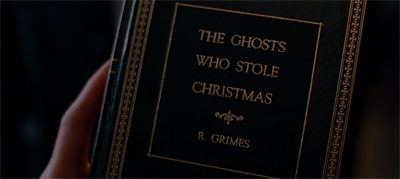
Building off episodes like Triangle and Dreamland, How the Ghosts Stole Christmas continues to develop and expand upon the sixth season’s fascination with issues of time and love.

With the closing of the X-files in The End, it seems like The X-Files has abandoned any real focus on the procedural element of the series. Instead of being a show about two people employed to investigate weird phenomenon together, it seems that The X-Files has evolved into a series about two people who investigate weird phenomena in their spare time. It seems likely that Mulder would have invited Scully on his Christmas Eve stake out even if they were working on the X-files together, but the fact that this is a recreational activity certainly recontextualises it.

Semi-title drop!

Semi-title drop!

The first half of the sixth season of The X-Files is perhaps the most invested that the show has ever been in the nature of the relationship between Mulder and Scully. After all, the seventh season shies away from questions concerning a Mulder and Scully romance; the eighth season keeps William’s parentage a mystery until the last possible moment. The opening stretch of the sixth season is really the only point in the show’s run where the series has an extended conversation about what the two mean to one another and how they express that.

How the Ghosts Stole Christmas is essentially an episode about Mulder and Scully receiving paranormal couples’ counseling that goes horribly wrong.

"Merry Christmas, everybody!"

“Merry Christmas, everybody!”

Continue reading

Star Trek: The Next Generation – Q-Squared by Peter David (Review)

This January and February, we’ll be finishing up our look at the second season of Star Trek: The Next Generation and moving on to the third year of the show, both recently and lovingly remastered for high definition. Check back daily for the latest review.

We’ll be supplementing our coverage of the episodes with some additional materials – mainly novels and comics and films. This is one such entry.

Q-Squared is probably Peter David’s most ambitious Star Trek: The Next Generation novel. “Q-Squared is almost my challenge to the reader to keep up with me,” he boasted in Voyages of the Imagination. Essentially a meditation on reality and free will within that construct, Q-Squared is a breathtakingly confident endeavour. It’s an interesting reflection on the potentiality embraced by The Next Generation, the broadening of the franchise’s perspective to embrace the best of all possible worlds.

Q-Squared hit stands in early July 1994, just over a month after All Good Things… brought the curtain down on The Next Generation for one last time. It’s tempting to look at the two stories as companion pieces. All Good Things… is an exploration of the time that the crew spent together – jumping backwards and forwards to trace our heroes over the course of their lives. In contrast, Q-Squared jumps sideways – looking at what might have been, or what could have been.

tng-q-squared

Continue reading

About Time: Time Travel Logic, Paradoxes and Looper…

I watched Looper again at the weekend. It’s still a pretty great movie, well-constructed and thoughtful. Of course, it still doesn’t feel like a proper “time travel” movie, because the time travel element doesn’t logically gel as easily as it otherwise would. After all, the original time line sees young!Joe kill old!Joe as soon as he appears. Therefore, old!Joe can’t logically kill Sara. If old!Joe doesn’t kill Sara, then why does Cyd become the Rainmaker? After all, we’re told (or it’s heavily implied) that young!Joe killing himself (and old!Joe) prevented Cyd from becoming the Rainmaker. So if this never happened in the time line where young!Joe grows into old!Joe, how did the Rainmaker come to be?

Oh no, I’ve gone cross-eyed.

This is the thing with time travel movies, and it’s something I’ve been thinking about. How important is internal consistency to a time travel movie? How necessary is it for a time travel movie to flow relatively logically from its own premise? At what point do we just stop trying to apply rules of logic and just enjoy the movie for what it is?

looper4

Continue reading

A Matter of Time – Doctor Who: Season 5

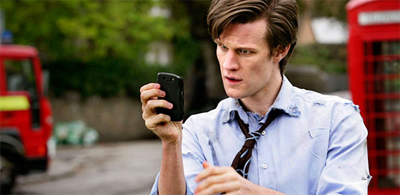
Sorry… Sorry! Dropped it!

Hello, Stonehenge! Who takes the Pandorica, takes the universe. But bad news everyone… cause guess who! Listenw you lot, cause you’re all whizzing about – it’s really could distracting. Could you all just stay still for a minute? Because I. am. talking!

Now, question of the hour: who’s got the Pandorica? Answer: I do. Next question: who’s coming to take it from me?

C’mon!

Look at me: no plan, no backup, no weapons worth a damn – oh, and something else I don’t have? Anything to lose! So if you’re sitting up there in all your silly little spaceships with your silly little guns and you’ve got any plans on taking the Pandorica tonight, just remember who’s standing in your way; remember every black day I ever stopped you; and then – and then! – do the smart thing: let somebody else try first.

– The Doctor, The Pandorica Opens

Well, the first season of Stephen Moffat’s run of Doctor Who is over. And what a ride it was. On one hand, you had budget cuts at the BBC, putting an even great financial strain on the show’s transition to high definition, the first wholsecale chance of the entire cast between seasons since the show’s transition to colour in 1970 (and, fittingly, this was the show’s transition to high definition), and you had the World Cup skewing ratings towards the backend of the season. On the other hand, you had the writer of some of the show’s best episodes directing the entire run behind the scenes, the exploration of the time travelling nature of the central protagonist, and a blatant admission that the show is more a fairytale than a science fiction epic. And along the way, there was barely enough time to catch your breath.

No time to lose...

Continue reading