• Following Us

  • Categories

  • Check out the Archives


  • Awards & Nominations

Space: Above & Beyond – Pilot (Review)

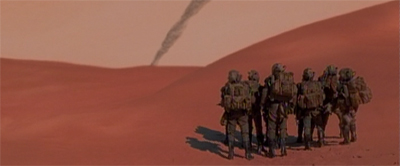
This November (and a little of December), we’re taking a trip back in time to review the third season of The X-Files and the first (and only) season of Space: Above and Beyond.

Space: Above and Beyond made a great deal of sense in the context of the mid-nineties. Fox had begun its life as a scrappy little network that had trouble producing seven nights of broadcasting, but had rapidly solidified itself into a credible alternative to the big three networks. There were lots of reasons for this. The X-Files was one reason, but the network had also solidified itself with a slate of popular young dramas like Beverly Hills 90210, Melrose Place and Party of Five. Securing the NFL rights in 1993 didn’t hurt.

By late 1995, Fox was largely past the growing pains stage of its evolution. The network had been announced in late 1985, and first hit the airwaves in late 1986. It was approach the end of its first decade by the time Space: Above and Beyond was broadcast. Fox was no longer a small network fighting for scraps, but a viable challenger to the so-called “big three.” This change in outlook would lead to great success in the twenty-first century, but would also lead to change in how Fox did business.

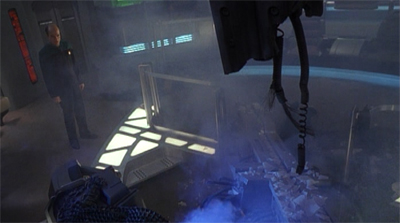
Everything burns...

Everything burns…

The X-Files had been the right show at the right time in a number of ways. It landed at the perfect point to speak to a generation that grew up in the shadow of Watergate, but also to tap into millennial anxieties and insecurities. From a commercial perspective, The X-Files launched towards the end of the period where Fox could take chances on young shows struggling to find an audience. The first season of The X-Files was a cult hit, but not a breakout success story. The network had faith in the show, and that faith paid off.

It is interesting to wonder whether The X-Files would have received a second season if it débuted even two years later. After all, Fox would develop a reputation as a network with a ruthless tendency towards cancellation and plug-pulling. If The X-Files had first appeared in September 1995, would it have enjoyed the same fate as Space: Above and Beyond?
Distant sands...

Distant sands…

Continue reading

Star Trek: Voyager – Projections (Review)

This September and October, we’re taking a look at the jam-packed 1994 to 1995 season of Star Trek, including Star Trek: Deep Space Nine and Star Trek: Voyager. Check back daily for the latest review.

Projections is really the first episode of Star Trek: Voyager that feels like it is the right script coming from the right staff writer. At the start of the show’s first season, it seemed like writing assignments were handed out almost at random, with no real acknowledgement of the relative strength of any of the writers involved.

Brannon Braga is one of the best science-fiction high-concept writers in the history of franchise, but he was assigned the character-driven second episode Parallax and the issue-driven Emanations; Michael Piller’s personal strengths were always more firmly aligned with character development, so it felt strange to see him writing the time travel adventure Time and Again and the anomaly of the week in The Cloud.

All by myself...

All by myself…

Pushing the boundaries of a writing staff is something worth doing – forcing various members of the team to ease themselves out of their comfort zone – but it felt counter-productive to do this during the first season of a new Star Trek show. After all, the first season is about putting the best foot forward, and many of the early scripts for the show feel like they were handed to the wrong writers during the development process.

With Projections, it feels like Brannon Braga finally has a Voyager script that plays entirely to his strengths as a writer. It is arguably his most character-driven script on the franchise to date, but it also anchored in a pretty fascinating existential dilemma. In many respects, it is a spiritual companion to Frame of Mind, a sixth season episode of Star Trek: The Next Generationpreoccupied with questions about what reality actually might be.

Everything falls apart...

Everything falls apart…

Following on from Heroes and Demons, Projections is only the second episode of Voyager to focus on the character of the Doctor. However, much like Heroes and Demons, it demonstrates the versatility of the character and the range of the actor. Projections is a very clever script that relies on its central character to really carry it across the line. At this point in Voyager‘s run, Robert Picardo seems to be one of the few members of the ensemble who could really pull it off.

The result is one of the (if not the) strongest episode of the show’s first two seasons – somewhat appropriate, given the way the show straddles the gap between the first and second seasons.

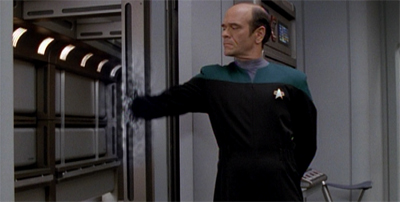
He's not all there...

He’s not all there…

Continue reading

Star Trek: Deep Space Nine – Facets (Review)

This September and October, we’re taking a look at the jam-packed 1994 to 1995 season of Star Trek, including Star Trek: Deep Space Nine and Star Trek: Voyager. Check back daily for the latest review.

Facets in more than a little muddled. It’s an episode that is all over the place. It’s a script that doesn’t seem to know what it wants to be, leaning in one direction and then another. The episode’s big plot point isn’t dropped until half-way through, and there are any number of points where the script offers a feint towards a plot that never quite develops. As befitting a story called Facets, this is an episode with quite a few different (and often conflicting) sides.

It’s a disjointed little story, and perhaps an effective demonstration of just how much trouble the producers were having with Dax as a character. And yet, despite all this, Facets works surprisingly well. This is likely down to the fact that – like Playing God and arguably Blood Oath before it – it feels like a Dax story that is as interested in the character as it is in the concept.

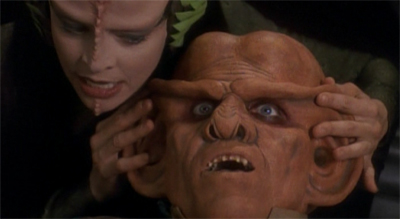
A little piece of herself...

A little piece of herself…

Continue reading

Non-Review Review: Nightcrawler

Nightcrawler features a tour de force performance from Jake Gyllenhaal.

Gyllenhaal plays Louie (“call me Lou”) Bloom, a wandering and lost soul who stalks late-night Los Angeles in search of a lucrative pay-day. He is just trying to get his foot on the ladder any way that an entrepreneurial young gentleman can – he’s introduced stealing construction supplies and scrap metal so he can sell them on, seguing effortlessly into a well-rehearsed job pitch applying for an unpaid internship.

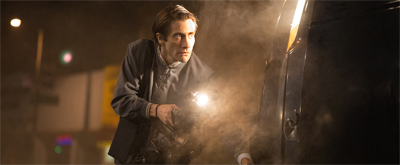
nightcrawler

Bloom seems like a man who has watched people from a distance for years, almost through a filter. Gyllenhaal injects a haunting eccentricity into the character, his wide eyes and practised stillness almost edging Bloom into the uncanny valley. Though he seems to always know just what to say, there’s something distinctly inhuman about Lou Bloom. He watches people, but from the outside. He has got a pretty passable impersonation of a human being down, but there’s just something missing.

Nightcrawler is a fascinating, harrow and occasional wry look at desperation and ruthlessness – and the heady cocktail they make when blended together.

nightcrawler1

Continue reading

The Flash – City of Heroes (Review)

So, I’m considering reviewing this season of The Flash, because the pilot looks interesting and I’ve always had a soft spot for the Scarlet Speedster. I’m also considering taking a storyline-by-storyline trek through the 1987-2009 Flash on-going series as a companion piece. If you are interested in reading either of these, please let me know in the comments.

Appropriately enough for a television show based around the fastest man alive, City of Heroes moves pretty damn quickly. The forty-five minute episode tears through all the requisite superhero origin elements in forty-five minutes. It takes us two minutes to brush through the story of Barry Allen’s childhood trauma. By the ten-minute mark, Barry has already been hit by lightning. At the end of the forty-five minutes, his uniform is complete and his ensemble fully formed.

There are some minor problems with The Flash, but City of Heroes offers a pretty solid start for the series – hinting that perhaps the show has already found its legs.

Suit up...

Suit up…

Continue reading

Star Trek: Deep Space Nine – Prophet Motive (Review)

This September and October, we’re taking a look at the jam-packed 1994 to 1995 season of Star Trek, including Star Trek: Deep Space Nine and Star Trek: Voyager. Check back daily for the latest review.

Now that Star Trek: Voyager is on the air, there’s a sense that Star Trek: Deep Space Nine can be more relaxed. The show was undeniably contrarian during the short period when it was the only Star Trek on the air, presenting a series of uncompromisingly cynical episodes to assure viewers that it would not be trying to fill the void left by Star Trek: The Next Generation. At the same time, there’s also a sense that show was acutely aware of it potentially wider audience watching during that window.

During that first half of the season, a new adversary was pushed to the fore, the show did a story about Klingons and featured three guest stars from The Next Generation – although not necessarily the guest stars anybody would have chosen. More than that, though, the show seemed to consciously avoid its more controversial types of episodes. Even by the show’s third year, it had become clear that certain “types” of episodes appeared a few times a year – a couple of “old favourites” for the writing team to fall back on while constructing a twenty-six episode season.

'Ear me out 'ere...

‘Ear me out ‘ere…

As such, it’s telling that the most divisive parts of any Deep Space Nine season were pushed into the second half of the season.  So Ira Steven Behr and Robert Hewitt Wolfe’s two Ferengi-centric scripts came after Voyager had premiered. Sure, Quark got to be the focus of the season’s third episode, House of Quark, but he shared that with the popular Klingons. The season’s two big Bajoran plot lines (Life Support and Shakaar) were positioned towards the end of the year.

Prophet Motive feels like the kind of Star Trek episode that could only be produced on Deep Space Nine as part of Ira Steven Behr’s unique vision for the show. It’s the kind of weird script that the show seemed to get away with by virtue of being “the other Star Trek on television.” That doesn’t mean that it’s particularly good, mind you, just that it’s distinctly a Deep Space Nine story.

Quark is a by-the-book Ferengi...

Quark is a by-the-book Ferengi…

Continue reading

Star Trek: Voyager – Phage (Review)

This September and October, we’re taking a look at the jam-packed 1994 to 1995 season of Star Trek, including Star Trek: Deep Space Nine and Star Trek: Voyager. Check back daily for the latest review.

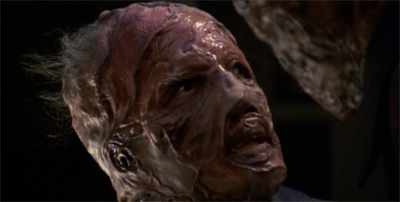
Phage is far from perfect. It is very far from perfect. However, there’s something rather endearing about this cheesy B-movie throwback written by Brannon Braga from a pitch by Timothy DeHass and first draft by Skye Dent. The Vidiians are probably the most memorably and effective aliens from the first three seasons of Star Trek: Voyager, feeling like they could have wandered into the show from some trashy late-night horror movie on another channel.

There’s a pulpy quality to the episode that makes it more enjoyable than many of the surrounding Voyager episodes, albeit one undermined by some of the more awkward resonances in the script.

The Vidiians survive by the skin of their teeth...

The Vidiians survive by the skin of their teeth…

Continue reading

Doctor Who: Time Heist (Review)

Why? There’s no immediate threat?

Warning, intruder alert!

I should really stop saying things like that.

After the ambition of Listen, Time Heist feels like a return to the general narrative conservatism that marks the first half of the season. Introducing the Twelfth Doctor, the first six episodes of the season are all written by veteran writers. With the exception of Listen, they all play it relatively safe. Five episodes into the Twelfth Doctor’s tenure, the approach is starting to grate just a little bit. The training wheels are still on, but there is a sense that the show is itching to remove them.

Indeed, without the ambition that tempers the many flaws with In the Forest of the Night, Time Heist is probably the weakest episode of the season. However, there is something to be said about that; Time Heist may not be a particularly memorable piece of television, but that alone is enough to mark it as much stronger than misfires like Fear Her or Night Terrors or Evolution of the Daleks

or Curse of the Black Spot.

... and they lived happily ever after...

… and they lived happily ever after…

Continue reading

Star Trek: Voyager – Caretaker (Review)

This September and October, we’re taking a look at the jam-packed 1994 to 1995 season of Star Trek, including Star Trek: Deep Space Nine and Star Trek: Voyager. Check back daily for the latest review.

So, Star Trek: Voyager.

Where do we begin? Voyager is probably the most divisive and controversial of the Star Trek spin-offs, the one that carries a lot of the blame for the franchise’s decline and decay in the mid to late nineties. It is the series that connects the tail end of the success story that was Star Trek: The Next Generation to the start of the dying gasp that was Star Trek: Enterprise. This spin-off had the misfortune to launch at the height of a revived franchise’s popularity and to finish as public interest waned.

Feels like going home...

Feels like going home…

Star Trek: Voyager felt like an act of hubris. It was positioned by Paramount to be the studio’s highest-profile television show. It was a feature of the television landscape, finally allowing Paramount the chance to leverage its own television network – a plan delayed since the late seventies, but deemed feasible in the mid-nineties. UPN branded itself “the first network of the new century”, a rather arrogant declaration. Caretaker was the first thing broadcast on UPN in early 1995, débuting to an audience of more than 21 million. However, Voyager would never reach those figures again.

Despite that success, things fell apart quickly. None of the shows that aired on UPN’s second night received a second season. The only shows to limp on to renewal from the network’s rocky first year were Voyager, The Sentinel and Moesha. Of these meagre freshmen hits. Voyager lasted the longest, with one more season to its name than Moesha. Over the summer of 1995, it was identified by The Los Angeles Times as the network’s “star survivor”, and the show upon which all of the network’s hopes rested. By 2000, five years later, the network had run up a debt of $800,000.

"I hope you don't mind, our tailors measured you while you were unconscious. It's all part of a standard probe."

“I hope you don’t mind, our tailors measured you while you were unconscious. It’s all part of a standard probe.”

That’s a lot of pressure for any television series to bear. Following (and, in the eyes of many, replacing) an illustrious predecessor, supporting the weight of a new television network, pushing into the future while remaining anchored to the past, it’s no wonder that Star Trek: Voyager wound up the confused mess that it became. Indeed, one can recognise many of the problems that would haunt the show through to its final season tied up in this pilot episode.

Continue reading

Star Trek: Deep Space Nine – Past Tense, Part II (Review)

This September and October, we’re taking a look at the jam-packed 1994 to 1995 season of Star Trek, including Star Trek: Deep Space Nine and Star Trek: Voyager. Check back daily for the latest review.

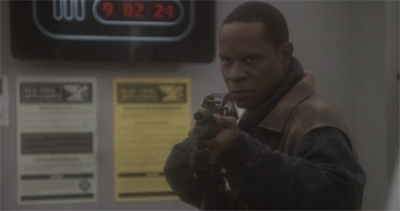
Past Tense, Part II is a nice way to close out Star Trek: Deep Space Nine‘s solo run, the only period in the show’s history where it was the only Star Trek on television. Caretaker, the première of Star Trek: Voyager, would be the next episode of the franchise to air. Deep Space Nine spent a lot of its early third season attacking various foundations of the Star Trek universe, as if hoping to demonstrate how profoundly different the show was from its predecessors.

The Search promised a war brewing on the horizon, and presented a cynical view of Starfleet foreign policy, where pacifism amount to appeasement. House of Quark reduced the Klingon Empire to a joke. Equilibrium suggested that Sisko could live with (and passively enable) a government lie if it kept his friend alive. Second Skin hinted that things might not be as they appear to be. The Abandoned embraced the idea that sometimes people are incapable of being anything more than what their genes might tell them to be. Defiant was the story of sibling desperately trying to prove his unique identity.

Everything is under control...

Everything is under control…

Part of me wonders if this very cynical stretch of episodes is responsible for the perception of Deep Space Nine as an incredibly cynical and pessimistic television show – one consciously at odds with the utopian ideals of the franchise. After all, this was the stretch where Deep Space Nine was most in the spotlight. It had the spot previously allocated to Star Trek: The Next Generation in most markets. It had no televised competition. If ever Star Trek fans were going to jump on board Deep Space Nine, this was the moment. It seems quite possible that this run of episodes cemented the show’s reputation.

So it seems strange that Deep Space Nine should wait until its last possible moment in the sun to embrace the humanism and optimism at the heart of the franchise. Past Tense is a story about building paradise, and about how humanity has the capacity to be so much better than we currently are. In short, it’s quintessential Star Trek, right down to the occasionally heavy-handed moralising and utopian idealism.

Keep your hat on...

Keep your hat on…

Continue reading