• Following Us

  • Categories

  • Check out the Archives


  • Awards & Nominations

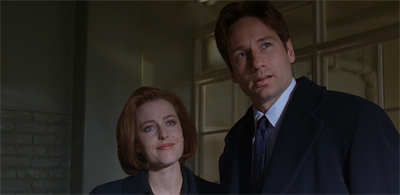
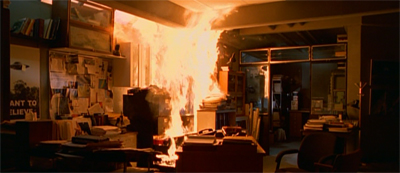
The X-Files – Two Fathers (Review)

This July, we’re taking a trip back in time to review the sixth season of The X-Files and the third (and final) season of Millennium.

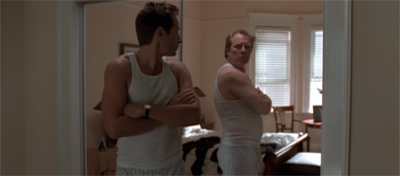
This is the end. I never thought I’d hear myself say those words after all these years. You put your life into something… build it, protect it… The end is as unimaginable as your own death or the death of your children. I could never have scripted the events that led us to this. None of us could. All the brilliant men… the secret that we kept so well. It happened simply, like this.

– the Cigarette-Smoking Man channels his inner Chris Carter

In case you were wondering about the title...

In case you were wondering about the title…

Continue reading

Millennium – The Sound of Snow (Review)

This July, we’re taking a trip back in time to review the sixth season of The X-Files and the third (and final) season of Millennium.

“Our pasts are what we are,” Alice Severin explains to Emma Hollis and Bob Giebelhouse towards the climax of The Sound of Snow. It seems as if she might be talking for Millennium itself.

The Sound of Snow is a literal homecoming for Frank Black and Millennium as a television show. It is the last time that a number of crucial elements of Millennium appear in the show. It is the last appearance of Detective Bob Giebelhouse, the Seattle police officer who has been around since The Pilot. It is the last appearance of the yellow house, although it has since been painted a less striking white. It is also the last appearance of Catherine Black, who was a regular character for the show’s first two seasons.

...............

……………

The Sound of Snow features Frank Black returning to Seattle. This is not a big deal of itself. After all, Frank visited Seattle during TEOTWAWKI. However, The Sound of Snow sees Frank wading through memories. He flashes back to the events of The Fourth Horseman and The Time is Now, and visits the yellow house. He even takes a trip out to visit the cabin where he tried to wait out the end of the world with his wife and daughter. The Sound of Snow is about reconciliation, allowing Frank one last conversation with his beloved.

The Sound of Snow is also about reconciliation for the show itself. Since Omertà, the show has been trying to deal with the legacy of a second season that the first eight episodes of the year had tried minimise or ignore. The Sound of Snow is the culmination of that approach, with the third season finally picking up from where the second season let off.

...............

……………

Continue reading

The X-Files – Dreamland I (Review)

This July, we’re taking a trip back in time to review the sixth season of The X-Files and the third (and final) season of Millennium.

It occasionally seems like the sixth season of The X-Files is having something approaching a midlife crisis.

It has gone through a fairly massive change in routine and lifestyle; the show recently pulled up sticks and moved to Los Angeles. It has gotten a lot more ostentatious; it looks to be spending a lot more money than it was before, and it is hanging around with a whole new caliber of guest star. It has reinvented itself completely; no longer the brooding and atmospheric show it once was, it is now downright goofy and silly. Old acquaintances would be forgiven if they had trouble recognising the show. And it’s perfectly understandable.

Back to back...

Back to back…

This is the sixth season. Dreamland I is the one-hundred-and-twenty-first episode of The X-Files. The show is well past what Chris Carter had originally planned, and well past just about any measure of success. Most shows are lucky to reach a sixth season, let alone come into the sixth season off the back of a summer film and with a great deal of security about the future. David Duchovny, Gillian Anderson and Chris Carter were all committed through to the end of the seventh season. There was even talk of a sequel to The X-Files: Fight the Future being released in 2000.

Dreamland I and Dreamland II just externalise that midlife crisis, using the classic “freaky friday” body swap set up putting Fox Mulder in a dead-end job with a family that hates him as Morris Fletcher tries to help the FBI agent grow up just a little bit.

"Yep. It's a little... out there."

“Yep. It’s a little… out there.”

Continue reading

Millennium – The Innocents (Review)

This July, we’re taking a trip back in time to review the sixth season of The X-Files and the third (and final) season of Millennium.

So, how do you write your way out of the end of the world?

To be fair, it is not an easy assignment. The Fourth Horseman and The Time is Now are two spectacular pieces of television, but they arguably work better as a series finalé than a season finalé. Once Fox decided to renew Millennium for a third season, the biggest problem facing the staff was the challenge of writing around the apocalypse that had arrived at the end of the second season. It is a problem that hobbled the third season of Millennium coming out of the gate. However, it was not the only such problem.

Guess who's Black?

Guess who’s Black?

Millennium is a show that feels particularly disjointed from year-to-year. It has been argued – quite convincingly – that Millennium was really three different shows, and that no two seasons of Millennium convincingly resemble one another. The third season of Millennium would be a different beast than the second. The Innocents and Exegesis demonstrate that clearly and quite articulately. The two-part season premiere made it quite obvious that Millennium was no longer a show particularly interested in ideas of apocalypse – whether global or personal.

Unfortunately, it seemed like the show had no real idea of what it wanted to be.

"Yep, this is what Chris Carter found when he took the show back."

“Yep, this is what Chris Carter found when he took the show back.”

Continue reading

The X-Files – Season 5 (Review)

This May and June, we’re taking a trip back in time to review the fifth season of The X-Files and the second season of Millennium.

The fifth season of The X-Files represents the height of the show’s popularity.

Bookended by the production and release of the motion picture, the fifth season also earned the highest overall Neilsen ratings of any of the show’s nine seasons. The X-Files was a cultural force to be reckoned with, and had come a long way from its origins as little-seen cult television show. In the late nineties, it seemed like it wasn’t just aliens conspiring to colonise the planet; Chris Carter and his team were doing a pretty good job of it themselves. The fifth season has all the swagger and confidence of a show enjoying the view as it stands on top of the world.

xfiles-postmodernprometheus33

The fifth season might not be able to match the third season for consistency from episode to episode. The fifth season might also struggle to match the breathless ambition of the fourth season’s best (and wildest) episodes. However, it is a highly enjoyable season of television on its own terms. The season feels a little more relaxed and organised than the fourth season, and more confident in itself than the third. The fifth season even makes better use of its own internal themes and motifs than any of the previous seasons, with most of the staff seemingly on the same page.

Oddly enough, this thematic consistency does not translate into clear or fully-formed arcs. Unlike the second season of Millennium, it seems like the fifth season of The X-Files has no real idea of where it is going or how it wants to get there. This is slight problem when the fifth season needs to build to a feature film that was shot in the gap between the fourth and fifth seasons. The X-Files gets a lot of credit for popularising serialised storytelling on prime-time television, but the fifth season demonstrates just how sloppy the show could sometimes be in that regard.

xfiles-badblood10

Still, this is a minor problem. With only twenty episodes, the fifth season is the shortest season of The X-Files produced at this point in the show’s history. The ninth season would run the same length, but there is an argument to be made that it is technically the shorter season; The Truth was written and broadcast as a single feature-length episode rather than two individual episodes. However, production necessities required a lot of innovation and experimentation in the fifth season, leading to a very playful and very off-format season of television.

While it is probably very difficult to argue that the fifth season of The X-Files was the show’s best run of episodes, it is a highly enjoyable collection of shows that brings together a lot of what was so much fun about The X-Files. The last season to be filmed in Vancouver, and the season that moves us closer to the end of the series than the beginning. Although certain segments of fandom would argue that it is the last truly great season of The X-Files, that feels unduly harsh to both the sixth and eighth seasons. Nevertheless, it is thrilling to watch a show so thoroughly enjoying its moment in the sun.

xfiles-theend32

Continue reading

Non-Review Review: Aonrú

Aonrú offers a fascinating insight into life on Cape Clear Island off the west coast of Cork. The small community had subsisted for years on farming and fishing – as the documentary notes, “the farmers were fishermen and the fishermen were farmers.” Now, due to a number of intersecting and overlapping hurdles – both natural and man-made – the community finds itself struggling to provide a future for itself. The thirty minute documentary examines what it must be like to live on Cape Clear.

Skilfully constructed from a myriad of first-person accounts, archive footage and beautiful images of the region, Aonrú explores the pace of life in one of the most remote parts of the country.

aonru1

Continue reading

Non-Review Review: Entourage

Entourage is surprisingly inoffensive.

It has been four years since HBO’s showbiz comedy went off the air. In many respects, Entourage feels like a class reunion – even to somebody unfamiliar with the source material. There is a lot of affection here, no real sense of tension or stress. Everybody is perfectly comfortable, and the entire film has the feeling of something that everybody involved has been doing for quite some time. Anything that looks like a rough edge has been smoothed off, so the film glides along without any meaningful obstruction.

All at sea...

All at sea…

Entourage is not a great film on its own terms. However, it is not trying to be. Instead, it feels like an affectionate slice of nostalgia. It is telling that most of the cameos in the film tend to nod towards older actors and audiences. At one point, Johnny “Drama” Chase reflects that he was cast in the table read of The West Wing and he finds himself competing for roles against David Faustino of Married With Children. Faustino is just one cast member of Married With Children to cameo. Entourage feels familiar and safe, and entirely comfortable with those attributes.

The result is a functional cinematic adaptation for a show that probably did not need one. The stakes in Entourage never feel particularly high, the characters never seem particularly worried. It seems like Entourage was produced in the same way that it was intended to be enjoyed – in a rather relaxed and cordial fashion, without any real verve or energy.

Going for Gold...

Going for Gold…

Continue reading

The X-Files – Chinga (Review)

This May and June, we’re taking a trip back in time to review the fifth season of The X-Files and the second season of Millennium.

Chinga is the episode of The X-Files that was written by Stephen King.

That is a pretty big deal. Stephen King is one of the most influential American writers of the twentieth and twenty-first centuries. He is a writer who has enjoyed tremendous commercial success, but who has also balanced that popularity with considerable respect of critics and academics. His work has permeated popular cultured, and sparked all sorts of analysis and exploration. While no creator of that calibre works without at least some small level of backlash, King is one of the most successful American writers by any measure.
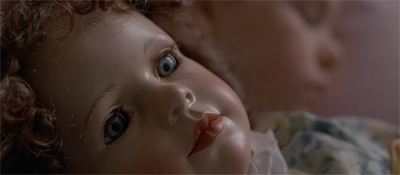
Play time!

Play time!

Writing about King in A Century of Great Suspense Stories, Jeffery Deaver argued that the author “helped free the popular name from the shackles of simple genre writing. He is a master of masters.” As such, he should be quite a comfortable fit for The X-Files. Even aside from any stylistic sensibilities that he might share with the series, King is a creator who manages to consistently producer work that might be dismissed as “genre”, but manages to compete with more prestigious and high-profiler literature.

The X-Files did something similar in the nineties. It was a show that frequently dabbled in cult genres – it was a show that dealt with horror and science-fiction themes on a regular basis. However, thanks to the craftsmanship of those involved, The X-Files was frequently able to compete with more “serious” fare at the major awards ceremonies. Chris Carter worked very hard to prevent the show from being relegated to the horror or science-fiction “ghetto.” It was a show that could slide to high-brow to low-brow over a single act; that was part of what made it so fun.
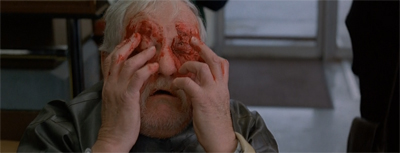
A bloody disaster...

A bloody disaster…

So landing King was very much a coup for The X-Files. He was one of the best-selling and most prolific American writers of the nineties, with his name all over a wealth of media. All that Chinga really needs to do is exist. It would be next to impossible for Chinga to be anything but “that episode of The X-Files written by Stephen King.” Indeed, it seems almost unreasonable to expect anything more from it. The hype on Chinga was unbelievable – as one might expect from a television show that had bagged one of the most popular fiction writers around.

Chinga is a very flawed piece of television, an episode that feels too much like an early draft than a fully-developed concept. The styles of Chris Carter and Stephen King blend reasonably well, but there is a sense that neither is pushing the other out of their comfort zone. Chinga is a pretty average piece of television, a pretty average Stephen King story, and a pretty average episode of The X-Files. While not necessarily a catastrophic failure, it is hardly a fantastic success.
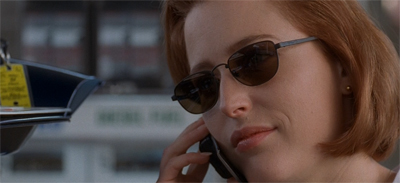
"Yeah, I'm sure this vacation will be completely uneventful!"

“Yeah, I’m sure this vacation will be completely uneventful!”

Continue reading

The X-Files – Schizogeny (Review)

This May and June, we’re taking a trip back in time to review the fifth season of The X-Files and the second season of Millennium.

Schizogeny has a pretty terrible reputation among some (or even most) fans of The X-Files.

During The A.V. Club’s coverage of the show’s fifth season, Todd VanDerWerff suggested that it “just might be the very worst episode of The X-Files.” Andrew Payne described the killer tress as the series’ “worst monster of the week.” Moving away from any sort of objective coverage, The X-Files Wiki lists the fact that Schizogeny is “generally considered by fans to be one of, if not the worst, X-Files episode” at the very top of “notes” section on the episode. It is fairly safe to say that Schizogeny is not well-liked.

The woodsman...

The woodsman…

And there are a lot of very valid reasons for this. There is a lot about Schizogeny that is not good; more than that, there is a lot that is just plain terrible. The writing is clumsy, the plotting is hazy, the special effects are jumbled, the dialogue is awkward. It is very difficult to tell what is going on at certain points in the story, and a truly woeful central performance from Chad Lindberg as Bobby Rich does not help matters. Schizogeny is not a classic episode of The X-Files, by any stretch of the imagination.

However, it is nowhere near as bad as its reputation suggests.

Go climb a tree...

Go climb a tree…

Continue reading

The X-Files – Christmas Carol (Review)

This May and June, we’re taking a trip back in time to review the fifth season of The X-Files and the second season of Millennium.

Part of the challenge of the fourth and fifth seasons is watching The X-Files adapt the speed of its mythology.

The mythology has a very clear momentum in the first three seasons. For all that Chris Carter and his writers loved teasing out new questions, there was a clear sense of momentum and movement. The show had gone from a series about an isolated alien abduction in The Pilot to a series with a date set for the alien colonisation of Earth in Talitha Cumi. For all that the series was accused of being ambiguous and mysterious, there was a sense that it was at least going somewhere.

And so this is Christmas...

And so this is Christmas…

Things changed during the fourth season, most likely as the prospect of The X-Files: Fight the Future loomed in the future. It was clear that Fox would not allow Carter to set an end date on the television show before transitioning to feature films, and that the series would have to stretch beyond Carter’s original roadmap for it. All of a sudden, the mythology started stalling. The fourth season’s mythology had no clear direction in which to go, as evidenced by the fact that the decision to give Scully cancer in Leonard Betts was an eleventh hour decision with no long-term planning.

The fifth season’s mythology comes with its own particular set of problems. The movie had been written during the fourth season and filmed during the gap between the fourth and fifth seasons. This is quite evident in the way that the movie carries over abandoned elements of the fourth season mythology like the bees, who do not register at all in the fifth season. However, this also meant that the end point of the fifth season was essentially set in stone for the production team. The End would have to lead into Fight the Future, no matter what happened in the intervening nineteen episodes.

Picture perfect...

Picture perfect…

This means a lot of things for the fifth season. It means that the fifth season is stuck with the “Mulder as a skeptic… sort of” setup until Fight the Future, even if the show generally ignores it as much as it can. It also means that the mythology episodes probably should not contain any earth-shattering revelations or introduce any major character who were not already written into the film. Although Patient X and The Red and the Black effectively throw out these constraints almost completely, Christmas Carol and Emily try to adhere to them.

The result is a mythology episode that adheres rather closely to the successful approach adopted by Tempus Fugit and Max, a story that takes the backdrop of what the show has already revealed about the conspiracy and then uses that as a setting in which it can tell a decidedly more intimate and personal story.

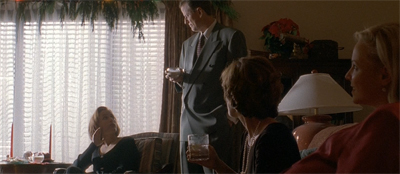
It's a Scully family Christmas...

It’s a Scully family Christmas…

Continue reading