• Following Us

  • Categories

  • Check out the Archives


  • Awards & Nominations

Star Trek: Deep Space Nine – ‘Til Death Do Us Part (Review)

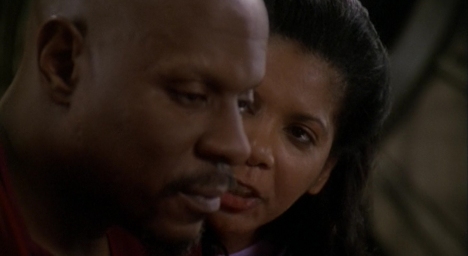
Perhaps more than any other Star Trek show, Star Trek: Deep Space Nine is an epic.

Sure, Star Trek: Voyager has more than a few characteristics of epic storytelling; it is a mythic journey, much like The Odyssey and The Iliad before it. In fact, several episodes of Voyager borrow quite heavily from those earliest of stories, with Favourite Son feature a planet for of sirens and Bliss finding the crew confronted with the deep space equivalent of lotus eaters. However, the storytelling on Voyager was always too small and too episodic to embrace the potential for a sprawling galactic epic.
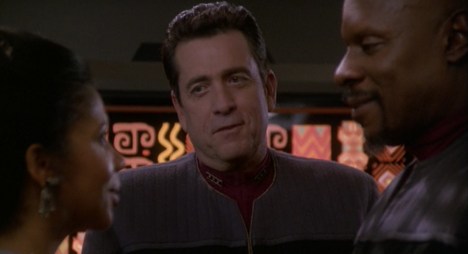
Wedded bliss.

In contrast Deep Space Nine is a story with a lot of breadth. Of course, there are any number of isolated and standalone episodes within the seven-year run of Deep Space Nine, but there is also a strong sense that these one-hundred-and-seventy-plus episodes of television can be taken together and fashioned into a single cohesive narrative that runs from Emissary through to What You Leave Behind. There are undoubtedly bumps and inconsistencies along the way, strange shifts in direction and sharp left turns, but the series hangs together relatively well as a single narrative.

This is particularly true when it comes to the final ten episode of the series, which are very much intended to draw down the curtain on seven years of storytelling, while reinforcing the sense that this has truly been an epic narrative.
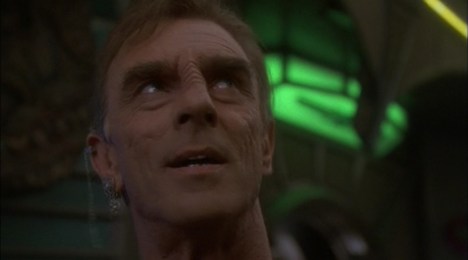
Feels like coming home…

Continue reading

Star Trek: Deep Space Nine – Penumbra (Review)

Penumbra represents the beginning of the end, kicking off the epic ten-episode conclusion to Star Trek: Deep Space Nine.

To be fair, Deep Space Nine had already embraced serialised storytelling, whether in the seeding of gradually-building plotlines or its long-term character development. The show was most serialised in the audacious six-episode arc that opened the sixth season; A Time to Stand, Rocks and Shoals, Sons and Daughters, Behind the Lines, Favour the Bold and Sacrifice of Angels. In some ways, the ten-episode closing arc is ultimately an extension of that basic idea. However, it is also something more complex.

When the moon is in the seventh house in the Kendra Province…

In some ways, this last narrative experiment would be the boldest creative decision of the entire seven year run. The production team had strained a little bit in structuring and pacing those six linked episodes; Sons and Daughters was notably the runt of the litter, telling a relatively standalone story about Worf while essentially repeating Kira’s character arc from Rocks and Shoals in a much less effective manner. As such, trying to tie ten hours of television together into a single cohesive narrative was a bold move. Then again, Deep Space Nine had never been short of ambition.

It is tempting to treat this ten-episode run as a single story, and it kinda is; Netflix labels the forty-five minute episodes as “Part 1”, “Part 2”, “Part 3”, “Part 4”, “Part 5”, “Part 6”, “Part 7” and “Part 8.” However, the run can also be broken down into smaller chunks. ‘Til Death Do Us Part and Strange Bedfellows were originally titled Umbra and Eclipse, suggesting a three-parter. In contrast, TV Guide listed the first four episodes in the run as a four-parter. When It Rains… and Tacking Into the Wind are definitely a two-parter. Extreme Measures is practically standalone.

Build a final arc.

Admittedly, the storytelling falters in places, as the production team’s reach occasionally exceeds their grasp. Some of these issues are outside the control of the production team, such as the budgetary concerns that hinder Extreme Measures. Some of these issues are entirely within the control of the production team, such as the pacing of the subplot with Winn and Dukat that leads to the most transparent stalling tactic in When It Rains…. Individual story choices are occasionally misguided, such as the emphasis on the Breen or the Pah-Wraiths.

Nevertheless, these ten episodes hang together surprisingly well. There is a sense of purpose and momentum running through these episodes that strengthens even the weaker hours. More than that, this ten-part saga includes some of the strongest episodes in the entire franchise, with episodes like When It Rains… and Tacking Into the Wind feeling like the culmination of more than nine years of storytelling across two different series. Though individual elements of this sprawling epic might miss the mark, the whole is greater than the sum of its parts.

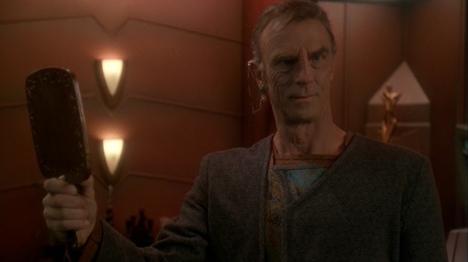
The Dukat is of Bajor…

Continue reading

Star Trek: Voyager – The Fight (Review)

“No, make them stop!”

The Fight is a disaster. To be fair, it’s not the worst episode of Star Trek: Voyager. It is not as overtly racist as second season offerings like Tattoo or Alliances, even if there is still something deeply uncomfortable about the way in which the show approaches Chakotay’s Native American heritage as a gateway to pseudo-mysticism. It is neither as xenophobic as Displaced nor as misogynist as Retrospect, although its approach to mental health is… questionable. Mostly, though, it is just a bad episode of television, not a spectacularly awful one.

Don’t worry. Jason Alexander will be here next week, if you can make it until then.

The problems with The Fight are somewhat typical of Voyager. It is an episode that decides to invent a new character trait in a regular character in order to justify the plot, revealing a lot of details about Chakotay that had never been suggested before and which will never be mentioned again. It is also overly reliant on techno-babble, with dialogue referencing nonsense like a “trimetric fracture” and a “paralateral rentrillic trajectory.” There is a pointless framing sequence designed to extend the runtime. There is nothing insightful about the characters or their world.

However, the biggest issue with The Fight is how it squanders a potentially compelling idea. Like Once Upon a Time before it, it is a great example of Voyager trying to write around a risk idea and effectively writing anything interesting out of the finished product.

Chaos and them.

Continue reading

Star Trek: Deep Space Nine – Inter Arma Enim Silent Leges (Review)

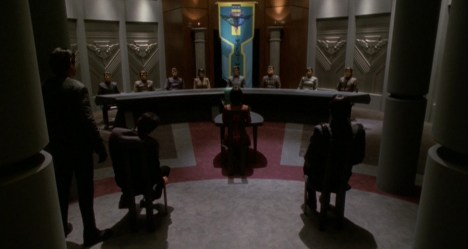
Inter Arma Enim Silent Leges is a perfectly fitting penultimate episode of Star Trek: Deep Space Nine.

Sure, the production team had originally planned for Badda-Bing, Badda-Bang to take the audience into the sweeping ten-hour epic that would wrap up the series. That certainly would have been a satisfying deep breath before the plunge, one last story celebrating this ensemble in a low-stakes adventure that treats them like an extended family before everything hits the fan. Badda-Bing, Badda-Bang would have been immensely fulfilling in that context.

Tribunal.

However, Inter Arma Enim Silent Leges feels like a necessary episode before Deep Space Nine commits to its sprawling ten-episode-long finale. In particular, Inter Arma Enim Silent Leges is the only episode of the seventh season to devote any time or any energy to the question of what happens after the Dominion War. Deep Space Nine has been so tied up in this epic existential struggle that the production team have never really acknowledged what happens when the dust settles, beyond the rolling of the closing credits and the conclusion of the series.

Inter Arma Enim Silent Leges represents the first time that Deep Space Nine has dared to look beyond the immediate status quo, to acknowledge that life will undoubtedly continue in the Alpha Quadrant after the end of What You Leave Behind. In many ways, Deep Space Nine is notable for extending a sense of political realism and pragmatism to the mechanics of the larger Star Trek universe, and Inter Arma Enim Silent Leges feels like an organic extension of that, acknowledging that events ripple beyond that arbitrary boundaries that are conveniently labelled as “endings.”

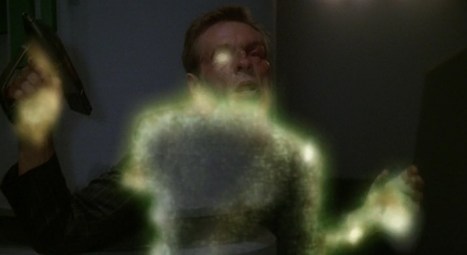
I met a man who wasn’t there.

Continue reading

Star Trek: Deep Space Nine – Badda-Bing, Badda-Bang (Review)

Badda-Bing, Badda-Bang is nonsense, but it is fun nonsense.

It goes without saying that the plotting of Badda-Bing, Badda-Bang is ridiculous, even by the standards of the obligatory “holodeck goes crazy” episodes like The Big Goodbye or Our Man Bashir or Bride of Chaotica! The episode’s internal logic is strikingly weak, to the point that even the most sympathetic and understanding audience member has to acknowledge the sizable plot holes in the narrative. It is not that the plotting of Badda-Bing, Badda-Bang is lazy or clumsy, it is that the plotting is almost non-existent.

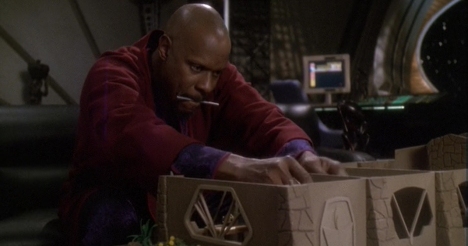
Sisko’s seven.

More than that, the seventh season has already had a much stronger “the crew hang out together and have fun in the holosuite” episode in Take Me Out to the Holosuite. More than that, Star Trek: Deep Space Nine is within a dozen episodes of the end of its seven-season run. There is a very valid argument to be made that Badda-Bing, Badda-Bang is a completely unnecessary indulgence at this late stage of the game and that the time invested in this episode could be more wisely invested in some other story thread or dangling plot.

But, yet. There is an incredible charm to Badda-Bing, Badda-Bang that comes from seeing this cast together and having fun for the last time.

“Well, I think we have a promo shot.”

Continue reading

Star Trek: Voyager – The Disease (Review)

One of the curses of Star Trek is the tendency to saddle the weakest and most ill-defined members of a given ensemble with a generic soul-destroyingly dull love story.

Deanna Troi has Haven, The Price and Man of the People. Geordi LaForge has Booby Trap and Galaxy’s Child. In the first few years of Star Trek: Deep Space Nine, both Bashir and Dax were subjected to such plots. Bashir had Melora, and Second Sight was originally developed with his character in mind. Dax got a similar story in Meridian. Chakotay has Unforgettable, and was shipped with both Janeway and Seven at various points in the run of Star Trek: Voyager. Even Mayweather’s subplot in Demons and Terra Prime was romantic in nature.

Kiss and Tal.

Of course, there are any number of compelling and interesting  romantic episodes built around characters over the history of the franchise. Kirk had The City on the Edge of Forever. Spock had All Our Yesterdays. Tuvok had Gravity. Even the more developed seventh season version of Bashir had Chrysalis. However, it frequently seems like the production team’s go-to plot for an underdeveloped regular character is a romance-of-the-week plotline, perhaps because it is a fairly standard story and because it can be applied to almost any type of character.

However, the problem with building these romantic storylines around undeveloped characters is that they lack any real hook. The audience implicitly understands that the romantic interest is unlikely to stick around, so the story has offer a compelling insight into the regular character. This is understandably difficult if the production team have chosen to tell this story with this character because they really cannot think of any other interesting story to tell. As a result, these episodes can feel like an exercise in boredom, in watching wheels turn.

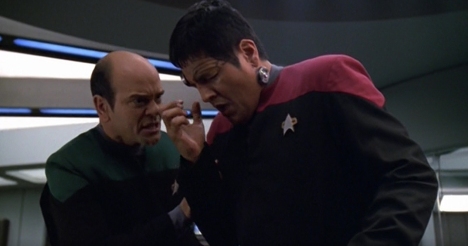
“Dammit, Harry. I thought we had this conversation after Favourite Son.”

This is particularly true in episodes built around weaker (or more disinterested) members of the ensemble. In a romantic installment of an episodic show, the audience needs to invest in the love story very quickly. This puts a lot of pressure on a performer to sell the romantic attraction. On a weekly schedule, with two performers who may not know one another particularly well, this can be very difficult to accomplish. Robert Beltran is a relatively serviceable performer with the right material, but he would never make a convincing romantic lead.

The Disease is a romantic episode built around Harry Kim. While the script has its own very severe problems, the biggest issue is that Garrett Wang simply cannot sell the intense attraction that is necessary for the episode to work.

Colony ship collapse disorder.

Continue reading

Star Trek: Voyager – Dark Frontier, Part II (Review)

Star Trek: Voyager has a morbid fascination with the Borg. Quite literally.

Time and time again, the series returns to the image of the Borg dead and dying. Blood Fever ends with the discovery of a Borg corpse. Unity features the extended autopsy of that corpse. In Scorpion, Part I, Kes is haunted by the image of a grotesque mound of Borg drones, torn apart and reassembled. In Unimatrix Zero, Part I, the Borg Queen tears the heads off her drones and mounts them on spikes. There is a very similar image in Dark Frontier, Part I, where Janeway wanders casually through the wreckage of a Borg ship.

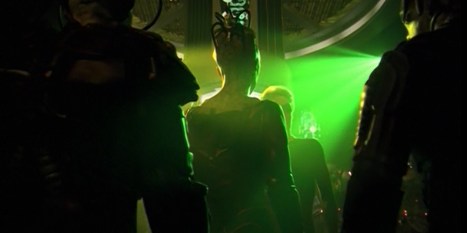
Queen of minds.

Star Trek: The Next Generation worked hard to establish the Borg as a credible threat. If the Borg were associated with death, it was only because they delivered something akin to it. In The Neutral Zone, the Borg scooped an entire outpost off the surface of a planet. In Q Who?, Picard had to literally beg Q to save the Enterprise after the loss of eighteen crewmembers. In The Best of Both Worlds, Part I and The Best of Both Worlds, Part II, the Borg tore through the Federation like it was made of tissue paper. The trauma of that invasion informed Emissary.

In contrast, Voyager seems preoccupied with the destruction and desecration of the Borg Collective. This is an interesting creative choice on a number of levels. Most obviously, it severely undercuts the menace and threat posed by the Borg Collective. Janeway seems to travel through the Delta Quadrant leaving a trail of broken Borg bodies in her wake. It is hard to believe that the Borg are a big deal, when Janeway seems to decorate her ship with their remains. The Kazon, the Vidians and the Hirogen have all taken Voyager at some point. The Borg have never.

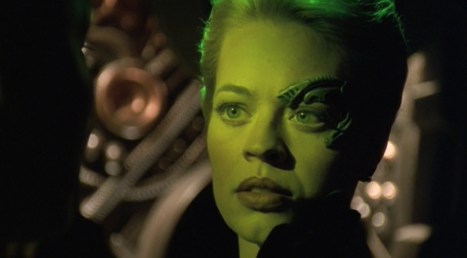
Green light for reassimilation.

Perhaps this fascination with Borg corpses and remains simply speaks to their visual aesthetic. With their pale skin and their lack of individual identity, the Borg have always evoked the walking dead; Star Trek: First Contact was essentially a zombie movie in deep space. However, perhaps this desecration of the Borg speaks to something buried deeper within the psyche of Voyager. The Borg are perhaps the most iconic aliens of the Berman era; they represent the moment that The Next Generation came into its own. Perhaps their decay mirrors that of the Berman era itself.

Dark Frontier, Part I and Dark Frontier, Part II represent something of a final frontier for the Borg Collective. While the Borg had been in decline for some time, Dark Frontier, Part I and Dark Frontier, Part II marked a point of no return. Regeneration is an underrated return to form for the iconic cyborgs, but it is too little and too late. Dark Frontier, Part I and Dark Frontier, Part II is effectively a funeral for the most iconic adversaries of the Berman era. However, they would remain shuffling lifeless for another two-and-a-half seasons.

Subject to change.

Continue reading

Star Trek: Voyager – Dark Frontier, Part I (Review)

The fifth season of Star Trek: Voyager arrives at a point when the Rick Berman era of the Star Trek franchise has hit its midlife crisis.

Star Trek: Deep Space Nine is coming to an end, bring down the curtain on a seven-year period where there were always two franchise series boldly going simultaneously. Star Trek: Insurrection had been released into cinemas as a snapshot of that midlife crisis, where Michael Piller’s last script for the franchise found the cast of Star Trek: The Next Generation desperately chasing their own youth and vitality on a planet with a fountain of youth.

Seven gets back in touch with her roots.

On the fifth season of Voyager, it seemed like the show turned inwards. The scripts for the fifth season are surprisingly retro and nostalgic in tone; Janeway’s reflections on the events of Caretaker in Night, the return of the Maquis and the Cardassians in Nothing Human, the indulgence of retro thirties sci-fi in Bride of Chaotica!, Tuvok’s childhood flashbacks in Gravity, the “telepathic pitcher plant” in Bliss, Seven’s trip back to the launch of Voyager in Relativity, Janeway’s investigation of her ancestor in 11:59.

However, there was a fundamental problem with all of this introspection. Voyager was a television series that had long struggled to define a unique identity, too often feeling like a half-hearted reheat of the leftovers from The Next Generation. It was very hard to turn the focus inwards when there wasn’t a lot unique or distinctive about Voyager. This is a show that was much closer to its end than to its beginning, and it still lacked any true sense of identity or self.

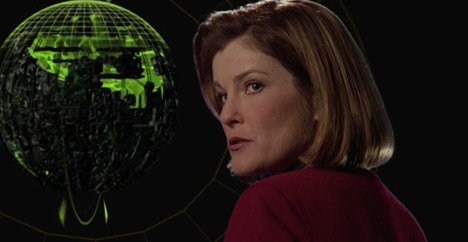
There’s coffee… I mean transwarp coils in that there Borg Sphere.

Dark Frontier, Part I and Dark Frontier, Part II serve as an example of this nostalgic indulgence, both in form and plot. It is a two-parter consciously designed to recapture the success of broadcasting The Killing Game, Part I and The Killing Game, Part II on the same night in the late fourth season. It is also a television movie that is very clearly patterned off the story for Star Trek: First Contact, borrowing key story beats and clear characters from that memorable Next Generation film.

However, Dark Frontier, Part I and Dark Frontier, Part II also demonstrate the shallowness of Voyager‘s own internal memory. This is a story built around an act of narrative archeology within the larger Star Trek universe, touching on the secret history of humanity’s true first encounter of the Borg. However, that history is ultimately illusory, built around what feels like a misremembrance of one of the franchise’s most iconic alien species. As Voyager turns its gaze backwards, it discovers that it has no real history.

Drone warfare.

Continue reading

Star Trek: Deep Space Nine – Chimera (Review)

Chimera is a welcome return to form for the seventh season of Star Trek: Deep Space Nine, following an underwhelming run of episodes from Prodigal Daughter through The Emperor’s New Cloak and into Field of Fire.

It is another example of how storytelling real estate in the seventh season is at a premium, the production team understanding that their remaining time is finite and that there are a number of key plot and character beats that the show needs to hit before it can begin the massive final arc that will run from Penumbra through to What You Leave Behind. As such, Chimera has a very clear purpose in the overall arc of the seventh season. As with Treachery, Faith and the Great River, this is an episode designed to clarify that Odo cannot remain on Deep Space Nine forever.

Their Laas.

However, Chimera is more than just the writing staff moving pieces across a chessboard. It is in many ways an exploration of one of the fundamental (and often unspoken) tensions within the larger Star Trek universe. As with a lot of Deep Space Nine, there is a sense that Chimera is consciously exploring and interrogating some of the underlying assumptions of Gene Roddenberry’s massive universe. In particular, Chimera is an episode that wonders whether mankind can ever be truly comfortable with the alien, and whether there is a difference between assimilation and multiculturalism.

The result is a powerful and provocative piece of science-fiction, a story that has aged as well as the show around it. Chimera is a story about what it means to be different, and what it means to part of a society. It is a cautionary tale about the unspoken conditions that are often attached to membership of a community, and of the conflict between blending in and standing out.

Changelings. Together. Strong.

Continue reading

Star Trek: Voyager – Bliss (Review)

Bliss is a textbook example of Star Trek: Voyager doing textbook Star Trek.

The episode feels like a stew composed primarily of leftovers, the residue of past meals thrown together to serve up something lukewarm and familiar. Bliss is not necessarily a bad episode of television, per se. It is rather lifeless and generic, but it is hardly the weakest episode of the season or the series. Instead, Bliss is the kind of episode that fades gently from memory, a hollow confection that doesn’t taste particularly nice, but which at least offers something to chew over.

Good Sheppard.

Bliss is a cocktail of familiar Star Trek plot elements. At the centre of the story is the sort of gigantic monstrous space entity that haunted earlier tales like The Immunity Syndrome or Datalore, a reminder of how weird and dangerous space can be. The “pitcher plant” in Bliss recalls the parasites from Operation — Annihilate! or the space vampire from The Man Trap. It feels like something almost Lovecraftian, a “beast” with tendrils that reach into the minds anybody near enough so that it might lure them to their doom. It is unfathomable to those caught within its grasp.

Qatai exists in opposition to this malign entity, caught in an immortal struggle with a force more vicious and more powerful than he could ever be. The EMH compares Qatai to Ahab, acknowledging the debt that Bliss owes to Moby Dick. Of course, the Star Trek franchise is populated with stories built upon that classic template; Obsession, The Doomsday Machine, Star Trek II: The Wrath of Khan, Star Trek: First Contact, Star Trek: Nemesis, Star Trek. It is hard to think of a more generic source of inspiration for an episode of Star Trek.

The show could use a shot in the arm.

Even beyond that, Bliss touches on plot ideas and elements that will be familiar to most Voyager viewers. As with episodes like Eye of the Needle or False Profits, the crew are tempted by a phenomenon that seems to promise the possibility of getting the crew home quickly. As in Hope and Fear and The Voyager Conspiracy, Seven of Nine becomes preoccupied with the notion that she is the only member of the crew with an objective perspective that allows her to see the truth. As with The Cloud or One, this might be deemed an “anomaly of the week” episode.

The result is something the feels very much like a representative distillation of Voyager, the statistical mean of the series derived to a decimal point. Bliss is perhaps the perfect encapsulation of Voyager as a television show. It is neither truly great or truly awful, it is merely there.

Coming down to Earth.

Continue reading