• Following Us

  • Categories

  • Check out the Archives


  • Awards & Nominations

Star Trek – Metamorphosis (Review)

The first Star Trek pilot, The Cage, was produced in 1964. To celebrate its fiftieth anniversary, this December we are reviewing the second season of the original Star Trek show. You can check out our first season reviews here. Check back daily for the latest review.

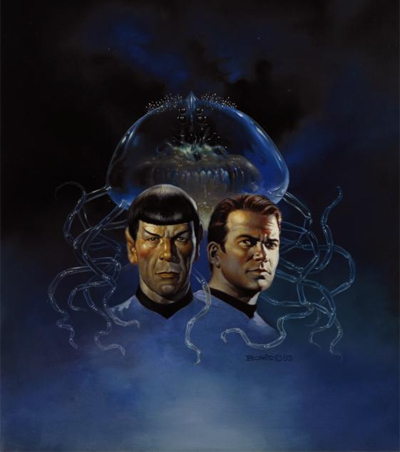
Gene L. Coon’s last solo script for Star Trek, Metamorphosis is an intriguing episode that seems trapped between two extremes.

A love story operating within the unique confines of the Star Trek universe, it is nominally a story about how love can take just about any form. Here, it’s a story between a lonely old man and sentient cloud of sparkles. However, at the same time, Metamorphosis is aggressively and actively heteronormative – suggesting that while it may be acceptable for a man to fall in love with a non-corporeal entity, that alien has to be female.

All your Cochranes are belong to us...

That “in love” glow…

Continue reading

Star Trek IV: The Voyage Home by Vonda N. McIntyre (Review)

This June, we’re taking a look at some classic Star Trek movie tie-ins. Check back daily for the latest reviews and retrospectives.

Comedy doesn’t always translate well between different media. That’s not to suggest that comedy works better in one medium as compared to others, merely to contend that certain forms of comedy don’t translate perfectly between different media. It works any number of ways. Something that is funny in sound and vision is not necessarily hilarious in prose. Gags relying on delivery might play better with a seasoned performer than in the mind’s eye of a reader. Witty prose doesn’t always lend itself to narration or articulation on film.

Much of Star Trek IV: The Voyager Home plays as broad farce, following a bunch of time-travelers from the future (and refugees from television land) as they try to interact with the real world. The movie does have some wonderful character moments – notably Spock’s character arc that beautifully brings him a full circle and Kirk’s relationship with Spock – but it also plays the Star Trek ensemble in a highly caricatured manner, more as archetypes than fully-realised three-dimensional characters.

This is grand. After all, these are fictional characters rather than real people. After all stories are more than just excerpts from the biographies of fictional characters. While it’s nice to have consistent characterisation, suggesting that you can’t have Kirk and Spock acting in an exaggerated fashion for the sake of comedy is a very narrow and restrictive view of what Star Trek is or should be.

The Voyage Home gets the big character beats right – Spock’s insistence that the crew rescue Chekov, Kirk convincing Gillian to trust him, Spock “guessing” – that we can excuse the crew’s lack of awareness about a time period they have visited before and the general flippancy of the movie itself. The novelisation, however, is another matter. Vonda N. McIntyre clearly cares a great deal about the characters. That was one of the strengths of her work on the novelisations of the last two films. Here, however, McIntyre struggles to balance that with the tone of the story.

startrekiv Continue reading

Star Trek III: The Search for Spock (DC Comics, 1984) (Review)

This June, we’re taking a look at some classic Star Trek movie tie-ins. Check back daily for the latest reviews and retrospectives.

In 1984, DC secured the license to print Star Trek comics. They retained the license into the nineties, allowing the publisher to release their own comic book adaptations of each of the four remaining classic Star Trek movies. They even got to publish an adaptation of Star Trek: Generations before the rights transferred to Marvel. Mike W. Barr and Tom Sutton got to produce 64-page adaptations of Star Trek III: The Search for Spock and Star Trek IV: The Voyage Home, lending some consistency to the last two instalments in the trilogy that began with Star Trek II: The Wrath of Khan.

While its impressive visuals and relaxed pacing meant that Star Trek: The Motion Picture leant itself to a comic book adaptation, The Search for Spock is not quite as nice a fit for the medium. The movie’s plot is quite complicated, with lots of things going on at different times with different characters in different locations. One of the joys of the film is the way that it tries to turn Star Trek into an ensemble piece in Spock’s absence, with each of the main characters getting a moment in the sun during the Enterprise jailbreak. The comic simply doesn’t have the space to do this, and the result is an adaptation feels a little compressed.

At the same time, though, writer Mike W. Barr does get to showcase his love of the franchise, and his deft technical skill.

Let's see what's out there...

Let’s see what’s out there…

Continue reading

Star Trek: The Next Generation (DC Comics, 1989) #47-50 – The Worst of Both Worlds (Review)

This November and December, we’ll be finishing up our look at the second season of Star Trek: The Next Generation and moving on to the third year of the show, both recently and lovingly remastered for high definition. Check back daily for the latest review.

We’ll be supplementing our coverage of the episodes with some additional materials – mainly novels and comics and films. This is one such entry.

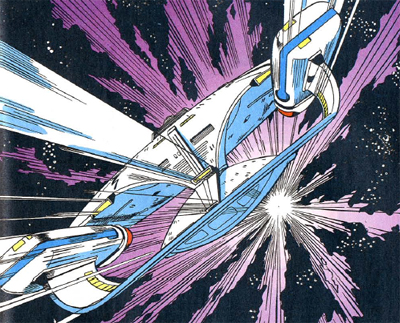
The Worst of Both Worlds, as the name implies, is an excuse to revisit one of the pivotal moments of Star Trek: The Next Generation. (Go on, guess which one!) Unfortunately, it’s not quite up to the task – a failing down to both to the scripts from Michael Jan Friedman and the artwork from Peter Krause. It winds up feeling like an interesting idea, given a rather lackluster execution, working best as a study of the impact that the show’s third season cliffhanger had on the franchise.

A time warp...

A time warp…

Continue reading

Star Trek: The Next Generation – Sarek (Review)

This January and February, we’ll be finishing up our look at the second season of Star Trek: The Next Generation and moving on to the third year of the show, both recently and lovingly remastered for high definition. Check back daily for the latest review.

Sarek is a rather wonderful episode of Star Trek: The Next Generation. It’s a celebration of the franchise’s history, but without being overwhelmed by the weight of continuity. It’s also a heart-breaking story about an old man coming to terms with his mortality, assessing the legacy that he leaves behind and the future he had hoped to shape. The beauty of Sarek, then, is the way that the episode ties these two threads together – offering a rather touching metaphorical exploration of Gene Roddenberry’s own influence on the franchise and his own deteriorating health.

Back to the future...

Back to the future…

Continue reading

Star Trek – Sarek by A.C. Crispin (Review)

This January and February, we’ll be finishing up our look at the second season of Star Trek: The Next Generation and moving on to the third year of the show, both recently and lovingly remastered for high definition. Check back daily for the latest review.

We’ll be supplementing our coverage of the episodes with some additional materials – mainly novels and comics and films. This is one such entry.

One of the more interesting things about the expanded Star Trek universe is the diversity. It is possible for supporting characters and guest stars to carry their own narratives and stories within the grand sweeping tapestry of the Star Trek universe. Despite his importance to the mythos, Mark Lenard’s Sarek only made a handful of appearances across the history of the franchise. He only appeared once in the entire classic Star Trek television show, in Journey to Babel.

It is a testament to Mark Lenard’s dramatic abilities and D.C. Fontana’s writing that Sarek would recur across Star Trek: The Animated Series, Star Trek: The Next Generation and even the original Star Trek movies. The character – despite only appearing in a supporting role across four televised episodes and four feature films – remains one of the most intriguing supporting characters across the franchise.

A.C. Crispin’s Sarek offers a fascinating glimpse at one of the show’s most compelling guest stars, even if the novel does suffer a bit trying to “fix” some of the problems that the author seems to see in Star Trek VI: The Undiscovered Country.

tos-sarek

Continue reading

Star Trek: The Lost Era – Well of Souls by Ilsa J. Bick (Review)

This November and December, we’ll be finishing up our look at the second season of Star Trek: The Next Generation and moving on to the third year of the show, both recently and lovingly remastered for high definition. Check back daily for the latest review.

We’ll be supplementing our coverage of the episodes with some additional materials – mainly novels and comics and films. This is one such entry.

Well of Souls is a story of the Enterprise-C, the ship introduced in Yesterday’s Enterprise. One of the best-received episodes in the history of Star Trek: The Next GenerationYesterday’s Enterprise established Rachel Garrett’s ship as the troubled Enterprise, the tragic flagship, the doomed space craft. Ilsa J. Bick builds on that characterisation in Well of Souls, one small story from some point in Garrett’s command of the Federation flagship.

While Well of Souls feels like a rather unconventional Star Trek novel, it is charming in its own way. Bick connects her tale to the themes of Well of Souls, suggesting a troubled ship manned by a struggling crew. The novel returns time and again to the theme of unfortunate choices, the weight of making the best decision of the options open. Unlike Kirk or Picard, Bick seems to suggest, this version of the iconic starship doesn’t get that many lucky breaks, with her crew repeatedly forced to accept the least bad of a selection of unappetising choices.

Well of Souls is  a thoughtful, introspective piece. It doesn’t flow or pace itself as well as it might, but Bick crafts a compelling picture the never-the-less. While not quite the best of the Lost Era tie-in novels, it’s ambitious and insightful. It lacks the energy of Serpents Among the Ruins or The Art of the Impossible, but it’s still a very worthy read for anybody looking to sketch out a gap in the Star Trek mythos.
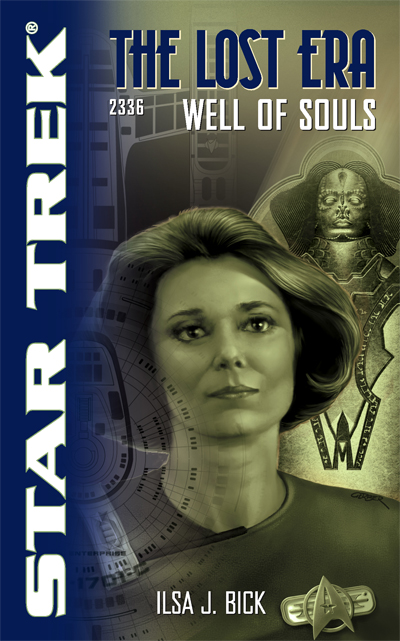
tng-wellofsouls

Continue reading

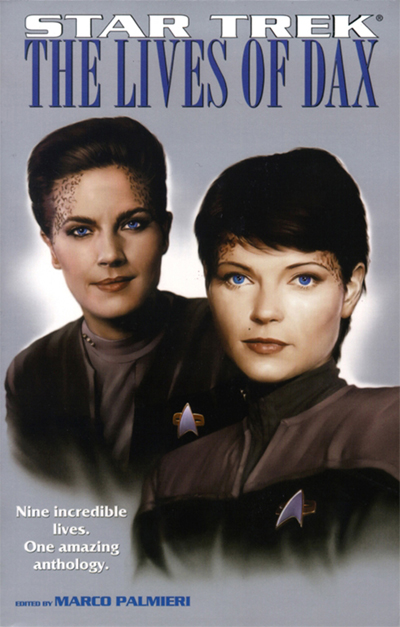
Star Trek: Deep Space Nine – The Lives of Dax: Sins of the Mother (Audrid) by S.D. Perry (Review)

This January and February, we’ll be finishing up our look at the second season of Star Trek: The Next Generation and moving on to the third year of the show, both recently and lovingly remastered for high definition. Check back daily for the latest review.

We’ll be supplementing our coverage of the episodes with some additional materials – mainly novels and comics and films. This is one such entry. This is actually supplementary to the first season of the Next Generation, specifically the episode Conspiracy.

The Star Trek: Deep Space Nine relaunch was the first truly successful attempt to continue a Star Trek television show past its final episode. Of course, there had been novels written before taking place after the finalés of the various shows, but the Deep Space Nine relaunch was the first conscious attempt to directly build upon the events of the series and structure the novels as something of an “eighth season” to the show. If I get through the seven years of Deep Space Nine, I am seriously considering covering the novels.

What’s interesting is that the novels didn’t quite come to be in an instant and decisive sort of way. There was a hazy grey period where books were published after What You Leave Behind, but not necessarily structured as part of that “eighth season.” Two of those books, The Lives of Dax and A Stitch in Time were retroactively welcomed into the relaunch. Indeed, this short story from S.D. Perry proves to pretty essential to the relaunch as a whole.

Like Deep Space Nine itself, the novels picked up and developed on particular themes and plot threads. The entrance of Bajor into the Federation is the most obvious, a plot point set up in Emissary and never completely resolved in the show. However, one particular plot thread seems to have emerged from out of nowhere, stretching back to an aborted arc from the very season of the second generation of Star Trek television shows. The relaunch built heavily on Conspiracy.

ds9-thelivesofdax1

Continue reading

Star Trek – The Wounded Sky by Diane Duane (Review)

This January and February, we’ll be finishing up our look at the second season of Star Trek: The Next Generation and moving on to the third year of the show, both recently and lovingly remastered for high definition. Check back daily for the latest review.

We’ll be supplementing our coverage of the episodes with some additional materials – mainly novels and comics and films. This is one such entry. This is actually supplementary to the first season of the Next Generation, specifically the episode Where No One Has Gone Before.

Diane Duane remains one of the most influential Star Trek tie-in writers ever to work on the franchise. She has been involved in publishing tie-in books pretty consistently since the early days of the publishing line. The Wounded Sky, her first tie-in novel, was lucky number thirteen in the “Pocket TOS” range, published in 1983. Her most recent tie-in novel, The Empty Chair, was published in 2006. As well as a distinguished career outside of Star Trek, she has written novels and comics for the franchise. She even has a television credit, for her work on the teleplay for Where No One Has Gone Before.

There’s a reason that Duane’s contributions to Star Trek fiction are held in such a high regard, and those reasons are quite clear on reading The Wounded Sky. It’s a beautiful and thoughtful piece of prose set within the Star Trek universe, one more concerned with continuing and advancing the spirit of exploration established in the television show than meddling in continuity minutiae or offering generic adventures starring James Tiberius Kirk.

It’s a whole-hearted recommendation for any fan of the original series.

tos-thewoundedsky

Continue reading

Star Trek: The Next Generation (DC) Annual #2 – Thin Ice (Review)

This January and February, we’ll be finishing up our look at the second season of Star Trek: The Next Generation and moving on to the third year of the show, both recently and lovingly remastered for high definition. Check back daily for the latest review.

We’ll be supplementing our coverage of the episodes with some additional materials – mainly novels and comics and films. This is one such entry.

Riker is a character caught between a rock and a hard place. According to the series bible, Riker was imagined as one of the “dual lead characters” for the show and clearly envisioned as an impulsive and brilliant Kirk to Picard’s more rational and stoic Spock. However, it didn’t quite work out that way, for a number of reasons. For one thing, the writing on the early years of Star Trek: The Next Generation tended to be a bit more sterile and bland, so Riker was never really allowed to step too far out of Picard’s shadow.

Instead, we got lots of characters talking about how ambitious Riker was, without seeing it for ourselves. It’s implied that Riker’s career led him to separate from Troi, something Peter David ran with in Imzadi. Everybody is constantly telling everybody else how Riker desperately wants to be a starship commander. And yet, when it come to the actual characterisation of Riker on the show, none of this shines through.

Due to the constraints imposed on the early years, interpersonal conflict was impossible in early Next Generation scripts, putting Riker in a paradoxical position as a character. We’re repeatedly told how ambitious and career-orientated he is, but none of that shines through.

Dead space...

Dead space…

Continue reading