• Following Us

  • Categories

  • Check out the Archives


  • Awards & Nominations

Star Trek: Deep Space Nine – Hippocratic Oath (Review)

This February and March, we’re taking a look at the 1995 to 1996 season of Star Trek, including Star Trek: Deep Space Nine and Star Trek: Voyager. Check back daily Tuesday through Friday for the latest review.

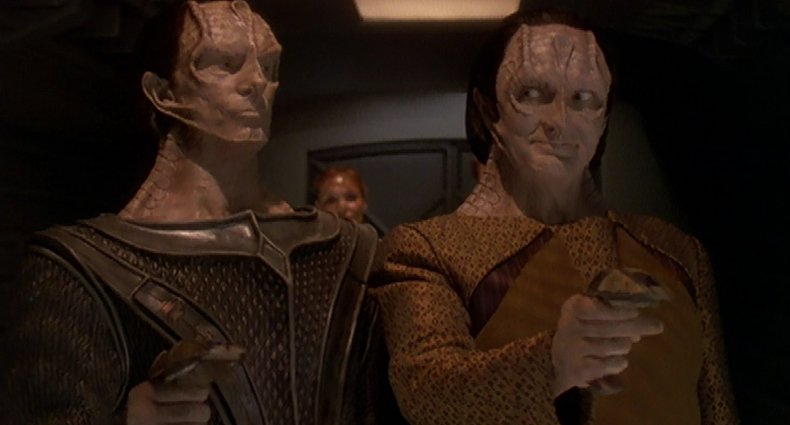
Hippocratic Oath represents a return to normality for Star Trek: Deep Space Nine. The Way of the Warrior was a feature-length war epic tasked with introducing a new regular character and a new status quo, while The Visitor was an intimate character study that stood quite apart from the show around it. With Hippocratic Oath, the show gets back to business as usual. It even has a classic a-story/b-story split with Bashir and O’Brien’s Gamma Quadrant hijinx juxtaposed with Worf learning his place on the station (and the show).

This is not to suggest that Hippocratic Oath is a bland hour of Star Trek. Indeed, it is a tightly-constructed story that hits on some of the show’s core themes and most interesting dynamics. One of the problems with the third season of Deep Space Nine was the fact that it had a strong start but no idea on how to build from that. Hippocratic Oath seems to serve very much as a “business as usual” episode of the fourth season, helping to set a baseline of quality of the show going forward.

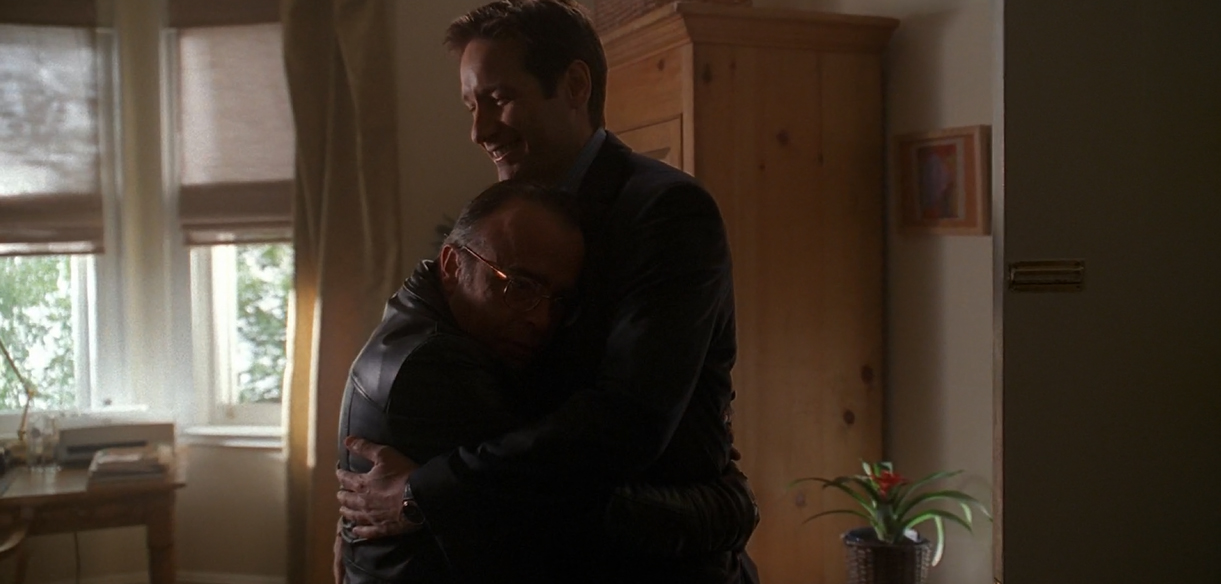
Awkward bromantic moment...

Awkward bromantic moment…

Continue reading

Star Trek: Deep Space Nine – The Way of the Warrior (Review)

This February and March, we’re taking a look at the 1995 to 1996 season of Star Trek, including Star Trek: Deep Space Nine and Star Trek: Voyager. Check back daily Tuesday through Friday for the latest review.

The third season of Star Trek: Deep Space Nine was really just a dress rehearsal for what lay ahead.

The third season had been a tumultuous time for the show, with Michael Piller departing the franchise to pursue opportunities outside Star Trek. It was the year directly after the end of Star Trek: The Next Generation, and all attention was focused on the pending release of Star Trek: Generations and the launch of Star Trek: Voyager. On top of that, the third season suffered from a great deal of confusion and disorganisation throughout the year, making it very hard for the production team to set an end goal for themselves.

"This could be the start of a beautiful friendship..."

“This could be the start of a beautiful friendship…”

In fact, the third season of Deep Space Nine was such a mess that the production team had not even managed to hit the end of season cliffhanger that they wanted. The Adversary had been drafted at the last possible minute when the studio vetoed the idea of ending the year with a Vulcan withdrawal from the Federation. This is not to discount the long list of impressive episodes produced during the season, but it does illustrate that the third season of Deep Space Nine had not progressed according to plan.

At the same time, it was a vital learning experience for the show. It provided a clear framework for what followed, providing producer Ira Steven Behr with a foundation from which he would build the rest of the run. The work put in during the third season would pay dividends in the fourth and fifth seasons, as the show began to play with and pay off ideas that had been carefully and meticulously established during that most chaotic of seasons. In fact, the show begins paying off those dividends with The Way of the Warrior, the first episode of the fourth season.

Klingons woz 'ere...

Klingons woz ‘ere…

Continue reading

The X-Files 102: Ten “Mythology” Episodes

Next week sees the release of The X-Files on blu ray for the first time, just over a month before the new six-episode series premieres on Fox in January. We’re running daily reviews of the show (and its spin-offs) between now and the end of the year, but we thought it might be worth compiling some guides for newer viewers who are looking to experience the length and breadth of what The X-Files has to offer. Every day this week, we’ll be publishing one quick list of recommended episodes every day, that should offer a good place to start for those looking to dive into the show.

There is no getting around the shadow of the “mythology”, the serialised central narrative of The X-Files which explored a sinister conspiracy between the United States government and alien forces building towards a sinister end. While the show was on the air, the mythology was a focal point for discussion and debate around the show, with many viewers speculating about the particulars of the allegiance between the shadowy syndicate and the mysterious visitors from outer space. It was one of the boldest and most distinctive features of the show.

xfiles-oneson4

Continue reading

Jessica Jones – AKA Crush Syndrome (Review)

The biggest problems with the first season of Jessica Jones are structural in nature.

Writing a season of television is tough. It is particularly tough when the season is heavily serialised, requiring the production team to break the story down into a distinct number of easily digestible chunks. It is especially tough when the season is going to be released all at once for public consumption, allowing the audience to watch as many episodes as they want as frequently as they want. Is a thirteen-episode drama released all at once effectively just a twelve-hour movie with conveniently timed bathroom breaks? Or is it the same as any other drama?

jessicajones-akacrushsyndromea

Jessica Jones struggles with this. It begins struggling with it quite early and continues struggling with it until the final couple of episodes. There is a sense that the production team are not entirely sure what the ideal mode of consumption is for Jessica Jones. Is the show supposed to gulped down in three or four marathon sessions, or is it meant to be savoured over a longer period of time? Do the episodes need to stand on their own or should they flow together? Do the team have to worry about repeating certain story beats (“capture and escape”) too close together?

Jessica Jones never quite answers this. The show has a strong enough cast of actors playing an interesting enough selection of characters that it is easy enough to forgive these problems. The world feels well-formed and the immediate story beats are generally interesting enough that the show never drags or feels repetitive. However, it does occasionally wander down certain storytelling dead ends. AKA Crush Syndrome and AKA It’s Called Whiskey take the show down its first such narrative cul de sac.

jessicajones-akacrushsyndrome20a

Continue reading

The X-Files – Three Words (Review)

This October/November, we’re taking a trip back in time to review the eighth season of The X-Files and the first (and only) season of The Lone Gunmen.

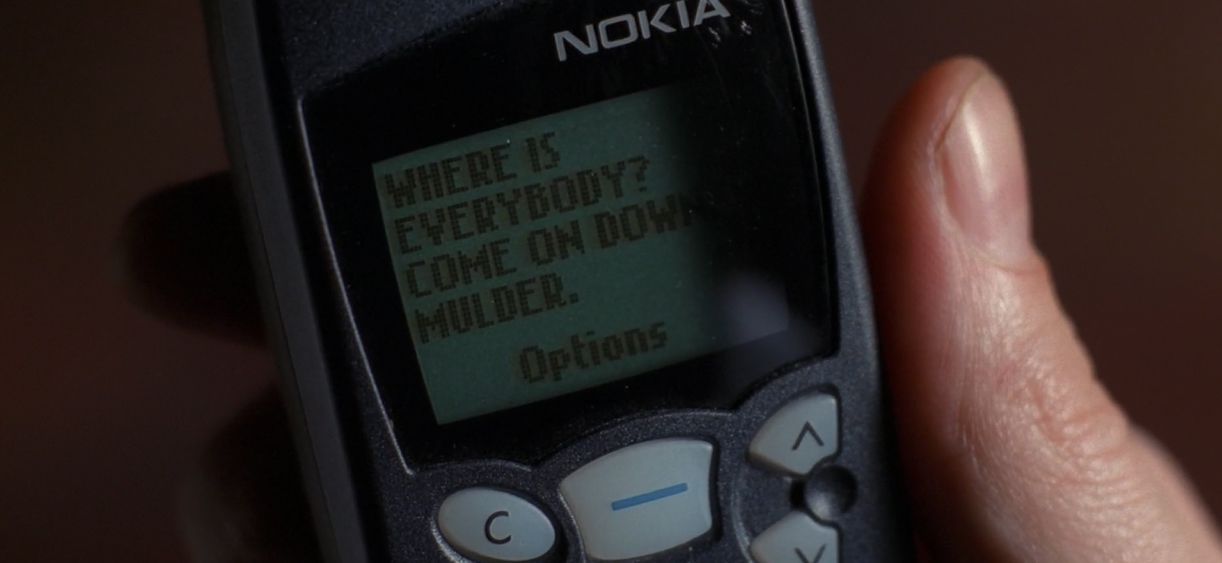
There is no “to be continued…” explicitly linking DeadAlive to Three Words, but there doesn’t have to be.

In this final stretch of the eighth season, The X-Files adapts a somewhat serialised narrative model. Although stories like Empedocles and Vienen technically serve as “monster of the week” stories that stand alone, they feel very particular to this moment in the show’s history. Mulder’s return to the land of the living in DeadAlive does not mark a return to the status quo, despite his best efforts. Instead, it creates a highly volatile (and, by its nature, transitory) set-up that cannot be maintained over an extended period.

Howard Salt was willing to go to any lengths to return the President's copy of The X-Files film.

Howard Salt was willing to go to any lengths to return the President’s copy of The X-Files film.

This is not a sustainable status quo. This is not “business as usual.” This is not what the ninth season will look like. This is not like those other changes to the status quo that occurred at the start of the second and sixth seasons, when Mulder and Scully were taken off the X-files but continued to investigate cases that were X-files in all but name. Episodes like Blood or How the Ghosts Stole Christmas could be transitioned into a regular season order with a minimum of changes, but these episodes all feel uniquely tailored to this point in the show’s history.

As such, the end of the eighth season takes on a loosely serialised quality, and not just in the story of the new mythology or the so-called “super soldiers.” The character dynamics evolve and grow, with the individual episodes seeding character development leading the season finalé. Episodes like Three Words and Vienen make it increasingly clear that Mulder is not back in an permanent sense by first pushing him away from the X-files and then firing him from the FBI. Scully’s pregnancy is actually allowed to progress at this point in the season.

He's back!

He’s back!

This serialisation is apparent in the discrepancies between the production and broadcast order. As with extended sections of the fourth season, the final stretch of the eighth season was produced in a different order than it was broadcast. Unlike the fourth season, however, this shift does not create any dissonance as significant as the conflict between the version of Never Again that was filmed and the one that was broadcast. Despite being produced in a different order, these stories could not work in any order other than the broadcast order.

Although The X-Files frequently gets credit for pioneering and popularising (or, at the very least, re-popularising) serialised narratives on prime-time television, the final stretch of the eighth season is perhaps the serialised stretch of the entire nine-year run.

A touching reunion...

A touching reunion…

Continue reading

Star Trek: Enterprise – Season 3 (Review)

Next year, Star Trek is fifty years old. We have some special stuff planned for that, but – in the meantime – we’re reviewing all of Star Trek: Enterprise this year as something of a prequel to that anniversary. This August, we’re doing the third season. Check back daily for the latest review.

The third season of Star Trek: Enterprise is a mess.

It is very clearly the work of a production team still figuring out how to plot long-form stories and struggling with the logistical difficulties of mapping out a single narrative across what was originally planned as a twenty-six episode season. There are extended periods where narrative momentum stalls; there are key moments where it seems like the show has no idea where it wants to go next. It seems like the production team never sat down in the gap before production began to figure out what story they wanted to tell, and ended up improvising.

ent-e2f1

However, it is also a bold and ambitious piece of television. It demonstrates an energy and excitement that had been lacking from the Star Trek franchise since Star Trek: Deep Space Nine went off the air. It is a season of television that doesn’t always work, but that is to be expected when the production team are trying something new. The failures of the first two seasons of the show often stemmed from a lack of ambition on the part of the production team; the failures in the third season are rooted in a surplus of ambition. It is hard to find them too objectionable.

The Xindi arc doesn’t always work as well as it might, but it works more than often enough to excuse the clumsy missteps along the way. There is something compelling and dynamic about a Star Trek show that is willing to push itself so far outside its own comfort zone. There is a spirit of adventure to the third season of Enterprise that had been sorely lacking from the first two seasons of the show. The biggest disappointment is that it took the show this long to find that confidence and that adventurousness.

ent-thexindi25 Continue reading

Star Trek: Enterprise – Azati Prime (Review)

Next year, Star Trek is fifty years old. We have some special stuff planned for that, but – in the meantime – we’re reviewing all of Star Trek: Enterprise this year as something of a prequel to that anniversary. This August, we’re doing the third season. Check back daily for the latest review.

If you can end on a high note, the audience will forgive a lot.

The third season of Star Trek: Enterprise is one of the boldest and most ambitious seasons of Star Trek ever produced; it is certainly the most adventurous season of the franchise to air outside of Star Trek: Deep Space Nine. However, on an episode-to-episode basis, the quality is quite variable. There are great episodes (Impulse, Twilight), underrated episodes (North Star, Exile), fun episodes (Stratagem), and experimental episodes (Harbinger), but there are also a lot of episodes that are more interesting in theory than in practice.

Explosive finalé...

Explosive finalé…

It becomes increasingly obvious over the course of the season that the writing staff did not plan the year-long arc far enough in advance and that the show struggles to figure out where it wants to go after the initial burst of speed wears off. There are even a couple of outright stinkers that rank with the worst that the franchise ever produced. However, there is a lot to be said for an ending. The third season of Enterprise hits a few speed bumps along the way, but it manages to rally for an impressive and largely satisfying conclusion.

Azati Prime begins the march towards the end of the season. It was the first episode to be filmed after the Christmas break, suggesting that it was the work of a revitalised writing staff and an energised production team. More than that, it was broadcast as the last episode before a six-week break in the broadcast schedule, suggesting that everybody involved knew exactly the kind of hit that they had on their hands. It injects an incredible energy into a show that might be racing towards its own apocalypse.

Future's end...

Future’s end…

Continue reading

Star Trek: Enterprise – Proving Ground (Review)

Next year, Star Trek is fifty years old. We have some special stuff planned for that, but – in the meantime – we’re reviewing all of Star Trek: Enterprise this year as something of a prequel to that anniversary. This August, we’re doing the third season. Check back daily for the latest review.

Proving Ground is an odd episode to sit in the middle of the third season’s larger arc involving the Xindi and the threat against Earth.

In a very real sense, it is more serialised than a lot of the episodes leading up to it. The episode even opens with a fairly sweeping “previously…” section that is sure to include a lot of nice action shots from the first half of the year. Proving Ground contributes more to the arc than anything like Carpenter Street or Chosen Realm, featuring the testing of the Xindi weapon. It also features the Andorians, suggesting that Star Trek: Enterprise has not completely divorced itself from its original place in the Star Trek canon.

Drinking away the blues...

Drinking away the blues…

At the same time, the episode is also very episodic. Shran makes a very quick cameo in Zero Hour, but this is the extent to which the Andorians are involved in the larger plot of the third season. Much like the second season, there is a sense that Shran has been slotted into “the obligatory Andorian episode” as a way to fill a production slot in a chaotic season. The sense of weight and impact of the episode is relatively minimal, like Cease Fire before it. The conclusion seems to be that Shran might be a nice guy underneath it all. It’s hardly shocking.

More than that, the structure and plot of the episode can’t help but emphasise some of the more misguided creative decisions of the third season, with Proving Ground introducing a bunch of clever (and exciting concepts) into the arc only to take them right away at the end. The fact that Proving Ground is so fun and enjoyable is almost a detriment, inviting the audience to wonder whether some of that love and affection might have been distributed across the season.

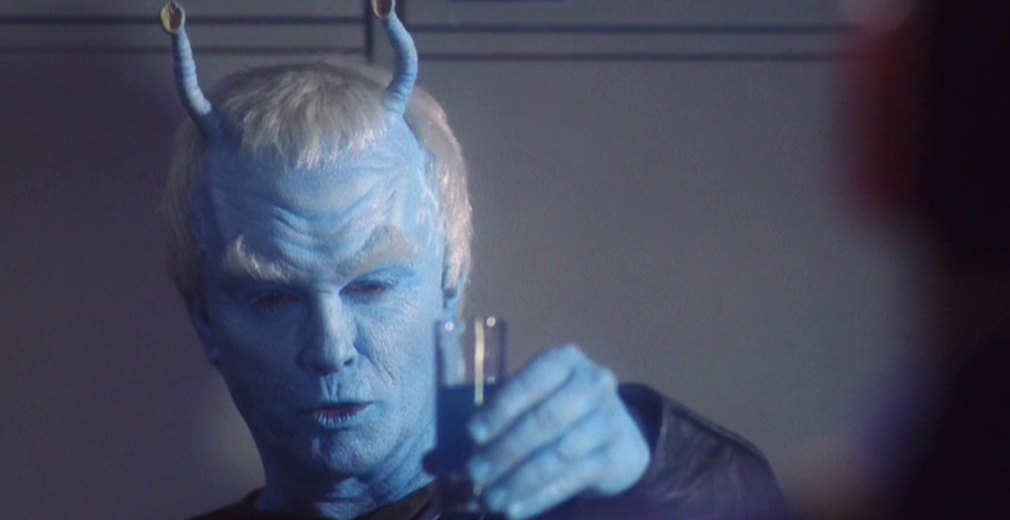
Look who just blue in...

Look who just blue in…

Continue reading

The X-Files – Dreamland I (Review)

This July, we’re taking a trip back in time to review the sixth season of The X-Files and the third (and final) season of Millennium.

It occasionally seems like the sixth season of The X-Files is having something approaching a midlife crisis.

It has gone through a fairly massive change in routine and lifestyle; the show recently pulled up sticks and moved to Los Angeles. It has gotten a lot more ostentatious; it looks to be spending a lot more money than it was before, and it is hanging around with a whole new caliber of guest star. It has reinvented itself completely; no longer the brooding and atmospheric show it once was, it is now downright goofy and silly. Old acquaintances would be forgiven if they had trouble recognising the show. And it’s perfectly understandable.

Back to back...

Back to back…

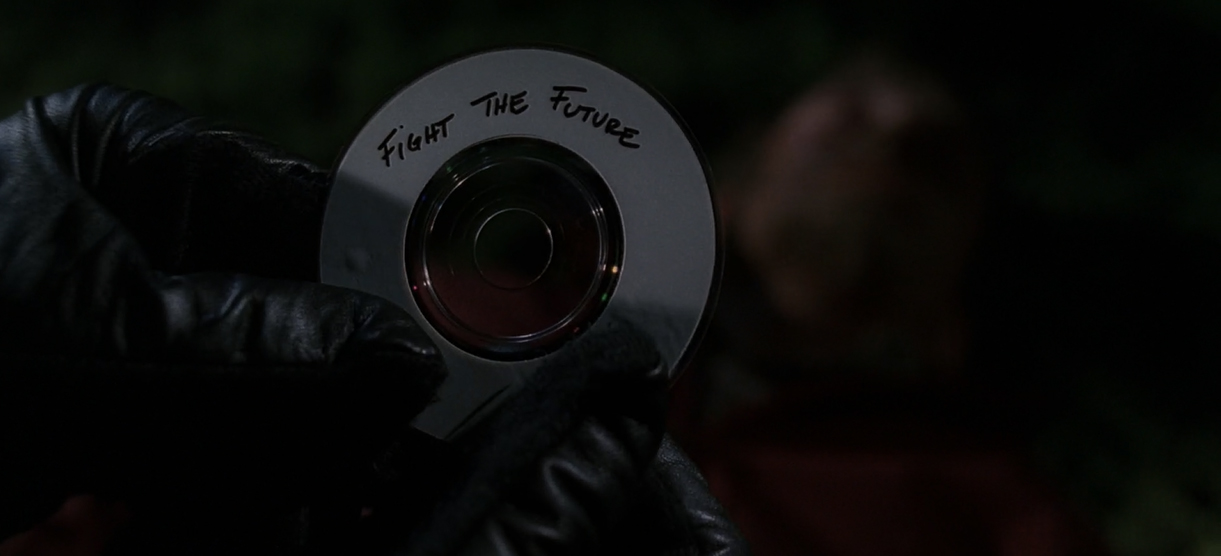
This is the sixth season. Dreamland I is the one-hundred-and-twenty-first episode of The X-Files. The show is well past what Chris Carter had originally planned, and well past just about any measure of success. Most shows are lucky to reach a sixth season, let alone come into the sixth season off the back of a summer film and with a great deal of security about the future. David Duchovny, Gillian Anderson and Chris Carter were all committed through to the end of the seventh season. There was even talk of a sequel to The X-Files: Fight the Future being released in 2000.

Dreamland I and Dreamland II just externalise that midlife crisis, using the classic “freaky friday” body swap set up putting Fox Mulder in a dead-end job with a family that hates him as Morris Fletcher tries to help the FBI agent grow up just a little bit.

"Yep. It's a little... out there."

“Yep. It’s a little… out there.”

Continue reading

Star Trek: Enterprise – Season 2 (Review)

Next year, Star Trek is fifty years old. We have some special stuff planned for that, but – in the meantime – we’re reviewing all of Star Trek: Enterprise this year as something of a prequel to that anniversary. This April, we’re doing the second season. Check back daily for the latest review.

The second season of Star Trek: Enterprise is a strange beast, breaking down into roughly three sections.

The first section runs from Shockwave, Part II through to A Night in Sickbay. There is a nice energy to these episodes, with the first appearance of the Romulans in Minefield and nice internal continuity between otherwise stand-alone adventures like Minefield and Dead Stop. Carbon Creek is a fun diversion and A Night in Sickbay at least tries to do something novel and exciting – even if the show can’t quite pull it off. This stretch of the season feels like an organic development from the first season, a collection of episodes of variable quality; balancing the desire to try new things with nods to the franchise’s strengths.

ent-theexpanse9

The final stretch runs from Judgment to The Expanse. The third season looms large over these episodes, with a sense of impending change in the air. These episodes seem to bid farewell to a version of Star Trek that has existed since the third season of Star Trek: The Next Generation. Judgment gives the Klingons one last epic story, Regeneration checks in on the Borg. The Breach offers a traditional Star Trek morality play, while Cogenitor brutally subverts it. Even episodes like Horizon and First Flight call back to the earliest episodes of Enterprise, as if to offer one last reflection on what might have been.

However, the second season is dominated by a long middle stretch – episodes running from Marauders through to The Crossing. While episodes like Future Tense provide an occasional reprieve, this middle stretch of the season is workmanlike and functional. This is the first two seasons of Enterprise as they are often dismissed: a lite version of Star Trek: Voyager in the same way that Star Trek: Voyager is a lite version of Star Trek: The Next Generation. In that long and dull middle stretch, it feels like the writing staff might as well be blowing dust off of scripts written for the seventh season of The Next Generation.

ent-shockwavepart2o

Unfortunately, while the first and third sections of the season have a lot to recommend them, it is the middle stretch that sets the mood for the season. The second season of Enterprise has more than a couple genuine stinkers – Precious Cargo, The Crossing and Bounty come to mind – but the season never hits the sustained lows of the third season of Star Trek, the first and second seasons of The Next Generation or the second season of Voyager. However, there is long string of episodes that are just dull and uninspired; formulaic and familiar.

In that extended run in the middle of the season, there are episodes that can be easily reduced to “[earlier episode or pop culture reference] by way of [earlier episode or pop culture reference]” without missing anything much. Marauders is The Magnificent Seven by way of Star Trek”, The Communicator is A Piece of the Action by way of First Contact”, Singularity is “Bliss by the way of The Game”, Vanishing Point is “Realm of Fear by way of Remember Me”, Precious Cargo is “Elaan of Troyius by way of The Perfect Mate”, Dawn is The Enemy by way of Darmok.” And so on.

ent-futuretense16

The result is a second season that is exhausting and draining. Watching it on original broadcast was a disheartening experience; each week seemed to bring more of the same. The long stretch from the end of October to the start of April was unforgiving; each week seemed to offer more evidence that Star Trek was tired and played out, a franchise disengaged from not only the world around it but also from the changing rules of its own medium. Coupled with the spectacular (but entirely foreseeable) failure of Star Trek: Nemesis, the second season of Enterprise seemed to seal the franchise’s fate.

There is a very real tragedy to all this. For all that the tail end of the second season sees a massive up-swing in quality and energy, it is perhaps too little and too late. By the time that Judgment had begun a late-season revitalisation, Rick Berman had already announced a bold new direction for the third season. That last stretch is a lame duck. In a way, the second season of Enterprise plays like a microcosm of the series itself; a dramatic upswing in quality and ambition at a point where fate has already made its decision.

ent-cogenitor

Continue reading