• Following Us

  • Categories

  • Check out the Archives


  • Awards & Nominations

Star Trek: Deep Space Nine – Sons and Daughters (Review)

If A Time to Stand and Rocks and Shoals demonstrate the raw potential and ambition of the sixth season of Star Trek: Deep Space Nine, then Sons and Daughters demonstrate its shortcomings.

The fourth and fifth seasons of Deep Space Nine rank among the very best seasons of Star Trek every produced. These two seasons demonstrated a striking level of consistency. There were undoubtedly terrible episodes, like Shattered Mirror and The Muse in the fourth season or The Assignment and Let He Who Is Without Sin… However, these episodes tended to be quite concentrated. Even other episodes that didn’t quite work, like The Sword of Kahless, Sons of Mogh, A Simple Investigation or Ferengi Love Songs, were more bland than outright bad.
Let me be your father figure...

Let me be your father figure…

The sixth and seventh seasons of Deep Space Nine lack that consistency. They are even more ambitious than the two seasons directly prior, pushing harder in bolder new directions and resulting in brilliant television like Waltz, Far Beyond the Stars, In the Pale Moonlight, Treachery, Faith, and the Great River, The Siege of AR-558, It’s Only a Paper Moon, Chimera, Inter Arma Enim Silent Leges and Tacking Into the Wind. The sixth and seventh seasons of Deep Space Nine were breathtaking and highly enjoyable on their own terms.

In fact, there is a very credible argument for ranking the sixth and seventh seasons of Deep Space Nine among the best seasons of the franchise. They represent the last great narrative leap forward until the third season of Star Trek: Enterprise. These two seasons are driven by a desire to take risks and try new things, to make ambitious gambles knowing that they might not pay off. These are certainly virtues to be encouraged, even without that laundry list of spectacular television.
The lost art of parenting.

The lost art of parenting.

However, with that level of ambition, the sixth and seventh seasons were also much more variable in terms of quality. They contained a lot more misfires than the previous two seasons. This is not just the obvious high-profile failures like Profit and Lace or The Emperor’s New Cloak, but also a lot more episodes that disappoint without hitting quite that level of awfulness; One Little Ship, The Reckoning, Time’s Orphan, Prodigal Daughter, Field of Fire, Extreme Measures. There is a sense that the number of bad episodes increases noticeably.

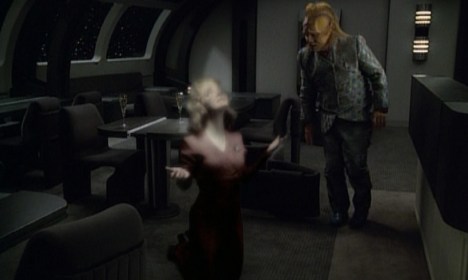
Sons and Daughters is perhaps the first example of this trend. It is an episode that is not soul-destroying terrible, but it simply does not work in the way that it is intended to work. Sons and Daughters is not only the weakest episode of the six-episode opening arc, it is also the first episode to be written by David Weddle and Bradley Thompson as members of the series’ writing staff. The two facts might not be unrelated.
All (Mar)tok tok tok.

All (Mar)tok tok tok.

Continue reading

Star Trek: Deep Space Nine – Rocks and Shoals (Review)

The opening arc of the sixth season of Star Trek: Deep Space Nine is one of the most ambitious storytelling experiments in the history of Star Trek.

To be fair, it is not entirely unique. In some ways, it mirrors the storytelling arc that unfolded across Star Trek II: The Wrath of Khan, Star Trek III: The Search for Spock and Star Trek IV: The Voyage Home. Both Kirk and Sisko are separated from their home and from their first officer and from their iconic command, before eventually finding their way to reunite with both. Obviously, a three-film trilogy is distinct from a six-episode arc, even before talking about the tonal, thematic and plotting differences between those three iconic films.

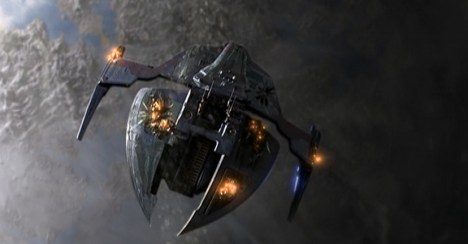
The Jem'Hadar warship that fell to Earth...

The Jem’Hadar warship that fell to Earth…

More than that, the success of the this arc would embolden the production team. They would attempt an even more audacious experiment to close out the seventh season of the series. The sixth season opened with six interconnected stories following the Cardassian reoccupation Terok Nor, building to Sisko’s retaking of the station. The seventh season pushes that even further, with a much more tightly integrated ten-episode arc that attempts to tell a single cohesive story. It is an even bolder creative decision than this arc, committing more strongly to the premise.

Ronald D. Moore’s departure from Star Trek: Voyager early in its sixth season would turn these experiments in serialisation into an evolutionary dead end for the franchise. It would be four years before Rick Berman and Brannon Braga would attempt to a tell a story on that scale. Indeed, faced with declining ratings and the spectre of cancellation, Star Trek: Enterprise attempted what was (on the surface at least) the even more ambitious attempt at a season-long arc across the entirety of the third season.

Winner takes it war...

Between a rock and a hard place.

Still, the six-episode arc that opens the sixth season of Deep Space Nine remains an impressive moment in the history of the franchise. Indeed, contrasted with the sprawling ten-episode arc that closes the series or the season-long arc on Enterprise, it could reasonably be argued that this six-episode stretch does a stronger job of balancing the integrity of individual episodes with the demands of the larger arc. These six episodes are all very strongly connected to one another, with a clear sense of story and character progression, but they also retain their own identities within that.

Rocks and Shoals might be the best example of this, an episode that delicately balances its own storytelling with the needs of the arc as a whole. Rocks and Shoals is at once a great episode in its own right and an essential part of a much larger story.

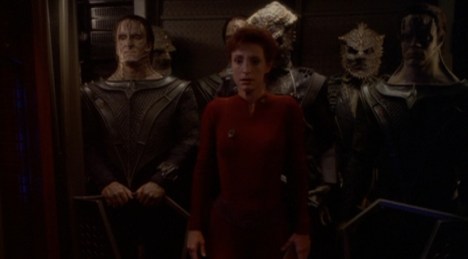
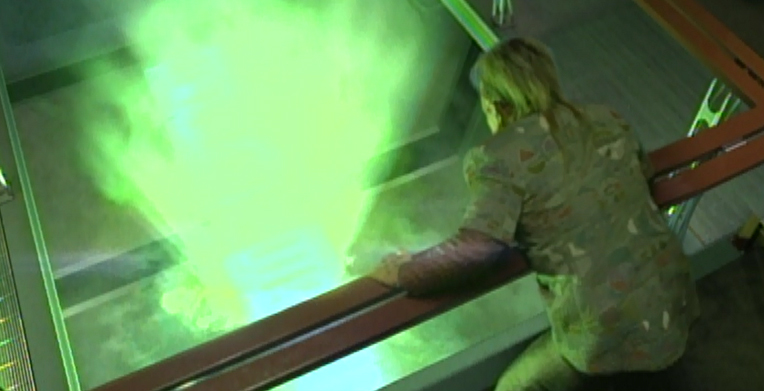
Express elevator to hell.

Express elevator to hell.

Continue reading

Star Trek: Voyager – The Gift (Review)

The Gift belongs to a very particular subgenre of Star Trek episodes.

It is an episode that fits comfortably alongside the other second stories of the other fourth seasons, alongside Family on Star Trek: The Next Generation, The Visitor on Star Trek: Deep Space Nine and Home on Star Trek: Enterprise. It is a relatively quiet and contemplative piece, more rooted in character than plot. In fact, very little of note happens during the episode, even as it is positioned at an important point in the larger run of Star Trek: Voyager following Scorpion, Part I and Scorpion, Part II.

Things come to a head.

Things come to a head.

As with FamilyThe Visitor and HomeThe Gift is a breather episode following a more epic adventure. As with Family and Home, The Gift is explicitly about working through the consequences of earlier episodes. Family allowed Jean-Luc Picard to work through the trauma of The Best of Both Worlds, Part I and The Best of Both Worlds, Part II, while Home provided an opportunity for Jonathan Archer to make sense of everything that happened between The Expanse and Zero Hour. (Let’s not worry too much about Storm Front, Part I and Storm Front, Part II.)

The Gift is an episode of contrasts, driven by the demands of the series rather than its own distinct plot. It is very heavily serialised, playing almost as the third part of Scorpion, Part I and Scorpion, Part II; much like Family played as the third part of The Best of Both Worlds, Part I and The Best of Both Worlds, Part II. However, there is something very cynical in the use of serialisation in The Gift, as the episode rather transparently exists to transition away from where the show was at the end of Scorpion, Part II towards a more sustainable status quo.

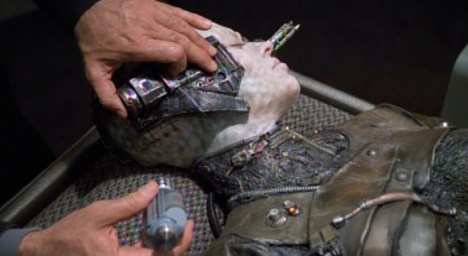
Kes of death to an established character.

Kes of death to an established character.

The Gift is also a tale of arrivals and departures. It is an episode about introducing Seven of Nine to the cast of Voyager, establishing her character arc and setting up her journey across the rest of the series building on her separation from the Borg Collective in Scorpion, Part II. At the same time, it is an episode about the departure of Jennifer Lien from Voyager, bidding farewell to Kes as a result of her exposure to “Fluidic Space” in Scorpion, Part II. There is something quite poetic in that set-up.

However, The Gift is just as much an episode of extremes in terms of quality. The story focusing on Janeway and Seven of Nine is rivetting and compelling, but the thread focusing on Kes plays almost as an afterthought. More than that, the episode’s final act plays as a gigantic cop out, another example of Voyager retreating from some of the bolder ideas in its core concept. The result is a curate’s egg of an episode, a reminder of Voyager‘s discarded potential.

Breakout character.

Breakout character.

Continue reading

Star Trek: Deep Space Nine – Blaze of Glory (Review)

Blaze of Glory is a spectacular piece of television.

It is an episode that serves a very clear plot function in the larger context of Star Trek: Deep Space Nine. It is clearly designed to tidy away some of the dangling loose ends before the show transitions into the Dominion War. Much like Children of Time was really the last “strange Gamma Quadrant phenomenon” episode, Blaze of Glory is the last Maquis episode. It also marks the last appearance of Michael Eddington, a character who has come a long way since his first appearance as the station’s new security officer in The Search, Part I.

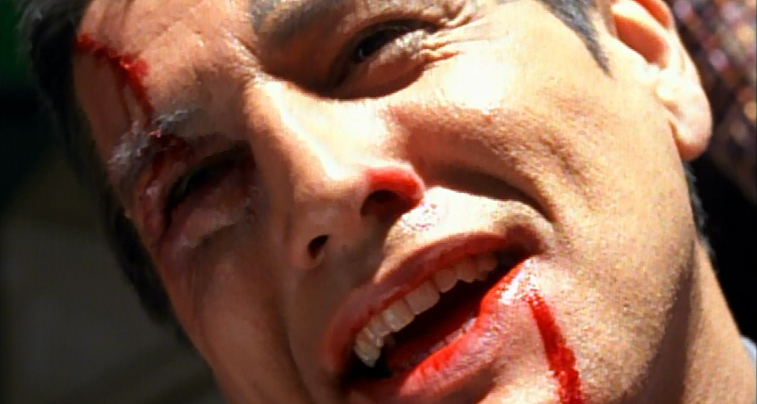
Michael Eddington, Noted Brigand.

Michael Eddington, Noted Brigand.

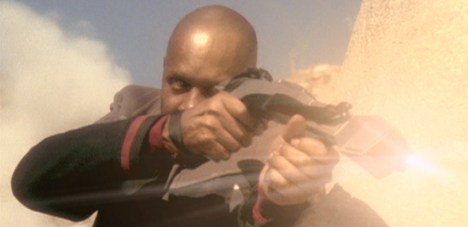
However, even ignoring the fact that Blaze of Glory fulfils these larger obligations in terms of the show’s long-running plot threads, the episode is an engaging and exciting buddy action film that finds Benjamin Sisko paired with one of his most hated adversaries on a dangerous mission into the heart of enemy territory. Ira Steven Behr and Robert Hewitt Wolfe prepare a script laced with wry banter for unlikely action heroes Avery Brooks and Ken Marshall, while Kim Friedman directs the episode as if it were a lost Reagan era Shane Black script.

However, Blaze of Glory also feels very much like Deep Space Nine at its best. It is an episode that celebrates how much these characters can grow and change, while also revelling in the diversity of perspectives that make Deep Space Nine such a compelling show. It is an episode that understands Sisko and Eddington are perhaps more alike than either would concede, but which explores those parallels in a way that never obscures their key differences or their mutual mistrust.

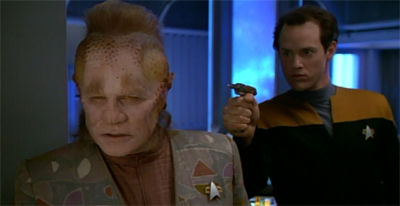
Disarming conversation.

Disarming conversation.

Continue reading

Star Trek: Deep Space Nine – Hard Time (Review)

This February and March, we’re taking a look at the 1995 to 1996 season of Star Trek, including Star Trek: Deep Space Nine and Star Trek: Voyager. Check back daily Tuesday through Friday for the latest review.

Hard Time is a fantastic (and vastly underrated) episode of Star Trek: Deep Space Nine.

The episode tends to get overlooked in discussions about the fourth season of Deep Space Nine, perhaps owing to the high average quality of the season or the fact that it arrives in the middle of what is admittedly the season’s weakest run of episodes. However, in spite of all that, Hard Time is an exemplary piece of Deep Space Nine. It is certainly the best of the series’ “O’Brien must suffer” episodes, and a showcase for Star Trek veteran Colm Meaney. In its exploration of trauma and recovery, and cycles of violence, it taps into the heart of the show.

Not phased in the slightest...

Not phased in the slightest…

That said, Hard Time arrives at a point where Deep Space Nine is nudging closer and closer to serialisation. The show has begun to embrace long-form storytelling, as evidenced by the ripple effect of the changes to the status quo in The Way of the Warrior and the way that little plot threads weave through the season. The show has not yet reached the point at which it can structure six- or ten-episode arcs, but it is getting close. Deep Space Nine is clearly moving towards what is (for Star Trek at least) a fairly novel style of television storytelling.

As such, Hard Time is particularly striking for the fact that it is a purely episodic adventure. The episode puts Miles O’Brien through hell, having him struggle with post-traumatic stress disorder while trying to reintegrate into society. This is the kind of plot that feels more suited to a long-running mini-arc than Worf and Dax’s arguments about the relative merits of bladed weapons or Worf’s decision to move to the Defiant. Instead, O’Brien’s trauma is dealt with over the course of a single episode. Hard Time plays as a defence of the tradition television episode structure.

Growing the beard...

Growing the beard…

Continue reading

Star Trek: Voyager – Investigations (Review)

This February and March, we’re taking a look at the 1995 to 1996 season of Star Trek, including Star Trek: Deep Space Nine and Star Trek: Voyager. Check back daily for the latest review.

Investigations is a misfire. It is a spectacular misfire.

Investigations is the episode that pretty much single-handedly killed any chance of Star Trek: Voyager embracing long-form storytelling once and for all. The first season had enthusiastically embraced an episodic structure, but the second season had played with the idea of playing out an arc across the majority of the season. Tying together the Kazon with the idea of a traitor on Voyager and the redemption of Tom Paris, the production team decided to attempt something relatively novel for Star Trek.

Kill me. Kill me now.

Kill me.
Kill me now.

It is worth stressing just how experimental this kind of story was. Star Trek: Deep Space Nine had played with the idea of serialisation. Threads like the Romulan and Cardassian invasion of the Gamma Quadrant were carefully seeded through episodes like Defiant and Visionary, but there was not the same tension and momentum afforded to the arcs of Michael Jonas and Tom Paris in the second season. The Romulans and the Cardassians were not discussed in every episode leading up to Improbable Cause and The Die is Cast.

At the same time, Deep Space Nine eased into serialisation in a way that allowed for failures and miscalculations that did not publicly humiliate the show. Bajoran politics could be quietly eased into the background when they weren’t quite working, characters like Primmin and T’Rul could be dropped when they weren’t what the show needed. The second season of Voyager was perhaps a bit too bold in its attempts at long-form storytelling, creating a situation where there was no way to pull back from an arc that wasn’t working.

"Well. That escalated quickly."

“Well. That escalated quickly.”

It became quite clear early on that the Paris and Jonas arc was not working. Episodes like Threshold and Dreadnought ground to a halt so that the audience could get yet another scene of Jonas selling out Voyager to the Kazon; treachery that never seemed to actually go anywhere. At the same time, Paris’ rebellious behaviour was tackled in a superficial manner in episodes like Meld and Lifesigns, with no real exploration of the interesting side of such a sting operation.

Investigations serves to bring the arc to a close, but in a manner that feels perfunctory rather than compelling. It is resolved out of a sense of tired desperation rather than any real inspiration. There is a feeling that the production team have determined this to be a failed experiment, of which they will never speak again.

See? I told you EVERYBODY's thought about it.

See? I told you EVERYBODY’s thought about it.

Continue reading

Star Trek: Voyager – Dreadnought (Review)

This February and March, we’re taking a look at the 1995 to 1996 season of Star Trek, including Star Trek: Deep Space Nine and Star Trek: Voyager. Check back daily Tuesday through Friday for the latest review.

Dreadnought is arguably a much better version of Prototype.

Both are essentially horror stories about B’Elanna Torres essentially creating a new mechanical life form, making a decision that has unforeseeable consequences. There is an element of reproductive horror to all this, reinforced by the clever decision to have B’Elanna literally give the eponymous warhead her own voice and watch it engage in a course that is quite literally self-destructive. It is perhaps the quintessential reproductive horror story, the fear that we might create something that will supplant us; that our children become the worst reflections of ourselves.

Engine of mass destruction...

Engine of mass destruction…

It is interesting that Dreadnought followed Meld so closely; both are essentially stories about how Star Trek: Voyager (and its characters) cannot cleanly escape their past, as much as the show might push it (and them) towards a generic Star Trek template. The middle of the second season sees an emphasis on the idea that Voyager is composed of two radically different crews – that Starfleet and the Maquis are not as integrated as shows like Parallax or Learning Curve might suggest.

Alliances, Meld and Dreadnought all build on the idea of underlying tensions that were mostly glossed over during the first season. Of course, this creates a weird dissonance, as Voyager seems to actually be moving backwards rather than forwards – attempting a half-hearted do-over of some of its earliest miscalculations.

Engineering a solution...

Engineering a solution…

Continue reading

Star Trek: Voyager – Alliances (Review)

This September and October, we’re taking a look at the 1995 to 1996 season of Star Trek, including Star Trek: Deep Space Nine and Star Trek: Voyager. Check back daily for the latest review.

One of the more persistent and convincing criticisms of Star Trek: Voyager is the idea that it was very narrative conservative; that the show got comfortable playing out the familiar formula that had been established by Star Trek: The Next Generation, and so never attempted to innovate or experiment in the way that Star Trek: Deep Space Nine (or eventually Star Trek: Enterprise) did. This is a perfectly valid criticism of the show as a whole, but it does ignore some of the weird tensions that played out across the first two seasons.

It is fair to say that Voyager never truly experimented. However, there are several moments in the first two seasons where it looks like the show was considering doing something unique or unprecedented. The show walked up to the edge, looking up and down; it never quite made the leap, but it seemed to weigh the possibility of jumping headlong into uncharted territory. However, it ultimately only dipped its toes in the water before getting cold feet and returning to the comfort of the familiar.

"Everyone liked Godfather III, right?"

“Everyone liked Godfather III, right?”

The sad truth about the second season of Voyager is that the show made a number of attempts to do something different or unique, only to botch each and every one of those attempts so completely that the production team learned not to even try. The second season’s more adventurous creative decisions all ended in humiliation and farce, explaining why the show desperately sought the warm blanket of a familiar format and an established template. After all, it was the more conventional episodes of the second season that had been (relatively) well received.

The second season of Voyager turned the process of trying something moderately ambitious and failing spectacularly into something of an artform. Of course, given the simmering tensions behind the scenes, it often seemed like the show wanted to fail. Michael Piller desperately wanted to do new things, only to meet resistance from his fellow producers and writing staff. Writers like Kenneth Biller would publicly criticise assignments they had been handed, offering a sense of just how much faith the staff had in these ideas.

"You wouldn't like me when I'm angry..."

“You wouldn’t like me when I’m angry…”

Alliances marks perhaps the most ambitious element (and most spectacular failure) of the second season of Voyager. It is the centrepiece of Michael Piller’s attempts to develop the Kazon into a credible (and convincing) alien threat, while also setting up a recurring arc that will allow Piller to push Tom Paris into the role of “lovable rogue” of which Piller was so fond. These were elements that excited Piller a great deal, but left most of the rest of the production team relatively cold.

So there is a great deal of irony in the fact that Alliances is ultimately written by Jeri Taylor, who was increasingly at loggerheads with Piller over the direction of Voyager. In light of that context, it makes sense that Alliances is an episode that aggressively critiques its own existence. Janeway spends most of the episode frustrated at the fact that the story is happening at all, and Alliances builds towards a climax that seems designed to convince the viewer that this whole idea is misconceived on just about every possible level.

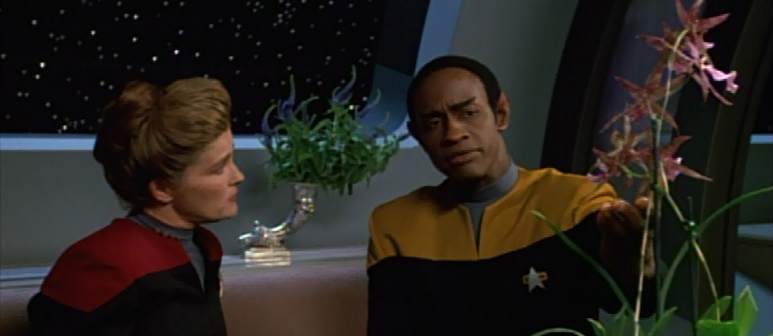
Blooming disaster...

Blooming disaster…

Continue reading

Star Trek: Deep Space Nine – Homefront (Review)

This February and March, we’re taking a look at the 1995 to 1996 season of Star Trek, including Star Trek: Deep Space Nine and Star Trek: Voyager. Check back daily for the latest review.

Homefront and Paradise Lost are a fascinating example of what Star Trek: Deep Space Nine does best, both in terms of theme and storytelling.

In many ways, Homefront and Paradise Lost are among the most culturally relevant episodes produced during the series’ seven-season run. The two-parter speaks to a lot of concerns and anxieties that were part of the public consciousness during the nineties, but exploded in the early years of the twenty-first century. Homefront and Paradise Lost feel more powerful in the era of airport security screenings and extraordinary powers than they did on their original broadcast. These are among the most important episodes the franchise ever produced.

Broken link...

Broken link…

However, the two-parter is also a great example of how the production team on Deep Space Nine approach storytelling. Not just in terms of arc-building and serialisation, but also in terms of structure and pacing. Unlike The Way of the Warrior, which was very clearly a single ninety-minute episode of television, Homefront and Paradise Lost are very clearly structured as two separate episodes of television. It is a subtle distinction, but one which has a significant impact in how the creative team tell their story.

More than that, Homefront and Paradise Lost represent a great example of the strengths of the production team’s improvisational approach to long-form plotting.

More like Starfleet INsecurity, amirite?

More like Starfleet INsecurity, amirite?

Continue reading

Star Trek: Voyager – Manoeuvres (Review)

This February and March, we’re taking a look at the 1995 to 1996 season of Star Trek, including Star Trek: Deep Space Nine and Star Trek: Voyager. Check back daily Tuesday through Friday for the latest review.

It is weird to think that the much-maligned Kazon provided perhaps the closest thing that Star Trek: Voyager had to a long-form story arc.

That probably says more about Voyager than it does about the Kazon. In storytelling terms, Voyager was firmly episodic. There were some loose threads that would span and connect multiple episodes, but the bulk of the show was comprised of very traditional “done in one” adventures. It seems fair to observe that Voyager represented something of a backslide for the franchise. It was much more episodic than Star Trek: Deep Space Nine, but also less interested in long-form storytelling than the later years of Star Trek: The Next Generation.

"This is still more enjoyable than Tattoo!"

“This is still more enjoyable than Tattoo!”

One suspects that the Kazon arc running through the second season had something to do with this storytelling choice. Michael Piller pushed really hard to make the Kazon a recurring threat to Voyager and to place them at the centre of the second season. As a result, they become a loose thread that runs through several of the season’s “big” episodes. They place a traitor on board Voyager in Alliances. They provided Tom Paris with a character arc culminating in Investigations. They provided the season-ending cliffhanger in Basics, Part I.

The arc was not well-received, whether by the fans or by the staff. It is not too difficult to understand why. Even before considering the quality of the arc itself – or the storytelling involved – the Kazon are hardly the most compelling Star Trek villains. Allowing for that, it seemed like the writing staff had no real idea how to serialise a story arc across a season, making all manner of clumsy mistakes along the way. The arc never gathered momentum and it never paid off, which are very real problems when trying something that ambitious.

Either you Kazon... or you be gone...

Either you Kazon… or you be gone…

Manoeuvres effectively kicks off the arc. Although the Kazon had appeared in Initiations earlier in the second season, Manoeuvres features the first reappearance of Seska and Cullah since State of Flux midway through the first season. The episode is perhaps the strongest of the “Kazon” shows, with a sense of momentum driving the first half of the script. However, things rather quickly come off the rails in the second half of the story. Already, the production team’s inexperience with serialised storytelling is showing.

Manoeuvres is perhaps as good as the Kazon ever got. It is nowhere near good enough.

So that's why they call them raiders...

So that’s why they call them raiders…

Continue reading