• Following Us

  • Categories

  • Check out the Archives


  • Awards & Nominations

Doctor Who: Silence in the Library (Review)

To celebrate the fiftieth anniversary of the longest-running science-fiction show in the world, I’ll be taking weekly looks at some of my own personal favourite stories and arcs, from the old and new series, with a view to encapsulating the sublime, the clever and the fiendishly odd of the BBC’s Doctor Who.

Silence in the Library originally aired in 2008.

There’s the real world, and there’s the world of nightmares. That’s right, isn’t it? You understand that?

Yes, I know, Doctor Moon.

What I want you to remember is this, and I know it’s hard. The real world is a lie, and your nightmares are real.

– Cal and Doctor Moon get to the root of what makes Moffat scripts terrifying

Ah, Silence in the Library. The Steven Moffat story that isn’t, that doesn’t. The first Steven Moffat script that isn’t the strongest story in its season by a clear margin; the first Steven Moffat adventure that didn’t claim the Hugo for Doctor Who. The biggest problem with Silence in the Library and Forest of the Dead is that they can’t quite measure to The Empty Child, The Doctor Dances, The Girl in the Fireplace or Blink. That’s hardly an unforgivable sin, and there’s no shame in not being quite as good an episode of Doctor Who as Midnight was.

I’m quite fond of the two-parter, even though I’ll concede that it has its problems. The most obvious of which is the fact that – four years into the revival – the audience has had a chance to come to appreciate “Moffat-isms”, with many viewers able to recognise the writer’s preferred genre tricks and tropes. Silence in the Library is far from the most original script of the season, but it’s well written and well executed.

It’s just a little too familiar.

Going by the book on this one...

Going by the book on this one…

Continue reading

Doctor Who: The Doctor’s Daughter (Review)

To celebrate the fiftieth anniversary of the longest-running science-fiction show in the world, I’ll be taking weekly looks at some of my own personal favourite stories and arcs, from the old and new series, with a view to encapsulating the sublime, the clever and the fiendishly odd of the BBC’s Doctor Who.

The Doctor’s Daughter originally aired in 2008.

Not what you’d call a natural parent, are you?

They stole a tissue sample at gunpoint and processed it. It’s not what I call natural parenting.

Rubbish. My friend Nerys fathered twins with a turkey baster. Don’t bother her.

You can’t extrapolate a relationship from a biological accident.

Er, Child Support Agency can.

– Donna and the Doctor discussing parenting

The Doctor’s Daughter is the weakest script of the fourth season. It’s just a mess of high concepts and ideas and in-jokes mashed together and then cut down to fit into a forty-five minute time slot. It’s a fundamentally flawed episode that has some meritorious elements, but a whole host of other ingredients that just fall flat. It’s the speed bump in the fourth season of the show, Russell T. Davies’ final season of Doctor Who, which had started out of the gate so very strong.

I suppose the real positive of The Doctor’s Daughter is that it doesn’t cause too much damage as it stumbles.

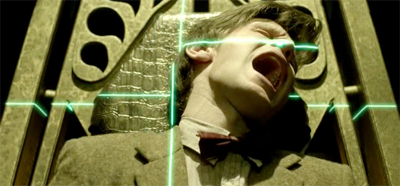
The ball's in his court...

The ball’s in his court…

Continue reading

Doctor Who: The Sontaran Stratagem (Review)

To celebrate the fiftieth anniversary of the longest-running science-fiction show in the world, I’ll be taking weekly looks at some of my own personal favourite stories and arcs, from the old and new series, with a view to encapsulating the sublime, the clever and the fiendishly odd of the BBC’s Doctor Who.

The Sontaran Stratagem originally aired in 2008.

Sontar-Ha!

– Sontaran hakka

The expectations for the opening two-parter of any Russell T. Davies season are markedly different from the expectations surrounding the second two-parter or even the season finalé – just as the expectations for the opening few episodes are different from the expectations for a mid-season stand-alone. It should go without saying, but it’s worth stressing at this point. The opening two-parter of a Davies season isn’t meant for the adults in the audience – it’s traditionally aimed towards the kids, with big epic iconic monsters, ridiculous set-pieces, broadly-defined settings and little room for nuance.

That’s not to excuses messes like World War III or Evolution of the Daleks, but simply to place them in context. The Sontaran Stratagem and The Poison Sky aren’t quite as profound or weighty as The Fires of Pompeii or Planet of the Ood. Instead, they offer bombastic spectacle, goofy visuals and a heightened sense of absolutely everything. In other words, The Sontaran Stratagem and The Poison Sky combine to form the strongest opening two-parter of the Davies era.

They hardly represent a crowning artistic accomplishment for the show, but they do a great job of accomplishing what they set out to do.

There's a potato eyes joke here, but I just can't make it work...

There’s a potato eyes joke here, but I just can’t make it work…

Continue reading

Non-Review Review: The World’s End

The World’s End feels curiously nostalgic. Not just in the way that lead character Gary King tries to recapture his old youth by roping four childhood friends into revisiting their old home town to complete a pub crawl they started upon leaving school, nor in the way the sound track includes such hits of yesteryear as Loaded by Primal Scream and Kylie Minogue’s Step Back in Time, and not even in the fact that the school reunion includes a trip to a literal school disco.

Instead, it feels like a belated criticism of a recent chapter in British history, a reflection on the era of “the special relationship”, and mournful retrospective on what might be perceived as the erosion of British culture by the relentless assault of American influence. The World’s End is an invasion story, but it’s a conscious reversal of the second wave “Britpop” invasion of the nineties (an era the movie evokes nostalgically). This isn’t a hostile occupation. It is, to quote one of the characters, “peaceful indoctrination.”

They've got him Pegged...

They’ve got him Pegged…

Continue reading

Doctor Who: The Green Death (Review)

To celebrate the fiftieth anniversary of the longest-running science-fiction show in the world, I’ll be taking weekly looks at some of my own personal favourite stories and arcs, from the old and new series, with a view to encapsulating the sublime, the clever and the fiendishly odd of the BBC’s Doctor Who.

The Green Death originally aired in 1973.

Where are you off to?

To pack a suitcase.

Oh, good. Give me a couple of minutes and we’ll be off.

Off? Off where?

Well, Metebelis III, of course.

I’m not going to Metebelis III.

Why? Where are you thinking of going to?

Well, South Wales, of course. Llanfairfach.

– the Doctor and Jo discuss travel plans… why would you want to go to Metebels III when you can visit South Wales?

The Green Death is a great example of the Jon Pertwee era. It offers a pretty solid showcase of the best of the era, along with the glaring structural and thematic weaknesses that the show never really tackled head-on. It’s a great yarn, an affectionate run-around. There is a reason, after all, that the overgrown maggots have managed to wedge themselves in British popular consciousness. There’s a conscious sense that The Green Death is a season finalé, in the biggest and boldest terms possible.

In an era where television wasn’t really structured in that way, you can trace a pretty clear line between The Green Death and the big epic series finalés of the Russell T. Davies era of Doctor Who.

And the Beatz go on...

And the Beatz go on…

Continue reading

Doctor Who: Army of Ghosts (Review)

To celebrate the fiftieth anniversary of the longest-running science-fiction show in the world, I’ll be taking weekly looks at some of my own personal favourite stories and arcs, from the old and new series, with a view to encapsulating the sublime, the clever and the fiendishly odd of the BBC’s Doctor Who.

Army of Ghosts originally aired in 2006.

How long are you going to stay with me?

Forever.

– the Doctor and Rose tempt fate

It’s only logical that anybody diving head-first into a fifty-year-old television show is going to have an opinion that radically diverges from the fandom consensus on a couple of stories. So, for example, I’ll concede that I like The Talons of Weng-Chiang, but less than most. However, the biggest divide – and the point on which I feel furthest from consensus – comes with Army of Ghosts and Doomsday, Russell T. Davies’ massive farewell to Rose Tyler, the companion he introduced all the way back in Rose. It’s generally acknowledged as one of the high points of Davies’ tenure and one of the truly great Tenth Doctor stories.

I am far from convinced.

The cracks are starting to show...

The cracks are starting to show…

Continue reading

Doctor Who: Cold Blood (Review)

To celebrate the fiftieth anniversary of the longest-running science-fiction show in the world, I’ll be taking weekly looks at some of my own personal favourite stories and arcs, from the old and new series, with a view to encapsulating the sublime, the clever and the fiendishly odd of the BBC’s Doctor Who.

Cold Blood originally aired in 2010.

It is the story of our past and must never be forgotten.

– Eldane attempts to justify the “traditional monster” two-parters the revived show is so fond of

The Hungry Earth wasn’t too bad. It wasn’t great. There was nothing too exciting or novel about it, but it wasn’t a complete failure. It was an interesting and affectionate throwback to an older style of Doctor Who. It wasn’t exceptional, but it was -broadly speaking – functional. Chris Chibnell’s script had some rough edges, mostly around characterisation, but there was nothing too unworkable about the premise, which basically consisted of a selection of classic Doctor Who tropes thrown in a blender and served up to the audience.

However, Cold Blood is much less satisfying. Part of that is because it’s part of a story that can’t be sustained by nostalgia or affectionate references to tales long past. There’s also the fact that it hinges on an emotional climax that asks us to invest in an especially two-dimensional supporting cast. And that’s saying nothing about how the last few minutes of the episode aren’t even devoted to tying up its own threads so much as playing into the much more interesting season-long arc.

Cold Blood leaves me… well, cold.

Doesn't scan...

Doesn’t scan…

Continue reading

Doctor Who: The Hungry Earth (Review)

To celebrate the fiftieth anniversary of the longest-running science-fiction show in the world, I’ll be taking weekly looks at some of my own personal favourite stories and arcs, from the old and new series, with a view to encapsulating the sublime, the clever and the fiendishly odd of the BBC’s Doctor Who.

The Hungry Earth originally aired in 2010.

Oh look! Big mining thing! Oh, I love a big mining thing. See, way better than Rio. Rio doesn’t have a big mining thing.

– the Doctor looks on the bright side of arriving in not!Rio

The Hungry Earth represents the biggest structural shift of Steven Moffat’s first season of Doctor Who. The writer would indulge in a number of radical structural changes over his time running the show, but his first season as showrunner conforms to the pattern of Russell T. Davies’ four full seasons. There’s the introductory present/past/future trilogy, the two mid-season two-parters and the gigantic two-part season finalé. The content of Moffat’s season might have been markedly different (actual romantic snog! a season building an arc that isn’t just references and easter eggs!), but the format was carried over faithfully.

Moffat’s following two seasons would get more experimental. For one thing, both seasons would be split in half. This allowed Moffat to offer the first genuine cliffhanger in the revival’s history to last more than a week, with a gap of several months between A Good Man Goes to War and Let’s Kill Hitler. His second season would feature the first two-part season opener (and first one-part season finalé) of the revived television show. His third season would feature no two-part episodes, spread across two calendar years.

However, sitting at the tail end of his first season, The Hungry Earth feels like the strangest structural element of Moffat’s first year in charge of Doctor Who. It’s what would traditionally be the first two-parter of the season, pushed back towards the end of the year.

Balancing the scales...

Balancing the scales…

Continue reading

Doctor Who: Delta and the Bannermen (Review)

To celebrate the fiftieth anniversary of the longest-running science-fiction show in the world, I’ll be taking weekly looks at some of my own personal favourite stories and arcs, from the old and new series, with a view to encapsulating the sublime, the clever and the fiendishly odd of the BBC’s Doctor Who.

Delta and the Bannermen originally aired in 1987.

Hey, this doesn’t look like Disneyland.

No, well, according to my reckoning, it seems to be somewhere in, er, Wales.

– Murray and the Doctor get in touch with the “real fifties”

Delta and the Bannermen is quite terrible. That said, it’s not terrible in the same way that, say, Timelash or Attack of the Cybermen or The Twin Dilemma is terrible. It doesn’t offer a demonstration of everything intrinsically wrong with this era of the show, and the frustration isn’t compounded by the sense that nobody producing the show seems interested in watching it and maybe learning from their mistakes.

While that is certainly a promising thing from the perspective of the show, it doesn’t really do the viewer that much good when they are watching it.

Large ham, incoming!

Large ham, incoming!

Continue reading

Doctor Who: Time and the Rani (Review)

To celebrate the fiftieth anniversary of the longest-running science-fiction show in the world, I’ll be taking weekly looks at some of my own personal favourite stories and arcs, from the old and new series, with a view to encapsulating the sublime, the clever and the fiendishly odd of the BBC’s Doctor Who.

Time and the Rani originally aired in 1987.

Right, that all seems quite clear. Just three small points. Where am I? Who am I? And who are you?

– the Doctor

A Doctor’s first story is always difficult. Even if it’s not as explicit as it was in Power of the Daleks, the new actor his constantly fighting against the weight of expectation, trying to cast off the spectre of their predecessor and make the show their own. There’s also a sense that the production team is trying to reinvent the show around their new lead. It’s transitional, and it’s not too difficult to see how the task could be daunting.

If that’s a typical first story, imagine how frustrating Time and the Rani must have been at the time. Hastily cobbled together in a rush, coming out of a season that had been a spectacular failure and with the shadow of cancellation looming heavy, there’s a lot of pressure on Time and the Rani. It is a story that is routinely trashed and mocked, and perhaps deservedly so. However, I must concede, it’s not as bad as it could have been and I’d be very reluctant to rank it among the worst Doctor Who serials of all time.

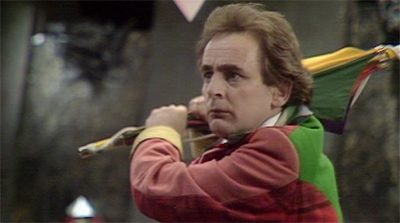
He's got an umbrella and he's not afraid to use it!

He’s got an umbrella and he’s not afraid to use it!

Continue reading