• Following Us

  • Categories

  • Check out the Archives


  • Awards & Nominations

Doctor Who: Born Again (Review)

To celebrate the fiftieth anniversary of the longest-running science-fiction show in the world, I’ll be taking weekly looks at some of my own personal favourite stories and arcs, from the old and new series, with a view to encapsulating the sublime, the clever and the fiendishly odd of the BBC’s Doctor Who.

Born Again originally aired in 2005.

Can you change back?

Do you want me to?

Yeah.

Oh.

Can you?

No.

– Rose and Doctor

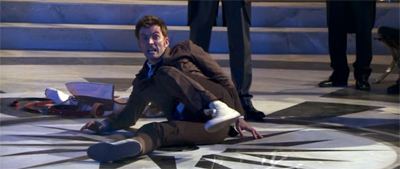
Davies revived Doctor Who devoted considerable time to reintroducing the core concepts of the series. Unlike The TV Movie, Davies saw no need to over-complicate Rose by featuring the regeneration from the previous Doctor to the current lead. The Ninth Doctor was introduced as-is to an entire generation of new viewers. Only a quick examination of his features in Rose seemed to hint that he was getting used to his new face.

The prospect of “regeneration” hadn’t been flagged too heavily by the time The Parting of the Ways aired. This makes sense. For one thing, there’s a sense that Eccleston’s departure was not something that the production team had accounted for – which makes it even stranger that the whole first season seems to be building towards his redemption in death. For another thing, it’s very hard to drop “by the way, I change into somebody else when I die” casually into conversation.

So the regeneration at the end of The Parting of the Ways was kind of a big deal, and a huge moment for the series. After all, the classic Doctor Who had enjoyed more than three seasons with its lead character before having to swap him out – Hartnell being the last member of the original ensemble to depart. And, given the rules of television narratives in 2005, there was no way that the show’s first regeneration wasn’t going to be a pretty significant event.

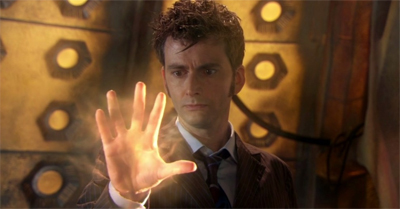
Somebody needs a Doctor...

Somebody needs a Doctor…

Continue reading

Doctor Who: Survival (Review)

To celebrate the fiftieth anniversary of the longest-running science-fiction show in the world, I’ll be taking weekly looks at some of my own personal favourite stories and arcs, from the old and new series, with a view to encapsulating the sublime, the clever and the fiendishly odd of the BBC’s Doctor Who.

Survival originally aired in 1989.

Where to now, Ace?

Home.

Home?

The TARDIS.

Yes, the TARDIS. There are worlds out there where the sky is burning, where the sea’s asleep, and the rivers dream. People made of smoke, and cities made of song. Somewhere there’s danger, somewhere there’s injustice, and somewhere else the tea’s getting cold. Come on, Ace, we’ve got work to do!

– the Doctor and Ace turn off the lights on their way out

There was a long gap between Survival and Rose. It was filled with stuff. It was filled with lost of interesting and different Doctor Who stuff. There were books and audio plays and even a television movie to help fill the decade and a half when Doctor Who was not a regular feature of British television. A lot of that stuff was important, and a lot of it helped determine and shape what Doctor Who would become when it did return. It’s telling that the many members of the writing staff on the revived Doctor Who cut their teeth on novels and short stories and audio plays and specials in the wilderness years, while no writers returned from the classic show.

At the same time, however, the gap between Survival and Rose doesn’t feel as profound as it might. It’s misleading to suggest that Survival was a clear bridge towards the Russell T. Davies era, or even to hint that the revival could have emerged fully formed from this three-part closing serial. At the same time, Survival is really the closest that the classic series ever came to the spirit of the Davies era, hitting on quite a few familiar themes and ideas and settings, as if Cartmel’s vision of the future of Doctor Who was not too far from the version proposed by Davies.

Survival was the end of an era, but it also motioned towards the start of another.

Riding into the sunset...

Riding into the sunset…

Continue reading

Doctor Who: The Curse of Fenric – Special Edition (Review)

To celebrate the fiftieth anniversary of the longest-running science-fiction show in the world, I’ll be taking weekly looks at some of my own personal favourite stories and arcs, from the old and new series, with a view to encapsulating the sublime, the clever and the fiendishly odd of the BBC’s Doctor Who.

The Curse of Fenric originally aired in 1989. The special edition cut of the episode was released on DVD in 2003.

I’ve said it a lot over this past year, but you really have to be incredibly grateful for the wonderful team behind the classic Doctor Who DVD releases. Not only do they loving restore classic adventures that might be forgotten to the ages, and not only do they packages the episodes with buckets of in-depth and lovingly-made featurettes, but they also occasionally revisit classic serials to bring them up-to-date, or to move them more in line with the director or writer’s artistic vision. Sure, some of these “special editions” occur in the most random of places (Planet of Fire, anyone?) or simply to remove a few technical impairments holding a story back from being an entertaining romp (as in Day of the Daleks), but occasionally they do something more substantial. In this instance, they make a great adventure into something truly spectacular.

This is not a drill…

Continue reading

Doctor Who: Battlefield – Special Edition (Review)

To celebrate the fiftieth anniversary of the longest-running science-fiction show in the world, I’ll be taking weekly looks at some of my own personal favourite stories and arcs, from the old and new series, with a view to encapsulating the sublime, the clever and the fiendishly odd of the BBC’s Doctor Who.

Battlefield originally aired in 1989.

Pitiful. Can this world do no better than you as their champion?

Probably. I just do the best I can.

– the Destroyer gets to know the Brigadier

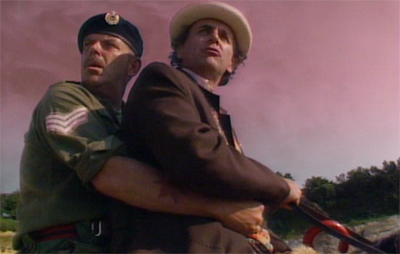
Battlefield gets a bit of a bum rap as the weakest story in the final season of the classic Doctor Who. This isn’t entirely fair. Battlefield is a well-produced and thoughtful piece of Doctor Who, it just happens to be inferior to The Curse of Fenric, Ghost Light and Survival; it’s hardly the most damning indictment possible. After all, Battlefield would arguably be treated as an unsung gem had it aired during Colin Baker’s time on the show.

In keeping with Ben Aaronovitch’s last season opener, Remembrance of the Daleks, Battlefield is preoccupied with the history of the show – of its legacy and the artifacts that it carries with it. Archeology is a key theme here, but juxtaposed against a near future setting and the clever conceit of the Doctor manipulating his own history. There’s a wealth of great material here, even if the production never quite lives up to the potential teased.

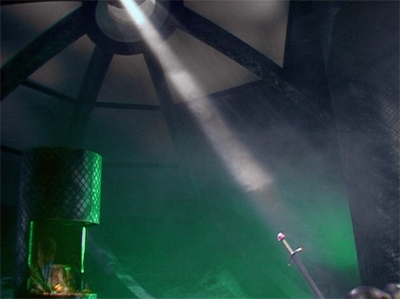
A beacon of light...

A beacon of light…

Continue reading

Doctor Who: The End of Time, Part II (Review)

To celebrate the fiftieth anniversary of the longest-running science-fiction show in the world, I’ll be taking weekly looks at some of my own personal favourite stories and arcs, from the old and new series, with a view to encapsulating the sublime, the clever and the fiendishly odd of the BBC’s Doctor Who.

The End of Time, Part II originally aired in 2010.

I don’t want to go.

– the Doctor channels David Tennant and Russell T. Davies

The End of Time, Part II is an incredibly confident piece of science-fiction. It’s also fiendishly self-indulgent. “Where are you going?” Wilf asks the Doctor after the Doctor takes a fatal dose of radiation. “To get my reward,” the Doctor responds, as if he has earned enough credit and kudos that he can cash it in for one last victory lap around the cosmos. Cue an exceptionally sentimental sequence in which the Tenth Doctor visits most of his major companions (and a few minor ones) before he departs.

It’s a nice excuse to trot out the familiar characters from the Davies era one last time. Martha is there; Jack shows up; even Jackie Tyler gets a look-in. It’s not just the Tenth Doctor’s farewell tour of the universe, it’s a reminder of how skilfully Davies has built a world around his lead character. And this was really the last chance for the show to say goodbye to all of that. It makes a great deal of sense, and it’s well earned. Davies resurrected a television show that died a joke and turned it into a success story that was strong enough to anchor the Christmas and New Year schedules. He’s earned the right to be this self-indulgent.

Worlds apart...

Worlds apart…

The problem is that the show seems more than a little entitled, more than a little brash about what is owed to it. The universe owes the Tenth Doctor one last go around; the audience owes Tennant and Davies enough to put up with this sort of ham-fisted sentimentality. There’s a moment when the Doctor seems to honestly consider leaving Wilf to die from radiation poisoning, and rants against the cruelty of the universe. How dare the universe put him in a position where he has to make this sort of moral choice!

The problem is that the episode tries to present this a sympathetic moment. We’re supposed to emphasise with the Doctor as he considers walking away from a poor old man who has been nothing but helpful and trustworthy and friendly to him. The End of Time, Part II is clearly intended as a celebratory romp in the style of Journey’s End, a reminder of how Doctor Who conquered television. The problem is that The End of Time, Part II overplays its hand a bit, and over-estimates how much the audience loves the Tenth Doctor.

Not quite a blaze of glory...

Not quite a blaze of glory…

Continue reading

Doctor Who: The End of Time, Part I (Review)

To celebrate the fiftieth anniversary of the longest-running science-fiction show in the world, I’ll be taking weekly looks at some of my own personal favourite stories and arcs, from the old and new series, with a view to encapsulating the sublime, the clever and the fiendishly odd of the BBC’s Doctor Who.

The End of Time, Part I originally aired in 2009.

The human race was always your favourite, Doctor. But now, there is no human race. There is only the Master race.

– the Master always did like a good pun

The problem with The End of Time isn’t a lack of good ideas. Indeed, there are far too many good ideas here. There are enough large concepts here to sustain an entire season of Davies’ Doctor Who, from the resurrection of the Master to the return of Gallifrey to the resurrection gate to Naismith to the Tenth Doctor’s impending mortality and quite a few more. The End of Time is bristling with so many ideas and concepts that only the truly outrageous examples really stick. Is that really the Tenth Doctor’s mother?

The End of Time is fundamentally flawed, but it remains intriguing. There’s a wealth of good ideas here that tend to get drowned out in the spectacle and fury of it all, a sense that Davies had a wealth of clever ideas but was unable to tie them into anything fully satisfying.

Ten cedes the floor...

Ten cedes the floor…

Continue reading

Doctor Who: The Beast Below (Review)

To celebrate the fiftieth anniversary of the longest-running science-fiction show in the world, I’ll be taking weekly looks at some of my own personal favourite stories and arcs, from the old and new series, with a view to encapsulating the sublime, the clever and the fiendishly odd of the BBC’s Doctor Who.

The Beast Below originally aired in 2010.

What are you going to do?

What I always do. Stay out of trouble. Badly.

So is this how it works, Doctor? You never interfere in the affairs of other peoples or planets, unless there’s children crying?

Yes.

– Amy and the Doctor reiterate the way things work

Steven Moffat’s first season producing Doctor Who owes a conscious debt to the rigid structure of the seasons produced by Russell T. Davies. There’s an opening episode in contemporary Britain, followed by one episode visiting the past, one visiting the future. There are three two-parters – the season finalé, a “monster”-driven two-parter and a more atmospheric and moody piece. There’s even a brief spell in the middle of the season where Moffat spices up the TARDIS dynamic by adding in a temporary companion.

This approach worked quite well. It’s worth noting that Moffat’s first season was the only point following the departure of Russell T. Davies that Doctor Who was able to deliver thirteen episodes of the show on thirteen consecutive weeks. It struck something of a happy middle between Davies’ more episodic approach to the show that the more arc-driven storytelling favoured by Moffat. Still, there are moments when it seems like this approach isn’t quite the perfect fit, with Moffat’s voice struggling to fit into the structure established by Davies.

Essentially Steven Moffat’s impression of Russell T. Davies’ update of Andrew Cartmel’s social allegory stories, The Beast Below is an interesting – if slightly unsuccessful – experiment. Moffat’s second season would feature much more effective attempts to evoke the Cartmel era of the classic show, without the sense that Moffat was trying a little too hard to emulate his predecessor.

The space in-between...

The space in-between…

Continue reading

Doctor Who: The Happiness Patrol (Review)

To celebrate the fiftieth anniversary of the longest-running science-fiction show in the world, I’ll be taking weekly looks at some of my own personal favourite stories and arcs, from the old and new series, with a view to encapsulating the sublime, the clever and the fiendishly odd of the BBC’s Doctor Who.

The Happiness Patrol originally aired in 1988.

Think I’ll hang out here for a while, Doc. See if I can teach this planet the blues again.

Yes, thank you for giving them back to us, Doctor.

– Earl and Susan shouldn’t be so surprised that the Doctor is fond of blue

The Happiness Patrol is an absolutely fascinating piece of Doctor Who. On the surface, it’s another example of the series’ rapidly falling budget and the production values point towards the show’s impending cancellation. While nowhere near as dodgy as Warriors of the Deep, The Happiness Patrol looks like a very cheap piece of television, struggling to realise a futuristic colony on a tiny budget. On a purely superficial level, The Happiness Patrol is really the kind of show that Michael Grade could point to and argue that Doctor Who was a show that desperately needed to be put out of its misery.

However, if the viewer is willing to pull back the layers a bit, and to peer beneath the somewhat rough trappings of The Happiness Patrol, the adventure is really everything that eighties Doctor Who could ever want to be. There is a reason that the serial has, somewhat improbably, endured. In 2010, The Happiness Patrol became headline news in Great Britain, with national newspapers astounded by the audacity of Andrew Cartmel’s vision for the show. The following year, the Archbishop of Canterbury casually name-dropped it in an Easter Sermon.

These references aren’t derogatory. These are proof that The Happiness Patrol, despite its dodgy special effects and the limitations of its production design, is one of the most important Doctor Who adventures of the eighties.

He's perfectly sweet!

He’s perfectly sweet!

Continue reading

Doctor Who: The Sun Makers (Review)

To celebrate the fiftieth anniversary of the longest-running science-fiction show in the world, I’ll be taking weekly looks at some of my own personal favourite stories and arcs, from the old and new series, with a view to encapsulating the sublime, the clever and the fiendishly odd of the BBC’s Doctor Who.

The Sun Makers originally aired in 1977.

Why did you come here, then?

Because my new little chum here seemed unhappy about something.

Mandrell discovers all he needs to know about the Doctor

The Sun Makers was reportedly written as a result of a disagreement between writer Robert Holmes and the British Revenue and Customs. That’s the oft-cited background to the story, so well known that it’s even included on the notes included in the DVD release. With that summary, you’d expect The Sun Makers to be a condemnation of the tax system, and a protest at the government’s funnelling off of money from the individual to pay like pesky things like roads or schools or hospitals.

Instead, Holmes has crafted The Sun Makers as something altogether more compelling and instructive. Rather pointedly, while The Sun Maker is a story about excessive taxation, the episode casts a large interstellar corporation as the villain of the piece. The episode’s primary antagonist isn’t a state official, it’s a single-minded number-crunching accountant who operates a large corporation that has managed to turn light itself into a financial commodity. This isn’t the story about individuals fighting for the right not to pay tax, it’s people fighting for decent working and living conditions.

Indeed, it’s quite easy to read The Sun Makers as a rather socialist piece of Doctor Who, ending with the massive organisation of the working class to resist their greedy capitalist overlords. That’s quite a radical shift from the story you’d expect given the background. In that respect, it seems almost like a call-forward to the pointed subversive social commentary of the Cartmel and even Davies eras.

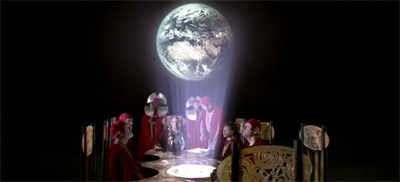
I see the future...

I see the future…

Continue reading

Doctor Who: The Long Game (Review)

To celebrate the fiftieth anniversary of the longest-running science-fiction show in the world, I’ll be taking weekly looks at some of my own personal favourite stories and arcs, from the old and new series, with a view to encapsulating the sublime, the clever and the fiendishly odd of the BBC’s Doctor Who.

The Long Game originally aired in 2005.

No, no, you stick with the Doctor. You’d rather be with him. It’s going to take a better man than me to get between you two.

– Adam outlines another reason he had to get kicked out of the TARDIS

The Long Game is a breathtakingly ambitious piece of Doctor Who, for a variety of reasons. The most obvious is the fact that it’s basically Russell T. Davies pushing through a story idea that Andrew Cartmel rejected when he pitched it to the classic show in the eighties, but there are a whole bunch of other reasons. The Long Game is trying to do so many things at once that it ends up getting a little lost. However, it does serve as an example of what Davies was really trying to do with this first season of the revived Doctor Who.

On the surface, The Long Game a clever and daring piece of science-fiction television, a piece of social commentary hidden behind funny-looking aliens and scenery-chewing villains. It’s really a spiritual successor to the science-fiction stories of the Cartmel era. However, it’s also something else entirely. It’s a conscious embrace of the new realities of television, an acknowledgement that these trappings have be blended with character-based storytelling and more modern tea-time telly conventions.

After all, for a show about the manipulation of the media to corrupt the public consciousness, the teaser doesn’t end on a monster reveal or a shocking twist, but a pithy personal comment. “He’s your boyfriend.”

Body of work...

Body of work…

Continue reading