• Following Us

  • Categories

  • Check out the Archives


  • Awards & Nominations

Star Trek: Voyager – Counterpoint (Review)

Counterpoint is a spectacular episode of Star Trek: Voyager, a highlight of the fifth season and of the seven season run in general.

Counterpoint is meticulously constructed, put together with a great deal of care and consideration. This is most obvious in the plotting and characterisation in the episode, in the way that the focus of the story remains constant while peeling back the layers on the characters involved. Too many Voyager episodes indulge in a contrived sequence of “… and then…” plotting, while Counterpoint is an episode that understands what it is about and is content to explore its ideas and its characters to their logical conclusions.

Playing it pitch perfect.

Counterpoint benefits from two superb central performances. Mark Harelik is one of the strongest one-shot guest stars to appear on Voyager, playing Kashyk as an endearingly ambiguous figure caught half way between a conventional romantic lead and a fascist thug. However, Counterpoint works best as a showcase for Kate Mulgrew as Kathryn Janeway. Mulgrew has always been one of the strongest members of Voyager‘s primary cast, but the production team always struggled to play to her strengths while building a consistent character.

Counterpoint is an episode that plays perfectly to the strengths of all involved, creating a symphony where all of the orchestra is playing both in key and in time with one another. At this point in the run, Voyager should be producing episodes like this with much greater consistency.

Near kiss.

Continue reading

Star Trek: Deep Space Nine – A Simple Investigation (Review)

A Simple Investigation is a quiet little episode.

This is particularly true in the context of the crowded second half to the fifth season of Star Trek: Deep Space Nine. In Purgatory’s Shadow and By Inferno’s Light radically upended the status quo and set the fifth season on a march towards A Call to Arms. The threat of war looms large over the second half of the season, following the admission of Cardassia into the Dominion. There is a creeping sense of inevitability to episodes like Blaze of Glory and Soldiers of the Empire.

Strange bedfellows...

Strange bedfellows…

At the same time, Deep Space Nine takes a little while to adjust to that dramatic shift. The Dominion and Cardassia only come back into focus with Ties of Blood and Water, the episode that reintroduces Weyoun to the series. Still, episodes like Doctor Bashir, I Presume and Business as Usual have a sense of weight to them as they offer up high-stakes family drama and arms-dealing morality plays. In contrast, A Simple Investigation feels relatively low key. It is not an episode with profound consequences or shocking revelations.

Instead, A Simple Investigation plays as a small-scale cyberpunk noir romance in which Odo falls head-over-heels in love with a guest star whom he will never see again. With all the chaos unfolding across the length and breadth of the fifth season, A Simple Investigation feels surprisingly… simple. The problems of these little people don’t amount to a hill of beans in this crazy world, but A Simple Investigation still takes the time to fixate upon them.

Star struck.

Star struck.

Continue reading

Star Trek: Deep Space Nine – Crossfire (Review)

This February and March, we’re taking a look at the 1995 to 1996 season of Star Trek, including Star Trek: Deep Space Nine and Star Trek: Voyager. Check back daily Tuesday through Friday for the latest review.

In many ways, Star Trek: Deep Space Nine has aged remarkably well.

Episodes like Homefront and Paradise Lost arguably have greater resonance now than they did on initial broadcast, their commentary on state authority and the erosion of civil liberties packing more punch during the War on Terror than it did during the long nineties. The Way of the Warrior even invites comparison to the invasion of Iraq, despite the fact that the episode aired eight years before the invasion took place. In many respects, Deep Space Nine has aged considerably better than its siblings.

Odo's attempts at redecorating were not going well...

Odo’s attempts at redecorating were not going well…

On the other hand, there are some aspects that have not aged particularly well. There are certain elements of Deep Space Nine that feel ill-judged or ill-advised in hindsight; for example, the thinly-veiled (and awkward) racial politics inherent in the exploration of the Jem’Hadar in The Abandoned. The relationship between Odo and Kira is another such example, the show’s central “will they?”/“won’t they?” dynamic seeded in Necessary Evil and brought to fruition in Heart of Stone.

Taken on its own merits, Crossfire is a spectacular piece of television. It is skilfully written and directed, with a superb central performance from Rene Auberjonois as Odo. The plot of the episode seems to focus on Odo working through his long-simmering crush on Kira, suffering a near breakdown and eventually deciding to work through it. It is, in many ways, the best possible story that could be told using the relationship. However, the problem is that Crossfire is not the end of this particular thread. It is just a hurdle for Odo to pass.

Quark serves some unpalatable truths...

Quark serves some unpalatable truths…

Continue reading

Star Trek: Enterprise – Harbinger (Review)

Next year, Star Trek is fifty years old. We have some special stuff planned for that, but – in the meantime – we’re reviewing all of Star Trek: Enterprise this year as something of a prequel to that anniversary. This August, we’re doing the third season. Check back daily for the latest review.

It goes almost without saying that the third season of Star Trek: Enterprise was an attempt to revitalise a franchise that had already been on television for a decade and half. It was an attempt to do something quite radical and dynamic with a television property that had become rather staid and conservative. Star Trek: The Next Generation had been perfectly calibrated for the late eighties and early nineties, but its approach towards storytelling was increasingly outdated after seven seasons of Star Trek: Voyager.

One of the recurring issues in the first season of Enterprise was the conflict between the established franchise structure and something more adventurous and exciting. So many of those first season episodes seemed laboriously paced and awkwardly arch; there was a sense of dull routine rather than exciting adventure. The show would occasionally try to deviated from the established template (to varying degrees of success) with stories like Dear Doctor, Shuttlepod One, and A Night in Sickbay, but narrative conservatism won out in the sophomore season.

"So... sweeps?"

“So… sweeps?”

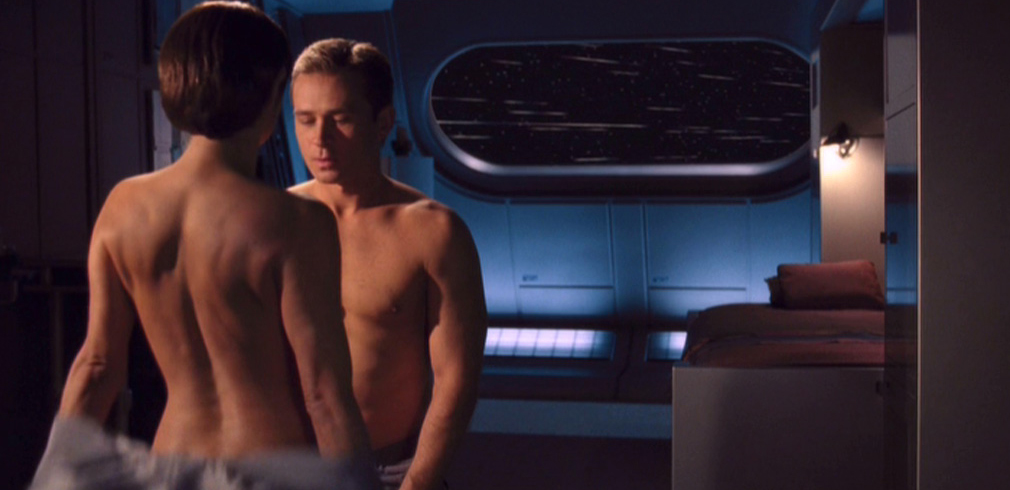
In many ways, Harbinger plays as a return to those earlier experiments in story structure. It is an episode that is not driven by story. Although the strange alien discovered by the crew provides a suitably dramatic climax, most of Harbinger is built around established character dynamics. Trip and T’Pol begin working through the sexual tension that has existed between them since the start of the third season; Reed and Hayes do something similar in a very different fashion. In the meantime, the ship just cruises along en route to the third season’s next big plot beat.

Harbinger is not entirely successful in this regard. There is a sense that the franchise is still figuring out how to construct episodes that don’t conform to a rigid story structure, with the mysterious alien visitor serving as an effective crutch to help get around these problems. Still, it is an interesting experiment and an example of how the show is consciously trying to reinvent itself in a manner that is more than simply cosmetic.

Expanding his Sphere of influence...

Expanding his Sphere of influence…

Continue reading

The X-Files – The Unnatural (Review)

This July, we’re taking a trip back in time to review the sixth season of The X-Files and the third (and final) season of Millennium.

Let me get this straight: a free-spirited alien fell in love with baseball and ran away from the other non-fun-having aliens and made himself black, because that would prevent him from getting to the majors where his unspeakable secret might be discovered by an intrusive press and public and you’re also implying that…

You certainly have a knack for turning chicken salad into chicken spit.

– Fox Mulder and Arthur Dales discuss the merits of The Unnatural

Swing and a hit...

Swing and a hit…

Continue reading

The X-Files – The Rain King (Review)

This July, we’re taking a trip back in time to review the sixth season of The X-Files and the third (and final) season of Millennium.

I do not “gaze” at Scully.

Somewhere over the rainbow...

Somewhere over the rainbow…

Continue reading

The X-Files – Dreamland I (Review)

This July, we’re taking a trip back in time to review the sixth season of The X-Files and the third (and final) season of Millennium.

It occasionally seems like the sixth season of The X-Files is having something approaching a midlife crisis.

It has gone through a fairly massive change in routine and lifestyle; the show recently pulled up sticks and moved to Los Angeles. It has gotten a lot more ostentatious; it looks to be spending a lot more money than it was before, and it is hanging around with a whole new caliber of guest star. It has reinvented itself completely; no longer the brooding and atmospheric show it once was, it is now downright goofy and silly. Old acquaintances would be forgiven if they had trouble recognising the show. And it’s perfectly understandable.

Back to back...

Back to back…

This is the sixth season. Dreamland I is the one-hundred-and-twenty-first episode of The X-Files. The show is well past what Chris Carter had originally planned, and well past just about any measure of success. Most shows are lucky to reach a sixth season, let alone come into the sixth season off the back of a summer film and with a great deal of security about the future. David Duchovny, Gillian Anderson and Chris Carter were all committed through to the end of the seventh season. There was even talk of a sequel to The X-Files: Fight the Future being released in 2000.

Dreamland I and Dreamland II just externalise that midlife crisis, using the classic “freaky friday” body swap set up putting Fox Mulder in a dead-end job with a family that hates him as Morris Fletcher tries to help the FBI agent grow up just a little bit.

"Yep. It's a little... out there."

“Yep. It’s a little… out there.”

Continue reading

The X-Files – Triangle (Review)

This July, we’re taking a trip back in time to review the sixth season of The X-Files and the third (and final) season of Millennium.

There are a lot of reasons to celebrate Triangle.

The episode gets a lot of attention for its wonderful use of long tracking shots. According to Chris Carter’s commentary, there are only twenty-four individual shots stitched together to produce the forty-five-minute episode. Considering the amount of split-screen action at the climax, that is not a lot. Triangle is an artistic tour de force for writer and director Chris Carter. The success that both Birdman and True Detective enjoyed in 2014 due to their extended takes suggests that Carter was significantly ahead of the curve.

Dragging up the past...

Dragging up the past…

There are other aspects to note. Triangle also ushers in a new mood and tone for the sixth season of The X-Files. The show had moved to Los Angeles, and would struggle with how to retain its identity in the new (and bright) surroundings of California. The Beginning and Drive had both answered the question in their own way, but Triangle ushers in a whole new approach to storytelling. Triangle is the first of a series of light and breezy episodes in the early stretch of the sixth season where The X-Files almost turns into a paranormal sitcom.

However, there is one other reason to celebrate Triangle. It is an extended forty-five minute pun on the word “ship.”

Cigarette-Smoking Nazi...

Cigarette-Smoking Nazi…

Continue reading

“Mulder and Scully” by Catatonia (Review)

This May and June, we’re taking a trip back in time to review the fifth season of The X-Files and the second season of Millennium.

Things are getting strange, I’m starting to worry

this could be a case for Mulder and Scully…

If you needed proof that The X-Files was a cultural juggernaut in the mid-to-late nineties, look no further than Mulder and Scully.

The first single off Catatonia’s International Velvet propelled the band to new heights of fame and fortune. Before the release of Mulder and Scully, the band had skulked around the bottom of the British charts; their biggest success before that point had been You’ve Got a Lot to Answer For, a song lucky to scrape the top forty. Indeed, reaching the third position in the United Kingdom charts, Mulder and Scully easily became the Welsh band’s largest pop hit. A month after the release of Mulder and Scully, its parent album would reach the top of the international charts.

catatonia-mulderandscully3

Having a Wales of a time…

Indeed, it could be argued that Catatonia’s success overlapped quite neatly with that of The X-Files. The core of the band’s “classic” line-up, Cerys Matthews and Mark Roberts, began writing songs together in 1992. The single Mulder and Scully and the album International Velvet represented the peak of their success. The band would release two more albums building off the success of International Velvet, before formally announcing the dissolution of the band in September 2001. It is an arc that roughly mirrors that of The X-Files – suggesting Catatonia were another nineties artifact.

Although Mulder and Scully was Catatonia’s biggest success, it is worth noting The X-Files had enjoyed a great deal of success in the British charts. Late in the show’s third season, the theme song had been released as a single in its own right. Mark Snow’s iconic opening credits music had climbed all the way to the number two slot. Nevertheless, Mulder and Scully is interesting because it is a massive hit about the show that came from outside the production office. The X-Files had conquered television, now it seemed to be laying claim to both cinema and the pop charts.

Sing when you're winning...

Sing when you’re winning…

Continue reading

Star Trek: Enterprise – Precious Cargo (Review)

Next year, Star Trek is fifty years old. We have some special stuff planned for that, but – in the meantime – we’re reviewing all of Star Trek: Enterprise this year as something of a prequel to that anniversary. This April, we’re doing the second season. Check back daily for the latest review.

Precious Cargo is a disaster. It is a spectacularly terrible piece of television. It is the kind of episode that fans point towards when they want to belittle or diminish Star Trek: Enterprise.

To be fair, it isn’t as if the show has the monopoly on bad episodes of the franchise. After all, the original Star Trek gave us And The Children Shall Lead, The Way to Eden and The Apple. Star Trek: The Next Generation gave us Code of Honour, Angel One, The Child and Up the Long Ladder. Star Trek: Deep Space Nine produced Let He Who Is Without Sin, Profit and Lace and The Emperor’s New Cloak. Star Trek: Voyager is responsible for Fair Haven and Spirit Folk. When you produce twenty-something episodes of television a year, terrible episodes happen.

We are Trip, of Bored...

We are Trip, of Bored…

Indeed, they will keep happening. Precious Cargo cannot even make an indisputable claim to being the weakest story of the troubled second season. There are fans who will argue that A Night in Sickbay or Bounty deserve that accolade. Nevertheless, it seems like everyone is agreed that Precious Cargo is a disaster from start to finish. It is a collection of pulpy science-fiction clichés that feels overly familiar, a lazy comedy without any solid jokes and a complete lack of chemistry between the two leads.

Precious Cargo is a spectacular misfire, an ill-judged and poorly-constructed addition to the franchise.

"Wait, another Trip comedy episode?"

“Wait, another Trip comedy episode?”

Continue reading