• Following Us

  • Categories

  • Check out the Archives


  • Awards & Nominations

Non-Review Review: The Shallows

The Shallows has a pretty great high concept that it stretches just far enough that it begins to creak, but not so far that it snaps back in the audience’s face.

The Shallows is very much a pulpy creature feature horror film, with a healthy dash of tourist anxieties thrown in for good measure. It is a film about a young surfer who finds herself stranded on a rock about two hundred metres from shore as she is menaced by a really determined shark. It is very much a high-tension high-stakes survival thriller, one that lends itself to pithy summaries like Jaws meets Phone Booth or Buried, where the part of Iraq is played by a menacing computer-generated shark.”

Still waters...

Still waters…

It is an absurd set up to sustain across a ninety-minute runtime, and it is to the credit of The Shallows that the movie realises this. The Shallows never resists the absurdity of its premise. It never hesitates or second-guesses itself. The film moves incredibly quickly, recognising that any moment where the tension slips is a moment at which the audience might begin question the underlying assumptions that hold the film together. Like its animal antagonist, The Shallows understands that it needs to keep moving forward if it is to survive.

The result is a survival horror movie less interested in subverting or deconstructing classic genre tropes than it is revelling in the pulpy possibilities of a story like this. The Shallows is much stronger for that.

Oh buoy...

Oh buoy…

Continue reading

Non-Review Review: The BFG

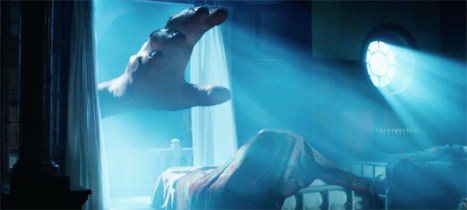
The BFG works better as setting and setpieces than it does as a story.

The first half of the film is largely episodic in nature, allowing director Steven Spielberg the opportunity to craft a delightful fantasia built upon the work of Roald Dahl. The world that The BFG builds through motion capture and computer-generated imagery combined with models and sets is quite striking. As befits an adaptation of Roald Dahl’s classic children’s novel, the film is rich in imagination. The first half of the film often feels like a child in a candy store, wandering with its protagonist from one magical set piece to the next.

Keeping it handy...

Keeping it handy…

It is enchanting in a way that evokes the best of Spielberg’s output, the wonder and imagination that has inspired a whole generation of filmmakers. More than that, Spielberg controls the camera with a deft ease that helps viewers to get a sense of why he is so often copied and so rarely equalled. For its first half, The BFG is pure and whimsical Steven Spielberg. Indeed, the film has a somewhat understated eighties setting, which serves to underscore the sense that Spielberg is consciously reconnecting with his crowd-pleasing blockbuster phase. He does not miss a step.

However, The BFG struggles in its second half once the script tries to impose a story upon these meandering and wandering adventures. Although this second half is very much carried over from the source material, it sacrifices a lot of the whimsy and charm that made the first half so endearing. In fact, although the ending is adapted quite faithfully from the novel, it also feels like a concession to modern big-budget film aesthetics. The BFG is a film that works quite well, up until the point that it chooses to emphasise “big” over “friendly.”

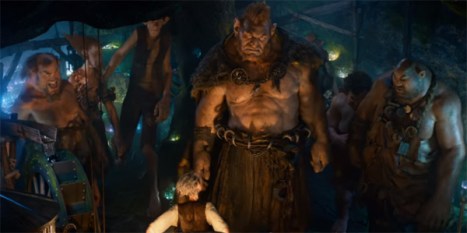
They might be giants.

They might be giants.

Continue reading

Non-Review Review: Finding Dory

Finding Dory is a demonstration of everything that Pixar does well, a bright and colourful treat for kids that offers enough depth for adults.

Pixar have one of the strongest track records in animation, even acknowledging recent missteps like Cars 2 or The Good Dinosaur. At its best, the studio is transcendent, producing films that speak as keenly to parents as they do to children, building entire worlds from pixels that feel so textured and real that audiences do not need 3D to end up lost in them. Inside Out is the most recent demonstration of the studio’s prowess in that regard, a film that deserved to be in the conversation as one of the very best movies of 2016.

I think I see her!

I think I see her!

Finding Dory is not quite at that level. The movie seems unlikely to be remembered as one of the studio’s finest efforts alongside Wall-E or Up. However, second tier Pixar is still fantastic. There is a solid argument to be made that Finding Dory is the film of the summer, a family-friendly treat that can appeal to whole audiences. Kids of all ages will react fondly to the colourful (and beautifully rendered) characters, while the movie also resonates on more profound levels for the more mature members of the family.

As with the best Pixar films, Finding Dory speaks to the idea of family and growing up. The film is held together by a beautiful metaphor about what it means to find a family, and about the idea of returning home as an emotional rather than a literal journey. It is a fascinating and powerful film, but also one with as much heart and energy as anything in the Pixar canon.

Something fishy is going on...

Something fishy is going on…

Continue reading

Non-Review Review: The Legend of Tarzan

The Legend of Tarzan is a dysfunctional film.

It is an interesting film in many ways, eschewing a lot of the conventional choices when it comes to adapting the Lord of the Jungle for the silver screen. There are a lot of reasons why this adaptation might want to steer clear of familiar trappings like the origin story or opt for an unconventional starting point, and the result is one of the most intriguing of the year’s big blockbusters. The Legend of Tarzan never follows the path of least resistance, and the resulting film is more fascinating for that.

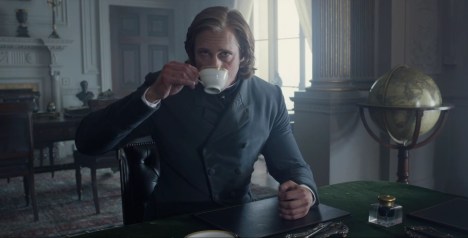
"Anyone for tea?"

“Anyone for tea?”

It is also a lot less satisfying. Tarzan is an archetypal character. Many of the character’s trappings linger in popular memory. Even people who have never seen a Tarzan film will recognise the character’s battle cry. The loincloth is just as iconic as Superman’s red underwear. There are certain expectations in a Tarzan adaptation. Defying many of those choices is a bold storytelling decision, but that decision creates an absence at the heart of the film. Director David Yates and star Alexander Skarsgård never manage to fill that void.

The result is a film that is fun to puzzle out, but not entirely engaging on its own terms. Characters repeatedly acknowledge “the Legend of Tarzan”, whether sketched on posters or memorialised in song. However, the film spends so much of its first half picking apart the legend that it struggles to put it back together at the climax.

Note: there is more colour in this frame than in the entire film.

Note: there is more colour in this frame than in the entire film.

Continue reading

Non-Review Review: Absolutely Fabulous – The Movie

Absolutely Fabulous: The Movie is that it feels very much like an extended special of the classic British sit-com. Sure, the film has an expanded budget that allows for some suitably glitzy location work. Of course, the film is stuffed to the gills with even more celebrity cameos than you could shake a stick at. However, there is very much a sense that Absolutely Fabulous has not been radically transformed in the transition from goggle box to silver screen. This is very much in the spirit and style of the source material.

That is perhaps both the best and worst thing that could be said about Absolutely Fabulous: The Movie.

Saundering off...

Saundering off…

Continue reading

Non-Review Review: The Neon Demon

Is it possible for a film set in the world of high fashion to be too superficial?

That is very much the crux around which Neon Demon pivots. Nicolas Winding Refn is a glorious stylish director with a strong visual sense and a provocative attitude. Thematically, his films tend to touch upon broad ideas like the correlation that exists between masculine identity and violence. It is familiar ground for anybody who has ever watched a film, followed a television show, read a book or even browsed a newspaper. Refn doesn’t necessarily do anything novel or compelling when it comes to his subject matter.

A cut throat industry...

A cut throat industry…

Instead, Refn offers a striking aesthetic that is lush and overwhelming. It is too much to suggest that Refn’s films would work just as well (or even better) with the volume turned down low. After all, Cliff Martinez’s scores are a key part of the appeal of Drive and Only God Forgives. More than that, the blunt metaphorical “nobody in the history of the world has ever talked like this” dialogue is very much part of the appeal. Characters in Neon Demon converse around one another, talking in abstracts and affectations. It is a pure pulpy delight.

At the same time, Neon Demon brushes up against its own limitations. When Refn draws on archetypal female characters, he seems to fall back on shallow sexist caricatures. “Are you food or are you sex?” one character asks young model Jesse early in the film. The movie suggests its own alternative (and sadly all too conventional) dichotomy. Refn’s female characters are reductive and crudely formed; just like his male characters. However, the reduction of the female characters in Neon Demon is much more problematic than that of his male characters.

This business can murder.

This business can murder.

Continue reading

Non-Review Review: Ice Age – Collision Course

Film franchises are delicate things. There comes a point at which certain concepts feel played out, at which familiar characters seem tired as they go through the proverbial motions. Over time, it can feel like a film franchise has done just about everything. It becomes harder and harder to generate conflict, to motivate the characters to action, to come up with credible stakes.

The art of franchise escalation is fine. It is more nuanced than most will readily acknowledge. Coming up with an organic reasons for an ensemble to reteam and embark on a new adventure can be tough enough after the original film, but it becomes a little exhausting by time that the fourth film rolls around. There is a point where even enlisting the audience feels like an insurmountable challenge.

Over the moon...

Over the moon…

However, there are film franchises that do manage to do this. After all, the Marvel Cinematic Universe is comprised of over a dozen franchise films. The James Bond series is more than twenty films long, but it still periodically finds a new groove. It is not impossible for a film franchise to find new and exciting possibilities past its third entry. Even earlier this year, Creed is testament to the appeal of a new approach.

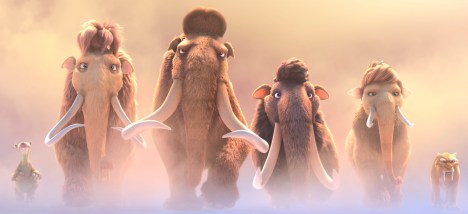
On the other hand, Ice Age: Collision Course is a film that opens with beloved squirrel Scrat hijacking a space ship while chasing his nut and setting an asteroid on a collision course with our protagonists.

Men and women of mist-ery...

Men and women of mist-ery…

Continue reading

Non-Review Review: Independence Day – Resurgence

Independence Day: Resurgence is the very limit case of nineties nostalgia.

This is true in a very real sense. The film is released two decades after the massive success of the original film, which came to theatres in 1996 offering unprecedented and awe-inspiring destruction on a previously unimaginable scale. Independence Day changed the public’s expectations for blockbusters, reworking the scale of apocalyptic destruction that could populate big summer releases. However, as much fun (and as well loved) as the film was, nobody was really clamouring for a sequel.
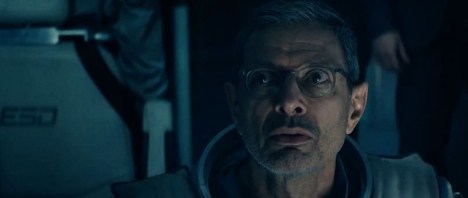
Jazzy Jeff, without the Fresh Prince.

Jazzy Jeff, without the Fresh Prince.

However, there is another truth about nineties nostalgia buried within this belated and bloated sequel. The nineties were a different time. They were a time at which Franci Fukuyami could make a semi-credible case that the United States stood at the end of history. The Cold War was over. The War on Terror had yet to begin. The Twin Towers still stood, and most Americans were oblivious to the existence of Osama Bin Laden or al-Qaeda. The economy was reasonably prosperous. Politics were relatively stable.

It is, of course, too easy to let nostalgia paint the nineties as some sort of “golden age.” There were horrific conflicts unfolding in Africa and Eastern Europe. There were clear shifts in American political rhetoric that paved the way for the current political climate. Paranoia and conspiracy theory were working their way into mainstream political discourse. However, the nineties were a time of much lower anxiety for most Americans, and time of peace rather than perpetual existential warfare.
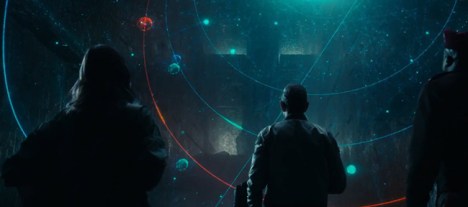
Maps to the stars.

Maps to the stars.

As a result, Independence Day had a radically different context in the summer of 1996 than it would in the summer of 2016. In 1996, the destruction of the White House and the Empire State Building could be treated as ridiculous escapism rather than traumatic repetition. The narrative of American individualism and exceptionalism was oddly endearing in the midst of a period of sustained global stability rather than an era of resurgent (and violent) political nationalism.

Even in terms of entertainment, the original Independence Day arrived at a point where it was enough for a blockbuster to be a blockbuster, where thematic resonance and political commentary were optional extras that were tolerated so long as they didn’t get in the way of the explosions. Independence Day was released at a point where it was enough for a movie to be “dumb fun” without carrying a deeper message. Without the internet to pick films apart and pour over their subtext, it was a lot easier to just release an unassuming spectacle.
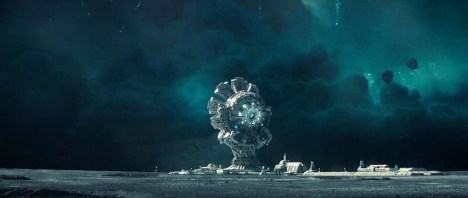
Over the moon about it.

Over the moon about it.

More than that, the sheer practical limitations of filming a blockbuster helped to rein in a lot of potential excesses of a film on this scale. While there was always computer-generated special effects, a heavy reliance on practical models and practical effects tended to dictate both the scripting and the direction of the film. Although Independence Day was an ode to heightened spectacle, there were limits to that spectacle. There was only so much of the aliens that could be shown, there were moments where things couldn’t be exploding.

In short, Independence Day was very much the perfect movie for 1996. In its own way, Independence Day: Resurgence is an ode to that. It is also a reminder that this is no longer 1996.

Not quite the Gold(blum) standard.

Not quite the Gold(blum) standard.

Continue reading

Non-Review Review: The Conjuring 2

The Conjuring 2 is effectively a tentpole horror.

It is very much a horror film, with James Wan demonstrating all the skill and technique that he had honed over years working in the genre. There some wonderful slow pans and creepy camera movements that emphasise negative space, some very effective use of timing and mounting dread, and a palpable sense of menace. There are jump scares and slow scares, and enough false alarms to keep the audience on the edge of their seats. The Conjuring 2 is in many ways an old-school archetypal horror film.

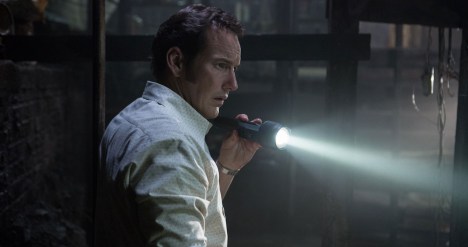
He ain't afraid of no ghost...

He ain’t afraid of no ghost…

However, there is something interesting happening in the background. The Conjuring 2 might have all the basic ingredients of a horror movie, but they are assembled in the style of a tentpole blockbuster. To be fair, the big summer release date is a bit of a clue, as is the climax that features a sweeping race-against-time as the heroes try to desperately make it back from the train station. Indeed, The Conjuring already launched something of a shared horror universe with the spin-off Annabelle.

In some respects, The Conjuring 2 feels like something of a mash-up, reflecting contemporary pop culture’s fascination with mashing existing concepts together to form intriguing cocktails. What is really surprising about the film is how well it works.

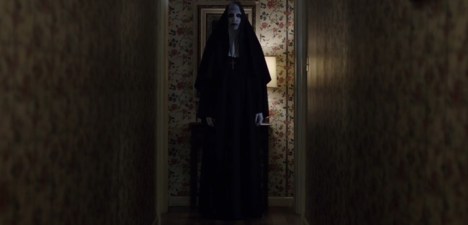
"I'm sorry, you wouldn't happen to be able to direct me to the Marilyn Manson concert, would you?"

“I’m sorry, you wouldn’t happen to be able to direct me to the Marilyn Manson concert, would you?”

Continue reading

Non-Review Review: Teenage Mutant Ninja Turtles – Out of the Shadows

There is something extraordinarily cynical about Teenage Mutant Ninja Turtles: Out of the Shadows.

The issue is not that movie refuses to make sense. The issue is not that its characters are (at best) archetypes and (at worst) plot functions. The issue is not that the script is at once thin on detail and heavy on exposition. The issue is not that the direction is clunky and unfocused, lacking basic technique and cluttering up would should be fairly standard set pieces. The issue is not even that the computer-generated imagery is ropey in places, with a lot of detail on the four turtles but great difficulty bringing Splinter to life.

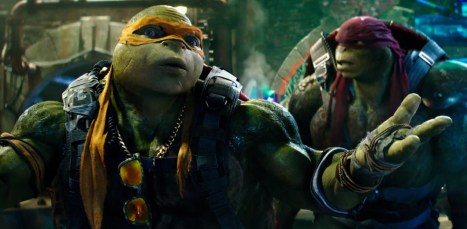
I like Mike.

I like Mike.

The issue is that the move is completely unapologetic about any of these issues. It is not that the movie abandons plot logic to focus on character dynamics, or that it ignores character development in order to get to impressive set pieces. The clunky expository dialogue is not countered by witty banter or knowing irony. There is a sense that Out of the Shadows is a film comfortable with its own shoddiness. It isn’t that the film tries and fails, it is that the film barely tries at all. There is a leaden and lifeless quality to it all.

The issue is not that Out of the Shadows is a stupid dumb action movie, because stupid dumb action movies can be great fun on their own merits. The issues is that Out of the Shadows assumes that its audience is just as dumb as it is.

Turtle power.

Turtle power.

Continue reading