• Following Us

  • Categories

  • Check out the Archives


  • Awards & Nominations

Non-Review Review: Dating Amber

Dating Amber is a sweet, if perhaps overly familiar, coming of age story.

Dating Amber has a pretty compelling hook. Eddie and Amber are both gay teenagers growing up in rural Ireland during the mid-nineties. The country has just decriminalised sodomy, and finds itself in the midst of a highly divisive and contentious referendum on divorce. Against this backdrop, Amber hits on a clever idea to avoid the scrutiny of her classmates. She and Eddie will pretend to be a couple, so that they can both present as heterosexual long enough for Amber to escape this suffocating environment.

Vicious cycles.

It’s a very straightforward but compelling premise. It evokes the set-up of something like Easy A, tapping into the youthful anxieties of teenage life, and combines it with the increasingly progressive and diverse entries into the genre like Love Simon or Handsome Devil. Writer and director David Freyne draws from his own teenage experiences to add a level of authenticity, and the film is elevated by two winsome performances by Lola Petticrew and Fionn O’Shea.

The film lacks the delicate tonal balance that is necessary to elevate a teenage coming of age story from a charming affair to a classic of the genre, swerving too dramatically from its playful and cheeky opening premise to an overly earnest and sincere final stretch. It allows suffers slightly from a heavy reliance on formula, hitting most of the marks expected of a story like this, but never really finding a way to push past those conventions into something more profound or insightful. However, Dating Amber is an appealing and engaging entry into the genre.

Couple of friends.

Continue reading

Non-Review Review: The High Note

The High Note doesn’t quite manage to hit the peak that it title suggests, but it hits most of the notes that it needs to.

The basic plot of The High Note concerns a personal assistant named Maggie who works for Grace Davis. Davis is a singer in the twilight years of her career, working hard to remain relevant and to stay afloat in an industry that seems ready to cast her aside. Maggie is convinced that her boss (and her idol) is capable of delivering so much more than her management and her record label expect of her, but finds herself trapped in an uphill battle to prove that she has a vision that is worth listening to.

She’s got the juice.

There are any number of obvious comparisons to be made with The High Note. The classic underappreciated-working-stiff-is-finally-recognised-as-a-prodigious-talent narrative unfolding against a Hollywood backdrop obviously evokes any of the myriad (official and unofficial) versions of A Star is Born. However, the emphasis within that template on a demanding ageing female star and the younger woman working under her feels like it is somewhat carried over from Nisha Ganatra’s previous film, Late Night.

The High Note is tremendously predictable, but it’s to the credit of Flora Greeson’s screenplay that the movie understands this. There are very few surprises nestled in the story, but The High Note leans into that. It is a surprisingly and endearing gentle movie about the path to stardom, one that keeps its stakes low and which tempers its formula with just enough self-awareness to avoid feeling stale or rehashed. The High Note is solid, sturdy and appealing – even if it seems to reflect the Grace Davis that audiences see, rather than the one that Maggie aspires towards.

Tune in for more…

Continue reading

Non-Review Review: Scoob!

Have you ever wondered what it might look like is a beloved fifty-one-year-old children’s television franchise had a midlife crisis?

If so, Scoob! might just be for you.

We have lift-off.

Continue reading

Non-Review Review: M.o.M. Mothers of Monsters

M.o.M. Mothers of Monsters is an ambitious and clever piece of indie horror constructed on a tight budget.

It marks the feature-length narrative directorial debut of Tucia Lyman. Lyman has a variety of experience in horror, particular on television shows like Fact or Faked: Paranormal Files, Ghosts of Shepherdstown and Ghosts of Morgan City. With that in mind, it makes sense that Lyman’s first narrative feature should borrow a lot of the language of paranormal reality television. M.o.M. is essentially a found-footage horror film, with the audience navigating and assembling a collection of seemingly raw video files into a cohesive narrative.

Will he snap?

There is something inherently old-fashioned about the found footage horror template. The format was all the rage in the early years of the twenty-first century, perhaps informed by the use of first-person camcorder footage to document events like 9/11. It arguably reached its apotheosis with the release of the security-camera home haunting horror Paranormal Activity in 2007. Contemporary horror has moved back toward more traditional approaches, prompted by the success of films like The Conjuring, making M.o.M.‘s found footage approach feel decidedly retro.

M.o.M. is occasionally a little clumsy and heavy-handed, sometimes stretching its premise a little too far and struggling to balance sharp tonal shifts between heightened sensationalism and grounded domestic horror. Still, there’s something endearingly committed and energetic in this low-fi horror thriller, an infectious and gleeful embrace of its more absurd elements.

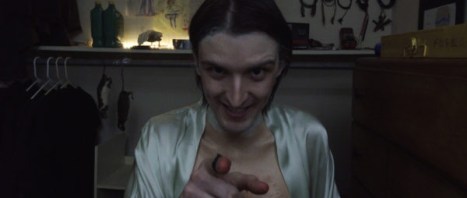
Receiving a dressing gown.

Continue reading

Non-Review Review: The Assistant

The Assistant is a quiet and simmering examination of complicity.

The story unfolds over the course of a single day in the life (mostly the office) of Jane. Jane is the eponymous assistant, working at an independent film company in New York as the right-hand woman to a(n in)famous producer with an explosive temper and monstrous appetites. Kitty Green’s film follows Jane from her early morning Uber ride into work to the single muffin that she allows herself at the deli on the way home, keeping an intense and claustrophobic close-up on lead actor Julia Garner.

Garnering praise.

The Assistant arrives with enough weight that the audience knows what it is about even before the film clearly articulates it. The Assistant is transparently a #metoo movie and the unnamed and largely unseen (but very clearly heard and very strongly felt) producer is very plainly a stand-in for convicted sexual offender Harvey Weinstein. This allows The Assistant a great deal of freedom. Because the audience comes to the film with that assumed knowledge, Green’s script and direction are able to peddle in ambiguity and tease the veil of plausible deniability.

The beauty of The Assistant lies in the way that both the audience and Jane (and seemingly everybody else) knows what is happening, but keep their head down and their focus elsewhere. It’s a story about looking away so that one might see no evil and the noise that people make so that they might hear no evil. It’s an anxious, ominous, suffocating study of the constant smoothing done at the margins of these sorts of horror stories.

Dial it back.

Continue reading

Non-Review Review: Underwater

There’s a surprising charm to Underwater, which largely extends from its sense of propulsive forward momentum.

Underwater is not necessarily a good movie. It often feels like two radically different and highly derivative science-fiction movies stitched together, transposed from deep space to the deep sea. Underwater is never entirely sure whether it wants to be Gravity… but in the ocean” or Alien… but in the ocean”, and so repeatedly finds itself caught between the two extremes. It is a film populated by archetypes rather than characters, and which is pushed from one set piece to the next by percussive force rather than any coherent throughline.

A deep dive.

And yet, in spite of all that, there’s something strangely appealing about the mismatch of elements at play in Underwater. It isn’t just the way in which the film bounces haphazardly between a disaster film and a monster movie, it is also reflected in the casting. Underwater is a B-movie that brings together quite an eclectic set of leads. Kristen Stewart continues the gentle transition back towards the mainstream that began with Charlie’s Angels, but finds herself working opposite a cast including arthouse favourite Vincent Cassel and broader performers like T.J. Miller.

These seemingly contradictory elements create a strange frisson within the film, one that is just as volatile as the energy reactor that (inevitably) threatens to got critical to add an extra layer of pressure to the already beleaguered characters. However, director William Eubank seems to understand that these components are highly unstable, and so Underwater moves a dizzying pace that helps to prevent any of internal imbalances from reaching critical mass. It’s hardly the stuff of create cinema, but it’s a surprisingly sturdy and energised B-movie.

Suited to the task.

Continue reading

Non-Review Review: Fantasy Island

What, exactly, is the point of the Blumhouse reboot of Fantasy Island?

To be fair, Blumhouse are a studio with a varied track record. They have produced some of the most interesting and compelling mainstream horror movies of the past few decades, including films like Get Out and The Invisible Man. They have also produced a fair amount of cynical schlock, such as Truth or Dare. There are also a number of films that seem to exist in the middle ground between those two extremes, like The Hunt or Black Christmas. It’s certainly a more varied approach than the standard horror films that heralded the studio’s arrival, like Insidious or Sinister.

Palming it off.

Jason Blum is a shrewd producer, and there’s a sense in looking at the studio’s output of trying to balance competing artistic and commercial demands. Blum tends to keep budgets under control, but he also seems to offset the riskier and more ambitious projects with generic crowd-pleasing fare. Fantasy Island would seem to belong in that category, but exactly what crowd is it intended to please? Watching Fantasy Island is a strange experience, and not just because of the multitude of structural and storytelling problems.

On a more basic level: who exactly is this movie for?

Can’t stick the island-ing.

Continue reading

Non-Review Review: Butt Boy

Butt Boy is a single joke stretched over one hundred minutes. However, the film is elevated by its sheer and unrelenting commitment.

At its core, Butt Boy is a piece of surrealist comedy. Chip Gutchell is a middle aged man who works a deadend job “in computers” and lives with a wife who seems actively hostile to the idea of intimacy with him. His life is empty and meaningless, until he has a spiritual experience in the middle of a proctology exam. Chip becomes obsessed with placing objects in his butt, indulging those urges whenever he is left unattended. Gradually, those desires grow in intensity with catastrophic results.

It is a naturally absurd set-up, one that simultaneous offers broad riffs on heterosexual masculine anxieties and the escalating horrors of addiction. After several people go missing, alcoholic police officer Russel Fox begins to put the pieces together with no idea about where it might end. Butt Boy is an ultra low budget independent film, and unapologetically so. Everything is hypersaturated, props and locations often seem improvised, and the quality of performance varies wildly from scene-to-scene. More than that, the film is essentially an extended riff on one comedic set-up.

And yet, in spite of all of that, Butt Boy works surprisingly well. The key is the film’s single-minded focus on that single absurd premise, on the image of a man who has developed an anal fixation so strong that he at point tries to consume an entire police car. Butt Boy never flinches. It never breaks eye contact. It never corpses, not matter how far it follows that premise down its various rabbit holes. There is something strangely appealing in that, which suggests a bright future for writer, director and lead actor Tyler Cornack.

Continue reading

Non-Review Review: Trolls World Tour

If nothing else, Trolls World Tour demonstrates how far animated American films have come in the past few decades.

Modern family audiences have come to expect – and not unreasonably – a certain amount of polish and sophistication in terms of the stories being told. It’s common to credit Pixar with this evolution of expectation, given the narrative and thematic sophistication of films like Toy Story or Finding Nemo. However, the truth is that this was a movement across the medium, with Dreamworks also making significant contributions with films like Shrek, How to Train Your Dragon and even Kung-Fu Panda.

Keep Trollin’, Trollin’, Trollin’, ya!

Children have always been more sophisticated media consumers than people credit them, and it’s notable that younger children increasingly process information and storytelling in more concentrated bursts; platforms like Vine and Tik Tok spoke more to younger audiences than older ones, often hypercompressing narratives with an impressive efficiency. As an audience, kids are both smart and shrewd, and often capable of handling whatever film or television can throw at them. It seems like only recent have film and television begun to catch up to them.

This is part of what makes Trolls World Tour so disheartening, particularly in the context of this revolution in family films. Trolls World Tour believes that all it needs to do to distract children is to confront them with bold colours and familiar music. Maybe that’s correct, and it seems likely that Trolls World Tour will be suitably soothing to younger viewers. However, there’s something slightly cynical and patronising in the movie’s commitment to the philosophy of “just enough.”

Ballooning problems.

Continue reading

Non-Review Review: Black Christmas (2019)

Black Christmas is an interesting misfire.

There’s something inherently clever about using the familiar template of a slasher movie to engage with the idea of toxic masculinity and the horrors of campus culture. Sophia Takal and April Wolfe certainly have a lot to say, and producer Jason Blum deserves a great deal of credit for positioning a film like this as part of the larger “social thriller” milieu that includes films like The Invisible Man or Get Out or Us. There’s a lot bubbling through Black Christmas, and it’s great to see a slasher film dabbling in these ideas.

Take a bow.

The biggest problem with Black Christmas is that it simply doesn’t work as a horror film. In terms of basic narrative mechanics and pacing, Black Christmas is a mess. The film suffers from many of the same structural problems that haunt so many disposable horror movies; the characters are thinly sketched, the film’s slow build-up feels a little too slow and its climactic confrontations feel a little too rushed and its internal logic is close to non-existent. These problems are compounded by the fact that actually positioning this movie as a remake creates an extra level of extraction.

Black Christmas has good ideas, but is somewhat lacking in the execution.

Don’t choke.

Continue reading