• Following Us

  • Categories

  • Check out the Archives


  • Awards & Nominations

Non-Review Review: Unbroken

The true story of Louis Zamperini is absolutely fascinating. It lends itself to this sort of big spectacle. It has everything you need for a movie that might clean up during awards season: a historical setting; a war; a sporting story about triumph of adversity; incredible physical transformations from the cast; a character enduring incredible hardship and coming out the other side. These are the sorts of ingredients that make a Best Picture contender. Unbroken just heaps more and more on top of these already alluring elements.

It isn’t the terrible and messy script that ultimately defeats Unbroken, with beloved filmmakers Joel and Ethan Cohen at the top of the bill. It isn’t the pedestrian unchallenging direction, either. It isn’t Alexandre Desplat’s condescending and patronising score, that doesn’t trust the audience to determine what they should be feeling from one moment to the next. It is not even the cynical Coldplay song playing over the closing credits, to put a pleasant life-affirming spin on events.

The Oscar race is on...

The Oscar race is on…

The detail that really shatter Unbroken is the fact that all of this has been very carefully and meticulously calibrated to check off the requisite items on the big Oscar check list. Unbroken is just as mechanical and lifeless a production as Transformers 4, but it happens to be built for a different purpose. There is no energy here, no enthusiasm, no emotion. It is just a bunch of things that have been successful in other stories heaped on top of one another, hoping to hit the high score on that fateful morning in January 2015.

Despite managing to eat up an incredible amount of attention and discussion in the larger Oscar race – taking attention off far more deserving contenders – Unbroken is a complete and utter misfire.

"This is what happens to anybody who suggests Merry Christmas Mister Lawrence is a better Japanese prisoner of war film."

“This is what happens to anybody who suggests Merry Christmas Mister Lawrence is a better Japanese prisoner of war film.”

Continue reading

Non-Review Review: Foxcatcher

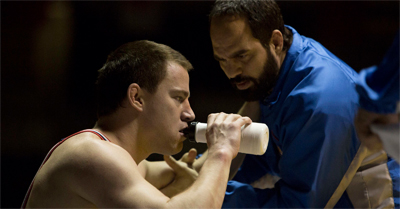
Foxcatcher is exhausting.

Director Bennett Miller’s account of the relationship between billionaire John “Eagle” DuPont and the Schultz brothers is a draining experience. Beautiful performances, stunning cinematography and a minimalist script create an uncomfortable and looming sense of dread. Even those unfamiliar with the story DuPont’s sponsorship of the United States Olympic Wrestling Team cannot help but feel tragedy bearing down. Foxcatcher is a heartbreaking and harrowing piece of work, an affecting and unsettling tale of power, desperation and loneliness.

Wrestling with demons...

Wrestling with demons…

Foxcatcher is beautifully crafted. Every element of the production is carefully and meticulously put together. Steve Carell transforms himself to play the role of DuPont, assisted by superb make-up overseen by Bill Corso and his team. Every frame of the movie looks crisp, the blues and reds and yellows popping out of the screen; Greig Fraser’s cinematography effectively captures the starkness of the Pennsylvanian landscape across the seasons. Miller is comfortable enough to let Foxcatcher unfold at its own pace, never rushing.

The result is a compelling and grimly fascinating story, told elegantly. There are points when Foxcatcher perhaps seems a little too distant and clinical, but the three lead performances help to keep the film firmly grounded.

To catch a fox...

To catch a fox…

Continue reading

Non-Review Review: Exodus – Gods and Kings

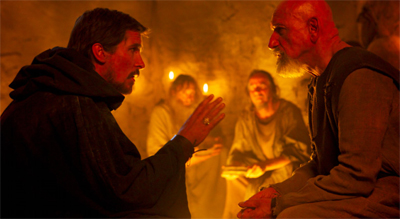
Exodus: Gods and Kings might be more traditional in structure and execution than the year’s other big biblical epic, but it shares a lot of the same core sentiments of Noah. Both films posit the Old Testament God as a primordial and almost unfathomable force, transforming biblical parables in epic horror stories. Both accept the divine as inhuman, almost by definition; both offer harrowing and unsettling depictions of stories that many viewers will know from childhood or have heard dozens of times before.

Exodus: Gods and Kings suffers a bit with its pacing, trying to boil the core Moses stories down into a single two-and-a-half hour narrative. The film runs through a check list of iconic moments, struggling to squeeze so much in that the story of the reed basket is mentioned only in passing. Instead, the film moves from Moses’ relationship with Ramses II through to his exile through to his epiphany through to his military rebellion through to the plagues through to the exodus.

"Well, I got back to Gotham in six days, I think I can get us to the Promised Land."

“Well, I got back to Gotham in six days, I think I can get us to the Promised Land.”

It is an epic story in almost every sense of the word, and Exodus: Gods and Kings struggles to contain it all. Often key elements are only present for moments before the film has to hurry along – the burning bush lingers in the background; the golden calf is glimpsed only from the distance. So much ground is covered that it is occasionally difficult to maintain focus, as Moses seems to lose and gain families with each passing act break. Exodus: Gods and Kings holds itself together under the pressure, but the strain can be felt.

Nevertheless, Exodus: Gods and Kings largely works. Feeling more like Kingdom of Heaven than Gladiator, the movie does a wonderful job of building a massive and sprawling (and foreign) world. Exodus: Gods and Kings looks and feels like a more traditional biblical epic than Noah, and Scott’s efforts to ground the film in a tangible reality only serves to enhance the awe-inspiring scale of the horror on display here. Exodus: Gods and Kings is an exploration of faith and devotion, asking uncomfortable questions and leaving the answers to the audience.

"Let us sit upon the ground and tell sad stories of the death of kings..."

“Let us sit upon the ground and tell sad stories of the death of kings…”

Continue reading

Non-Review Review: The Penguins of Madagascar

The Penguins of Madagascar is solid family entertainment. It does not rank among the best of Dreamworks’ animated output, nor among the year’s best animated films. However it is a fun adventure movie that moves along at just the right pace – allowing a number of action set-pieces and a solid cast carry most of the weight. The Penguins of Madagascar is fun and solid; it is arguably more fun and more solid than any of the three Madagascar movies that spawned this spin-off.

The Penguins of Madagascar is just what the doctor ordered with the holiday season approaching. It is a film that makes for a solid family diversion, a movie that will appeal to kids without pandering too heavily, and will acknowledge the adults in the audience without losing focus. It is an enjoyable romp, one that delivers almost perfectly on what it sets out to do. It isn’t transcendental or brilliant in the way that The Lego Movie was, but it is more than merely functional.

Cheesy? Sure.

Cheesy? Sure.

Continue reading

Non-Review Review: Wild

Wild is adapted from Wild: From Lost to Found, Cheryl Strayed’s autobiographical account of her spiritual 1,100 mile trek across the California Pacific Trail. The bulk of the movie features Reese Witherspoon carrying a gigantic backpack stuffed with the essentials – described accurately, and perhaps affectionately, by some observers as a “monster.” This image adorns the posters and publicity materials, and feels strangely appropriate. Cheryl may have carried a gigantic back upon her back, but Reese Witherspoon carries the entire movie.

To be fair, Wild is not a bad film on its own merits. It is perfectly functional, if a little familiar in places. However, it is Reese Witherspoon’s performance that sets the film apart. It is a powerful and naked lead performance which counts among the best work in the actress’ career. The plot and character beats may feel like they have been inherited from countless other “find yourself in nature” films, it is Witherspoon who imbues Cheryl (and, by extension, the film) with a warm humanity.

Into the wild...

Into the wild…

Witherspoon a momentous performance, and Wild seems keenly aware of this. The film knows it has a gifted performer at its core giving one of the most memorable performances of the year. So Nick Hornby’s screenplay and Jean-Marc Vallée are clever enough to stand back; the bulk of the film seems built around Witherspoon, a showcase for the performer. That is a lot of weight; even more than the hefty backpack that Strayed carried with her across California. Witherspoon is more than up to the task.

Wild is a movie that lives or dies on the strength of its lead performance. Luckily, Witherspoon is tremendous.

A long walk home...

A long walk home…

Continue reading

Non-Review Review: Horrible Bosses 2

Horrible Bosses 2 is a cluttered film. In many ways, it is handicapped by a reluctance to let go of what worked the first time around. As a result, the film seems to bring back just about every cast member it can, ensuring that everybody gets their own little arc and their own pay-offs. Two of the three original horrible bosses get extended subplots in the sequel, with an expanded role for another side character.

This leaves the film feeling a little crowded. The new additions to the cast seldom get room to breath. Horrible Bosses 2 brings in a rake of superb talent to fill out the supporting cast, but doesn’t have the time to do anything particularly interesting with them. Chris Pine makes the most significant impression, but Horrible Bosses 2 wastes  talent like Christoph Waltz and Jonathan Banks in fairly bland roles.

"I spot a sequel..."

“I spot a sequel…”

And yet, despite its problems managing space, Horrible Bosses 2 holds itself together. It’s a clumsy film, one that feels like it could have done with a script polish and some judicious editing at an early story phase, but it manages to hang a lot on the chemistry of its three leads. Even more than in the original film, Bateman, Sudeikis and Day find themselves playing archetypes rather than characters – but the fit rather comfortably into those archetypes.

Bateman, Sudeikis and Day spend a lot of Horrible Bosses 2 talking over one another – something that more than one character acknowledges over the course of the film. The result is a lot like the film itself; it’s often difficult to separate the important material from the background noise, but there’s also an underlying sense of fun that just about keeps everything ticking over.

"We've all seen Reservoir Dogs, right?"

“We’ve all seen Reservoir Dogs, right?”

Continue reading

Non-Review Review: Woman in Black – Angel of Death

Horror sequels are notoriously difficult beasts. Much like comedy sequels, there’s the inevitable conflict between what the audience wants and what the audience has seen before. If you plan on replicating the jump scares too faithfully, why not watch the original? If you want to do something fresh, why bother sticking the name on the front? It is an interesting challenge facing film makers, and it’s something that shows. It is very hard to think of a horror sequel that competes on the same level as the original, let alone surpasses it.

Woman in Black: Angel of Death finds itself stuck in that trap. The original Woman in Black was very much a classic Hammer Horror film, a movie more about suggestion and scale than blood and guts. Never afraid to reinforce a jump scare with an orchestra string section, there was something quite endearing and old-fashioned about the way that Woman in Black conducted itself. It was an affectionate throwback to a style of horror largely forgotten in this day and age.

"Gee... I wonder what could possibly be in this creepy basement at this hour of the night..."

“Gee… I wonder what could possibly be in this creepy basement at this hour of the night…”

Given the success of Woman in Black, a sequel was inevitable. However, Angel of Death faces a lot of the issues that tend to plague horror sequels – cast attrition, a sense of familiarity, a sense that most of the best tricks have already been used. To be fair, Angel of Death holds itself together reasonably well for its first two acts. There are creaky moments, and a sense that the movie is trying to hit too many familiar notes. However, the script comes off the rails in the third act, as the film stops trying to imitate its predecessor and attempts to offer something new.

Sadly, the third act simply doesn’t work, bouncing between an air field and a supernatural hostage crisis. The result is that Angel of Death collapses in on itself – leading to the sense that this is a rather disappointing sequel.

Sadly, Chris deBurgh has yet to provide a theme song for the series. Maybe next time?

Sadly, Chris deBurgh has yet to provide a theme song for the series. Maybe next time?

Continue reading

Non-Review Review: Whiplash

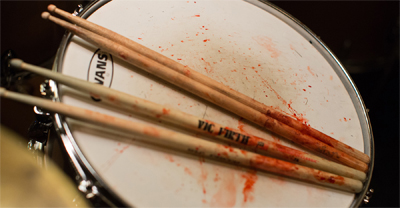
The joy of Whiplash is in how the film subverts so many of the conventions of the “unconventional teacher pushes promising young student” subgenre. A one-sentence plot summary for the film suggest an inspirational and life-affirming tale. Andrew heads to a prestigious music school to hone his skills on the drums, and encounters an obnoxious and confrontational teacher who pushed him to his limits. One can already hear the applause, see the inevitable hug, feel the radiating mutual respect.

Whiplash carefully and meticulously subverts these expectations, avoiding many of the familiar plot beats that one might expect from a story like this. There’s a raw, gruelling honesty to the story – Whiplash is not a story calibrated or tailored to make the audience feel particularly comfortable or happy. Indeed, it addresses its central themes with a refreshing candidness. It asks some very tough questions about honing talent and the responsibilities of a teacher. It doesn’t offer any easy answers.

Anchored in two compelling central performances and a beautiful soundtrack, Whiplash builds to a beautifully cathartic climax, one that refuses to wrap too tight a bow around an intriguing little film.

Stick around...

Stick around…

Continue reading

Non-Review Review: Interstellar

Interestingly, Christopher Nolan seems to have generated a reputation as a rather detached director. Common wisdom around Nolan’s films suggest that the film-maker is perhaps too cold and clinical in his approach to the material; that his films lack warmth or humour. This reputation is probably a result of the director’s fascination with non-linear storytelling. After all, The Dark Knight is his only straight-arrow-from-beginning-to-end film.

Probably also due to the narrative contortions and distortions of films like Memento or The Prestige, Nolan is generally presented as a film-maker who constructs visual puzzle-boxes. His films are frequently treated as riddles to be solved. Consider the discussion of narrative “plot holes” in The Dark Knight Rises that fixates on how Bruce Wayne got around back to Gotham, or the discussion on the mechanics of the final shot of Inception. This approaches to his work tend to divorce the viewer from his films.

Everything burns...

Everything burns…

Interstellar will likely be Nolan’s most polarising film to date, replacing The Prestige or The Dark Knight Rises. The film offers an extended two-and-a-half hour rebuttal to accusations that Nolan is detached or distant. Much has been made about the attention to detail on Interstellar. The physics on the movie were so exact and precise that physicist Kip Thorne actually made theoretical advances while working on the film.

However, at the same time, one character posits love as a force more powerful than gravity or time. Interstellar might be precise and meticulous, but it is not a film that lacks for an emotional core; it is not a movie that lacks for warmth. Interstellar feels like a conscious attempt to cast off the image of a cynical and cold film-maker.

Out of this world...

Out of this world…

Continue reading

Non-Review Review: The Drop

It is suggested that hell is other people. Perhaps not so much. Perhaps hell is the absence of other people. Towards the end of The Drop, a character ruminates on the idea of eternal damnation – suggesting that hell is nothing but eternal emptiness, a cosmic echo chamber where the damned are left with nothing but their own sense of isolation. Maybe that is what damnation is, nothing but an individual’s own loathing and self-doubt reflected back them, amplified through the darkness.

The Drop is a tense and claustrophobic thriller. The bulk of the action unfolds around the small world as Bob knows it. Bob is a simple man. He works at a small dive, “Cousin Marv’s Place.” When asked tough questions, he simply answers, “I just tend bar.” As Bob explains, the dive bar occasionally serves as a “drop” for all the money laundered through local crime. Bob doesn’t know where it comes from or where it goes. He is only aware of it when it comes into his care and when it leaves.

It's a dog's life...

It’s a dog’s life…

The Drop is a story about isolation and loneliness. Characters reflect on their place in the world, trying to make sense of what unfolds around them. Most are unknowable to each other, mysteries and enigmas. Asked a personal question, Bob replies, “That’s my business.” When his friend Nadia asks why Bob never inquired about her own very obvious scars, Bob simply answers, “I figure that’s your business.” The world as Bob knows it is a small place. Maybe it’s constantly getting smaller.

Adapted by Dennis Lehane from his own short story Animal Rescue, The Drop wallows in its own sense of lost direction and impending doom. Michaël R. Roskam’s direction never rushes the story or the actors, allowing the film time to take in the emptiness and hollowness in this small world that briefly intersects with something much bigger and more unpleasant. Perhaps a little too stately and relaxed in places, The Drop is nevertheless an atmospheric delight.

Just Cous...

Just Cous…

Continue reading