• Following Us

  • Categories

  • Check out the Archives


  • Awards & Nominations

Star Trek – Wolf in the Fold (Review)

The first Star Trek pilot, The Cage, was produced in 1964. To celebrate its fiftieth anniversary, this December we are reviewing the second season of the original Star Trek show. You can check out our first season reviews here. Check back daily for the latest review.

Wolf in the Fold is Robert Bloch’s third and final contribution to Star Trek.

In keeping with What Are Little Girls Made Of? and Catspaw, the result is intriguing, bizarre and more than a little bit dysfunctional. More than any of the other writers drafted in to write for the science fiction show, Bloch’s fingerprints remain all over his script. Writers like Gene L. Coon and D.C. Fontana generally do a good job reconciling the work of science-fiction writers like Ray Bradbury, Theodore Sturgeon, Norman Spinrad or Harlan Ellison to make their stories fit within the frame work of Star Trek. However, even after re-writes, Bloch’s voice remains his own.
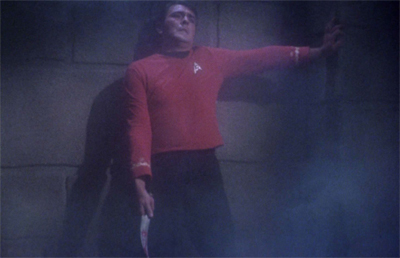
Knife to see you...

Knife to see you…

Of course, it’s quite clear that Wolf in the Fold has been through the standard re-write process. The script is a mess, struggling to tie together two basic plots (Scotty is accused of murder; the Enterprise is possessed by Jack the Ripper) in ways that don’t always work. There’s a really long and awkward expositional scene in the middle of the episode that consists primarily of Majel Barrett reading off weird-sounding words in order to assure viewers that Jack the Ripper really could be an immortal hate-fueled killing machine, given the rules of the Star Trek universe.

The are very serious problems with Wolf in the Fold. On a storytelling level, the pacing is a mess and the tone is all over the place. Bloch’s scripts continue to be even more problematic than usual when it comes to issue of gender – “Star Trek does slasher horror” is as borderline misogynistic as you might fear. However, there is something endearingly bizarre about the whole thing, as Bloch once again forces Kirk and his crew to confront an irrational universe that doesn’t necessarily conform to their understanding of it.
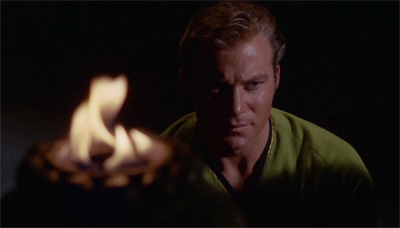
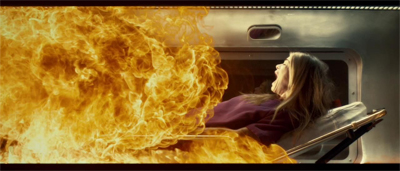
Flame on...

Flame on…

Continue reading

The X-Files (Topps) #13 – One Player Only (Review)

This November (and a little of December), we’re taking a trip back in time to review the third season of The X-Files and the first (and only) season of Space: Above and Beyond.

After a twelve-issue opening mega-arc of interconnected stories about conspiracies-within-conspiracies and wheels-within-wheels, author Stefan Petrucha and artist Charles Adlard step back a little bit to close out their run with a series of standalone stories. The four issues (and three stories) that make up the rest of their run on Topps’ X-Files comic stand alone. They are connected by themes and subtext, but very clearly stand apart from what came before. Indeed, they play out almost like a postscript to the main body of work, a series of smaller bite-sized chunks.

In that light, it is interesting that One Player Only feels – superficially, at least – a lot more in step with the television show. The early issues of the comic had seen Petrucha and Adlard creating their own supporting cast and their own conspiracy, so as to avoid stepping on the toes of the production company. The Cigarette-Smoking Man was largely reduced to a number of cameos, with Skinner popping up once or twice along the way.

Ghosts in the machines?

Ghosts in the machines?

Not only does One Player Only feature a guest appearance from supporting characters like Mr. X or yhe Lone Gunmen, it also harks back to the structure and format of the first season of the show. On the most basic of levels, One Player Only feels like a more cyberpunk take on Ghost in the Machine, right down to the fact that Mulder is drawn into a murder at a tech company by an acquaintance from his days in the Violent Crimes Division. At one point, Mulder and Scully stumble on a ransacked house, for Mulder to deadpan, “Hm. Nothing new.”

However, if one peels back the layers, One Player Only is a fascinating piece that sets the tone for Petrucha and Adlard’s last three issues on the series, while infusing the comic with a host of fascinating cyberpunk stylings and body horror that seem to call forward to William Gibson’s future writing for the show.

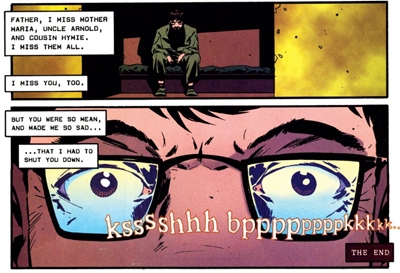
Coding out...

Coding out…

Continue reading

The X-Files – The List (Review)

This November (and a little of December), we’re taking a trip back in time to review the third season of The X-Files and the first (and only) season of Space: Above and Beyond.

The List taps into a lot of contemporary anxieties.

As with Chris Carter’s last stand-alone script for The X-Files, there is something very timely about The List. The late second season medical conspiracy thriller F. Emasculata had aired at a point where national anxieties about Ebola and other killer diseases were at a high, with the high-profile release of Outbreak and the publication of Crisis in the Hot Zone. One of Carter’s strengths as a producer and a writer was his ability to take the national pulse, and to make The X-Files reflect whatever made nineties America uncomfortable.

A capital idea...

A capital idea…

Continue reading

Non-Review Review: The Call

The Call is one-half knock-off of the underseen and underrated Cellular, a delightfully pulpy high-concept thriller which perhaps felt a little bit too similar to Phone Booth. The Call is also one-half knock-off of Silence of the Lambs, with the second half of the film in particular feeling like one of those psycho killer thrillers that were oh-so-popular in the mid- to late-nineties, but which became less popular in the post-CSI era. The Call has a delightfully ropey central premise, a high-concept for the mobile age, straining all manner of credibility and suspension of disbelief.

However, the problem lies in the execution. The Call wallows in heightened melodrama, struggling to sustain its central premise by trying to make us “feel” for the central characters in the most coy and manipulative of manners. Director Brad Anderson’s intrusive style doesn’t help matters too, seemingly unsure whether he’s making an action movie, a psychological horror or a high-concept thriller, and so instead tries to mash the three genres together with limited success.

Holding the line...

Holding the line…

Continue reading

Hannibal – Savoureux (Review)

That was one impressive first season. Hannibal has developed from something that seemed like an idle curiosity – a police procedural based around the over-used cannibalistic serial killer? – into one of the best new American dramas of the past season. I suspect a lot of that is down to the decision to structure the season across thirteen episodes, instead of a larger (more traditional) network structure of twenty-or-more. To be fair, there were a few missteps early in the first season as Hannibal tried to balance the expectations of a procedural drama with the demands of an intimate character study, but it found its feet almost half-way through the season and it has never looked back.

Hannibal has been tightly plotted and cleverly constructed from around about Coquilles, and it’s remarkably how the show has found a way to weave its “serial killers of the week” into the over-arching plot. For example, Georgia from Buffet Froid winds up being a vital piece of Hannibal’s plot to incriminate Will. The clock that the sinister psychiatrist asked Will to draw in that episode is used to generate some exquisite tension here. Everything seems to have been building towards this point, and Bryan Fuller has done a simply tremendous job constructing a thirteen-episode Rube Goldberg machine that pays off beautifully.

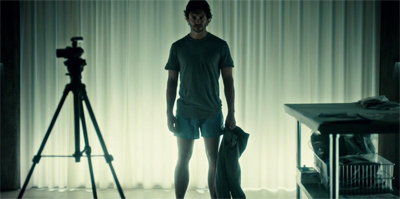
Portrait of the killer?

Portrait of the killer?

Continue reading

Hannibal – Relevés (Review)

For a show about a serial killer and the FBI’s Behavioural Analysis Unit, Hannibal is often surprisingly deep. That’s not much of a surprise, given the quality of the staff working on it, but the show is absolutely stunning meditation on identity and personality. In a way, that’s one of the smartest things about Fuller’s first thirteen episode season, building on the foundations set by Thomas Harris to construct something that fits quite elegantly while remaining its own distinct entity.

Relevés is the penultimate episode of the first season, and the point where – having used Roti to clear away some of the clutter – the show starts tying up a lot of those loose ends. Perhaps one of the most impressive things about the episode is the amount of suspense that Bryan Fuller and his staff can wring from the set-up – despite the fact that we know how this story ends, Hannibal manages to engage us so completely in the telling that what we already know seems almost irrelevant.

Things are heating up...

Things are heating up…

Continue reading

Hannibal – Buffet Froid (Review)

Buffet Froid is the most strikingly horrific episode of Hannibal to date. Of course, the show is very much a horror story and enjoys its fair share of grotesque imagery. This is the series, after all, that gave us the makeshift angels, the do-it-yourself cello and the human totem poll. However, Buffet Froid plays most obviously on the imagery and iconography of horror. This is the episode where people have no faces and skin comes off at the slightest touch and the serial killer is waiting for you under your bed.

As you might imagine for a show with such complete control of its own atmosphere, Buffet Froid works very well indeed – providing what might be the most horrific episode of the show to date.

The doctor will see you now...

The doctor will see you now…

Continue reading

Hannibal – Trou Normand (Review)

Trou Normand has a rather beautiful twist, and one which caught me – and, I suspect, a significant portion of the audience – completely off-guard. It’s not overstated or overplayed, but it manages to pack one hell of a punch. It fits surprisingly well with everything we know about the show and the characters who inhabit it, while still serving as something of a game-changer. It doesn’t change the rules of Hannibal too much, but only because the show has been so dedicated to playing with audience assumptions.

In any other show, Abigail Hobbs would be the victim that Will Graham so desperately needs her to be. Jack Crawford’s cynical suspicions would prove to be as completely off-base as his absolute faith in Hannibal Lecter. It would provide a nice moral victory for Will, even if only the audience ever knew about it, and serve as foreshadowing to Jack’s only blindness. It’s a neat narrative hook, we’ve become so subconsciously familiar with the way that these sorts of narratives work that we have come to expect it.

However, Hannibal isn’t any other show, and it demonstrates it by pulling off a particularly shrewd (and nasty) character twist.

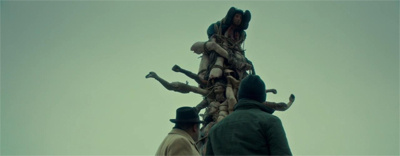
A monument...

A monument…

Continue reading

Hannibal – Sorbet (Review)

Hannibal took its time building up Hannibal Lecter as a serial killer. According to creator Bryan Fuller, there would have been a joke in Aperitif about Lecter’s culinary habits, but holding off on the sight of Lecter as a serial killer until the end of Entrée feels like it was a shrewd move. Not because it could ever fool the audience into forgetting that Hannibal Lecter is a murdering cannibal or anything like that. Instead, it builds up a certain amount of tension and suspense around the character, allowing us to see how those around him could have been blinded by his persona.

With a few obvious exceptions – knocking out Doctor Bloom in Potage or phoning the Hobbs household in Aperitif – we’ve mostly seen Lecter through the eyes of others. While the very premise of the show counts on the audience knowing who or what Lecter is, keeping him at a distance allowed the show a bit of breathing room in its first year. However, now that we’ve caught a glimpse of Lecter in action, Sorbet feels like its willing to pull back the layers on our eponymous epicurean.

Best served warm...

Best served warm…

Continue reading

Non-Review Review: Blood Rising

This film was seen as part of the Jameson Dublin International Film Festival 2013. It was the closing gala.

It is sometimes quite tough to review documentaries. It’s tempting to confuse a worthy cause with a worthy film. Blood Rising is certainly about a worthy cause. It explores the “femicides” that have been occuring in Juárez, Mexico since the nineties (if not earlier). Women are kidnapped, raped and murdered – and the local authorities have done next-to-nothing to help stem the tide of abuse. Those who dare speak up have been hounded out of the area, with some advocates even continuing the cause “in exile.” It is a very compelling and a very worthy cause, and one that deserves as much attention as it can garner.

However, even factoring in the very worthy cause and the fact that its heart is in the right place, Blood Rising feels like a rather ill-judged piece of cinema.

bloodrising2

Continue reading