• Following Us

  • Categories

  • Check out the Archives


  • Awards & Nominations

The X-Files – Zero Sum (Review)

This February and March, we’re taking a trip back in time to review the fourth season of The X-Files and the first season of Millennium.

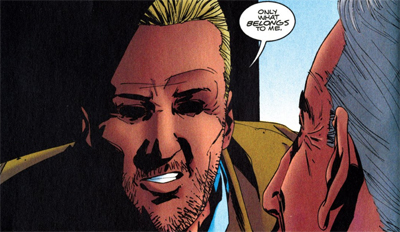
For all that The X-Files exists in a murky shadow world populated by ambiguous figures and a government conspiracy dating back generations, the show has a pretty straightforward sense of morality. No good can stem from evil, the show seems to suggest; the show’s central mythology repeatedly has Mulder and Scully confront the legacy of sins committed by their forefathers. Even the title of Zero Sum alludes to the hollowness of Walter Skinner’s deal with the devil, his moral compromise that has no demonstrable benefit and severe demonstrable harm.

In Memento Mori, Walter Skinner compromised himself. He made a deal with the Cigarette-Smoking Man, in return for Agent Scully’s continued well-being. “What’ll it take?” Skinner asked, desperate for a chance to save Dana Scully. Ever ambiguous, the Cigarette-Smoking Man offered, “Well, I’ll have to get back to you on that.” Unfolding a few months later, Zero Sum is essentially about paying the piper. It is Walter Skinner settling up with the Cigarette-Smoking Man. He rolls up his sleeves and jumps into the dirty work.
Fire and brimstone...

Fire and brimstone…

Zero Sum is a story that you could not tell with Mulder. Although Mulder never faces the same choice as Skinner, the show has been quite consistent in its portrayal of Mulder’s morality. Mulder does not compromise; Mulder does not subscribe to the theory that a deal with the devil could ever pay dividends. In contrast, Skinner is a more ambiguous and pragmatic figure. Skinner spent significant sections of the second season caught between Mulder and the Cigarette-Smoking Man. The show only firmly committed him to Mulder and Scully in Paper Clip.

Zero Sum is a fantastic example of how the world of The X-Files has really grown and expanded around the lead characters. While the show will never quite develop into an ensemble, it is a series with a broad cast. It makes sense that it should begin to use them in a productive manner.
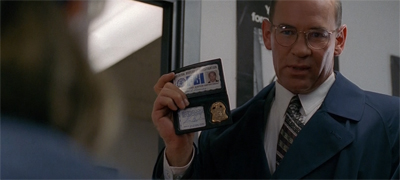
"Walter Skinner, F.B.I."

“Walter Skinner, F.B.I.”

Continue reading

The X-Files (Topps) #23 – Donor (Review)

This February and March, we’re taking a trip back in time to review the fourth season of The X-Files and the first season of Millennium.

Donor is the strongest of John Rozum’s work on The X-Files to this point. It might be his best work overall.

It is a story that very clearly and very strongly plays off the classic horror vibe that has been running through this stretch of episodes, taking the idea of supernatural revenge and poetic justice to almost blackly comic extremes. In many respects, John Rozum has pushed the comics towards a very traditional sort of moralistic storytelling – with characters frequently facing ironic consequences of their actions.

Organ grinder...

Organ grinder…

In The Silent Blade, a mass murderer kills himself with the blade that compelled him to kill. In The Kanashibari, a bunch of college kids who terrified an asthmatic classmate to death by locking him in a closet are themselves scared to death by a suffocating spectre. In Silver Lining, a killer murders innocent people to reclaim his good looks, only to lose them almost immediately in a fire while fleeing the FBI.

So Donor pushes this sort of storytelling to its logical extreme, as the resurrected body of Bruce Miller tries to reclaim the organs that his widow donated without his consent. Bruce Miller plans to take back what is rightfully his, harvesting various vital organs from recipients. Donor is a very dark little done-in-one story with a delightfully wry and cynical attitude that elevates it above many of its contemporaries.

"You have something that I need..."

“You have something that I need…”

Continue reading

The X-Files (Topps) #22 – The Kanashibari (Review)

This February and March, we’re taking a trip back in time to review the fourth season of The X-Files and the first season of Millennium.

The Kanashibari confirms what readers should expect from Topps’ licensed comics based on The X-Files. It is another atmospheric and episodic horror story, tightly plotted and written, with a grim sense of moral certainty underpinning it. The Kanashibari feels like something of a throwback, a modern-day take on those classic E.C. Comics horror stories – morality tales where the vengeance is exacted against those who have committed an injustice.

It is a throwback in other ways as well. The Kanashibari and Donor are both old-fashioned “supernatural revenge stories”, the kind of stories that would sit comfortably in the first season of The X-Files. Episodes like Shadows, Lazarus, Young at Heart, Born Again and Roland were all stories about characters seemingly returning from beyond the grave to wreak a terrible revenge against those had wronged them.

Who ya gonna call?

Who ya gonna call?

Continue reading

Star Trek: Enterprise – Dear Doctor (Review)

Next year, Star Trek is fifty years old. We have some special stuff planned for that, but – in the meantime – we’re reviewing all of Star Trek: Enterprise this year as something of a prequel to that anniversary. This January, we’re doing the first season. Check back daily for the latest review.

Dear Doctor is certainly the most ambitious episode from the first season of Star Trek: Enterprise, and also the most controversial.

The show’s first true “Prime Directive” episode, the show wrestles with the moral implications of “playing god”, attempting to justify the inevitable development of “Starfleet General Order Number One”, the rule prohibiting interference in the development of “less advanced” species. As such, there is almost an impossible amount of weight bearing down on Dear Doctor, as the show tries to explore the moral conundrums that result from contact with a less technologically advanced species.

Stargazing...

Stargazing…

Dear Doctor is an episode that is deeply problematic. Indeed, it was a show that was so controversial and so divisive that UPN itself insisted on a change to the episode’s ending. It’s an episode that tends to provoke strong reactions, from both defenders and detractors. It inspires passion. It is not uncommon to find people who will rank the episode among the very best of Enterprise and the very worst of Enterprise.

While the show’s internal logic and conclusions are quite unsettling, Dear Doctor is a provocative and challenging hour of television. It is decidedly more ambitious than any of the episodes surrounding it, even other experimental shows like Breaking the Ice or Shuttlepod One. While it might not be the best episode of the first season, it is certainly the most breathakingly ambitious and engaging. And that must count for something.

There's trouble in its DNA...

There’s trouble in its DNA…

Continue reading

Star Trek (DC Comics, 1989) #49-50 – The Peacekeepers (Review)

The first Star Trek pilot, The Cage, was produced in 1964. To celebrate its fiftieth anniversary, this December we are reviewing the second season of the original Star Trek show. You can check out our first season reviews here. Check back daily for the latest review.

There is something quite disconcerting about Gary Seven.

Abducted from Earth at a young age by a race of mysterious aliens, Gary Seven was then returned to Earth in order to ensure that human history unfolds as expected. The unstated assumption is that “as expected” is a euphemism for “according to the wishes of his mysterious employers.” Using his advanced technology, Gary Seven manipulates the world around him. His technology allows him to cloud the minds of his enemies, and to materialise wherever he might wish. He tinkers with nuclear weapons, keeping his existence – and his objectives – a secret from the local people.

Everything comes apart...

Everything comes apart…

It is interesting to wonder how Assignment: Earth might have developed had it successfully spun off from Star Trek. After all, a pilot does not exist to completely define a new television show; it exists to set up a framework through which interesting stories might be told. Would a weekly television show built around Gary Seven have explored these big questions? Or would it have been content to exist as an imitation of Mission: Impossible? As with ever road not taken, it is absolutely impossible to be sure where it might lead.

Still, Howard Weinstein’s The Peacekeepers teases out some of these interesting questions and queries. Even if it never really offers any answers, there is a lot to chew over.

A spectre...

A spectre…

Continue reading

Space: Above and Beyond – And If They Lay Us Down to Rest… (Review)

This November (and a little of December), we’re taking a trip back in time to review the third season of The X-Files and the first (and only) season of Space: Above and Beyond.

The last stretch of episodes of Space: Above and Beyond are quite mournful and introspective.

It is very difficult to tell a war story. There are a host of tightropes that any writer has to navigate. After all, it is very easy for a story about the bonds of warfare and humanity in wartime to be interpreted as militaristic or fascistic. At the same time, it is very easy for an anti-war parable to seem critical of the soldiers fighting the war, to dismiss the bravery and courage on display in that most horrific of environments.

Seeing eye-to-eye...

Seeing eye-to-eye…

With its futuristic tech and gigantic guns, as well as its fascination with the military apparatus, it is easy to read Space: Above and Beyond as a pro-military piece. Given how much pride it takes in the way that it presents military life, or how much it wallows in the military setting, a casual viewer might be forgiven for assuming the it glorifies warfare. However, this is the most superficial of readings. It ignores a lot of what the show actually has to say about combat and warfare.

Space: Above and Beyond is by turns cynical and romantic in its portrayal of this futuristic conflict – it clearly respects and appreciates the sacrifices made by those in service of mankind, but is also wary about the motivations of those ordering the sacrifices. It is a very delicate balance to maintain. However, And If They Lay Us Down to Rest… and … Tell Our Moms We Done Our Best seem to lay the cards out on the table, once and for all. This is as anti-war as the show ever gets.

Face of the enemy...

Face of the enemy…

Continue reading

The X-Files – Wetwired (Review)

This November (and a little of December), we’re taking a trip back in time to review the third season of The X-Files and the first (and only) season of Space: Above and Beyond.

Wetwired is an oddity.

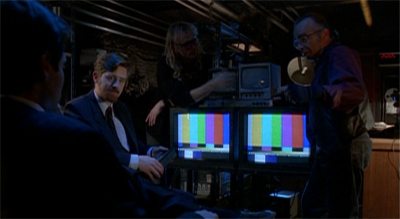
It is the penultimate episode of the third season, written by special effects supervisor Matt Beck. It is very much a conspiracy episode, albeit one lacking any real sense of forward moment and with only the loosest thematic ties to the rest of the show’s mythology. Unlike – say – Soft Light, this is not simply a “monster of the week” story with elements of the mythology grafted in. The show has largely move past those, which is why Avatar felt so weird.

More like

More like “terror vision”, am I right?

Instead, Wetwired is that strangest of government conspiracy stories. It is an episode dedicated almost exclusively to shady goings-on at the highest levels of government, but with no mention or inference of aliens or other sinister long-term plots. Wetwired stands out as something strange and hard to place; perhaps its closest analogue is The Pine Bluff Variant from towards the end of the fifth season.

The result is an oddity that is a little uneven and disjointed, an episode packed with clever ideas and concepts, but difficulty connecting them to each other.

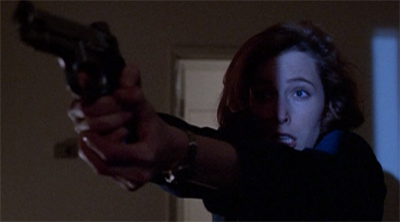
Scully has had it with Mulder's quips about her driving...

Scully has had it with Mulder’s quips about her driving…

Continue reading

Pointing Eastwood: Clint Eastwood’s Moral Compass…

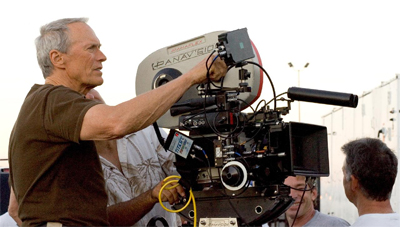
Clint Eastwood is a fascinating director. It’s hard to imagine, watching those early Spaghetti Westerns, that the badass cowboy would emerge as one of the great American directors. To be honest, while he wasn’t the first major actor to work behind the camera, I think that Eastwood really paved the way for established actors being taken seriously as directors. I’ve always been somewhat fascinated by Eastwood’s work, even when it isn’t necessarily completely satisfying as a viewing experience. I’ve still found something interesting and compelling in most of his films, even if they aren’t brilliant in and of themselves. I think that Eastwood manages a thematic consistency that’s very rare these days, and it’s possible to see a lot of the director’s moral philosophy in his work.

Continue reading

What Measure is a Monster? or Sympathy for the Devil…

I loved Super 8. It was just a wonderfully made coming-of-age tale that paid excellent homage to those old Spielberg films (even those he produced, like The Goonies, not just the ones he directed). However, as I got thinking about the film, and the plot that focuses on a rather ugly-looking alien escaped from government custody, I did find myself somewhat conflicted in what to make of the menace. Was it a poor victim of torture and inhumane treatment at the hands of the United States military, or was it a genuinely evil creature that deserved to be put down? It’s interesting how Abrams manipulates us into feeling sympathy for the creature, despite the fact it tends to feast on innocent human flesh.

Well, it's certainly alien...

Continue reading

Blood on Film: Violence and Morality…

I am always fascinated about discussions over violence in movies. Mostly because it’s one of those “hot button” issues which always comes up in some context or another and is typically portrayed as an argument with two extremes. This week, while promoting his new movie Faster, actor Billy Bob Thornton offered his own opinion of modern movie-making:

In our current state of affairs, especially in the entertainment business, we’re living in a time when we’re making — in my humble opinion — the worst movies in history.

They’re geared toward the video game-playing generation. And these video games, which I’m on my son about constantly, these games are people killing for fun, and I think traditionally in movies, there’s always been some kind of lesson in the violent movies.

In fairness, Thornton is a typically controversial figure (for example, recently alienating Canadian fans), but it’s an interesting idea to look at – the assumption that violence (and specifically how it is handled) can contribute to a movie’s quality (or lack thereof). Is he being just a little melodramatic?

Well, it is the second of December...

Continue reading