












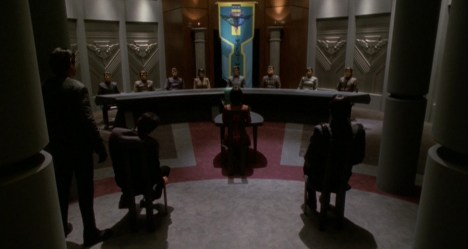
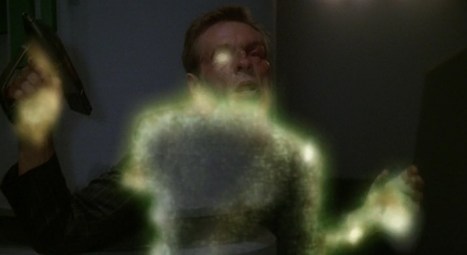
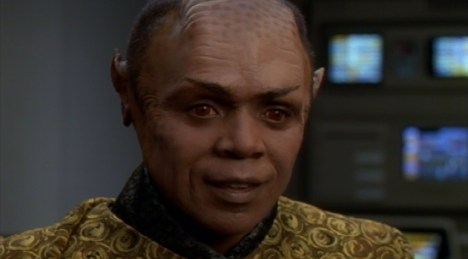
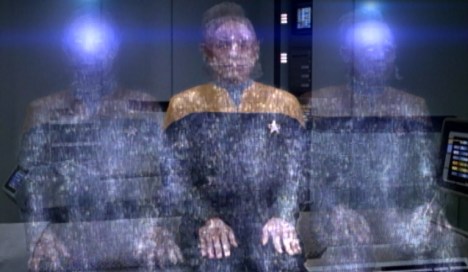
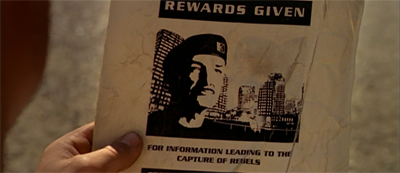
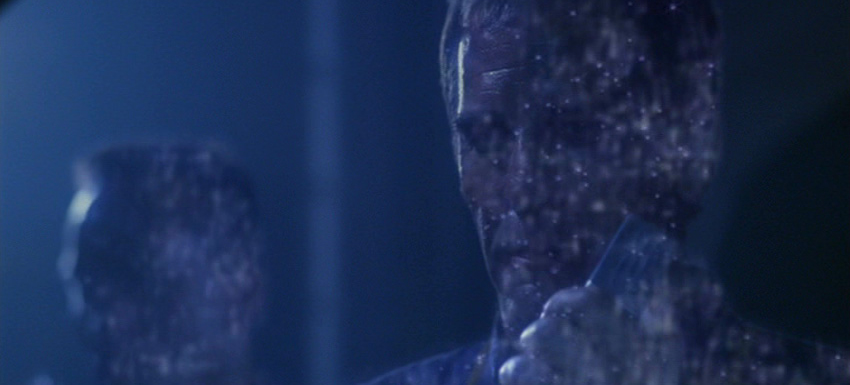
Inter Arma Enim Silent Leges is a perfectly fitting penultimate episode of Star Trek: Deep Space Nine.
Sure, the production team had originally planned for Badda-Bing, Badda-Bang to take the audience into the sweeping ten-hour epic that would wrap up the series. That certainly would have been a satisfying deep breath before the plunge, one last story celebrating this ensemble in a low-stakes adventure that treats them like an extended family before everything hits the fan. Badda-Bing, Badda-Bang would have been immensely fulfilling in that context.
Tribunal.
However, Inter Arma Enim Silent Leges feels like a necessary episode before Deep Space Nine commits to its sprawling ten-episode-long finale. In particular, Inter Arma Enim Silent Leges is the only episode of the seventh season to devote any time or any energy to the question of what happens after the Dominion War. Deep Space Nine has been so tied up in this epic existential struggle that the production team have never really acknowledged what happens when the dust settles, beyond the rolling of the closing credits and the conclusion of the series.
Inter Arma Enim Silent Leges represents the first time that Deep Space Nine has dared to look beyond the immediate status quo, to acknowledge that life will undoubtedly continue in the Alpha Quadrant after the end of What You Leave Behind. In many ways, Deep Space Nine is notable for extending a sense of political realism and pragmatism to the mechanics of the larger Star Trek universe, and Inter Arma Enim Silent Leges feels like an organic extension of that, acknowledging that events ripple beyond that arbitrary boundaries that are conveniently labelled as “endings.”
I met a man who wasn’t there.
Filed under: Deep Space Nine | Tagged: bill ross, culpability, Dominion War, Inter Arma Enim Silent Leges, morality, romulans, section 31, star trek, star trek: deep space nine, war | 7 Comments »










 the m0vie blog
Star Trek: Enterprise – The Breach (Review)
Next year, Star Trek is fifty years old. We have some special stuff planned for that, but – in the meantime – we’re reviewing all of Star Trek: Enterprise this year as something of a prequel to that anniversary. This April, we’re doing the second season. Check back daily for the latest review.
One of the more interesting aspects of a heightened franchise like Star Trek is the way that invites particular members of staff to define their own voices. On most of the Star Trek shows, it is easy to distinguish the work of particular writers from one another. Ronald D. Moore likes militarism and world-building; Brannon Braga likes time travel and classic science-fiction. There are clear voices that can be distinguished from the choir on each of the shows, for better or for worse.
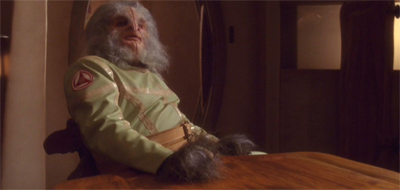
Although it enjoyed a considerably shorter run than the other Star Trek spin-offs, Star Trek: Enterprise is no exception. The Breach is a script credited to writers Chris Black and John Shiban. The two had collaborated unofficially on Canamar, a script credited to Shiban alone. The two would work together again on First Flight towards the end of the season. It is certainly a partnership that had considerable potential, if not for Shiban’s departure at the end of the season.
What’s up, Doc?
In many respects, The Breach feels like the product of those two voices. Xenophobia is a major theme of The Breach – as it was in Shiban’s other scripts for the season like Minefield, Dawn or Canamar. Like their last collaboration on Canamar and their future collaboration on First Flight, it seems The Breach presents a more balanced version of Archer than episodes like The Crossing or Horizon. This is a version of Archer who feels compelled to do the right thing, but without the same oppressive self-righteousness that drives his more awkward moments.
However, it seems like Chris Black provides The Breach with its very traditional and old-fashioned Star Trek aesthetic. A veteran of genre television with an understanding of the narrative conventions associated with the franchise, Black understands how Star Trek storytelling is supposed to work. The Breach is perhaps a little too formulaic and traditional in its storytelling, but it does demonstrate that – despite its best efforts – The Crossing had not completely buried a certain optimistic strain of Star Trek ethics.
Into darkness…
Continue reading →
Filed under: Enterprise | Tagged: 9/11, allegory, chris black, cycle of violence, cycles of violence, denobulans, enterprise, ethics, Guilt, hatred, john shiban, legacy, metaphore, morality, morals phlox, robert duncan macneill, social commentary, star trek: enterprise, the breach, war, xenophobia | 5 Comments »