• Following Us

  • Categories

  • Check out the Archives


  • Awards & Nominations

X-Men: Messiah War (Review/Retrospective)

This is the eleventh in a series of comic book reviews that will look at the direction of Marvel’s shared universe (particularly their “Avengers” franchise) over the past five or so years, as they’ve been attempting to position the property at the heart of their fictional universe. With The Avengers planned for a cinematic release in 2012, I thought I’d bring myself up to speed by taking a look at Marvel’s tangled web of continuity.

Messiah Complex is billed as the “second instalment” of the X-Men “Messiah Trilogy”, following on from Messiah Complex and leading into Second Coming. The arc essentially follows Hope, the first mutant baby born in the wake of the infamous House of M crossover and the quest by various factions to exploit her – will she be a salvation of Marvel’s erstwhile bunch of mutants, or their ultimate damnation? Messiah War essential combines the two on-going X-Men books launched in the wake of Messiah Complex, with Cable following Hope and the time-travelling X-Man as they flee those who wish the child harm and X-Force following Wolverine’s bunch of “black-ops” “darker and edgier” X-Men strike force. Of course, the only way it could get more nineties was if you threw in Deadpool, Apocalypse and Stryfe… oh, wait. They did.

Has the bar been raised?

Continue reading

Peter Milligan & Michael Allred’s Run on X-Force – Famous, Mutant & Mortal (Review/Retrospective)

For the past few months, I’ve been taking a look at Marvel’s sometimes convoluted crossover chronology as a sort of lead-in to The Avengers, arriving in cinemas in 2012. Later on today, I’ll be reviewing Messiah War, a crossover between two of the series relaunched in the wake of Messiah Complex so I thought I might take a look back at some of the series leading into it beforehand. However, the two series – Cable and X-Force both have roots in the “darker and edgier” period of X-Men history known as the nineties. Driven by Rob Liefeld, the two series became by-words for ridiculous violence, convoluted storytelling, shallow characters and lots of guns. Lots of guns.

That is not the version of X-Force I’m going to look at today.

British writer Peter Milligan apparently laughed pretty hard when he was asked to write X-Force. However, the early part of the naughties was a different time at Marvel. Perhaps the financial collapse of the company in the nineties had made the company bolder, more willing to take creative chances. Perhaps they figured that, with Grant Morrison working on New X-Men, there wasn’t anything that much more radical that Peter Milligan could do. Either way, the author was granted incredible creative control and the chance to do something truly different. He took advantage of it, and produced one of the most fascinating comic books of the past decade.

At least he’s honest about it…

Continue reading

Annihilation: Conquest (Review/Retrospective)

This is the tenth in a series of comic book reviews that will look at the direction of Marvel’s shared universe (particularly their “Avengers” franchise) over the past five or so years, as they’ve been attempting to position the property at the heart of their fictional universe. With The Avengers planned for a cinematic release in 2012, I thought I’d bring myself up to speed by taking a look at Marvel’s tangled web of continuity.

Perhaps it was the novelty of Marvel’s Annihilation crossover which lent the series its appeal. It took some of the more often overlooked space heroes of the Marvel Universe and tied them all together as part of a gripping narrative fighting against the extinction of life itself. It was loud and bright and colourful and frentic – it was perhaps the best crossover that Marvel have produced in the past five years or so. So I was very much anticipating the sequel, Annihilation: Conquest – hoping that it could be another breath of fresh air in this long trek through Marvel’s shared universe. Unfortunately, it seemed that a lot of energy of the original was gone – the series couldn’t help but feel somewhat anti-climactic.

Feel the Wraith...

Continue reading

Nova: Annihilation (Hardcover) (Review/Retrospective)

I’m currently taking a look at the modern history of the Marvel Universe. I kinda figured that I should go through at least one cycle of big continuity-heavy events to at least engage with this style of storytelling, so I can get a feel for it. Although I’m focusing on The Avengers (what with the movie and all), I’m also checking out cosmic Marvel and the X-Men at the same time. My review of the big intergalactic crossover Annihilation: Conquest is going out today, so this is a bit of a sidenote on that. Nova was the first relaunched on-going “cosmic” Marvel series, launched in the wake of Annihilation, so I thought I’d follow the first year of the book. 

I have to confess that I quite enjoyed Marvel’s attempt to reinvigorate their line of cosmic comic books with the gigantic crossover event Annihilation. And it apparently did quite well, spawning a series of associated crossovers in the years that followed, as well as an on-going series following the character perhaps most greatly affected by the events of the miniseries. Although the character has had his own series in the past (no fewer than three times) and featured in a few high-profile teambooks, it’s good to see Nova returned to prominance, particularly written by two authors who clearly know and cherish him.

Iron Man expects Richard to show some Initiative...

Continue reading

Brian Michael Bendis’ Avengers – Mighty Avengers: Assemble & Secret Invasion (Hardcover) (Review/Retrospective)

This is the ninth in a series of comic book reviews that will look at the direction of Marvel’s core continuity (and in particular their “Avengers” franchise) over the past five or so years, as they’ve been attempting to position the property at the heart of their fictional universe. With The Avengers planned for a cinematic release in 2012, I thought I’d bring myself up to speed by taking a look at Marvel’s tangled web of continuity. Get an overview of what I’m trying to take a look at here.

After the schism of Civil War, a title like Mighty Avengers makes sense on some level. If you’ve pitted heroes against heroes in a contest that you’ve deemed to be allegedly subjective (Marvel’s editorial policy was that there was no right or wrong side to the conflict), then it makes sense to follow the winners as well as the losers. The post-Civil War issues of Bendis’ New Avengers followed those heroes who had fought against registration of superheroes and lost, and Mighty Avengers was launched to offer us an on-going narrative featuring the winning side. It also seems to be a conscious nostalgic effort on the part of author Bendis, perhaps a response to the criticism that his early work on New Avengers steered clear of conventional Avengers storylines – occupied as they were with Japanese ganglands, prison breakouts and Sentry’s inter-personal issues. Here, Bendis seems to be consciously focusing on classic Silver Age devices – in the first run of issues, the State-sanctioned Avengers team faces classic foes like Ultron, the Symbiotes and even Doctor Doom. The problem is that Bendis isn’t necessarily comfortable drafting conventional superheroic fare.

Ultron puts Tony in touch with his feminine side…

Continue reading

Brian Michael Bendis’ Avengers – New Avengers Vol. 3-4 (Hardcover) (Review/Retrospective)

This is the eighth in a series of comic book reviews that will look at the direction of Marvel’s continuity (and, in particular at their “Avengers” franchise) over the past five or so years, as they’ve been attempting to position the property at the heart of their fictional universe. With The Avengers planned for a cinematic release in 2012, I thought I’d bring myself up to speed by taking a look at Marvel’s tangled web of continuity.

And now we’re entering a continuity-heavy area. You have been warned. As if we’ve been in a continuity-free zone for the past couple of weeks, remarks you, trusted reader. This is where my little experiment to venture deep into the heart of Marvel’s comic book continuity becomes a little bit more complicated and a little bit more difficult. Whereas the first part of Bendis’ run on New Avengers was relatively stand-alone (while still drawing on decades of events and continuity), it’s at this point the series becomes irrevocably intertwined with the on-going events at the heart of the Marvel Universe. It’s been described as “a spine”, and that’s pretty much exactly what it is: it’s a support structure which ties together the big Marvel events year-on-year, a thread that joins events like Civil War and Secret Invasion and Siege to each other and the greater fictional universe.

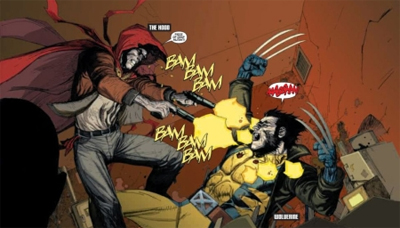
Wolverine learns the hard way not to bring claws to a gun fight...

Continue reading

X-Men: Messiah Complex (Review/Retrospective)

This is the seventh in a series of comic book reviews that will look at the direction of Marvel’s core continuity (and in particular their “Avengers” franchise) over the past five or so years, as they’ve been attempting to position the property at the heart of their fictional universe. With The Avengers planned for a cinematic release in 2012, I thought I’d bring myself up to speed by taking a look at Marvel’s tangled web of continuity.

It has been commonly accepted that the “golden days” of X-Men crossovers are behind us. Of course, “golden days” is a subjective term – for every Age of Apocalypse, there was an Onslaught Saga – but there’s no way to argue that the mutants didn’t dominate Marvel’s output in the nineties. One would have thought that with Bryan Singer’s X-Men helping give birth to the superhero genre, this past decade might have been an even better one for the franchise, but it was not to be. In fact, The Avengers seem to have replaced the X-Men as the engine driving Marvel’s storytelling universe. Some might suggest that it is so blatant that it looks intentional (prompting a movie-related “conspiracy theory”), although Marvel have casually denied it – with vice president Tom Brevoort stating “these things tend to go in waves”. However, Messiah Complex is the first of a series of crossovers with the X-Men titles following House of Mwhich would chart the franchise’s gradual return to the status quo.

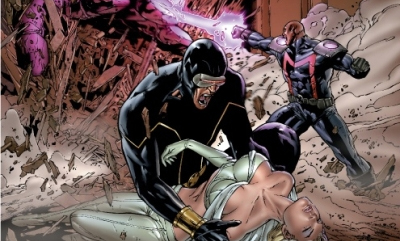
Cyclops has warmed to Ms. Frost…

Continue reading

World War Hulk (Review/Retrospective)

This is the sixth in a series of comic book reviews that will look at the direction of Marvel’s continuity (and particularly their “Avengers” franchise) over the past five or so years, as they’ve been attempting to position the property at the heart of their fictional universe. With The Avengers planned for a cinematic release in 2012, I thought I’d bring myself up to speed by taking a look at Marvel’s tangled web of continuity. Get an overview of what I’m trying to take a look at here.

Forget sides. They’re all screwed when the Hulk gets back.

– a popular internet meme which puts Civil War in perspective

I have to admit, World War Hulk reads like something of a guilty pleasure. The fantastic artwork from John Romita Jr. (whose fantastical character designs work much better here than in Kick-Ass or even Enemy of the State) certainly helps, as does the relative brevity of the miniseries. It’s a relatively self-contained five-issue storyline, as opposed to the large House of M or Civil War which directly preceded it and Secret Invasion which would follow – it also helps that the tie-in issues seem a lot less essential (and certainly less omni-present) than they did for any of those series. World War Hulk is pretty far from perfect, but it’s an enjoyable little arc from a writer who is clearly familiar with the Incredible Hulk.

Hulk makes quite an impact...

Continue reading

Non-Review Review: Punisher – WarZone

Punisher: WarZone is not a good film. But it’s not necessarily a poorly-made film, either. There’s a fair amount of skill on display here, but the problem is that the movie never seems to be sure how seriously it wants to be taken. Perhaps the closest point of reference is one of the well-made Steven Seagal films: it spends a great deal of its time delivering what amounts to ridiculousness while offering itself to the audience with a stoic face. It’s a fairly entertaining piece of disposable action fare, but it’s nothing to write home about.

Oh shoot, it's another Punisher movie...

Continue reading

Annihilation – Vol. 1-3 (Hardcover) (Review/Retrospective)

This is the fifth in a series of comic book reviews that will look at the direction of Marvel’s mainstream shared universe over the past five or so years – primarily with a focus on The Avengers as they’ve been attempting to position the property at the heart of their fictional universe. With The Avengers planned for a cinematic release in 2012, I thought I’d bring myself up to speed by taking a look at Marvel’s tangled web of continuity. This is more of a tangential entry, though, as we’re going into space with marvel’s “cosmic” titles. But still, sometimes you need to go away to come back.

When people think of the Marvel crossover events of the past decade, they’ll name ones like Civil War or Secret Invasion or House of M. Very few will mention Annihilation, Marvel’s first big cosmic crossover event of the past ten years, but those few will generally speak quite highly of it.

The Silver Surfer goes for gold...

Continue reading