• Following Us

  • Categories

  • Check out the Archives


  • Awards & Nominations

403. Prometheus – All-ien 2024 (#—)

Hosted by Andrew Quinn, Darren Mooney and Jess Dunne, this week with special guest Niall Glynn, The 250 is a (mostly) weekly trip through some of the best (and worst) movies ever made, as voted for by Internet Movie Database Users. New episodes are released every second Saturday at 6pm GMT, with the occasional bonus episode between them.

This week, Ridley Scott’s Prometheus.

Inspired by strange discoveries from around the globe, reclusive ageing billionaire Peter Weyland funds a journey into the deepest and darkest recesses of outspace. Led by Elizabeth Shaw, the Prometheus mission is intended to find not just new life, but also discover the origins of all life on Earth. However, when the scientific team arrive at their destination, they find something altogether more sinister waiting for them.

At time of recording, it was not ranked on the list of the best or worst movies of all time on the Internet Movie Database.

Continue reading

364. Star Trek V: The Final Frontier (#—)

Hosted by Andrew Quinn and Darren Mooney, The 250 is a weekly trip through some of the best (and worst) movies ever made, as voted for by Internet Movie Database Users. New episodes are released Saturdays at 6pm GMT.

This week, William Shatner’s Star Trek V: The Final Frontier.

The planet Nimbus III was supposed to be “the Planet of Galactic Peace”, but it has descended into a wretched hive of scum and villainy. From the desert comes a stranger, a mysterious Vulcan named Sybok with an incredible gift for recruiting followers. Sybok has a divine mission. He plans to journey to the centre of the galaxy and speak to God. He just needs a starship to do so. And, to get that, Sybok will be reunited with his estranged half-brother: Spock.

At time of recording, it was not ranked on the list of the best movies of all time on the Internet Movie Database.

Continue reading

337. Spider-Man: Across the Spider-Verse (#19)

Hosted by Andrew Quinn and Darren Mooney, and with special guests Graham Day and Deirdre Molumby, This Just In is a subset of The 250 podcast, looking at notable new arrivals on the list of the 250 best movies of all-time, as voted for by Internet Movie Database Users.

This time, Joaquim Dos Santos, Kemp Powers and Justin K. Thompson’s Spider-Man: Across the Spider-Verse.

Sixteen months into his career as Brooklyn’s one-and-only Spider-Man, teenager Miles Morales is reunited with his old friend from another universe, Gwen Stacy. However, Gwen brings word of a team of multiversal spider-people headed by the mysterious Miguel O’Hara. Miles quickly discovers that things are not as he expects, and that membership of this team may come at too high a price.

At time of recording, it was ranked the 19th best movie of all time on the Internet Movie Database.

Continue reading

291. Star Trek: The Motion Picture – The Director’s Edition (#—)

Hosted by Andrew Quinn and Darren Mooney, The 250 is a weekly trip through some of the best (and worst) movies ever made, as voted for by Internet Movie Database Users. New episodes are released Saturdays at 6pm GMT.

So this week, Robert Wise’s Star Trek: The Motion Picture.

When a mysterious entity appears at the edge of Federation space, Admiral James Tiberius Kirk finds himself recommissioned as commander of the Starship Enterprise. When his former Science Officer, Spock, is summoned from across the cosmos by the creature’s psychic cries, the crew find themselves on a desperate mission to save Earth from a creature that exists beyond human comprehension.

At time of recording, it was not ranked on the list of the best movies of all time on the Internet Movie Database.

Continue reading

228. Interstellar (#29)

Hosted by Andrew Quinn and Darren Mooney, and this week with special guest Andy Hazel, The 250 is a fortnightly trip through some of the best (and worst) movies ever made, as voted for by Internet Movie Database Users.

This time, Christopher Nolan’s Interstellar.

Cooper is a former astronaut who has resigned himself to life on a farm, raising his two children Tom and Murph. However, when the fates align to send Cooper back out into space, he finds himself faced with the terrible choice to leave his kids behind with no idea of when – or even if – he might return.

At time of recording, it was ranked the 29th best movie of all time on the Internet Movie Database.

Continue reading

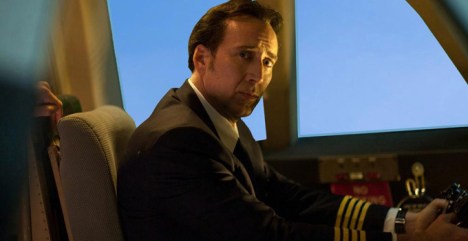
172. Left Behind (-#33)

Hosted by Andrew Quinn and Darren Mooney, and this week with guest Andy Melhuish, The 250 is a (mostly) weekly trip through some of the best (and worst) movies ever made, as voted for by Internet Movie Database Users.

This time, Vic Armstrong’s Left Behind.

Captain Ray Steele has it all: a beautiful wife, a loving family, a successful job as a high-flying pilot. Still, he finds his eye wandering and temptation calling. Everything changes when disaster strikes during a long-haul flight, when Ray’s co-pilot and several passengers mysterious disappear without any reason whatsoever. What could possibly abduct passengers from an airplane mid-flight? And what happens to those who are left behind?

At time of recording, it was ranked 33rd on the list of the worst movies of all time on the Internet Movie Database.

Continue reading

Non-Review Review: Boy Erased

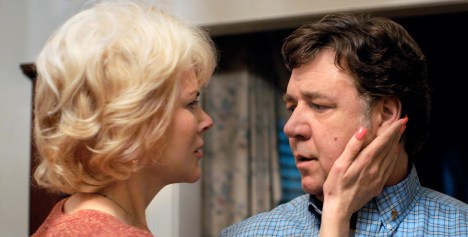
Perhaps the most remarkable thing about Boy Erased is the amount of faith that writer and director (and supporting actor) Joel Edgerton puts in the material at hand.

Boy Erased is based on a memoir written by Garrard Conley, offering a fictionalised account of the writer’s time in gay conversion therapy in rural conservative America. The film is fiction to the extent that the names have been changed; Garrard Conley becomes Jared Eamons. However, Boy Erased never tries to disguise its influences or to assert ownership of the story. The end of the film includes pictures of the real-life inspirations for various characters, often illustrating how uncanny the film’s casting had been.

Bedfellows.

More than that, perhaps as a nod to the increased self-awareness within these sorts of stories, the film hints at its own fictionalisation. The article and book that Jared decides to write towards the end of Boy Erased is very plainly the basis of the film that audience is watching. There is something intriguing in that, in the way that Boy Erased folds itself into its own narrative. The ending of Boy Erased is rooted in the characters responding to the story that Jared has written of his experiences, a clever and reflexive narrative choice that is consciously (and shrewdly) underplayed.

However, the fact that this is the closest that Boy Erased comes to a subversive or deconstructive moment only underscores the matter-of-factness with which Edgerton’s handled the material. Outside of using the origins of the film to provide the basis for a third-act catharsis within the film, Edgerton takes a very straightforward approach to this story. He never seems particularly interested in bending the narrative out of shape or of heightening particular elements for dramatic tension.

Syke out.

In its own weird way, Boy Erased feels decidedly conservative for a contemporary awards film. It is much less energised or dynamic than other similar works, such as the addiction drama Beautiful Boy starring Lucas Hedges’ Lady Bird co-star Timothée Chalamet. This creative restraint is not a criticism in any way; quite the opposite. Edgerton trusts the story that he has been given, and trusts his cast to deliver. Boy Erased is not a showy or ostentatious piece of work, instead a film constructed to specification with care and craft.

Boy Erased is a film that exists primarily as a vehicle for its subject and for its cast, and that is a credit to Edgerton’s approach to the material.

They said that he needed this, but it couldn’t be father from the truth.

Continue reading

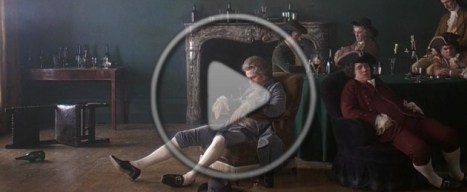
70. Barry Lyndon – St. Patrick’s Day 2018, w/ When Irish Eyes Are Watching (#225)

Hosted by Andrew Quinn and Darren Mooney, The 250 is a fortnightly trip through some of the best (and worst) movies ever made, as voted for by Internet Movie Database Users. New episodes are released Saturdays at 6pm GMT.

This week, a special crossover episode with When Irish Eyes Are Watching, an Irish film podcast wherein Alex, Clíona and Séan take at a look at films connected to the Emerald Isle.

The 250 and When Irish Eyes Are Watching are crossing over for a St. Patrick’s Day treat. Stanley Kubrick’s Barry Lyndon.

Barry Lyndon is the epic story of the eponymous character, a dashing Irish rogue who seems to bumble his way through the eighteenth century. Using nothing but his wits, Barry manages to manipulate his way to the fame and fortune that he so covets, only to discover a fortune won is not so easily kept.

At time of recording, it was ranked the 225th best movie of all time on the Internet Movie Database.

Continue reading

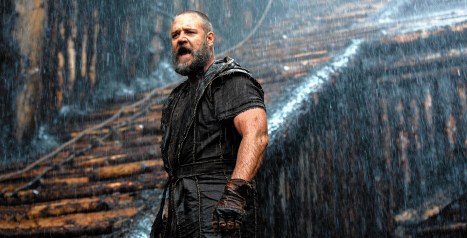
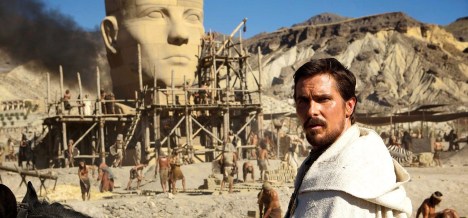
Oh My God: Modern Cinematic Depictions of the Almighty…

Religion is understandably one of the great cinematic themes.

After all, religion provides a way of making sense of a seemingly chaotic world, of imposing order upon the universe. More than that, it connects into any number of other rich themes, from man’s place in the grand scheme of things to the art of creation. However, religion is understandably a subject that needs to be treated with some delicacy, joining sex and politics on topics to be avoided in dinner table conversation. Of course, there has always been a market for religious subject matter in cinema.

Classic Hollywood produced any number of broad religious epics for public consumption, films like Ben Hur, The Robe, The Ten Commandments. These stories blended familiar biblical narratives with large-scale spectacle, offering reassuring tales of conventional heroics often anchored in Christian iconography. These biblical epics faded from view towards the end of the sixties; perhaps tellingly, they faded out of view around the same time as that other American creation myth, the western.

However, there remains a market for religious entertainment. The twenty-first century has seen an explosion of smaller Christian-based movie studios producing wholesome narratives couched in religious language and imagery. Films like Saving Christmas or God’s Not Dead are clearly calibrated to appeal to a very particular market instead of a broader audience, akin to specialty cinema like Bollywood. However, entire studios exist to feed this market and provide a solid return on a reasonable budget; just look at Left Behind, starring Nicolas Cage.

Nic Cage doesn’t get raptured. It turns out God has seen the remake of The Wicker Man.

While these specialty studios are offering a much more conventional and old-school depiction of divinity and religion, there is something interesting happening in more mainstream cinema. The twenty-first century has seen a number of high-profile creators grappling with strong religious themes in explicitly Christian terms, and – in doing so – offering a number of provocative and subversive interpretations of God.

Note: the post will include spoilers for mother! If you have not seen the film yet, proceed at your own peril.

Continue reading

The X-Files – The Truth (Review)

This December, we’re taking a trip back in time to review the ninth season of The X-Files.

It is interesting how the popular memory of a thing can differ from the actual thing itself.

Memory was always a key theme of The X-Files, particularly in the early years of the show. Although the aliens and the conspirators were plucked from the demented imaginations of the most paranoid tinfoil hat enthusiasts, a surprising amount of the show was rooted in real history that had been allowed to slip by under the radar: the genocide of the Native Americans; the resettlement of German and Japanese war criminals after the Second World War; radiation experiments upon prisoners; the Tuskegee syphilis experiment.

Daddy's home.

Daddy’s home.

The truth is contained in the gap between memory and history. In a way, then, it feels entirely appropriate that the popular memory of The X-Files should remain quite distinct from the show itself. The popular memory of The X-Files tends to suggest that the mythology makes no sense, that it does not fit together in any tangible form. This is an opinion repeated so often that it has become a critical shorthand when discussing the end of the show; much like the assertion “they were dead all along” tends to come when discussing Lost.

The truth is that the mythology of The X-Files largely made sense. Sure, there were lacunas and contradictions, inconsistencies and illogicalities, but the vast majority of the mythology was fairly linear and straightforward. It had been fairly straightforward for quite some time. The show had been decidedly ambiguous in its first few seasons, only confirming that colonisation was the conspiracy’s end game in Talitha Cumi at the end of the third season. Elements like the black oil and the bees tended to cloud matters, but the internal logic was clear.
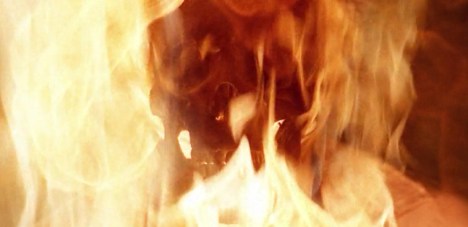
Everything burns...

Everything burns…

Significant portions of both The X-Files: Fight the Future and Two Fathers and One Son had been dedicated to spelling out the finer details of the mythology in great detail. Mankind were not the original inhabitants of Earth; the former occupants had returned and were making a rightful claim; the conspirators had agreed to help them, selling out mankind for a chance to extend their own lives. Everything else was window dressing. The production team had laid everything out during the fifth and sixth seasons.

Still, the general consensus of The X-Files was that it was a show driven by mysteries that was always more interested in questions than answers. This was certainly true, but it was somewhat exaggerated. When the cancellation was announced, the media immediately demanded answers. A month before The Truth was broadcast, Tim Goodman complained about how the show offered “precious few answers to Carter’s riddles.” Two days before the broadcast, Aaron Kinney wondered of the conspirators, “Who are these people and what is their agenda?”
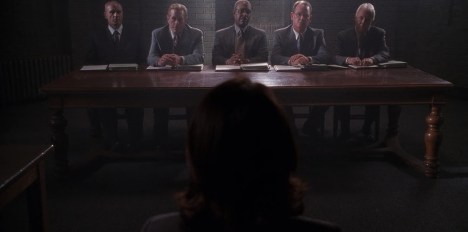
The Truth on trial...

The Truth on trial…

It does not matter that these answers have mostly been provided and that the truth is mostly know. This was the context of the conversation unfolding around The Truth, and it likely explains a number of the creative decisions taken during the production of the episode. The Truth plays as an extended video essay dedicated to providing answers that were offered three or four seasons earlier in relation to mysteries that are no longer part of the show. The Truth is a passionate and intense argument that the mythology of The X-Files does make sense.

For viewers tuning back into the show for the first time in years, this means long expository monologues and skilfully edited montages that do not tie into the plot of the episode in any significant way. For those who stuck with the show for these past few seasons, it means rehashing everything that the show has taken for granted since the fifth or sixth season. While it feels like The Truth is desperately longing for vindication, to the extent where the show puts itself on trial in the person of Fox Mulder, this does not make for compelling viewing.

Happy ending.

Happy ending.

Continue reading