• Following Us

  • Categories

  • Check out the Archives


  • Awards & Nominations

Millennium – Beware of the Dog (Review)

This May and June, we’re taking a trip back in time to review the fifth season of The X-Files and the second season of Millennium.

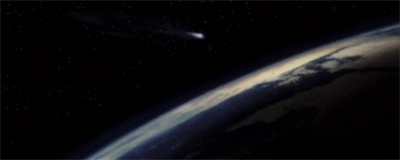
Beware of the Dog opens with the shot of the same comet discussed at the start of The Beginning and the End, just in case viewers thought that The Beginning and the End was somehow a fluke or a deviation. The Beginning and the End was not a freak occurrence, it was not some random divergence from the rest of Millennium. It was very much a new beginning for the series, harking in a bold new direction utterly unlike that marked out by The Pilot. The second season of Millennium was a new breed of animal.

And so a lot of Beware of the Dog is devoted to reinforcing this new direction – convincing the viewers at home that Millennium had reinvented itself from the ground up. Part of what is interesting about Beware of the Dog is the way that the basic structure and beats of the episode hark back to the formula and themes of the first season, but in a way that makes it quite clear that things have changed. Beware of the Dog embraces the pulpy absurdity of a show about millennial fears and anxieties, about the nature of good and evil in the world.
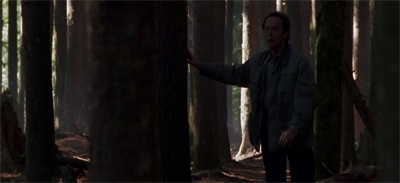
Call of the wild...

Call of the wild…

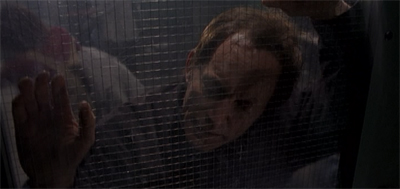
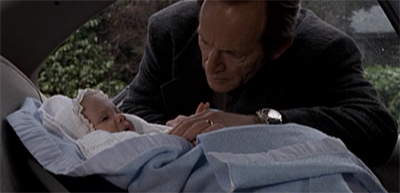
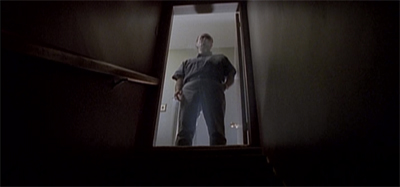
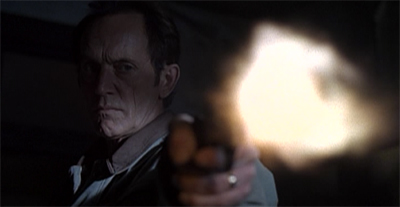
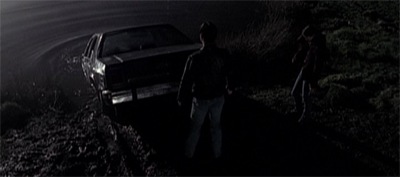
Beware of the Dog is a very weird piece of television. It is resoundingly and unapologetically odd. It is nowhere near as quirky and eccentric as the second season would become in episodes like The Curse of Frank Black or Jose Chung’s “Doomsday Defense” or The Time is Now, but decidedly more surreal than the first season had allowed itself to be – even in episodes like Force Majeure or Powers, Principalities, Thrones and Dominions. This is an episode which takes the first season’s “serial killer of the week” format, and substitutes in packs of wild dog.

The result is a piece of television that is quite difficult to classify and quantify, but which feels fresh and exciting. As with The Beginning and the End, there is a playfulness and fun to Beware the Dog that was sorely lacking from extended stretches of the first season. Indeed, it seemed unlikely during the first season that Millennium would ever be classed as “playful” or “fun.” That sense of energy and vibrance imbues the second season with life, helping to carry the show across some admittedly rough episodes later in the year.
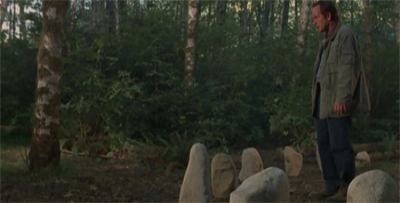
Circle of trust...

Circle of trust…

Continue reading

Millennium – The Beginning and the End (Review)

This May and June, we’re taking a trip back in time to review the fifth season of The X-Files and the second season of Millennium.

The Beginning and the End manages the impressive and paradoxical feat of both rebooting Millennium and resolving the cliffhanger at the end of Paper Dove. These two contradictory impulses become part of the thematic fabric of The Beginning and the End, an episode fascinated by duality and opposition. Can the polaroid stalker be both a serial killer of the week and the herald of something so much greater? Can Catherine and Frank Black be both united and separated? Can Millennium be the same show it was last year and something completely new?

The Beginning and the End is the start of the show’s polarising and divisive second season. To critics, the second season completely branches off from the first season of the show, replacing a framework that had grown and developed over the course of the year with a bizarre and unwieldy approach that was gonzo and surreal. To fans, the second season was an ambitious and exciting piece of television utterly unlike anything that had been broadcast before or has been broadcast since.

Up in the sky...

Up in the sky…

With Chris Carter back focusing on the development of The X-Files and the looming release of The X-Files: Fight the Future, Fox drafted in Glen Morgan and James Wong to steer the second season of Millennium. The duo had helped to define the identity of The X-Files in its first year, and had produced the failed (but ambitious and prescient) series Space: Above and Beyond for the network. After working on the fourth season of The X-Files and the first season of Millennium, Fox allowed the pair to produce their own pilot – The Notorious Seven.

When Fox opted not to take The Notorious Seven to series, they asked Glen Morgan and James Wong to take charge of Millennium in its sophomore season. As The Beginning and the End demonstrates, Morgan and Wong promptly made the show their own.

Looking up and wondering...

Looking up and wondering…

Continue reading

Millennium – Broken World (Review)

This February and March, we’re taking a trip back in time to review the fourth season of The X-Files and the first season of Millennium.

On paper, there is a lot to like about Broken World.

In theory, it is Robert Moresco building off the success of Covenant, developing another story that works within the framework of Millennium without adhering to the formulaic “serial-killer-of-the-week” approach. As in Covenant, Frank Black is wandering the country to do good, a stranger who comes to town to fight evil. In this case, the evil takes the form of a budding young serial killer – a fiend who has not yet claimed a human life, but seems to be building towards it.

"I think he's trying to tell us something..."

“I think he’s trying to tell us something…”

In reality, Broken World is a number of great ideas suffering from terrible execution. While the story is technically quite distinct from the stock “serial-killer-of-the-week” stories that haunted the series in the middle of the series, the practical difference is minimal. Broken World is another story of sadism and brutality that inevitably feels sleazy and exploitative. While the episode could be an interesting twist on a tired structure, Willi Borgsen is just another generic psychopath like Edward Petey or Art Nesbitt.

Still, the title feels somewhat appropriate. Broken World does a lot to demonstrate how far Millennium has come in this stretch of episodes. Broken World would have felt quite comfortable sandwiched between Weeds and Loin Like a Hunting Flame. Sitting between Powers, Principalities, Thrones and Dominions and Maranatha, it feels almost like a relic.

Who's gonna ride your wild horses?

Who’s gonna ride your wild horses?

Continue reading

Millennium – Powers, Principalities, Thrones and Dominions (Review)

This February and March, we’re taking a trip back in time to review the fourth season of The X-Files and the first season of Millennium.

High matter thou injoinst me, O prime of men,

Sad task and hard, for how shall I relate

To human sense th’ invisible exploits

Of warring Spirits; how without remorse

The ruin of so many glorious once

And perfet while they stood; how last unfould

The secrets of another World, perhaps

Not lawful to reveal? yet for thy good

This is dispenc’t, and what surmounts the reach

Of human sense, I shall delineate so,

By lik’ning spiritual to corporal forms,

As may express them best, though what if Earth

Be but the shaddow of Heav’n, and things therein

Each to other like, more then on earth is thought?

– Raphael, Paradise Lost, Book V

This is about to get biblical...

This is about to get biblical…

Continue reading

Millennium – Walkabout (Review)

This February and March, we’re taking a trip back in time to review the fourth season of The X-Files and the first season of Millennium.

Walkabout continues to demonstrate the flexibility of Millennium‘s format.

Millennium is often unfairly dismissed as a “serial-killer-of-the-week” show, an impression undoubtedly created by the stretch of early- to mid-season episodes that adopted an almost procedural formula in their exploration of evil. However, after Sacrament, the show takes a break from those narratives to do something a little more experimental and nuanced. Covenant had seen Frank investigating a murder that had already been solved. Here, Frank finds himself struggling to piece together a fractured memory of his own recent experiences.

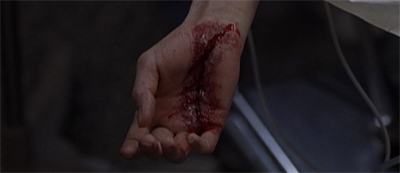
A bleedin' disaster!

A bleedin’ disaster!

Walkabout is the third of four scripts from writer Chip Johannessen in the first season of Millennium. Each is a rather strange entity; doing something strange or unconventional for the show, helping to define the boundaries for this young television series. Walkabout is perhaps most interesting for the way that it engages with an aspect of Millennium that has been bubbling away in the background since The Pilot. Although Walkabout never explores the nature or purpose of Frank’s visions, the episode is built around the visions as a concept rather than simply a tool.

Walkabout is an unsettling and effective mood piece that grows more conventional as it progresses. While the final act is a little clunky, Walkabout is a fascinating piece of television and a demonstration of how Millennium has found its own voice.

"Let me outta here!"

“Let me outta here!”

Continue reading

Millennium – Sacrament (Review)

This February and March, we’re taking a trip back in time to review the fourth season of The X-Files and the first season of Millennium.

If Force Majeure and The Thin White Line seem to call forwards towards the weird and eccentric second season, Sacrament is a bit more modest. In many ways, Sacrament seems to foreshadow the last stretch of episodes in the first season. The forces of evil seem to encircle the Black family, creeping closer and closer to the big yellow house and everything it represents. For the first time, Sacrament explicitly puts Frank’s family at the heart of a case; this time focusing on the kidnapping of his sister-in-law from her child’s christening.

In many respects, this points towards the direction the show will take in its final stretch of episodes. Lamentation and Powers, Principalities, Thrones and Dominions will see the forces of evil explicitly violate the Black residence, insidiously eroding the idealised life that Frank has tried to build for his family in their new Seattle home. The cliffhanger at the end of Paper Dove pushes the concept to its logical conclusion, as a secret that Frank has tried to keep from his family finally comes home to roost.

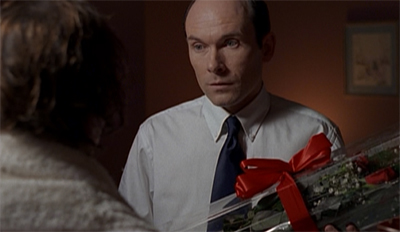
Worst. Uncle. Ever.

Worst. Uncle. Ever.

As with WeedsSacrament demonstrates that writer Frank Spotnitz has an uncanny understanding of how Chris Carter built Millennium. It is an episode that is soaked through with the core themes of the series; it is a story about good and evil, and how evil taints everything that it touches. As with a lot of Millennium, Sacrament is not subtle; the moment that Tom Black is identified as the brother of our protagonist, it is inevitable that the forces of evil will come barrelling down upon him.

Nevertheless, Sacrament demonstrates a clear understanding of what it wants to be, and is a pretty effective snapshot of Millennium at this moment in time. The first season of Millennium is often overlooked and overshadowed amid the controversies surrounding the second or third seasons, but Sacrament stands as a great example of what the first season was trying to do.

Our father...

Our father…

Continue reading

Millennium – The Thin White Line (Review)

This February and March, we’re taking a trip back in time to review the fourth season of The X-Files and the first season of Millennium.

The Thin White Line is the final script from James Wong and Glen Morgan for this season of Millennium, following closely after Never Again, their final script (ever) for The X-Files.

Indeed, there is considerable overlap between the two stories – at least thematically. Both are episodes about destructive cycles. In Never Again, Scully faces the very real possibility that she is now trapped with Mulder; that her life outside the X-files is over. In The Thin White Line, Frank Black contemplates the idea that people are trapped in perpetual cycles of violence and abuse; that the world resembles the ouroboros featured so prominently in the opening credits, a snake constantly eating its own tail.

Frank discharge...

Frank discharge…

Never Again is relentlessly cynical. The closing image suggests that nothing will change, that something is broken than cannot be fixed. Important statements hang in the air, unresolved. The Thin White Line is perhaps slightly optimistic. Both Frank Black and Bob Bletcher try in their own way to end cycles of violence and recrimination. While Bob Bletcher responds with brutal cynicism and more violence, Frank Black responds with compassion and humanity. There is a sense of cynicism to The Thin White Line, but there is also some hope.

The Thin White Line is a stand out piece of work, a fantastic illustration of what Millennium can do when it sets its mind to it. Like Force Majeure before it, The Thin White Line suggests that Millennium has very clearly and definitely figured out its own voice. It is no wonder that both episodes come from future showrunners.

Cutting retort...

Cutting retort…

Continue reading

Millennium – Force Majeure (Review)

This February and March, we’re taking a trip back in time to review the fourth season of The X-Files and the first season of Millennium.

Papa?

It’s begun.

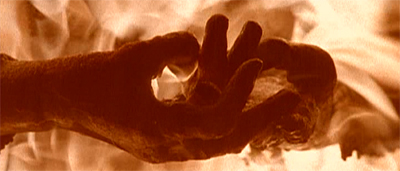
Fire and ice.

Fire and ice.

Continue reading

Millennium – Loin Like a Hunting Flame (Review)

This February and March, we’re taking a trip back in time to review the fourth season of The X-Files and the first season of Millennium.

Loin Like a Hunting Flame represents the peak of a particular type of Millennium story.

It is an episode towards which the season seems to have been building. It is an episode that rather explicitly and candidly ties together two of the show’s favourite subjects: sex and violence, in harmony together. Loin Like a Hunting Flame is something of a stalking horse for the rest of the season; it is the first season episode that most obviously embodies the excesses of any show like Millennium. Fetishised violence has been baked into Millennium since The Pilot opened with a stripper dancing in her own blood; here, it reaches a logical end point.

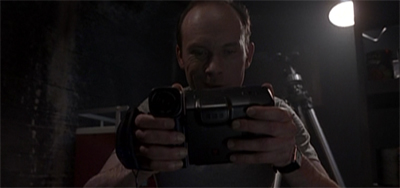
Candid camera!

Candid camera!

Loin Like a Hunting Flame is an episode that is guilty of just about any criticism that might be thrown at it. It is gratuitous; it is sensationalist; it is excessive. It tries to have things both ways, titillating the viewer with glimpse of “exotic” sexual liberation while warning them that those sexually liberated individuals will be punished for their perceived transgressions. Yes, Loin Like a Hunting Flame tries to say something a bit more nuance, but it flails around for most of its forty-five minute runtime like a dying fish.

In many respects, this could be treated as a catharsis for the series. After this point, Millennium turns a corner. The rest of the first season is a lot more ambitious in tone and scope. As much as Loin Like a Hunting Flame closes off a particularly evolutionary line of Millennium, Force Majeure and The Thin White Line push forwards towards a more adventurous show. Loin Like a Hunting Flame just has to work these issues out, once and for all, to their logical (and unsatisfying) conclusion.

Wholesome family fun...

Wholesome family fun…

Continue reading

Millennium – The Wild and the Innocent (Review)

This February and March, we’re taking a trip back in time to review the fourth season of The X-Files and the first season of Millennium.

The Wild and the Innocent is an ambitious piece of television.

It is not a piece of television that works as well as it might, the execution of the central ideas leaving a little to be desired, but it is an episode that commits whole heartedly to something unique. In I Want to Believe, Robert Shearman refers to The Wild and the Innocent as “a plot more suited to Cormac McCarthy than Chris Carter.” He’s not wrong. The Wild and the Innocent is a story about cycles of violence and abuse in the American south, a grim road movie with some very harsh conclusions about the way that the world works.

That sinking feeling...

That sinking feeling…

It still fits within the milieu of Millennium. After all the classic “serial killer road movie” is still a serial killer story, and Millennium has already carved out that niche for itself. However, the image of Frank Black and Peter Watts following a trail of bodies from Missouri down through Arkansas suggests a different show than the one that has been airing since The Pilot. In many respects – with its heavy philosophical voice-over, its country-tinged soundtrack, its fixation on the outlaw couple – The Wild and the Innocent feels almost like some old American folk tale.

There’s something decidedly old-fashioned here, with the episode playing more like a western than a police procedural. In the documentary Order in Chaos, Carter described Frank Black as character from a story “like Shane, like any cowboy, any good movie, Western movie.” As such, he fits in quite comfortably with this new type of story.

Road warrior...

Road warrior…

Continue reading