• Following Us

  • Categories

  • Check out the Archives


  • Awards & Nominations

Non-Review Review: The Predator

The Predator adopts the as-ambitious-as-it-is-counter-productive of smirkingly mocking big budget franchise films while also actually being a big budget franchise film.

Shane Black’s sequel to the beloved eighties actioner is jarring, caught between two masters. On the one hand, Black writes the characters in his patented self-ware style, with banter and wry liners to beat the band. However, these characters are then dropped right into the middle of a fairly brain-dead paint-by-numbers action film that is clearly structured to feel like a contemporary franchise foundation stone. There is a constant push-and-pull between these two extremes, which is disorienting and distracting.

The Predator took the reviews rather well.

The Predator never seems sure whether it is a good old-fashioned fun-dumb blockbuster mocking the pretensions of modern franchise films or alternatively a smart self-aware action comedy picking at the tropes of fun dumb action films. It’s never entirely clear whether the issues with The Predator are playful self-parody or just terrible plotting; whether Shane Black is not taking any of this seriously or whether he is taking all of it much too seriously.

Whenever The Predator seems to be working, it veers too sharply one way or the other and the audience gets whiplash.
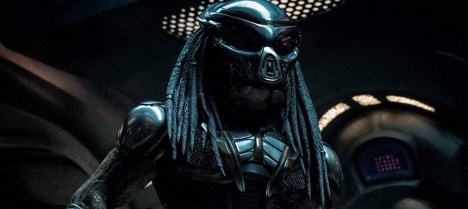
Pred-locks.

Continue reading

Non-Review Review: The Fast and the Furious

I’m rewatching The Fast and the Furious for a separate project, as solidarity with fellow film critic Jay Coyle for his “Cinema of Experience” project to look at the changing face of cinema in the twenty-first century. He’ll be writing up his account of how the experience of watching movies has changed in the past twenty-or-so years, but I found my rewatch of The Fast and the Furious interesting enough to write a longer-form review of it.

The Fast and the Furious is a curious piece of work, especially in the light of everything that followed.

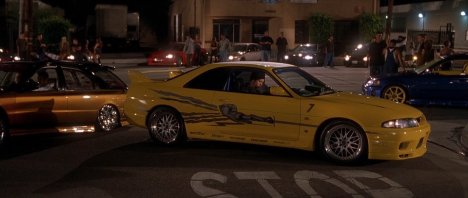
From the opening scene through to the climactic setpiece, The Fast and the Furious is very much framed as an urban western, a tale of conflicted masculinity within an urban wasteland that might as well be lawless. Street racers serve as traffic cops at one point, blocking civilian cars from the predetermined race track without any interference from actual law enforcement. Towards the end, Dom Torreto seeks to evade the law by outrunning a train to a train crossing, one of the classic high-stakes western set pieces.

More than that, the introduction of Dom Torreto in The Fast and the Furious is very much meant to evoke the introduction of a western protagonist. He is first seen from obscured angles, glimpsed from behind and through a wire mesh. His presence is felt at a distance, an island of calm in a chaotic world. Torreto is introduced as an outlaw who seeks peace in a world that is constantly at war. This is perhaps a canny approach from a scripting and directorial perspective, acknowledging Vin Deisel’s strengths as a screen presence. Torreto’s first act is to break up a street fight outside the little restaurant stall operated by his sister.

Released in June 2001, The Fast and the Furious is one of the last action films of the nineties. It is a snapshot of a nation still paranoid about street gangs and boy racers, of urban decay and social collapse, of the apocalyptic notion that Los Angeles is the final frontier of the nation’s westward expansion. Explored in hindsight, these were perhaps more innocent times.

Continue reading

Star Trek: Enterprise – Zero Hour (Review)

Next year, Star Trek is fifty years old. We have some special stuff planned for that, but – in the meantime – we’re reviewing all of Star Trek: Enterprise this year as something of a prequel to that anniversary. This August, we’re doing the third season. Check back daily for the latest review.

There was a very real chance that Zero Hour might have been the last episode of Star Trek: Enterprise to air.

In fact, it was entirely possible that Zero Hour‘s distinctive (and downright provocative) closing shot of an evil!alien!space!Nazi might have been the last shot of Star Trek to air on television for quite some time.

Time is running out...

Time is running out…

Continue reading

Star Trek: Enterprise – Stratagem (Review)

Next year, Star Trek is fifty years old. We have some special stuff planned for that, but – in the meantime – we’re reviewing all of Star Trek: Enterprise this year as something of a prequel to that anniversary. This August, we’re doing the third season. Check back daily for the latest review.

With Stratagem, the third season of Star Trek: Enterprise gets its head back in the game.

The recent stretch of third season episodes seemed to lose sight of what made this such an intriguing premise. Although Rick Berman had conceded that there was an escape hatch in place in case the Xindi arc could not sustain a full season of television, it was increasingly clear that the third season of Enterprise would be a single extended arc exploring Archer’s attempts to find the source of a deadly threat against mankind. It was a bold experiment for a show that had been quite rigidly episodic to this point. At least in theory.

Archer's on candid camera...

Archer’s on candid camera…

In practice, the third season of Enterprise seemed to flounder a little bit once it got past the initial burst of speed powering it into the third season. All of a sudden, the crew found themselves involved in a number of increasingly stand-alone adventures with superficial ties to the larger arc. Episodes like Extinction and Chosen Realm could easily have been produced and broadcast during the show’s first two seasons, with minor alterations. Exile and North Star were only loosely connected to the season’s plot. Carpenter Street was a time travel episode.

Proving Ground had suggested that the show was ready to re-focus its attention on the matter at hand and get back to the imminent threat posed by the Xindi. At the same time, the episode was also keen to stress its episodic nature – most notably in its role as the show’s annual check-in with the Andorians. Stratagem is very much its own self-contained story, but it is a lot more confident about how it fits in the larger scheme of things, and where it fits in the broader arc of the season.

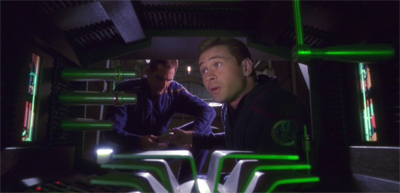
Engineering a convincing set-up...

Engineering a convincing set-up…

Continue reading

Non-Review Review: Terminator Genisys

“I am inevitable,” the villain boasts towards the climax of Terminator Genisys, just as things look their darkest for our heroes. He is a fully 3D digital image sourced from wall-mounted projectors, reflecting the way that the film itself has been marketed.

He might as well be talking on behalf of the film itself. The Terminator franchise has evolved into an unlikely juggernaut, spanning over three decades and evolving from a low-budget science-fiction film into a blockbuster series. Critical (and popular) reception to Terminator III: Rise of the Machines and Terminator: Salvation has been somewhat muted, but the film franchise just keeps coming. In a way, it feels like Skynet making itself manifest. Or, more appropriately, the eponymous robot killing machine.

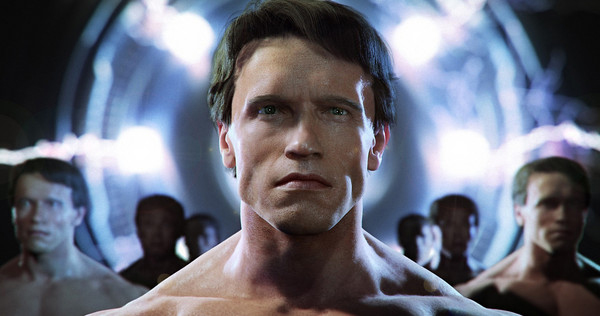
Fresh off the factory line...

Fresh off the factory line…

There are points where Terminator Genisys seems incredibly self-aware, posing the sort of existential and philosophical questions that are confronting the audience. In The Terminator and Terminator II: Judgement Day, James Cameron positioned time travel as a metaphor for the strings of fate and destiny that seemed to bind free will. In Terminator Genisys, time travel becomes a powerful metaphor for the process of film- (or franchise-) making itself.

Both a sequel and a prequel, a reboot and a remake, the time travel plot element of Terminator Genisys turns the franchise into a gigantic mix tape. Screenwriters Laeta Kalogridis and Patrick Lussier collaborate to turn Terminator Genisys into a live-action version of a Jive Bunny and the Mix Masters track, a sample filled with familiar beats played at the wrong tempo. There are moments when the wrongness seems the point, when Terminator Genisys wanders into the uncanny valley. There are points where it almost achieves consciousness.

Prick me, do I not leak?

Prick me, do I not leak?

Continue reading

Brian Michael Bendis’ Avengers – New Avengers Vol. 1-2 (Hardcover) (Review/Retrospective)

This is the first in a series of comic book reviews that will look at the direction of Marvel’s “Avengers” franchise over the past five or so years, as they’ve been attempting to position the property at the heart of their fictional universe. With The Avengers planned for a cinematic release in 2012, I thought I’d bring myself up to speed by taking a look at Marvel’s tangled web of continuity. Get an overview of what I’m trying to take a look at here.

Alright. I figure I sound a bit hypocritical complaining about the impact of big events on Marvel’s storytelling continuity without reading said big events. Well, actually, I don’t think I’m a hypocrite – I think it’s perfectly reasonably that a reader should be able to pick up Ed Brubaker’s Captain America without having to worry about Mark Millar’s massive Civil War crossover which they either don’t know enough to care about or know enough not to care about. However, I feel like maybe – just maybe – I should try to ride this “cross-continuity” thing out just once and see if the story somehow justifies the damage it causes to the cohesion of individual runs.  Yes, I’m going to jump head-first into the event-populated minefield of continuity which is recent Marvel history, and I will be using New Avengers as a checklist to that. I’m going down the rabbit hole, following the arc from Civil War through to Siege.

Sentry is responsible for the Carnage in this run...

Continue reading

Non-Review Review: X-Files – I Want to Believe

The title just about says it all. I want to believe in The X-Files. I want to believe in Mulder and Scully. I want to believe in Chris Carter. But I’m looking for proof. Proof that the franchise that held the entire world’s attention for a few minutes in the mid- to late-nineties still has some life in it. Proof that a ridiculous complicated and illogical and poorly written final few seasons on the air had not sucked the marrow entirely from the bones of a once unique pop cultural entity. So, what does the movie give me? Not concrete proof, but a little hint of faith. The film is not as bad as the final two years of the show. That’s the good news. The bad news is that it isn’t as good as the first five.

"X" doesn't mark the spot...

"X" doesn't mark the spot...

Continue reading