• Following Us

  • Categories

  • Check out the Archives


  • Awards & Nominations

Non-Review Review: Star Trek (2009)

This August, to celebrate the upcoming release of Star Trek: Into Darkness on DVD and blu ray, we’re taking a look at the Star Trek movies featuring the original cast. Movie reviews are every Tuesday and Thursday.

Star Trek was not in a healthy place at the end of the first decade of the twenty-first century. The last film, Star Trek: Nemesis, had been box office poison – partially due to the terrible script and direction, and partially due to the monumentally stupid decision of opening it during a winter season including The Lord of the Rings: The Two Towers, Harry Potter and the Chamber of Secrets and Die Another Day.

On television, things hadn’t been much brighter. Ratings had been in decline since Star Trek: Voyager hit the air, and Star Trek: Enterprise went through both a re-tool and a creative shift before becoming the first Star Trek television show since the eighties to be cancelled before running a full seven seasons. Even the most ardent Star Trek fan would have to concede that the franchise did not appear to have a bright future at that point in time.

And yet, against all odds and despite all the goodwill the franchise had lost, JJ Abrams and Paramount managed to reinject both an energy and a vitality into the film, producing one of the best blockbusters of the decade.

A commanding Enterprise....

A commanding Enterprise….

Continue reading

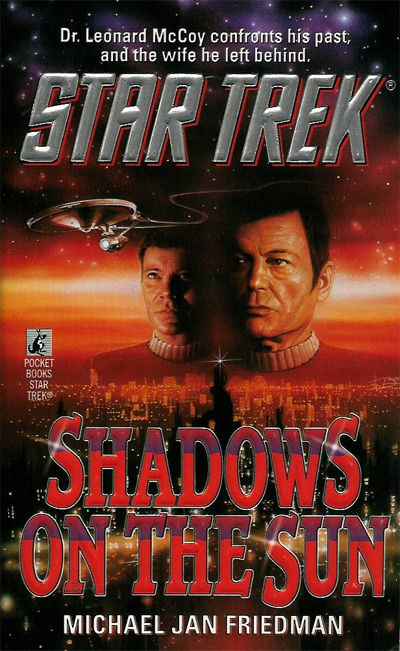
Star Trek – Shadows on the Sun by Michael Jan Friedman (Review)

This August, to celebrate the upcoming release of Star Trek: Into Darkness on DVD and blu ray, we’re taking a look at the Star Trek movies featuring the original cast. Movie reviews are every Tuesday and Thursday.

We’ll be supplementing our coverage of the movies with tie-ins around (and related to) the films. We’ll be doing one of these every week day. This is one such article.

It almost feels like sacrilege to fill in the gap left at the end of Star Trek VI: The Undiscovered Country. The film was such a perfect send-off that picking up a novel directly after the end credits role feels like it might undermine the perfect farewell story for the veteran crew. After all, director Nicholas Meyer suggested that the film was an attempt to capture the spirit of Fukuyama’s “end of history”, representing the “end of history” for the original crew.

Except, of course, it wasn’t the end. In terms of internal Star Trek chronology, episodes of Star Trek: The Next Generation had picked up on the later adventures of Scotty and Spock. Star Trek: Voyager would flashback to a Sulu story unfolding concurrently with The Undiscovered Country. Scotty and Chekov would appear in Star Trek: Generations, which would also serve as a disappointing farewell to one James Tiberius Kirk. It seems bitterly appropriate (if far from fair) that Uhura should remain the only major player whose story actually ends with The
Undiscovered Country
.

Still, despite his passing of the torch appearance in Encounter at Farpoint, you could make an argument that The Undiscovered Country was the end of the line for Leonard McCoy more than Kirk or Spock. And, as such, Michael Jan Friedman’s Shadows on the Sun serves as an effective (if flawed) reflection on the way that McCoy’s presence sort of faded from the 24th century spin-offs. startrek-shadowsonthesun

Continue reading

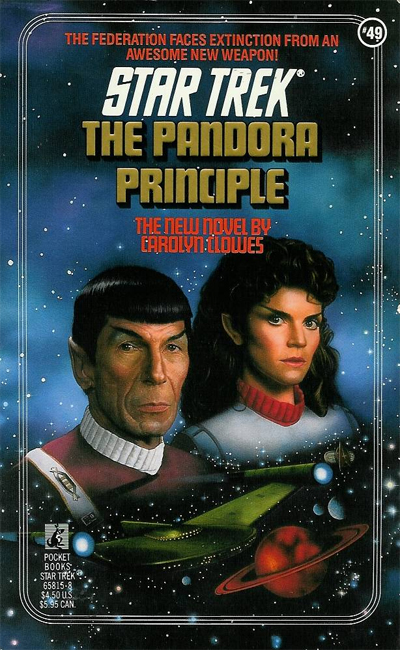
Star Trek – The Pandora Principle by Carolyn Clowes (Review)

This August, to celebrate the upcoming release of Star Trek: Into Darkness on DVD and blu ray, we’re taking a look at the Star Trek movies featuring the original cast. Movie reviews are every Tuesday and Thursday.

We’ll be supplementing our coverage of the movies with tie-ins around (and related to) the films. We’ll be doing one of these every week day. This is one such article.

It’s amazing to think how much tie-in material the character of Saavik has generated, considering that she only appeared in three Star Trek films. There are regular characters who have never attracted the same degree of attention as Saavik. There’s probably a reason for this. After all, Saavik was introduced as an important character in Star Trek II: The Wrath of Khan. There’s even some speculation that she might have been originally intended as a replacement for Spock, had Leonard Nimoy decided not to return to the franchise. As such, she was introduced as a surprisingly developed character with a background rife with storytelling potential.

It’s a bit of a disappointment, then, that she was first re-cast as Robin Curtis in Star Trek III: The Search for Spock and then she was quietly shuffled off-stage at the start of Star Trek IV: The Voyage Home, never to be seen again. Perhaps that squandered potential is at the root of the fascination with Saavik. The Pandora Principle, the only Star Trek novel from author Carolyn Clowes, offers us an origin and a history for the character, building off hints and character attributes that were never even mentioned on-screen.

startrek-thepandoraprinciple

Continue reading

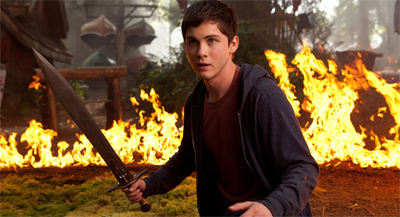
Non-Review Review: Percy Jackson and the Sea of Monsters

Percy Jackson and the Sea of Monsters demonstrates just how lucky the Harry Potter films were when it came to casting teenage performers. As a movie series centred around the off-spring of Greek deities, the movie relies on the charisma of its leads to sell the premise. Unfortunately, they aren’t quite up to the task. While none of the performers are terrible or wooden, the film drags to a hault when the teenage actors are asked to carry a scene. As a result, a quiet boat ride in the middle of the film seems interminable, and a heart-to-heart before the climax feels overlong.

None of the cast are assisted by a script from Marc Guggenheim. Guggenheim is capable of a well-placed zinger, and the movie offers its fair share of wit, but everything about the movie feels pandering and simplistic, as if Guggenheim doesn’t trust his audience to pick up on the plot points if they aren’t painstakingly catalogued and repeatedly spelt out with cringe-worthy dialogue. Indeed, Guggenheim’s desire to slow everything down so he can repeatedly explain what’s going on only adds to the pacing issues caused by the weak leads.

It’s a shame, because the adult cast seem to be genuinely enjoying themselves, and there’s something quite charming about the idea of “demi-googling” as a means of retrieving information.

Another stab at a Percy Jackson film...

Another stab at a Percy Jackson film…

Continue reading

Non-Review Review: Only God Forgives

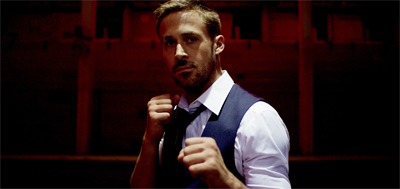
Only God Forgives is a journey into hell. It’s an unpleasant, uncomfortable, terrifying, surreal, macabre, haunting, eerie and beautiful exploration of brutality and violence. Nicolas Winding Refn’s latest film isn’t anywhere near as accessible as Drive. It isn’t just bereft of sympathetic characters, it doesn’t even feature any characters who lend themselves to empathy or recognisability. Ryan Gosling’s Julian is so introverted and withdrawn that it’s often difficult to determine the difference between reality and his surreal dream sequences.

Then again, given Refn suggests the man is living in his own private hell, perhaps there’s not too much difference any way.

Wanna fight?

Wanna fight?

Continue reading

Non-Review Review: Elysium

Elysium is good old-fashioned high-concept science-fiction. With production design alternately evoking the seventies (the upper class satellite that gives the movie its name) and eighties (the apocalyptic wasteland of future Los Angeles), Elysium feels like a conscious attempt to evoke classic genre films. Blomkamp builds in a healthy amount of social commentary, and there’s something quite satisfying in seeing a large-scale science-fiction film that isn’t afraid of big bold ideas.

However, the execution feels just a little bit muddled. The plotting is a little convoluted, and the third act becomes incredibly messy. The characters inhabiting the world never seem organic, with their motivations and behaviour prone to change rapidly to meet the rapidly-changing demands of a very messy script.

In a bit of a fix...

In a bit of a fix…

Continue reading

Non-Review Review: The Canyons

The Canyons struggles to surmount the weight of productions stories bearing down on it. Paul Schrader’s latest film was famously the subject of a 7,000-word article in the New York Times documenting the trials and tribulations behind the scenes. In a way, these troubles made the film somewhat larger-than-life, turning it into one giant attempt at career resurrection for director Paul Schrader and lead actor Lindsay Lohan.

Given the film’s much publicised sexual content (and the decision to cast pornography actor James Deen in the lead role), there’s a sense that this could be Lohan’s Last Tango in Paris, a bold and blistering performance from a once-respected talent eclipsed by years of behind-the-scenes gossip and idle chatter. Ironically, it’s none of the established talent that impresses with The Canyons. Bret Easton Ellis’ story feels like a shallow pastiche of Ellis-ian touches, while Schrader’s direction is intrusive and overwhelming. Lohan shows flickers of honesty and risk-taking, but is lost in the shuffle and the hum-drum plotting.

In contrast, it’s relative newcomer (as much a man with a filmography containing over 1,000 titles can be a newcomer) James Deen who makes the strongest impression as a surprisingly efficient Ellis-ian protagonist.

thecanyons1

Continue reading

Non-Review Review: Alan Partridge – Alpha Papa

Alan Partridge: Alpha Papa successfully brings the BBC icon to the big screen. He’s come a long way from a sports desk persona on a BBC4 parody radio show, and modern British comedy owes a lot to Coogan’s creation. Partridge has been around for over twenty years at this point, in many ways becoming more recognisable than Steve Coogan himself. It’s surprising that it’s taken this long to shepherd Partridge to the big screen.

Partridge is the king of what might be termed “cringe comedy”, and is a clear forbearer of Ricky Gervais’ David Brent. As such, it’s possible to feel that Partridge is a little dated. Certainly, there are times when Alpha Papa plays out like it could be an extended holiday special featuring North Norfolk’s most famous radio DJ. To be fair, that’s not a bad thing. Coogan is on fine form here, the comedy is broad and the wit is quick enough that there’s never a dull moment.

It’s a giant-sized helping of the comedy character, one which stays true to his roots even if it does occasionally feel like it over-simplifies him a bit.

On the air, and on the line...

On the air, and on the line…

Continue reading

Non-Review Review: RED 2

Red 2 is a stronger film than Red, although it’s still not quite a wholly satisfying cinematic experience. There’s a certain charm to watching all these veteran stars reuniting on the screen together, with a considerably lighter touch than The Expendables. What’s interesting about Red 2 isn’t a dearth of good ideas or interesting hooks in the set-up of this sequel, it’s just a littler rushed, a little unfocused, a little disjointed. However, Red 2 generally moves so fast that these problems never quite reach critical mass. The result is more-than-occasionally great fun, but also just a little too light for its own good.

Growing old disgracefully...

Growing old disgracefully…

Continue reading

Non-Review Review: The World’s End

The World’s End feels curiously nostalgic. Not just in the way that lead character Gary King tries to recapture his old youth by roping four childhood friends into revisiting their old home town to complete a pub crawl they started upon leaving school, nor in the way the sound track includes such hits of yesteryear as Loaded by Primal Scream and Kylie Minogue’s Step Back in Time, and not even in the fact that the school reunion includes a trip to a literal school disco.

Instead, it feels like a belated criticism of a recent chapter in British history, a reflection on the era of “the special relationship”, and mournful retrospective on what might be perceived as the erosion of British culture by the relentless assault of American influence. The World’s End is an invasion story, but it’s a conscious reversal of the second wave “Britpop” invasion of the nineties (an era the movie evokes nostalgically). This isn’t a hostile occupation. It is, to quote one of the characters, “peaceful indoctrination.”

They've got him Pegged...

They’ve got him Pegged…

Continue reading