• Following Us

  • Categories

  • Check out the Archives


  • Awards & Nominations

Non-Review Review: A Girl From Mogadishu

This film was seen as part of the Virgin Media Dublin International Film Festival 2019. Given the high volumes of films being shown and the number of reviews to be written, these may end up being a bit shorter than usual reviews.

One of the most striking aspects of discussing a biographical film is separating the biography from the film.

Ifrah Ahmed is a truly spectacular human being, with a truly incredible story. More than that, Ahmed is a hugely influential figure who has done an impressive amount of work to draw public attention to a very important cause. Ahmed is an inspiring figure, and very much worthy of all the praise and publicity that she has received. Her advocacy for women affected by female genital mutilation is a cause that merits support and encouragement. More than that, there is probably a great movie to be made about Ahmed’s story.

Unfortunately, A Girl From Mogadishu is not that story. The film is a disaster on a spectacular scale. The issue is certain not its choice of subject or subject matter; in the hands of a competent production team, those two elements could combine to create a truly engaging and exciting piece of film. The problem with A Girl From Mogadishu is the sheer level of creative incompetence involved. This is a film that often seems like it was assembled by a director who had only ever heard films described, rather than actually watched any of them.

A Girl From Mogadishu is cinematically illiterate, which is massively disappointing on a number of level. It betrays a talented international cast, an audience hungry for good stories told well, and a subject who is arguably one of the most important Irish social figures of the past decade and who very much deserves a much better spotlight.

Continue reading

Non-Review Review: Rafiki

This film was seen as part of the Virgin Media Dublin International Film Festival 2019. Given the high volumes of films being shown and the number of reviews to be written, these may end up being a bit shorter than usual reviews.

Rafiki is a sweet and tender love story, and well worth seeking out.

Writer and director Wanuri Kahiu is part of an artistic movement that brands itself “Afrobubblegum.” A collective of artists working together to redefine what Africa looks and feels like on screen, the “Afrobubblegum” movement is dedicated to breaking away from many of the clichés and conventions associated with continent to provide a much broader perspective of twenty-first century Africe. Rafiki is very much a part of that movement. It is a story of teen love, of the simmering attraction between two young women on the cusp of adulthood within a reactionary society that would crush such love underneath its heel. It’s a familiar set-up, evoking any number of coming-of-age same-sex love stories, the obvious (and perhaps lazy) comparison being Moonlight.

Rafiki is a fairly conventional narrative in these in terms. Indeed, the audience has a fairly good idea of where the film is going from the opening scenes that establish the realities with which Kena lives before also suggesting her strong attraction to Ziki. However, Rafiki is elevated by a number of factors. Most obviously, there are the winsome performances from young leads Samantha Mugatsia and Sheila Munyiva, who bring a very naturalistic vulnerability to their roles. However, there’s also the sheer charm of the script and the direction, which beautifully captures the feeling of young love from moment to moment, without recourse to exposition or purple prose or heavy-handed soliloquies. Rafiki feels like a movie that knows love, in a very personal and intimate way.

Rafiki is perhaps a little unpolished around the edges, but works well where it matters. It is a movie that understands the trepidation, the excitement, the longing, the fear, the passion, and the power of what it is to want another person, even (and especially) when there are so many reasons not to. There is a simple and convincing beauty in that.

Continue reading

Non-Review Review: Her Smell

This film was seen as part of the Virgin Media Dublin International Film Festival 2019. Given the high volumes of films being shown and the number of reviews to be written, these may end up being a bit shorter than usual reviews.

Put frankly, Her Smell stinks.

To be fair, there’s some interesting material here. film has long been obsessed with stories about fame and celebrity, particularly when filtered through the lens of tragedy and recovery. After all, A Star is Born roared to life as the early frontrunner in this year’s awards race, while Vox Lux provided a darker and weirder meditation on similar themes. Her Smell is very much a companion piece to these other films, a meditation on what fame does to a person, how strange it is. Her Smell is the story of a washed up punk rocker who inevitably collides with rock bottom, and yet somehow finds a way to keep going despite (or perhaps because of) the love of the people around her.

It is interesting to note that “Becky She” hits rock bottom and just keeps going, because this feels like an adequate assessment of Her Smell. Alex Ross Perry’s latest film is two hours and fifteen minutes long, and feels every single one of them. The movie has one single point that it keeps hammering again and again and again, one particular rhythm that it keeps playing again and again and again. Scenes within the film are interminable of themselves, but somehow repeated again and again and again. However, this shallow repetition is not the biggest problem with Her Smell, it’s the combination of that shallow repetition with a smug satisfaction, the cocky assuredness that underscores every single moment.

Her Smell is a dull and lifeless movie convinced of (and insistent upon) its own profundity. Roger Ebert famously argued that no good movie is too long and no bad movie is too short. One could cut two hours from Her Smell and it would still be fifteen minutes too long.

Continue reading

Non-Review Review: Papi Chulo

This film was seen as part of the Virgin Media Dublin International Film Festival 2019. Given the high volumes of films being shown and the number of reviews to be written, these may end up being a bit shorter than usual reviews.

Papi Chulo has a very narrow line to walk.

At its core, Papi Chulo is a very old-fashioned opposites-ultimately-attract buddy comedy. In keeping with the conventions of the genre, the central duo crosses racial and class divides. It is the story of a burnt-out Los Angeles weatherman who hires a Mexican day labourer to (ostensibly) paint his patio deck. Despite the fact that the two are from very different worlds and literally speak different languages, an unlikely bond develops between the two. This is a fairly standard set-up, and an old feel-good Hollywood standard. Indeed, Green Book employed the formula to considerable awards-season success, demonstrating that the template endures.

Peak happiness.

As such, Papi Chulo comes a fascinating premise, but a loaded one. Indeed, the Green Book comparison is something of a double-edged sword. The decision to position an immigrant day labourer as one half of the mismatched couple at the centre of Papi Chulo gives the movie a lot of political weight in the current cultural climate. It would be impossible for a movie about an unlikely friendship between a white man and a Mexican in modern California that crosses class divides not to resonate with everything else happening in the world around it. In fact, given the popularity of this sort of template for exploring issues of race and class in America, it is surprising that there have been so few movies along these lines. It is also surprising that this movie comes from an Irish director.

To be fair to Papi Chulo, the movie always seems aware of how deeply awkward it is for a rich white person to hire a day labourer to (in effect) be his friend. That power imbalance and privilege is always lurking off-screen, and the film is never particularly ambiguous in its assessment of Sean’s behaviour; the weatherman is not working through his issues in a healthy way, but imposing himself on Ernesto. However, these issues never come to the fore, and are only fleetingly acknowledged over the course of the film. This works well enough when the film can count on the unlikely chemistry between Matt Bomer and Alejandro Patino to carry the first half of the film, but it doesn’t really work when the film makes a conscious choice to separate the duo in the second half.

Snap chat.

Continue reading

Non-Review Review: Isn’t It Romantic?

Isn’t It Romantic? is a movie that seriously misjudges its own premise.

At the heart of Isn’t It Romantic? is a fairly solid observation. The conventional romantic comedy has seen better days. The genre enjoyed a boom in the nineties, largely driven by the star power and charisma of actors like Sandra Bullock, Julia Roberts, Meg Ryan and Tom Hanks. It is no surprise that Isn’t It Romantic? opens with the familiar chords of Roy Orbinson’s Pretty Woman and then cuts to a childhood memory of the lead character watching Pretty Woman. In recent years, the genre has gradually been squeezed out of cinemas. It is no longer the cultural force that it once was, with a handful of notable exceptions. Isn’t It Romantic? positions itself as part of a larger discussion about the state of the genre.

He will, in fact, take you to the candy shop.

However, Isn’t It Romantic? approaches this issue in a very strange way. Typically, genres that have been marginalised or pushed to the fringes respond with a level of introspection and analysis; think of Unforgiven with westerns or even Cabin in the Woods with schlocky teen horrors. The idea is that the genre can take itself apart and put itself back together. On the surface, Isn’t It Romantic? seems to be positioning itself as this sort of movie. Indeed, a significant portion of the movie’s stretch of set-up is given over to an extended sequence of the lead character working through the tropes and rhythms of, and the problems with, the romantic comedy genre in almost excruciating detail. Isn’t It Romantic? seems to position itself as an autopsy.

However, it very quickly becomes clear that beyond pointing out these tropes, Isn’t It Romantic? has very little interesting to actually say about them. If the film genuinely believes that the genre is dead, then Isn’t It Romantic? opens as a public autopsy before morphing into a strange act of cinematic necrophilia.

The best laid plans.

Continue reading

Non-Review Review: The Hole in the Ground

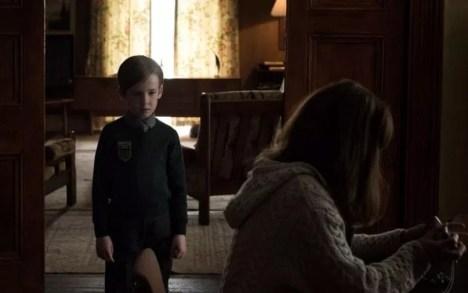
Reduced to a snappy elevator pitch, The Hole in the Ground is perhaps best described as Without Name by way of The Babadook with a dash of The Descent for flavour.”

Such descriptions are inevitably reductive, and don’t do justice to Lee Cronin’s maternal pagan wilderness horror, but they provide a strong sense of texture for the film. Indeed, given the quality of the three horror movies cited, The Hole in the Ground is at least drawing from the best sort of sources. The Hole in the Ground is a horror movie that draws upon Ireland’s rich supernatural framework to deliver a more relatable and universal sort of horror. The Hole in the Ground is a tale about the parental anxiety about the bond between mother and child informed by a heritage of faeries and changelings. It’s very shrewdly constructed so that one set of primal fears resonates with another quintessentially human fear.

Curtains for you.

The Hole in the Ground is a canny and well-constructed horror. It is effectively directed by Cronin, who knows how to build suspense and dread. It understands the power of something as simple as close-ups and sound effects to create a feeling of repulsion in an audience, even confronted with a seemingly mundane activity; if not for The Killing of a Secret Deer, this film would have cornered the market on the visceral horror of eating spaghetti. Cronin’s ability to build suspense carries the film through to its logical conclusion, culminating in the relatively rare horror movie third act that feels confident, effective and ambitious. It helps that Cronin has actor Seana Kerslake in a lead role as well, effectively tasked with carrying much of the film singlehandedly.

The Hole in the Ground is well made and efficient. Its biggest issue is that it often feels assembled from left-over parts, that it is playing with clusters of ideas that have already been thorough and substantively explored by films with an even tighter focus. This isn’t a fatal flaw by any means; the horror films that The Hole in the Ground evokes are some of the finest of the twenty-first century. The Hole in the Ground isn’t quite competing at that level, but it is stille very, very good.

You must be kidding.

Continue reading

New Podcast! Scannain Podcast (2019) #6!

It’s time for the latest Scannain podcast!

This week, I join Ronan Doyle, Jay Coyle and Luke Dunne from Film in Dublin to discuss the week in film news. We have a broad and wide-ranging discussion of what we watched, asking tough questions like whether Flash Gordon really is the horniest movie ever made and ruminating on the visual power of Shrek Retold. There are also discussions of The Miseducation of Cameron Post and the thirties thriller Red Dust.

News-wise, awards season continues apace with the race settling down after the BAFTAs and Roma emerging as the frontrunner. Simultaneously, the Oscars continue to be struggle to get their show organised. Meanwhile, closer to home, the Irish Film Institute unveils its plans for 2019 and its evening course in British cinema since the eighties.

The top ten:

  1. Can You Ever Forgive Me?
  2. Vice
  3. Mary Queen of Scots
  4. Glass
  5. The Mule
  6. A Dog’s Way Home
  7. Alita: Battle Angel
  8. Green Book
  9. How to Train Your Dragon III: The Hidden World
  10. The Lego Movie 2: The Second Part

New releases:

You can download the episode here, or listen to it below.

Non-Review Review: Happy Death Day 2 U

“You mean this is all about money?” asks a confused grad student early in Happy Death Day 2 U, as a stubborn college dean shuts down his (frankly reckless science experiment. The dean explains that the college is primarily interested in cultivating intellectual property and patents, which comes as news to his more innocent students. The dean protests, bluntly, “Somebody has to keep the lights on around here.”

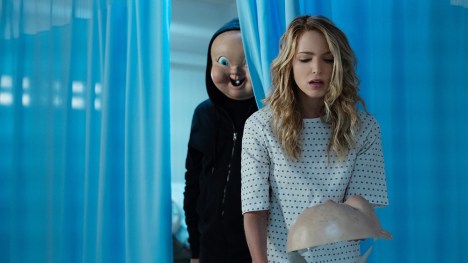
It’s an odd exchange within an odd film, and one that makes relatively little sense in the context of the story being told. however, it feels like a very revealing exchange in terms of the logic underlying Happy Death Day 2 U. The original Happy Death Day was a cinematic highlight of 2017. Somewhat (and fairly) overshadowed by Get Out, the original film was a playful and self-aware slasher movie hybrid which worked as both a charming example of the genre and broad critique of the exhausting and repetitive nature of such films.

Masking his intentions.

Happy Death Day was the story of a young woman who finds herself trapped reliving the same day over and over, facing a masked serial killer and getting murdered in a variety of inventive ways before resetting to do it all over again. Within that premise was a clear critique of horror franchise formulas that tended to trap protagonists within these familiar frameworks over and over and over again. In that context, Happy Death Day 2 U seems almost redundant. Tree has already lived the same story twelve times. What could a sequel possibly add, beyond some dollars to the bottom line?

It is to the credit of Happy Death Day 2 U that the film inherently and intrinsically understands this. Happy Death Day 2 U is a messy and awkward film, but it is crystal clear in at least one respect. Happy Death Day 2 U knows exactly what sort of film it doesn’t want to be. Unfortunately, it never seems entirely certain of the film that it does want to be.

Stab me, Baby, one more time.

Continue reading

New Podcast! Scannain Podcast (2019) #5!

It’s time for the latest Scannain podcast!

This week, I join Ronan Doyle, Jay Coyle and Alex Towers from When Irish Eyes Are Watching to discuss the week in film news. We have a broad and wide-ranging discussion of what we watched, including everything from John Carpenter’s The Fog to 3,000 Miles to Graceland to the work of Agnes Varda and some preemptive highlights of the upcoming Virgin Media Dublin International Film Festival. We also discuss a little bit about David Fincher’s Zodiac, which we all caught on 35mm at the Lighthouse.

In terms of film news, there is a lot to cover. The big story concerns the cinema-going habits of the Irish (and international) audiences. However, there’s also news from the European Film Market, including a number of prospective Irish films on sale.

The top ten:

  1. Second Act
  2. Escape Room
  3. Mary Poppins Returns
  4. Mary Queen of Scots
  5. Vice
  6. Glass
  7. The Mule
  8. A Dog’s Way Home
  9. Green Book
  10. How to Train Your Dragon III: The Hidden World

New releases:

You can download the episode here, or listen to it below.


Non-Review Review: On the Basis of Sex

On the Basis of Sex is a sturdy, old-fashioned awards season film.

On the Basis of Sex is earnest, unshowy and very conventional in both concept and execution. All of its beats are familiar, all of its rhythms predictable. It’s not especially inventive or innovative. It is a meat-and-potatoes awards fare, a fascinating story that is told in an uncluttered manner. While there are still a handful of these sorts of films released every year, it often seems like the ground is shrinking out from under them. As awards season has leaned towards quirky indie films like Vice or The Favourite, it has left films like On the Basis of Sex and Can You Ever Forgive Me? sitting in the dust.

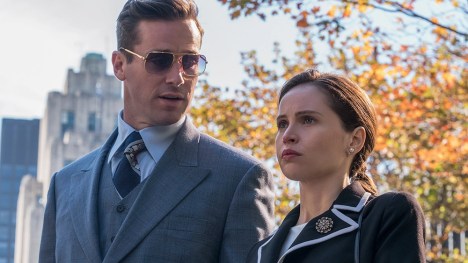
Ruthless litigation.

There is nothing wrong with old-fashioned awards fare, even if On the Basis of Sex occasionally feels conflicted about which particular mode of old-school biographical film it seeks to emulate; it starts like a conventional subject’s-life-in-two-hours piece in the style of films like Ghandi or Patton, and then shifts into the slightly more modern twist on the genre that tends to focus on one formative event like Frost/Nixon or The Queen or Elvis & Nixon. It is a strange shift, with On the Basis of Sex spending half an hour on a general introduction to Ruth Bader-Ginsberg before focusing on the meat of this particular story.

This lack of focus is not a major issue. Old-fashioned awards fare can work reasonably well with the right material and talent, despite seeming quaint by the standards of the time. On the Basis of Sex never stands out from the crowd in the same way as its central character, but then that might be expecting too much given that surprisingly long shadow cast by Ruth Bader-Ginsberg.

Courting controversy.

Continue reading