• Following Us

  • Categories

  • Check out the Archives


  • Awards & Nominations

Non-Review Review: IT – Chapter Two

IT: Chapter Two is muddled, messy and bloated, particularly in its middle stretch.

The horror sequel opens relatively strong and delivers a satisfying emotional pay-off. Unfortunately, the film’s structure means that it meanders wildly between those two fixed narrative points. Chapter Two runs a muscular two-hours-and-fifty-minutes, a full quarter-of-an-hour longer than the original film’s already impressive run time. In fact, taken together, the two films are more than one-and-a-half times the length of the early nineties miniseries adaptation of the novel. Chapter Two spends a lot of time on repetitive storytelling beats, splitting up the cast so each of the leads has their own identically-structured adventure.

Glowing, glowing… gone.

These structural flaws feel inevitable. Part of what worked so well with IT: Chapter One was the decision to largely eschew the complicated and convoluted mythology that King wove through his beloved doorstopper of a novel. The original film was not concerned with alien invaders or local legends beyond what was strictly necessary, allowing it to offer an extended horror movie riff on Stand by Me, a coming-of-age saga about young teens on the cusp of adulthood. In Chapter Two, that bill comes due. The sequel not only has to do its own heavy lifting, but take on a lot of the world-building the original film mostly ignored.

Indeed, there is a sense that Chapter Two works much better as a companion piece to the earlier film than as a narrative in its own right. Indeed, there is something interesting in the way that, taken as a whole, the two IT films represent the first real cinematic glimpse of Stephen King as an author of the American epic. IT is the story of a group of childhood friends facing a monstrous evil, but it feels much larger than that. Perhaps the most compelling thing about Chapter Two is the manner in which it creates a sense of scale and scope that has previous eluded adaptations of King’s work.

Pennywise, pound foolish.

Continue reading

Non-Review Review: Ready or Not

“It’s true what they say,” remarks Daniel Le Domas at one point in Ready or Not. “The rich really are different.”

The basic plot of Ready or Not should be familiar. A young woman finds herself welcomed into a wealthy family with an eccentric tradition. After each wedding, the new member of the family is invited to compete against the family in a game. That game can be anything, from tic-tac-toe to checkers. (“I will play the f&!k out of checkers,” Grace playfully boasts when the tradition is revealed.) However, when Grace draws the “hide and seek” card, things quickly take a turn for the macabre. Unlike other games, “hide and seek” is deathly serious. The family plan to hunt Grace down and offer her up as a ritual sacrifice.

What’s on the cards for this evening?

Although Ready or Not brings its own unique perspective to the template, the film is consciously riffing on the classic Most Dangerous Game set-up. Armed with bows-and-arrows, antique firearms and crossbows, the Le Domas family stalk their prey through their decadent mansion as the stakes gradually become clear to Grace. Ready or Not filters this premise through the lens of class and wealth, focusing on economic divide between Grace and her husband’s family. “She’ll never be one of us,” complains Charity Le Domas during the wedding, to her husband Daniel. Daniel responds, “Of course not. She has a soul.”

Ready or Not is pulpy and visceral fun, an engaging and exciting horror-comedy that skillfully blends the two genres in a way that plays to each’s strength. Ready or Not shrewdly positions itself as both a side-splitter and a skull-splitter.

The family that prays together, stays together.

Continue reading

145. Lock, Stock and Two Smoking Barrels – Summer of ’99 (#137)

Hosted by Andrew Quinn and Darren Mooney, and this week with special guests Babu Patel and David Singleton, The 250 is a (mostly) weekly trip through some of the best (and worst) movies ever made, as voted for by Internet Movie Database Users. New episodes are released every Saturday at 6pm GMT.

This time, continuing our Summer of ’99 season, Guy Ritchie’s Lock, Stock and Two Smoking Barrels.

1999 was a great year for movies, with a host of massively successful (and cult) hits that would define cinema for a next generation: Being John Malkovich, The Blair Witch Project, Go, Cruel Intentions, American Beauty. The Summer of ’99 season offers a trip through the year in film on the IMDb‘s 250.

Four young men in London find themselves in the middle of an elaborate scheme involving half a million bounds, mountains of marijuana, a shady sex shop proprietor, and two antique shotguns. As the situation rapidly escalates outside of their control, can these four young men keep their heads above water?

At time of recording, it was ranked 137th on the Internet Movie Database‘s list of the best movies of all-time.

Continue reading

Non-Review Review: The Informer

The Informer is essentially three films packaged in one.

While it’s hard to precisely outline these films without giving too much away, The Informer begins as a sleazy urban thriller about a police informer before morphing into a gritty prison drama before escalating into an elaborate hostage film. There’s nothing inherently wrong with any of these central premises. In fact, as fodder for film making goes, they are very reliable. Each of those three basic premises comes with stakes built in, and would be ubiquitous enough that the audience can follow along without the need for too much exposition or context.

🎵Oh Kinnaman, where’d you run to?
Oh Kinnaman, where’d you run to?
Kinnaman… where you gonna run to?🎶

Unfortunately, The Informer never quite settles on a particular tone or mood as it breezes through each of these three set-ups. The film runs just under two hours, which is a respectable run-time, but it does mean that each of those three genres ends up compressed. The film arguably spends more time on the transition between that initial urban thriller and subsequent prison drama than it does in either setting, creating the impression of a film more interested in visceral movement than a larger journey.

None of the three genres get enough screen-time or development to truly work, instead feeling like rough drafts rather than compelling set-ups. The characters and the storytelling are similarly rushed, often feeling flattened or sanded down in order to ease the movie’s transition from each type of story to the next. The result is a movie that only fleetingly engages, never holding its gaze long enough to deliver on any of its potential.

Poor (in)form.

Continue reading

Non-Review Review: Extra Ordinary

Extra Ordinary is very Irish ghost story.

“Irishness” is a very nebulous quantity. It can be very hard to precisely quantify. In humour, it tends towards a blend of irony and irreverence, often a surreal juxtaposition of the mundane with the surreal. As such, Extra Ordinary feels like a very Irish ghost story. It is a film anchored in the tropes and conventions of ghost stories – possessions, exorcisms, hauntings, satanic pacts – but which contextualises these things as just another minor frustration of country living. As the title implies, Extra Ordinary exists at the junction of the familiar and the uncanny. If the team produce a sequel, they should call it “Super Natural.”

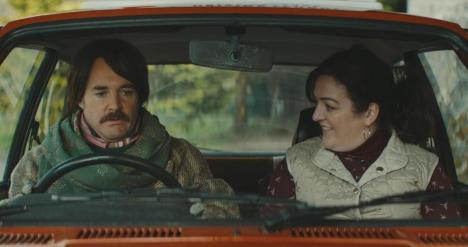
Driving curiosity.

Extra Ordinary adopts a uniquely Irish approach to its premise, wondering what happens to those ghosts that are a bit less dramatic and lot more mundane than the usual spirits. There’s something engagingly quirky in Extra Ordinary’s depiction of the eccentricity of country living, and how so much of that eccentricity just goes on as a fact of life; the dancing lead attached to a discarded toaster, the tree branch that sways without even a breeze, the wheelie bin that just keeps flapping through the night. This is just the way that things are in this part of the world, and the locals have (mostly) made their peace with it.

Despite its supernatural premise, the most endearing aspect of Extra Ordinary is how perfectly it captures the smaller and more intimate eccentricities of the Irish countryside.

Now I seance you…

Continue reading

144. La Vita è Bella (Life is Beautiful) – Summer of ’99 (#26)

Hosted by Andrew Quinn and Darren Mooney, and this week with special guests Ethan Shattock and Gerard Rooney from Disconnected Talk, The 250 is a (mostly) weekly trip through some of the best (and worst) movies ever made, as voted for by Internet Movie Database Users. New episodes are released every Saturday at 6pm GMT.

This time, continuing our Summer of ’99 season, Roberto Benigni’s La Vita è Bella.

1999 was a great year for movies, with a host of massively successful (and cult) hits that would define cinema for a next generation: The Matrix, The Blair Witch Project, The Sixth Sense, 10 Things I Hate About You, Fight Club. The Summer of ’99 season offers a trip through the year in film on the IMDb‘s 250.

In mid-century Italy, lovable fool Guido embarks on a courtship of the beautiful Dora, a woman far outside of his station. As Italy descends into fascism, Guido hopes that his optimism will allow himself – and his family – to endure in the face of unimaginable evil.

At time of recording, it was ranked 26th on the Internet Movie Database‘s list of the best movies of all-time.

Continue reading

Non-Review Review: UglyDolls

UglyDolls exists in the “uncanny valley” of modern children’s animated films.

Films like UglyDolls are a reminder of how profoundly Pixar has altered the cinematic landscape, and shifted expectations in terms of what audiences – young and old – expect from these sorts of films. Most obviously, the basic premise of UglyDolls echoes that of Toy Story; in much the same way that, say, The Emoji Movie mirrors Inside Out. This is a film about sentient toys trying to find an existential justification for their existence, often defined in terms of their relationship to a child. UglyDolls is a movie aout misfit toys cast out from the factory assembly line, wondering if they will ever be worth of love.

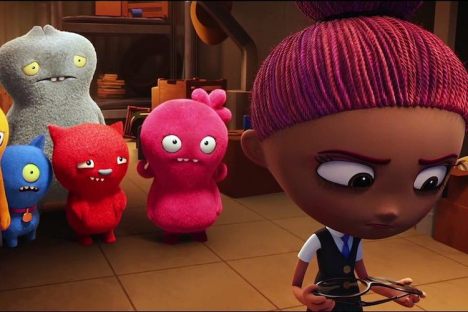
All dolled up with nowhere to go.

To be fair to UglyDolls, it is much better than The Emoji Movie. At the very least, UglyDolls understands that the film needs to be ordered around a strong central theme. UglyDolls has a solid conceptual basis, a familiar children’s movie allegory, and a very straightforward narrative structure. That said, although somewhat less crass in its materialist ambitions than The Emoji Movie, the film feels cynically calculated in other ways. The casting of performers like Kelly Clarkson, Nick Jonas, Janelle Monáe and Blake Sheldon seems designed to move the film’s soundtrack album. And the premise is obviously toyetic.

Still, UglyDolls comes closer than most of these sorts of films to working, largely failing because it ultimately underestimates the maturity and intelligence of its target audience.

A glass apart.

Continue reading

142. American History X – Summer of ’99 (#34)

Hosted by Andrew Quinn and Darren Mooney, and this week with special guest Charlene Lydon, The 250 is a (mostly) weekly trip through some of the best (and worst) movies ever made, as voted for by Internet Movie Database Users. New episodes are released every Saturday at 6pm GMT.

This time, kicking off our Summer of ’99 season, Toby Kaye’s American History X.

1999 was a great year for movies, with a host of massively successful (and cult) hits that would define cinema for a next generation: The Matrix, The Blair Witch Project, The Best Man, Cruel Intentions, Fight Club. The Summer of ’99 season offers a trip through the year in film on the IMDb‘s 250.

Danny Vinyard finds himself called to the principal’s office after submitting a salacious and controversial essay citing Adolf Hitler as a civil rights hero. There, the school principal Doctor Sweeney sets Derek another assignment: a personally essay exploring his relationship with his white supremacist brother Derek. Derek Vinyard was just released from prison that morning, and is about to discover that putting his life back together will not be as easy as he might have hoped.

At time of recording, it was ranked 34th on the Internet Movie Database‘s list of the best movies of all-time.

Continue reading

Non-Review Review: Animals

Animals lacks any real bite.

At its core, Animals is the story of the unhealthy relationship that exists between Laura and Tyler. Laura is a Dublin girl, with close ties to her extended family. Tyler is an American abroad, a young woman who seems to be running as far away from her family as possible. A chance encounter on a night out brought the two together in their twenties, and they have since become inseparable. Laura lives with Tyler in her lavish city centre apartment, while Tyler is a welcome guest at all of Laura’s family gatherings. The two seem to share a single life.

Putting the matter to bed.

Naturally, that relationship has begun to strain and fray as the women enter their thirties – Laura is about two years older than her best friend, while Tyler’s thirtieth birthday is a significant event in the context of the film. Laura seems to want to move on, to embrace adulthood and responsibility; she courts a young professional pianist named Jim and tries desperately to work on the novel she’s been picking over for the last decade. Tyler pushes back against this, terrified at the prospect that her best friend might leave her behind to wallow in her own hedonistic insecurities.

Animals is too generic to make a meaningful impression. Its major character and narrative beats are all helpfully signposted from the get-go, its destination obvious from the end of the first few scenes. However, there’s not enough substance present to justify that sense of inevitability, the leisurely-paced journey towards a foregone conclusion that hits every expected plot point and character moment along the way. Animals feels very much like every other “young person has a life crisis and has to find a way to be comfortable with themselves” narrative of the past decade, with little to distinguish it.

At home on the (G)rainger.

Continue reading

Non-Review Review: Luce

Luce is a compelling dialogue-driven thriller, anchored in a set of impressive performances and a meaty script.

At its core, Luce is a study of integration and idealism. It touches on the question of identity, that established by an individual and that imposed by the people around them. Luce derives its title and its tension from its lead character, a promising young African American student. Adopted by an upper-middle class white couple and rescued from his past as a child soldier, Luce has become an exemplar. He is an all-star debater, an impressive academic student, a successful athlete. He is loved by both the faculty and his fellow students. To hear the other characters talk about him, Luce is just about perfect.

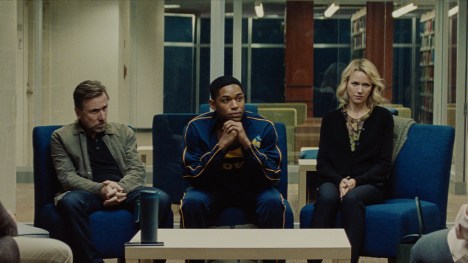
Getting schooled.

Naturally, Luce challenges that idea. Luce invites the audience to wonder whether the title character really is everything that everybody else believes him to be. More than that, the film interrogates why so many people seem to need Luce to be an exemplar. The film is a fraught push-and-pull as questions are raised about Luce. When the honours student turns in an inflammatory essay and when fireworks with the explosive power of a shotgun are found in his locker, the characters around Luce find themselves asking if they understand the teenager, or if they ever could.

The result is a tense and claustrophobic drama, as the characters navigating these accusations and insinuations try to constantly reconfigure their understanding of the title character. It’s a remarkable push-and-pull, elevated by some very potent themes and a wealth of strong performances.

Keeping track.

Continue reading