• Following Us

  • Categories

  • Check out the Archives


  • Awards & Nominations

Star Trek: Deep Space Nine – Prophet Motive (Review)

This September and October, we’re taking a look at the jam-packed 1994 to 1995 season of Star Trek, including Star Trek: Deep Space Nine and Star Trek: Voyager. Check back daily for the latest review.

Now that Star Trek: Voyager is on the air, there’s a sense that Star Trek: Deep Space Nine can be more relaxed. The show was undeniably contrarian during the short period when it was the only Star Trek on the air, presenting a series of uncompromisingly cynical episodes to assure viewers that it would not be trying to fill the void left by Star Trek: The Next Generation. At the same time, there’s also a sense that show was acutely aware of it potentially wider audience watching during that window.

During that first half of the season, a new adversary was pushed to the fore, the show did a story about Klingons and featured three guest stars from The Next Generation – although not necessarily the guest stars anybody would have chosen. More than that, though, the show seemed to consciously avoid its more controversial types of episodes. Even by the show’s third year, it had become clear that certain “types” of episodes appeared a few times a year – a couple of “old favourites” for the writing team to fall back on while constructing a twenty-six episode season.
'Ear me out 'ere...

‘Ear me out ‘ere…

As such, it’s telling that the most divisive parts of any Deep Space Nine season were pushed into the second half of the season.  So Ira Steven Behr and Robert Hewitt Wolfe’s two Ferengi-centric scripts came after Voyager had premiered. Sure, Quark got to be the focus of the season’s third episode, House of Quark, but he shared that with the popular Klingons. The season’s two big Bajoran plot lines (Life Support and Shakaar) were positioned towards the end of the year.

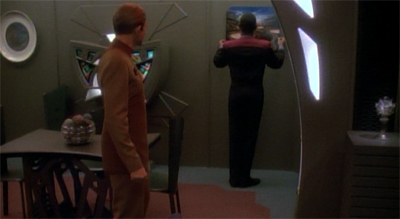
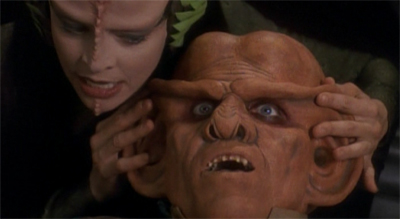
Prophet Motive feels like the kind of Star Trek episode that could only be produced on Deep Space Nine as part of Ira Steven Behr’s unique vision for the show. It’s the kind of weird script that the show seemed to get away with by virtue of being “the other Star Trek on television.” That doesn’t mean that it’s particularly good, mind you, just that it’s distinctly a Deep Space Nine story.

Quark is a by-the-book Ferengi...

Quark is a by-the-book Ferengi…

Continue reading

Star Trek: Deep Space Nine – The 34th Rule by Armin Shimerman & David R. George III (Review)

This September and October, we’re taking a look at the jam-packed 1994 to 1995 season of Star Trek, including Star Trek: Deep Space Nine and Star Trek: Voyager. Check back daily for the latest review.

The 34th Rule is a particularly notable piece of Star Trek fiction. It is the first Star Trek novel credited to a main cast member while their show was still on the air. Armin Shimerman, Eric A. Sitwell and David R. George III had pitched the idea for The 34th Rule as an episode of Star Trek: Deep Space Nine. When the producers were not interested in developing the idea, Shimerman and George decided to expand the idea out into a full-length novel. The 34th Rule was released during the seventh season of Deep Space Nine.

Shimerman was not the first actor to be credited on a Star Trek novel. William Shatner had already launched his own “Shatner-verse” series of novels following the “resurrection” of James Tiberius Kirk after his death in Star Trek: Generations. However, Shatner was pretty much done with the franchise at this point – having officially passed the torch to his successors as part of Generations. However, Shimerman was the first to publish a novel while the show was on the air.

The 34th Rule is a decidedly ambitious piece of work. It is clumsy in places, perhaps a little heavy-handed and on the nose. Nevertheless, it is a well-constructed and thoughtful Star Trek epic – one the feels in keeping with the mood of Deep Space Nine, even if it occasionally veers a little too far.

the34thrule

Continue reading

Star Trek: Deep Space Nine – Destiny (Review)

This September and October, we’re taking a look at the jam-packed 1994 to 1995 season of Star Trek, including Star Trek: Deep Space Nine and Star Trek: Voyager. Check back daily for the latest review.

The biggest problem with Destiny is that it doesn’t feel fully-formed. The show plays more like a series of vignettes than a single story. There are some nice character beats, and a sense that Star Trek: Deep Space Nine is an ensemble show, but Destiny meanders far too much. It seems like it wanders around without any singular purpose, any strong central point to tether it.

Is it about Sisko’s relation to the title of “Emissary”? Is about peace between Bajor and Cardassia? Is it about O’Brien and flirty Cardassians? Is it about Kira’s faith and her position on Deep Space Nine? Is it about end time prophecies?

It seems to be about all these things, but with no real commitment to any of them above the others. The end result is that it’s not about any of them particularly well.

Picture perfect...

Picture perfect…

Continue reading

Star Trek: Deep Space Nine – Prophecy & Change: The Orb of Opportunity by Michael A. Martin and Andy Mangels (Review/Retrospective)

The September and October, we’re taking a look at the jam-packed 1994 to 1995 season of Star Trek, including Star Trek: Deep Space Nine and Star Trek: Voyager. Check back daily for the latest review.

It is fun to imagine the negative space that exists between various episodes of Star Trek: Deep Space Nine. In its third season, the show was making nods towards serialisation, but there was never really a point where the series could not be broken down into reasonably well-defined episodic units. Even during the ten-hour series finalé, each of the constituent elements had its own narrative thrust and its own clear purpose. So it is fun sometimes to try to connect these threads together.

The ordering of episodes in a season of television is very interesting. It creates a fascinating connective tissue in the minds of fans. Although each episode is its own story, they come together to form something larger and more intriguing. On The X-Files, for example, placing Never Again directly after Leonard Betts changed the whole context of the episode. There are threads that do not necessarily exist within the individual episodes, but can be implied by the sequencing of the shows.

Placing Heart of Stone directly after Life Support is an interesting choice in several respects. It creates all sorts of interesting implications and developments, contradictions and possibilities. It is weird to have an episode about Odo’s attraction to Kira air directly after an episode focusing on the death of Kira’s long-term love interest; give her a week or two of space, guys. Similarly, it is strange to go from Nog’s characterisation in Life Support to his development in Heart of Stone.

The Orb of Opportunity is very clearly intended to bridge the gap between those two episodes, explaining how and why Nog developed in the way that he did.

ds9-prophecyandchange

Continue reading

Star Trek: Deep Space Nine – Past Tense, Part I (Review)

This September and October, we’re taking a look at the jam-packed 1994 to 1995 season of Star Trek, including Star Trek: Deep Space Nine and Star Trek: Voyager. Check back daily for the latest review.

It’s weird to think that Past Tense aired at the very end of the period where Star Trek: Deep Space Nine was the only Star Trek on television. The two parts were broadcast in early January 1995, after the release of Star Trek: Generations but before the broadcast of Caretaker, the pilot episode of Star Trek: Voyager.

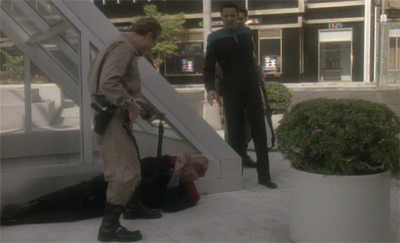
In a way, these are the most “Star Trek”-y episodes of the third season of Deep Space Nine. Embracing the franchise’s utopianism and optimism, the two episodes are even structured as a gigantic homage to The City on the Edge of Forever. Unlike the somewhat cynical and jaded run of episodes leading into them, Past Tense seems to exist as an episode that could draw fans of Star Trek: The Next Generation into Deep Space Nine.

Panic in the streets...

Panic in the streets…

It would have made sense to position the episodes earlier in the season, where they might have done a better job of attracting casual Star Trek viewers jonesing for a fix after The Next Generation went off the air. Unconnected to the serialised long-form plot of Deep Space Nine, engaging with important social issues of contemporary society and playing with familiar Star Trek tropes like time travel, it’s hard to imagine an episode of the third season of Deep Space Nine better suited to reeling in viewers.

As it stands, though, Past Tense aired at the last possible moment where Deep Space Nine could truly claim to be “the only Star Trek on television”, making the two-parter feel more like a footnote than a crescendo. It’s a shame, as Past Tense remains a vastly underrated instalment of the show’s third season.

Arresting drama...

Arresting drama…

Continue reading

Star Trek: Deep Space Nine – Fascination (Review)

This September and October, we’re taking a look at the jam-packed 1994 to 1995 season of Star Trek, including Star Trek: Deep Space Nine and Star Trek: Voyager. Check back daily for the latest review.

Well, that could have been much more unpleasant than it ultimately was.

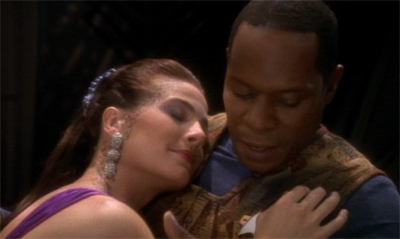
Yes, that’s damning with faint praise, but Fascination feels like a long sigh of exhaustion after what has been a tough run of episodes. The last episode of Star Trek: Deep Space Nine to air in 1994, Fascination came at the end of a production crunch that had seen the show desperately grasping for time. Quite a few of the first ten episodes of the season had been rushed through, with varying results – from Second Skin to Meridian.

So the fact that Fascination is not a massive soul-destroying screw-up on the scale of Meridian is a good thing, even if the episode’s plot does smell a little bit of desperation.

Dax can be quite touchy...

Dax can be quite touchy…

Continue reading

Star Trek: Deep Space Nine – Defiant (Review)

The September and October, we’re taking a look at the jam-packed 1994 to 1995 season of Star Trek, including Star Trek: Deep Space Nine and Star Trek: Voyager. Check back daily for the latest review.

Defiant is a cheeky piece of work.

On the surface, it appears to be a rather lame bit of cross-promotion for the release of Star Trek: Generations. The first movie featuring the cast of Star Trek: The Next Generation had opened three-days before Defiant aired, and so it seemed like the perfect opportunity to get a nice cameo from a well-loved cast member and remind audiences that the film was currently in cinemas. Jonathan Frakes is a likeable actor, and Riker has been used as an ambassador for the series before. He appeared in Cybill, after all.

However, then Defiant takes one sharp left-turn, massively upsetting expectations and becoming something a lot more interesting than a cross-media tie-in.

Guess who's coming to Quark's...

Guess who’s coming to Quark’s…

Continue reading

Star Trek: Deep Space Nine (Malibu Comics) #29-30 – Sole Asylum (Review)

The September and October, we’re taking a look at the jam-packed 1994 to 1995 season of Star Trek, including Star Trek: Deep Space Nine and Star Trek: Voyager. Check back daily for the latest review.

Whatever happened to Thomas Riker?

Star Trek: Deep Space Nine receives a lot of credit for its move towards serialisation as a prime-time genre show. It wasn’t a pioneer in the same way that Babylon 5 was or even Murder One had been, but it was was definitely ahead of the curve. Deep Space Nine arguably holds up better today than any of the other Star Trek shows, and part of that is down to the way that the show leaned into serialisation. Actions had consequences, effects lingered after the credits.

Hostage of fortune...

Hostage of fortune…

The show was very much leaning that way in the second and third season, building up plot threads that would pay off down the line. The Dominion had been seeded in the show since Rules of Acquisition. The Romulan and Cardassian pre-emptive strike was foreshadowed by episodes like Defiant and Visionary. In the third season, it became clear that Deep Space Nine was ready to commit to some long-form storytelling, in a way that was unusual for a high-profile syndicated genre show in the nineties.

However, it is tempting to give Deep Space Nine a little bit too much credit. There were points where the show seemed to struggle with pay-off and arc-building. In Emissary, Sisko was tasked with bringing Bajor into the Federation; that never happened. After Battle Lines, Kai Opaka never appeared again. Characters who seemed important dropped into and out of the show at random; characters like Martok’s son Drex, Bajoran First Minister Shakaar Edon, Subcommander T’Rul… and Thomas Riker.

The welcome wagon...

The welcome wagon…

Continue reading

Star Trek: Deep Space Nine – Meridian (Review)

The September and October, we’re taking a look at the jam-packed 1994 to 1995 season of Star Trek, including Star Trek: Deep Space Nine and Star Trek: Voyager. Check back daily for the latest review.

Meridian is, to be frank, an absolutely abominable episode of Star Trek: Deep Space Nine. As a series, Deep Space Nine never really had a concentrated run of bad episodes, like the first and second seasons of Star Trek: The Next Generation or the second season of Star Trek: Enterprise or the third season of the original Star Trek. The first two seasons of Deep Space Nine might not be spectacular, but they are competently produced television – while there are a few scattered stinkers to be found, the bulk of the show comprises of mediocre and solid stories.

Instead, Deep Space Nine tended to pepper its weakest episodes throughout its run, perhaps a firm reminder that the show was never an entirely serialised experience. This wasn’t one story pushing forward, despite the presence of arcs and character development; Deep Space Nine was still prone to the pratfalls of episodic television. In this case, the pratfall was the necessity of churning out filler on a tight schedule and hoping to meet a deadline while pumping out two dozen episodes a year.

So we get unforgivably shoddy episodes like The Emperor’s New Cloak or Profit and Loss or Let He Who Is Without Sin mixed in with Deep Space Nine at the height of its form. The third season of Deep Space Nine lacks the highs of the later seasons, but that doesn’t mean it lacks the lows. Meridian stands out as the weakest episode of the season, and a serious competitor for one of the worst episodes of the show.

It appears that the toxic smell of the script is suffocating Terry Farrell...

It appears that the toxic smell of the script is suffocating Terry Farrell…

Continue reading

Star Trek: Deep Space Nine – Civil Defense (Review)

This September and October, we’re taking a look at the jam-packed 1994 to 1995 season of Star Trek, including Star Trek: Deep Space Nine and Star Trek: Voyager. Check back daily for the latest review.

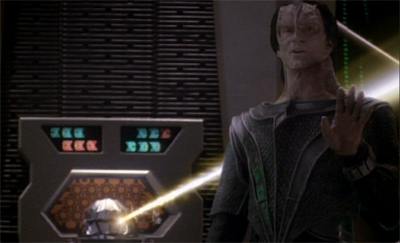
Civil Defense is an episode that really worked a lot better than it should have. The third season of Star Trek: Deep Space Nine hit a bit of a stumbling block in the early part of the third season. Indeed, Second Skin had been shot from what was pretty much Robert Hewitt Wolfe’s first draft of a teleplay. The Abandoned felt like a good premise pushed in front of the camera too early. Civil Defense was similarly rushed into production, with very little turn around from the production staff.

However, despite these production concerns, Civil Defense turns out to be an enjoyable pulpy adventure. The production team wouldn’t royally screw up until the next episode. The biggest problem with the script is that it feels like we’re seeing it far too late in the show’s run. Civil Defense is a fun third season episode, but it would have been a spectacular first season adventure.

"Free dissident suppression system with every purchase over twelve bars!"

“Free dissident suppression system with every purchase over twelve bars!”

Continue reading