• Following Us

  • Categories

  • Check out the Archives


  • Awards & Nominations

Star Trek: Deep Space Nine – Starship Down (Review)

This February and March, we’re taking a look at the 1995 to 1996 season of Star Trek, including Star Trek: Deep Space Nine and Star Trek: Voyager. Check back daily Tuesday through Friday for the latest review.

It is surprising that the Star Trek franchise has not done more “disaster” episodes, given the science-fiction setting and the occasional budget overruns that make a simple and effective bottle show all the more effective.

Starship Down is not the first time that the franchise has attempted to emulate the classic disaster film formula. Star Trek: The Next Generation had produced an episode (called Disaster, appropriately enough), which used many of the classic disaster movie tropes to explore various cast dynamics. Starship Down is arguably structured more like a submarine thriller than a disaster film, but the point of comparison still stands. There are conflicts over command styles, characters caught in lifts, high stakes and higher tension.

"Hanok, would you care to assist me in performing surgery on a photon torpedo?"

“Hanok, would you care to assist me in performing surgery on a photon torpedo?”

It is interesting to compare Starship Down to Disaster, if only as a point of comparison between the two shows in question. In many ways, the contrast serves to highlight the difference between the respective shows and their ensembles. In Disaster, the show was careful to give every combination of the cast something to accomplish. Picard and kids escape the turbolift; Geordi and Beverly vent the containers; Riker and Data’s head have excellent adventures; Worf delivers Molly.

In contrast, the character combinations in Starship Down are less goal-orientated. Worf and O’Brien defeat the Jem’Hadar while Quark and Hanok disarm a torpedo. However, Kira simply tries to keep Sisko awake while reflecting on their relationship and Bashir and Dax huddle together in a turbolift waiting for their oxygen to run out. There is a sense that Starship Down is much more interested in its character dynamics than it is a sense of narrative momentum or objective-orientated storytelling.

"Thank goodness only the LED's were affected."

“Thank goodness only the LED’s were affected.”

Continue reading

Star Trek: Deep Space Nine – Rejoined (Review)

This February and March, we’re taking a look at the 1995 to 1996 season of Star Trek, including Star Trek: Deep Space Nine and Star Trek: Voyager. Check back daily Tuesday through Friday for the latest review.

For a show that is supposedly about an enlightened and utopian future, Star Trek really doesn’t have the best record when it comes to gay rights.

Many fans laud the work that the franchise did in popularising the Civil Rights anxieties of the sixties, offering memorable and distinctive parables and the futility of racism while offering one of the first interracial kisses to air on national television. Fans of the franchise are quick to celebrate these triumphs as an example of Star Trek holding up a mirror to contemporary society and championing the causes of equality and social justice. It is part of the mythmaking that Gene Roddenberry baked into the foundation of the Star Trek legend.

A Trill alone...

A Trill alone…

Of course, the reality is more complicated. As important as it was to have a racially diverse crew on the bridge of the classic Enterprise, that idea came from the studio rather than Roddenberry. The show defended and vindicated the Vietnam War just as often as it criticised and opposed it. The interracial kiss in Plato’s Stepchildren might had more meaning if it weren’t an example of telepathic mindrape by sadistic aliens, or if it had aired before I, Spy had broadcast its own interracial kiss.

As much as fans like to believe Star Trek is progressive and enlightened, the franchise does not have as strong a track record as its advocates would contest. This is particularly true of the depiction of homosexuality in Star Trek. In the first season of Star Trek: The Next Generation, David Gerrold’s script for Blood and Fire was scrapped. Richard Arnold claimed that it was because the script was terrible; but this was the same season that produced The Last Outpost, Angel One and The Neutral Zone. It seems “terrible” is a relative term.

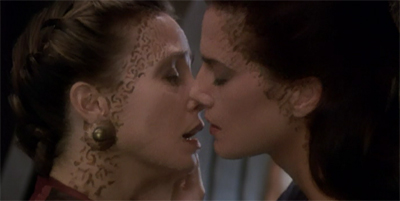
Kiss me.

Kiss me.

There were other examples. During production of The Offspring, there are accounts of David Livingston sprinting down to the sets to stop a shot of a same-sex couple holding hands making it into the episode. When the show finally decided to do an allegory for homosexuality, it was careful to cast a female performer in the role of Riker’s love interest to be sure that the audience did not get the wrong idea. The mirror universe episodes of Star Trek: Deep Space Nine are populated with gay stereotypes and clichés.

No matter how alien the creatures in Star Trek might get, sexuality tends towards heterosexual. In Metamorphosis, Kirk and Spock only realise that the Companion is attracted to Cochrane once they deduce the creature’s gender. Odo’s pseudo-sexual relationship with other Founders is typically expressed in relation to the character known as the Female Changeling. (Chimera does try to fix this.) Although there have been allusions to Andorian marriages featuring four partners, Star Trek: Enterprise presents the relationships as decidedly normative.

Take a bow!

Take a bow!

What little queer content exists seems to have slipped in under the radar. There is a decidedly homoerotic undertone to Amok Time. In The Offspring, Data allows Lal to assign her own gender and Whoopi Goldberg defined kissing as something that happens when “two people” (rather than “a man and a woman”) fall in love. In Rules of Acquisition, Jadzia Dax suspected that Quark’s newest employee had a crush on the rogue trader; Dax was just surprised to discover that the waiter in question was a woman in disguise who was trying to subvert the Ferengi patriarchy.

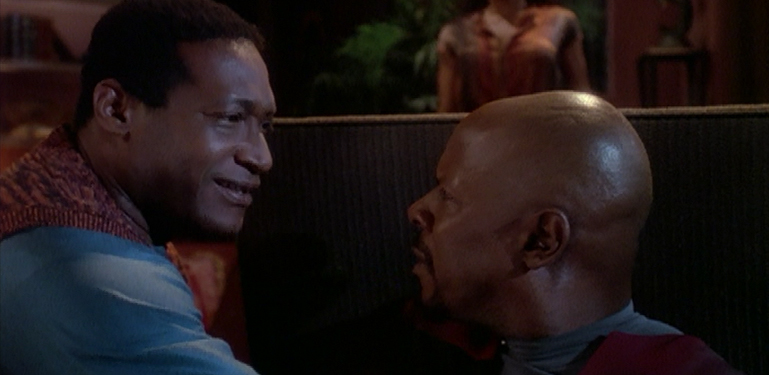
All of this serves to make Rejoined the most successful Star Trek episode to deal with the topic of homosexuality. This is not to argue that Rejoined is perfect or flawless. It is a science fiction show that aired in 1995, and there are some uncomfortable subtexts to the whole story. At the same time, its heart is in the right place. Rejoined is a beautiful piece of work, because it represents a rare example of the franchise trying to live up to its own publicity. In doing so, it serves to emphasise how frequently (and easily) the property has allowed itself to fall short.

Just Trilled to be there...

Just Trilled to be there…

Continue reading

Star Trek: Deep Space Nine – Indiscretion (Review)

This February and March, we’re taking a look at the 1995 to 1996 season of Star Trek, including Star Trek: Deep Space Nine and Star Trek: Voyager. Check back daily Tuesday through Friday for the latest review.

Much like Hippocratic Oath before it, Indiscretion serves to set the baseline of quality for the fourth season of Star Trek: Deep Space Nine. While The Way of the Warrior and The Visitor were ambitious deviations from form, Hippocratic Oath and Indiscretion offer a much clearer vision of what the show will look like from this point forward. As with Hippocratic Oath, a heavy two-hander a-plot is paired with a lighter b-plot that explores the day-to-day life on the eponymous space station, a structure that allows for world-building with sacrificing momentum.

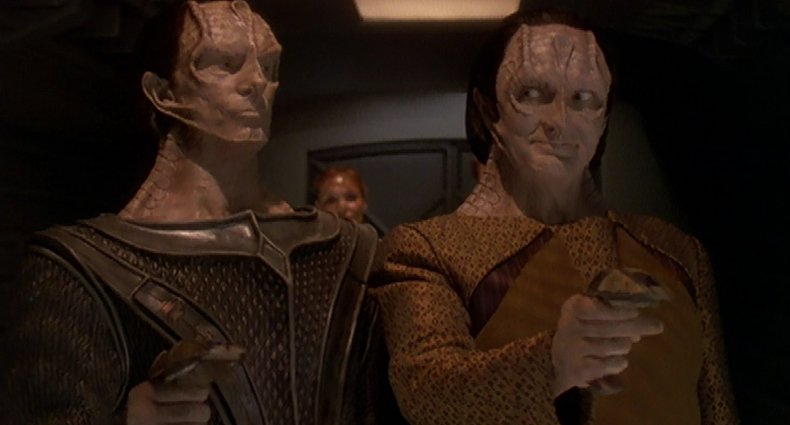
Indiscretion works very well on its own terms. It throws together two of the show’s more fascinating a well-defined characters, putting Major Kira and Gul Dukat on a road trip from hell that inevitably throws them headfirst into conflict with one another. Watching Nana Visitor and Marc Alaimo interact is worth the price of admission alone, and Indiscretion throws a fairly heated personal conflict into the mix to create some tense and compelling drama. Indiscretion works very well as forty-five minutes of television.

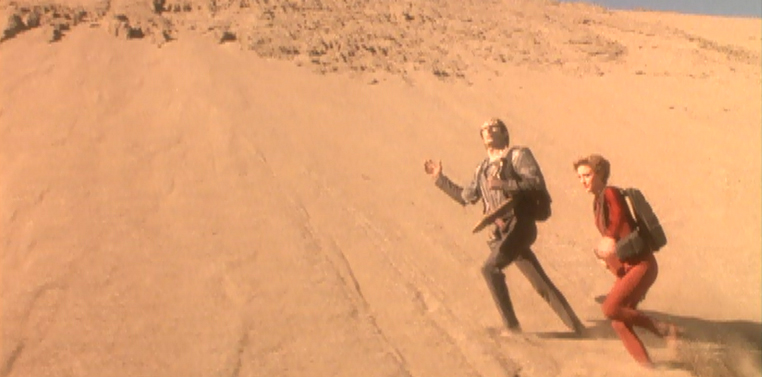
Road trip!

Road trip!

However, it also works quite well as an exercise in setting up a longer game. As with most of the episodes that end up rippling through the continuity of Deep Space Nine, it is hard to be sure if the writers knew exactly where they wanted to go with the plot threads stemming from this instalment. Some of the difficulties dealing with the episode’s biggest legacy suggest that more thought might have gone into it. Nevertheless, Indiscretion is an episode that is clearly written with one eye on the future of the show.

As much as it stands on its own two feet, the episode is clearly written with a view to drama that it might enable further down the line. It is a story that seems to be written so that its consequences might fuel further storytelling opportunity. Deep Space Nine had toyed with the idea of serialised storytelling before, but this marks the point where the show just rolls up its sleeves and jumps right on in.

"You know, I think she likes me."

“You know, I think she likes me.”

Continue reading

Star Trek: Deep Space Nine – The Visitor (Review)

This February and March, we’re taking a look at the 1995 to 1996 season of Star Trek, including Star Trek: Deep Space Nine and Star Trek: Voyager. Check back daily Tuesday through Friday for the latest review.

To my father, who is coming home.

Daddy's home...

Daddy’s home…

Continue reading

Star Trek: Deep Space Nine – The Way of the Warrior (Review)

This February and March, we’re taking a look at the 1995 to 1996 season of Star Trek, including Star Trek: Deep Space Nine and Star Trek: Voyager. Check back daily Tuesday through Friday for the latest review.

The third season of Star Trek: Deep Space Nine was really just a dress rehearsal for what lay ahead.

The third season had been a tumultuous time for the show, with Michael Piller departing the franchise to pursue opportunities outside Star Trek. It was the year directly after the end of Star Trek: The Next Generation, and all attention was focused on the pending release of Star Trek: Generations and the launch of Star Trek: Voyager. On top of that, the third season suffered from a great deal of confusion and disorganisation throughout the year, making it very hard for the production team to set an end goal for themselves.

"This could be the start of a beautiful friendship..."

“This could be the start of a beautiful friendship…”

In fact, the third season of Deep Space Nine was such a mess that the production team had not even managed to hit the end of season cliffhanger that they wanted. The Adversary had been drafted at the last possible minute when the studio vetoed the idea of ending the year with a Vulcan withdrawal from the Federation. This is not to discount the long list of impressive episodes produced during the season, but it does illustrate that the third season of Deep Space Nine had not progressed according to plan.

At the same time, it was a vital learning experience for the show. It provided a clear framework for what followed, providing producer Ira Steven Behr with a foundation from which he would build the rest of the run. The work put in during the third season would pay dividends in the fourth and fifth seasons, as the show began to play with and pay off ideas that had been carefully and meticulously established during that most chaotic of seasons. In fact, the show begins paying off those dividends with The Way of the Warrior, the first episode of the fourth season.

Klingons woz 'ere...

Klingons woz ‘ere…

Continue reading

Star Trek: Enterprise – Acquisition (Review)

Next year, Star Trek is fifty years old. We have some special stuff planned for that, but – in the meantime – we’re reviewing all of Star Trek: Enterprise this year as something of a prequel to that anniversary. This January, we’re doing the first season. Check back daily for the latest review.

Acquisition feels like a misstep for the first season of Star Trek: Enterprise.

It’s not the worst episode of the season. In fact, it falls rather comfortably into the show’s “big middle” – the random and generic episodes that take Star Trek clichés and execute them in a competent manner while overlooking the opportunity to do something a bit more novel and exciting. Acquisition ranks with failures like Civilisation or Sleeping Dogs or Rogue Planet. It is competently executed and contains a few moments of merit, but there’s a feeling that this has all been seen before.

"Take us to your leader."

“Take us to your leader.”

Of course, Acquisition serves to foreground a number of pressing concerns about the production of Enterprise. It’s something of a lightening rod to certain aggressive elements of fandom. Bringing back the Ferengi for a guest appearance proves that the show is more of a prequel to Star Trek: The Next Generation than to the original Star Trek. Glossing over continuity issues by refusing to name these marauding aliens demonstrates that the show clearly doesn’t care about continuity at all. Trying to do a comedy episode featuring the Ferengi demonstrates the producers have no idea what does and doesn’t work in Star Trek production.

All of this is, of course, nonsense. Acquisition isn’t a bad episode because it plays with continuity, or because it features the Ferengi. It’s a bad episode because it’s a comedy adventure that isn’t particularly funny or exciting.

"Hey, at least we got here before the Borg..."

“Hey, at least we got here before the Borg…”

Continue reading

Star Trek: Deep Space Nine – Season 3 (Review)

This September and October, we’re taking a look at the jam-packed 1994 to 1995 season of Star Trek, including Star Trek: Deep Space Nine and Star Trek: Voyager. Check back daily for the latest review.

The third season of Star Trek: Deep Space Nine was a turning point for many reasons. The most obvious was that Star Trek: The Next Generation had gone off the air, meaning the first half of the third season was broadcast during a window where Star Trek: Deep Space Nine was the only Star Trek show on the air. The show was no longer the goofy kid brother to a much beloved mainstream television show. It was out in the syndication market place by itself.

More than that, though, Star Trek: Deep Space Nine was no longer the child of the franchise. With Star Trek: Voyager on the way, launched as the flagship of UPN, Deep Space Nine was left to its own devices for the first time since it was created. Voyager was the high-profile standard-bearer for the franchise, serving as the cornerstone of a new network. In contrast, Deep Space Nine chugged along in syndication, with the powers that be working overtime to bring Voyager to screen.

ds9-thesearchpart1a

In some respects, this was a tough time for Deep Space Nine. It was no longer the newest and freshest Star Trek. It was no longer the bright promising future of the Star Trek franchise. The novelty of having a second Star Trek show on the air had worn off. (Indeed, the decision to treat Voyager as the eighth season of The Next Generation was largely a response to how Deep Space Nine was not filling the niche.)

At the same time, the fact that Michael Piller and Rick Berman were focused on other projects meant that Deep Space Nine really came into its own during the third season. Ira Steven Behr had helped run the writers’ room towards the end of the third season of The Next Generation, and was the logical choice to take the reigns on Deep Space Nine. His influence on the show had been obvious since the beginning, becoming more pronounced after The Maquis.

ds9-defiant19

However, the third season saw Behr becoming the driving creative force on Deep Space Nine, a changing of the creative guard. Ronald D. Moore and Rene Echevarria joined the show from the staff of The Next Generation. Given all this drama behind the scenes, the third season was as chaotic as you might expect. There were all manner of production problems that haunted the third season, with a sense that Deep Space Nine was being produced by the seat of the producers’ pants.

Episodes tended to get shifted around in production order. Various scripts ended up produced under time constraints so tight that there was no opportunity to properly polish them before putting them in front of the camera. There were rumours that Colm Meaney might have been considering leaving;. Episodes had to be extended into two-parters at the last minute. The show had great ideas, but difficulty realising them. The season as a whole was rather oddly paced, plotted haphazardly. And yet, despite all this, the chaos felt necessary.

ds9-explorers28

Continue reading

Star Trek: Deep Space Nine – The Adversary (Review)

This September and October, we’re taking a look at the jam-packed 1994 to 1995 season of Star Trek, including Star Trek: Deep Space Nine and Star Trek: Voyager. Check back daily for the latest review.

The Adversary is a strange little episode. In many respects, barring the last line, it really doesn’t feel like a season finalé. While Star Trek: Deep Space Nine typically eschewed the season-ending cliff-hangers that came to define Star Trek: The Next Generation and Star Trek: Voyager, the last episode of a given year typically ended with a major shake-up to the status quo. They may not have ended with the promise “to be continued…”, but they usually carried a great deal of weight.

In contrast, The Adversary feels like a fairly standard episode of Deep Space Nine. It doesn’t radically alter anything. Although Odo’s last line hints at the shape of things to come, it’s not much more than what Lovok assured us in The Die is Cast. The episode is well-executed, well-constructed and it’s distinct enough from a standard Star Trek episode that it works, but The Adversary feels like it’s not really positioned to close out the year.

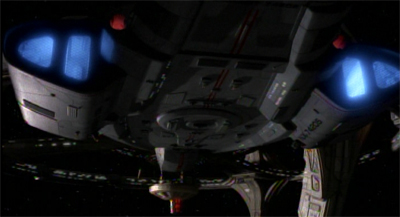
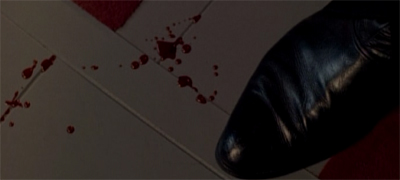
There's blood on the Defiant's floor...

There’s blood on the Defiant’s floor…

This is, of course, because it wasn’t intended to close out the year. The third season of Deep Space Nine was quite troubled. While not anywhere near as troubled as the third season of The Next Generation, it was a year where plans were constantly changing and scripts were frequently written on the fly. It seemed like the writers were constantly struggling against deadlines while trying to keep track of all the moving pieces.

Second Skin was filmed from little more than a first draft; Improbable Cause was extended into a two-parter at short notice. Scripts like The Abandoned looked like they needed a bit more work before being put in front of the camera. Shows like Meridian, Facets and Life Support seemed stitched together out of desperation. Indeed, The Adversary was produced at only a week’s notice. It’s to the credit of the episode – like Second Skin before it – that it holds up remarkably well.

There won't be blood...

There won’t be blood…

Continue reading

Star Trek: Deep Space Nine – Facets (Review)

This September and October, we’re taking a look at the jam-packed 1994 to 1995 season of Star Trek, including Star Trek: Deep Space Nine and Star Trek: Voyager. Check back daily for the latest review.

Facets in more than a little muddled. It’s an episode that is all over the place. It’s a script that doesn’t seem to know what it wants to be, leaning in one direction and then another. The episode’s big plot point isn’t dropped until half-way through, and there are any number of points where the script offers a feint towards a plot that never quite develops. As befitting a story called Facets, this is an episode with quite a few different (and often conflicting) sides.

It’s a disjointed little story, and perhaps an effective demonstration of just how much trouble the producers were having with Dax as a character. And yet, despite all this, Facets works surprisingly well. This is likely down to the fact that – like Playing God and arguably Blood Oath before it – it feels like a Dax story that is as interested in the character as it is in the concept.

A little piece of herself...

A little piece of herself…

Continue reading

Star Trek: Deep Space Nine – The Lives of Dax: The Music Between the Notes (Curzon) by Steven Barnes

This September and October, we’re taking a look at the jam-packed 1994 to 1995 season of Star Trek, including Star Trek: Deep Space Nine and Star Trek: Voyager. Check back daily for the latest review.

Star Trek: Deep Space Nine struggled with the character of Dax on-and-off for the first three years. Terry Farrell found herself at the centre of interesting character-driven stories with Playing God and Facets, but the show tended to treat the Dax symbiont as a macguffin that just happened to be inside Jadzia. Episodes like Dax, Invasive Procedures and Equilibrium tended to marginalise Jadzia so that the symbiont itself could be pushed to the centre of a story driven by other members of the ensemble.

However, Dax is a character with absolutely phenomenal potential. There is something absolutely fascinating idea of a creature that has lived for centuries, and seen generations of history unfold within its lifetime.The symbiont has witnessed countless changes and pivotal moments. Dax has seen civilisations fall and alliances form; Dax has seen old enemies become true friends, and watched civilisations reach out into the cosmos.

The realities of a seven-season television show mean that Deep Space Nine never really got to explore the fact that Dax was living history. Perhaps Blood Oath and Trials and Tribble-ations come closest, using Dax as a rather logical bridge spanning almost a century of continuity. One of the joys of the Star Trek universe is how expansive and how limitless it is. Infinite diversity and all that. While even Dax cannot have seen everything, Deep Space Nine never felt like it captured the sense of Dax as living history.

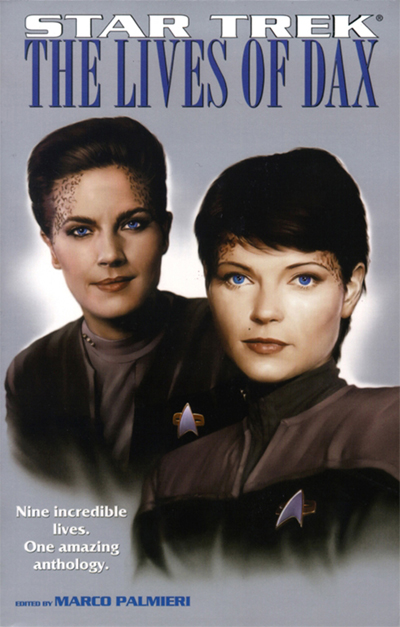
At its best, Pocket Books’ The Lives of Dax anthology captures this sense of change and movement. The books spans the width and breadth of the Star Trek franchise, as lived through the life of one single organism. It is beautiful.

ds9-thelivesofdax1 Continue reading