• Following Us

  • Categories

  • Check out the Archives


  • Awards & Nominations

New Escapist Column! On Power Without Responsibility in the MCU…

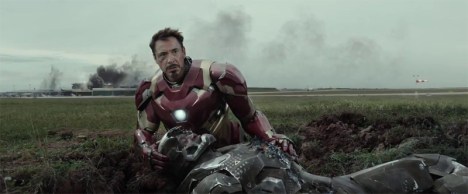
I published a new In the Frame piece at The Escapist this evening. With WandaVision launching this weekend and with reports that Chris Evans would be returning to the role of Steve Rogers, it seemed like a good time to take a look back at Captain America: Civil War as the point at which the MCU embraced the idea of power without responsibility.

Superhero stories are often about power and responsibility. However, one of the most striking aspects of the MCU has been its recurring embrace of the idea that power should come without any responsibility. Civil War is supposed to be a story about consequences, but instead becomes a story about characters desperately evading consequences, and asking the audience to cheer for them as they do. There’s something hollow and empty in that, and it’s arguably a rot at the root of the MCU.

You can read the piece here, or click the picture below.

New Escapist Column! On “Star Wars” Continuity Power Games…

I published a new piece at The Escapist today. As ever, there are rumours in Star Wars fandom about the possibility that the sequel trilogy will be removed from canon.

As ever, these rumours are most likely nonsense designed to generate clicks in an economy that has monetised outrage clicks by stoking and feeding fan resentment and anger. However, they also reveal something very interesting about the nature of canon in modern fandom. The idea of “canon” has nothing to do with continuity. It is instead a way of asserting power and ownership over media, of asserting that a franchise “belongs” to one particular group and not for others.

You can read the piece here, or click the picture below.

New Podcast! The Escapist Movie Podcast – “An Ever-Escalating Series of Star Wars”

The Escapist have launched a movie podcast, and I was thrilled to join Jack Packard and Elijah Beahm for the sixteenth episode. Obviously, the big news is the slate of announcements from Disney’s Investor Day, including plenty of Star Wars and Marvel announcements, more news about Zack Snyder’s Justice League, and reports about Tom Cruise’s rant on the set of the new Mission: Impossible movie.

You can listen to the episode here, back episodes of the podcast here, click the link below or even listen directly.

New Escapist Column! On “The Mandalorian”, Continuity and Brand Synergy…

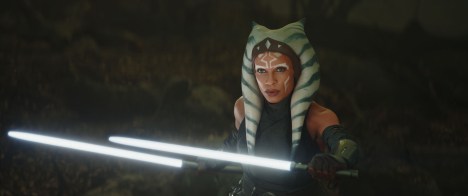
I published a new In the Frame piece at The Escapist this evening. There’s been a lot of Star Wars continuity dropped into the second season of The Mandalorian, with Boba Fett returning to the show following his apparent death in Star Wars: Episode VI – Return of the Jedi, and the live action introduction of characters like Bo Katan and Ahsoka Tano from The Clone Wars.

This is interesting, in large part because the first season of The Mandalorian was comfortable aiming for a broader sort of Star Wars nostalgia, things that looked like existing elements of continuity, rather than things that were existing elements of Star Wars continuity. The second season is much more heavy of Star Wars cross-promotion, populated with references designed to push viewers towards supplementary material. This is a nice illustration of transmedia storytelling in the streaming age, where it isn’t enough to attract fans, services have to retain them.

Streaming services hold on to existing subscribers by adding value, and Disney appear to have figured out that continuity offers its own added value. In its second season, The Mandalorian increasingly feels like an advertisement for the other riches that the streaming service has to offer, and a promise that any subscriber who doesn’t cancel once the season is over will have a treasure trove of archival material to binge at their leisure.

You can read the piece here, or click the picture below.

New Escapist Column! On James Gunn’s Upcoming “The Suicide Squad”…

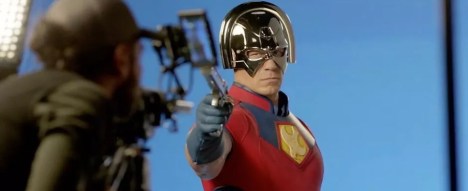
I published a new In the Frame piece at The Escapist earlier in the week. With DC’s Fandome event at the weekend, it seemed like a good time to take a look at one of their upcoming projects: James Gunn’s The Suicide Squad.

Gunn didn’t actually premiere too much material from The Suicide Squad, primarily unveiling the cast roster and screening some behind the scenes footage. However, the announcement was interesting, marking a clear delineation from David Ayer’s Suicide Squad. In these brief snippets, Gunn suggests an understanding of what has historically made the Suicide Squad such a compelling concept: its status the island of misfit toys in larger DC continuity.

You can read the piece here, or click the picture below.

New Escapist Column! On the Future of “Star Wars” on Streaming…

I published a new piece at The Escapist yesterday. With the announcement that Star Wars is launching a Bad Batch television series off the back of The Clone Wars, it seemed like a good opportunity to take a look at why the franchise’s future might lie on streaming.

To a certain extent, Star Wars has suffered because it is no longer a pop cultural monolith. It arguably hasn’t been a monolith since the release of The Empire Strikes Back in 1980. Since then, Star Wars has built a fanbase populated by different audiences who want different things from the franchise. There are a lot of problems with The Rise of Skywalker, but at least part of the problem comes down to the fact that the film tried to avoid offending anybody and so satisfied nobody. Streaming offers a chance for Star Wars to be multiple things, to multiple people.

On streaming, freed from the burden of being a box-office-record-smashing success, Star Wars has the opportunity to be more experimental and more bold. It can also specifically target particular segments of its diverse fanbase, offering a little something for everybody while still potentially offering room to grow and expand. If managed wisely, Star Wars is in prime position to make the jump from big screen to small screen.

You can read the piece here, or click the picture below.

New Escapist Column! On Versatility and Adaptability as Batman’s True Superpowers…

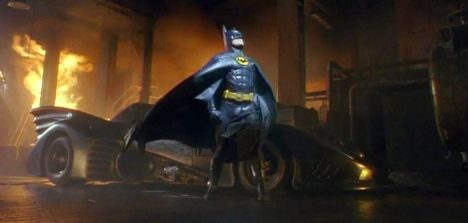
I published a new In the Frame piece at Escapist Magazine this evening. It’s been a busy couple of weeks with actors talking about the role of Batman. Val Kilmer discussed it in a long-form interview with The New York Times and Robert Pattinson brought it up in his GQ quarantine profile.

Kilmer argued that the actor playing Batman was unimportant in irrelevant, which is both true in the general case and false in this specific situation. In a general sense, Hollywood is moving away from movie stars and towards intellectual property. However, Batman remains one of the few established brands that is flexible enough to allow a unique approach shine through; Adam West, Kevin Conroy, Michael Keaton, Christian Bale, Will Arnett and Ben Affleck have all offered distinctive takes on the Caped Crusader, each finding a different window to explore the cultural icon.

There is no single “right” interpretation of Batman, and this has contributed to the character’s ubiquity and endurance. Indeed, it’s arguable that Superman has struggled to remain relevant precisely because he doesn’t have that same flexibility. Superman remains largely stuck in a template defined by the Richard Donner movies, unable to escape their gravity and the pull of the nostalgia around them. Batman can be anything that he needs to be – and that is why he remains as popular as ever.

You can read the piece here, or click the picture below.

The Unlikely Validation of Steven Moffat’s “Doctor Who” by Chris Chibnall…

To be entirely fair, the twelfth season of Doctor Who offers a marked improvement over the eleventh. It has a lot more enthusiasm and ambition, a stronger sense of ownership, and a higher baseline of competence.

Still, watching the twelfth season is a surreal experience. On the most basic of levels, the season does not contain a single episode as good as either of the eleventh season’s standouts, Demons of the Punjab or It Takes You Away. The best episode of the season is Fugitive of the Judoon, which is not so much an episode as a forty-odd minute teaser. The second best episode of the season hinges its climax on the moral argument that Percy Shelley’s life is worth more than millions in the future because he’s a “great man of history.” As such, it is a fundamentally flawed season.

At the same time, there is something interesting in the season’s relationship to the Moffat era. Every era of Doctor Who has an interesting relationship with the one that preceded it. The Third Doctor’s status as an establishment figure was best read as a reaction against the Second Doctor as a wandering hobo, with the Fourth Doctor’s bohemian sensibilities itself a reaction against that. Indeed, specific stories with the Hinchcliffe era seem to exist as plays upon (or critiques of) the Letts era, most notably Terror of the Zygons.

The Moffat era was no stranger to this, involving itself in an evolving conversation with the Davies era. The fifth season adhered religiously to the structure that Davies had employed for each of his four seasons, while later seasons would become structurally ambitious. The entirety of the ninth season seemed to be built outwards from Journey’s End, from the return of Davros and resurrection of Skaro in The Magician’s Apprentice to the reframing of the Doctor’s memory wipe of companion in Hell Bent. Moffat even affectionately named the “good Dalek” in Into the Dalek as “Rusty” in honour of Russell T. Davies.

As such, it is no surprise that the Chibnall era should have something to say about the Moffat era. To be fair, historical episodes like Nikola Tesla’s Night of Terror or The Witchfinders, along with attempts to ground the series in the companions’ domestic lives in Arachnids in the U.K. and Can You Hear Me?, suggest a stronger affinity for the Davies era. Still, the decision to open the twelfth season with a two-parter globe-trotting adventure (that morphs into a time-hopping adventure) in Spyfall, Part I and Spyfall, Part II feels consciously indebted to Moffat’s sixth season opener The Impossible Astronaut and Day of the Moon.

The most striking aspect of the twelfth season’s relationship to the work of Steven Moffat is how its season premiere and finale feel like long-delayed set-ups to punchlines that Moffat delivered years ago. In particular, Spyfall, Part II feels like the premise of Let’s Kill Hitler played depressingly straight, and The Timeless Children is essentially the sort of notionally “epic” continuity-fest that Hell Bent so studiously avoided. There’s something incredibly depressing in this, a sense that the Chibnall era not only missed the point of Let’s Kill Hitler and Hell Bent, but is committed to being the kind of stories that they so roundly mocked.

Continue reading

Non-Review Review: Birds of Prey (And the Fantabulous Emancipation of One Harley Quinn)

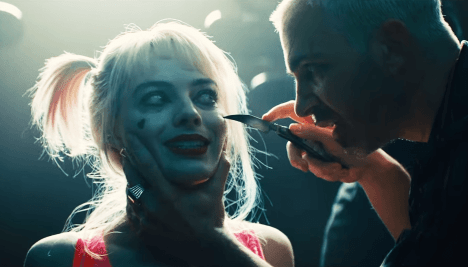
Birds of Prey (And the Fantabulous Emancipation of One Harley Quinn) is an immensely charming and high-energy romp, that is as unfocused as its central character and suffers more than a little bit from a non-linear narrative style that it never really justifies or employs effectively.

There is a lot to love in Birds of Prey, but perhaps the most charming aspect of it is the intimacy. Birds of Prey is bereft of the sort of city-, planet- or galactic-sized stakes that have come to define so much of modern superhero cinema, from Thor: The Dark World to Man of Steel to Avengers: Endgame. The bulk of Birds of Prey consists of a wrestling match over a diamond that happens to contain bank account details that point to an even larger payday. Its climax is on the scale of an eighties or nineties action movie, which means it involves anonymous henchmen rather than a literal army.

A cutting retort?

This consciously low-stakes approach allows Birds of Prey to simply enjoy itself, to revel in the charm of the cast and the relatively straightforward journeys of the central characters. Warner Brothers have been pushing their DC properties away from the MCU-emulating shared universe model that led to the spectacular disaster of Justice League, instead focusing on affording creators the freedom to do what they want to do. Joker rejected the modern superhero template to offer a throwback to films like Taxi Driver and King of Comedy. In contrast, Birds of Prey seems to hark back to The Long Kiss Goodnight.

Birds of Prey is perhaps a little too messy and unfocused in terms of narrative, which affects the movie’s pacing and rhythm. However, it also trusts its cast and its energy to carry it a long way, working best when it feels confident enough to play as a live action Looney Tunes cartoon.

Girl gang.

Continue reading

Doctor Who: Fugitive of the Judoon (Review)

“Is there even word for how dumb you are?”

“… Doctor?”

Fugitive of the Judoon is a breath of fresh air. The only question is whether it is blowing in the right direction.

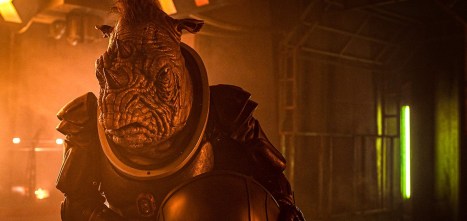
There are obvious problems with Fugitive of the Judoon. The episode is overloaded with fan service, just starting with the returning monsters in the title and bubbling over into an entire subplot that seems to exist to give three quarters of the primary cast something to do. More than that, the episode is deliberately and purposefully ambiguous in a way that makes it impossible to properly assess its more audacious and ambitious twists. Fugitive of the Judoon is an episode that relies heavily on context, context that will be derived from the rest of the season.

The devil you Rhino.

And, yet, there is something exhilarating in Fugitive of the Judoon. This is the most ambitious that Doctor Who has felt since World Enough and Time and The Doctor Falls. This is an episode bursting at the seams with ideas that seem designed to upend what the audience think they know about Doctor Who, while also boldly reassuring viewers at home that showrunner Chris Chibnall actually has some sort of vision of where he wants the show to go. Fugitive of the Judoon suggests an impressive jigsaw puzzle, even if the pieces are yet to be assembled.

It helps that the episode is fast on its feet and breezy, probably managing to balance the “overstuffed Chibnall era plot” better than any episode since It Takes You Away. If Spyfall, Part I and Spyfall, Part II suggested that the season was going to take its cues from Russell T. Davies third season, then Fugitive of the Judoon might represent the best expression of this approach. Fugitive of the Judoon is not so much “season three redux” as “season three remix.” While hopefully there’s more to it than that, it is enough to elevate the episode above most of its contemporaries.

Space police stop.

Continue reading