• Following Us

  • Categories

  • Check out the Archives


  • Awards & Nominations

Secret Invasion (Review/Retrospective)

This is the twelfth in a series of comic book reviews that will look at the direction of Marvel’s shared universe (particularly their “Avengers” franchise) over the past five or so years, as they’ve been attempting to position the property at the heart of their fictional universe. With The Avengers planned for a cinematic release in 2012, I thought I’d bring myself up to speed by taking a look at Marvel’s tangled web of continuity.

Well… that was anti-climactic.

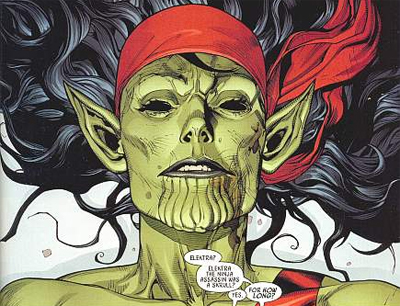
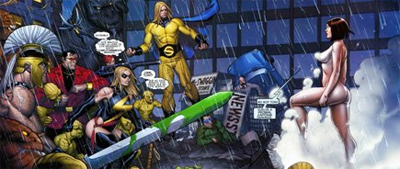
Well, at least green and red go together...

Continue reading

Brian Michael Bendis’ Avengers – Mighty Avengers: Assemble & Secret Invasion (Hardcover) (Review/Retrospective)

This is the ninth in a series of comic book reviews that will look at the direction of Marvel’s core continuity (and in particular their “Avengers” franchise) over the past five or so years, as they’ve been attempting to position the property at the heart of their fictional universe. With The Avengers planned for a cinematic release in 2012, I thought I’d bring myself up to speed by taking a look at Marvel’s tangled web of continuity. Get an overview of what I’m trying to take a look at here.

After the schism of Civil War, a title like Mighty Avengers makes sense on some level. If you’ve pitted heroes against heroes in a contest that you’ve deemed to be allegedly subjective (Marvel’s editorial policy was that there was no right or wrong side to the conflict), then it makes sense to follow the winners as well as the losers. The post-Civil War issues of Bendis’ New Avengers followed those heroes who had fought against registration of superheroes and lost, and Mighty Avengers was launched to offer us an on-going narrative featuring the winning side. It also seems to be a conscious nostalgic effort on the part of author Bendis, perhaps a response to the criticism that his early work on New Avengers steered clear of conventional Avengers storylines – occupied as they were with Japanese ganglands, prison breakouts and Sentry’s inter-personal issues. Here, Bendis seems to be consciously focusing on classic Silver Age devices – in the first run of issues, the State-sanctioned Avengers team faces classic foes like Ultron, the Symbiotes and even Doctor Doom. The problem is that Bendis isn’t necessarily comfortable drafting conventional superheroic fare.
Ultron puts Tony in touch with his feminine side…

Continue reading

Brian Michael Bendis’ Avengers – New Avengers Vol. 3-4 (Hardcover) (Review/Retrospective)

This is the eighth in a series of comic book reviews that will look at the direction of Marvel’s continuity (and, in particular at their “Avengers” franchise) over the past five or so years, as they’ve been attempting to position the property at the heart of their fictional universe. With The Avengers planned for a cinematic release in 2012, I thought I’d bring myself up to speed by taking a look at Marvel’s tangled web of continuity.

And now we’re entering a continuity-heavy area. You have been warned. As if we’ve been in a continuity-free zone for the past couple of weeks, remarks you, trusted reader. This is where my little experiment to venture deep into the heart of Marvel’s comic book continuity becomes a little bit more complicated and a little bit more difficult. Whereas the first part of Bendis’ run on New Avengers was relatively stand-alone (while still drawing on decades of events and continuity), it’s at this point the series becomes irrevocably intertwined with the on-going events at the heart of the Marvel Universe. It’s been described as “a spine”, and that’s pretty much exactly what it is: it’s a support structure which ties together the big Marvel events year-on-year, a thread that joins events like Civil War and Secret Invasion and Siege to each other and the greater fictional universe.

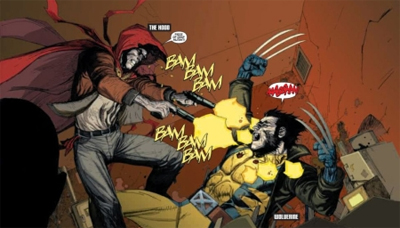
Wolverine learns the hard way not to bring claws to a gun fight...

Continue reading

World War Hulk (Review/Retrospective)

This is the sixth in a series of comic book reviews that will look at the direction of Marvel’s continuity (and particularly their “Avengers” franchise) over the past five or so years, as they’ve been attempting to position the property at the heart of their fictional universe. With The Avengers planned for a cinematic release in 2012, I thought I’d bring myself up to speed by taking a look at Marvel’s tangled web of continuity. Get an overview of what I’m trying to take a look at here.

Forget sides. They’re all screwed when the Hulk gets back.

– a popular internet meme which puts Civil War in perspective

I have to admit, World War Hulk reads like something of a guilty pleasure. The fantastic artwork from John Romita Jr. (whose fantastical character designs work much better here than in Kick-Ass or even Enemy of the State) certainly helps, as does the relative brevity of the miniseries. It’s a relatively self-contained five-issue storyline, as opposed to the large House of M or Civil War which directly preceded it and Secret Invasion which would follow – it also helps that the tie-in issues seem a lot less essential (and certainly less omni-present) than they did for any of those series. World War Hulk is pretty far from perfect, but it’s an enjoyable little arc from a writer who is clearly familiar with the Incredible Hulk.

Hulk makes quite an impact...

Continue reading

Civil War (Review/Retrospective)

This is the fourth in a series of comic book reviews that will look at the direction of Marvel’s “Avengers” franchise over the past five or so years, as they’ve been attempting to position the property at the heart of their fictional universe. With The Avengers planned for a cinematic release in 2012, I thought I’d bring myself up to speed by taking a look at Marvel’s tangled web of modern continuity. Get an overview of what I’m trying to take a look at here.

Civil War was Marvel’s big event of 2006-7, and – as this lovely deluxe edition loves to remind you – it was “the industry’s best selling series in over a the decade”. The premise of the series is straight-forward enough – it’s a conflict between the heroes of the Marvel Universe (it’s all there in the title) – and perhaps that is the reason that the series has arguably had more crossover mainstream appeal than the vast majority of comic book crossovers. Marvel have produced a lovely deluxe hardcover which contains just about everything you could possibly want from the event, it’s just a shame I’m not overly impressed by the event itself.

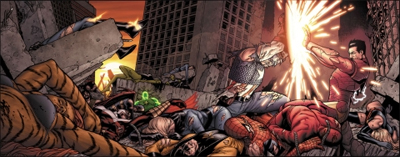
I'm sure we can iron this out...

Continue reading

Brian Michael Bendis’ Avengers – New Avengers Vol. 1-2 (Hardcover) (Review/Retrospective)

This is the first in a series of comic book reviews that will look at the direction of Marvel’s “Avengers” franchise over the past five or so years, as they’ve been attempting to position the property at the heart of their fictional universe. With The Avengers planned for a cinematic release in 2012, I thought I’d bring myself up to speed by taking a look at Marvel’s tangled web of continuity. Get an overview of what I’m trying to take a look at here.

Alright. I figure I sound a bit hypocritical complaining about the impact of big events on Marvel’s storytelling continuity without reading said big events. Well, actually, I don’t think I’m a hypocrite – I think it’s perfectly reasonably that a reader should be able to pick up Ed Brubaker’s Captain America without having to worry about Mark Millar’s massive Civil War crossover which they either don’t know enough to care about or know enough not to care about. However, I feel like maybe – just maybe – I should try to ride this “cross-continuity” thing out just once and see if the story somehow justifies the damage it causes to the cohesion of individual runs.  Yes, I’m going to jump head-first into the event-populated minefield of continuity which is recent Marvel history, and I will be using New Avengers as a checklist to that. I’m going down the rabbit hole, following the arc from Civil War through to Siege.

Sentry is responsible for the Carnage in this run...

Continue reading

The Immortal Iron Fist Omnibus

My name is Daniel Rand. I am the Immortal Iron Fist. And though it may be in chaos, my world just got a little bigger. My sense of self has grown ten thousandfold.

– Danny Rand reflects on the first half of his run

Who the hell is the Immortal Iron Fist, I hear you ask? It’s a good question. The character traces his roots back to 1974, with Marvel attempting to work off the success of the period’s kung-fu films with a line of martial arts comics. Just like they used to have western comics and war comics and so on. However, the character – despite enjoying success at the time and creating a vocal supportive fan base – never really breached pop culture consciousness in the same way that the truly big comic book characters did. He remained mostly a cult figure, beloved of some and virtually unknown to others. Matt Fraction and Ed Brubaker, two very talented comic book creators who had recently found a home at Marvel, decided to stage a revival of the character in the middle of the last decade. Apparently Marvel was so happen with the result that they omnibus’ed it, releasing it in one giant collection.

Okay, maybe ‘giant’ is exaggerating, but it’s certainly impressive.

Everybody was kung-fu fighting...

Continue reading

Captain America by Ed Brubaker Omnibus (Review)

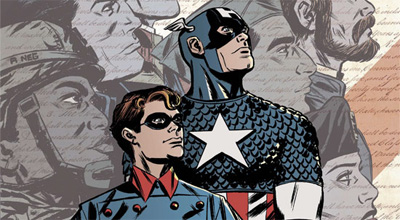
There’s a lot of buzz out there suggesting that Ed Brubaker’s run on Captain America might be the run on the character, the one for the ages – like Frank Miller’s tenure on Daredevil, for example. I decided that – with the movie coming out next year – it might be worth bringing myself up to speed on the character. While I haven’t finished Brubaker’s run (it’s on-going and I still have to read The Death of Captain America Omnibus), it is a very solid run, packed with great ideas. It’s a clever and well-crafted story that demonstrates that Brubaker has more in him than just gritty pulp like his fantastic runs on Daredevil and Gotham Central. On the other hand, I’m slow to call the run an instant classic – I’d rather finish his run before I make that judgement. Towards the end it feels like Brubaker’s own story has become somewhat derailed by the larger events looming in a shared universe. He’s still an amazing writer and succeeds in keeping the train mostly on the tracks, but one gets the sense that the collection would have been better if he had been granted complete control over it.

"Hey, Cap, what are we staring at?""You'll know it when you see it, Bucky; you'll know it when you see it."

Continue reading