• Following Us

  • Categories

  • Check out the Archives


  • Awards & Nominations

Hannibal: Coquilles (Review)

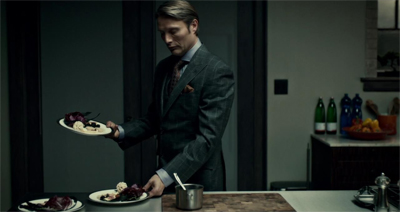
I feel a little bad now. I spent a lot of time in Amuse-Boche and Ceuf complaining about the possibility that Hannibal might turn into a serial-killer-of-the-week procedural, at a time when the networks are over-saturated with that sort of forensic drama. However, Coquilles manages to be a pretty superlative hour of television despite feeling like a pretty conventional “catch the serial killer” story. The key is in the execution, with Coquilles serving as a rich character-driven drama that just happens to involve the hunt for a gruesome serial killer.

It also helps that the “angel maker” feels like a refugee from an early draft of a Thomas Harris novel rather than a bland psychopath of the week.

Served...

Served…

Continue reading

Doctor Who: Smith & Jones (Review)

To celebrate the fiftieth anniversary of the longest-running science-fiction show in the world, I’ll be taking weekly looks at some of my own personal favourite stories and arcs, from the old and new series, with a view to encapsulating the sublime, the clever and the fiendishly odd of the BBC’s Doctor Who.

Smith & Jones originally aired in 2007.

It’s only roentgen radiation. We used to play with roentgen bricks in the nursery. It’s safe for you to come out. I’ve absorbed it all. All I need to do is expel it. If I concentrate I can shake the radiation out of my body and into one spot. It’s in my left shoe. Here we go, here we go. Easy does it. Out, out, out, out, out. Out, out. Ah, ah, ah, ah! It is, it is, it is, it is, it is hot. Hold on.

Done.

You’re completely mad.

You’re right. I look daft with one shoe.

– the Doctor and Martha get off to a good start

I’d argue that Smith & Jones is Russell T. Davies’ most successful season-opener of Doctor Who. By its third year, Davies had firmly established the format of the show, to the point where he could successfully lose both of his leading actors. Christopher Eccleston had been replaced by David Tennant at the end of the first season, and Billy Piper had departed at the end of the second. Davies had demonstrated that the series could survive a cast rotation like that, and there’s a sense of looseness about Smith & Jones that suggests the show has really found its comfort zone.

The reason that Smith & Jones works so very well is not that it has an abundance of ambition. Its goal is relatively modest: to tell an enjoyable modern day adventure while introducing a new companion to the show. The beauty is in the execution. Smith & Jones races along, barely pausing to catch its breath, relying on Tennant’s abundant charisma, a constant flow of clever high concepts and a charming new companion to carry it through.

It works surprisingly well.
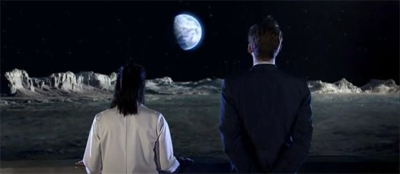
Standing in the Earthlight...

Standing in the Earthlight…

Continue reading

Doctor Who: Warriors’ Gate (Review)

To celebrate the fiftieth anniversary of the longest-running science-fiction show in the world, I’ll be taking weekly looks at some of my own personal favourite stories and arcs, from the old and new series, with a view to encapsulating the sublime, the clever and the fiendishly odd of the BBC’s Doctor Who.

Warrior’s Gate originally aired in 1980. It was the third instalment of the E-Space Trilogy.

We found it.

Yes, well, that’s one of the advantages of living in a rapidly shrinking micro-universe.

What are the others?

Other what?

Other advantages?

Ah, well, it’s difficult to say.

– Adric, the Doctor and Romana discuss modern living

I’m actually very, very fond of Warriors’ Gate. It’s a piece of bold science-fiction that actually manages to accomplish what a lot of these stories in Tom Baker’s final season try to do. It offers an effective bit of speculative fiction while playing to the theme of entropy, decay and collapse. Both Stephen Gallagher’s fine script and Paul Joyce’s direction come together to produce a very thoughtful and clever Doctor Who story that manages to avoid a lot of the problems facing this era of the show.

More than that, though, it turns some of those disadvantages into advantages. After all, when else is the show’s tiny production budget going to produce something this beautiful?

Shades of grey...

Shades of grey…

Continue reading

Doctor Who: The Last of the Time Lords (Review)

To celebrate the fiftieth anniversary of the longest-running science-fiction show in the world, I’ll be taking weekly looks at some of my own personal favourite stories and arcs, from the old and new series, with a view to encapsulating the sublime, the clever and the fiendishly odd of the BBC’s Doctor Who.

The Last of the Time Lords originally aired in 2007.

I just need you to listen.

No, it’s my turn. Revenge!

– the Doctor and the Master

I like quite a lot of The Last of the Time Lords. I think, for example, that Russell T. Davies does an exceptional job creating a version of the Master that manages to remain true to the character’s pantomime roots, while also seeming a credible threat and dark mirror to the Doctor. I also think that Martha’s character arc has a fairly logic and fluid conclusion. On the other hand, there’s a great deal about the resolution to The Last of the Time Lords that feels a bit rushed, a bit convenient, a bit tidy.

I’m quite fond of Davies’ writing style, but I’ll concede that he tends to favour theme and character over plot and structure. The Last of the Time Lords does an excellent job illustrating this, providing a bunch of fascinating thematic and character-based moments, but positioning them in a plot that doesn’t really work.

You know, for once I actually feel sorry for the Master...

You know, for once I actually feel sorry for the Master…

Continue reading

Doctor Who: The End of the World (Review)

You’ve seen how dangerous it is. Do you want to go home?

I don’t know. I want… Oh, can you smell chips?

Yeah… Yeah.

I want chips.

Me too.

Right then, before you get me back in that box, chips it is, and you can pay.

No money.

What sort of date are you? Come on then, tightwad, chips are on me. We’ve only got five billion years till the shops close.

-the Doctor and Rose contemplate the mysteries of the universe

If Rose proved that Doctor Who was back for a new generation, The End of the World demonstrates that it’s still the same show that it was all those years ago. The show has always struggled to do “future” on the budget afforded by the BBC, but this second episode of the show offers a glimpse of what the series was capable of. It’s not quite perfect, but has all the ambition that a revived Doctor Who needs in its first season, laying a great deal of thematic groundwork and character development on top of a visual feast. If Rose promised an update to everyone’s favourite Time Lord for the twenty-first century, The End of the World existed to assure viewers that some things never quite change.

... and I feel fine...

… and I feel fine…

Continue reading

Doctor Who: The Vampires of Venice (Review)

To celebrate the fiftieth anniversary of the longest-running science-fiction show in the world, I’ll be taking weekly looks at some of my own personal favourite stories and arcs, from the old and new series, with a view to encapsulating the sublime, the clever and the fiendishly odd of the BBC’s Doctor Who.

The Vampires of Venice originally aired in 2010.

Tell me the whole plan!

One day that will work.

– the Doctor

The Vampires of Venice is interesting because it looks very different in 2013 as compared to when it was originally broadcast in 2010. In 2010, it looked a bit overly familiar, a collection of the tropes and storytelling tricks that we took for granted in the show under Russell T. Davies. The elements felt, at the time, a little over-familiar. Indeed, it seemed like Toby Whithouse’s script owed a great deal to his earlier adventure School Reunion.

However, Doctor Who looks very different in 2013. The show has definitely radically changed, so that these familiar plot points don’t seem quite so familiar any longer. Whereas The Vampires of Venice didn’t feel so strange after five years of Russell T. Davies, it does seem a bit more unique after three years of Steven Moffat. It doesn’t seem so much an attempt to repackage these story elements as it does one final celebration of them, a fond farewell to many of the narrative bits and pieces that we’d come to take for granted.

How times change.

A late-night bite...

A late-night bite…

Continue reading

Doctor Who: Rose (Review)

To celebrate the fiftieth anniversary of the longest-running science-fiction show in the world, I’ll be taking weekly looks at some of my own personal favourite stories and arcs, from the old and new series, with a view to encapsulating the sublime, the clever and the fiendishly odd of the BBC’s Doctor Who.

Rose originally aired in 2005.

So, I’m going to go up there and blow them up, and I might well die in the process, but don’t worry about me. No, you go home. Go on. Go and have your lovely beans on toast. Don’t tell anyone about this, because if you do, you’ll get them killed.

(beat)

I’m the Doctor, by the way. What’s your name?

Rose.

Nice to meet you, Rose. Run for your life!

– the Doctor and Rose

It’s amazing to think of the pressure weighing down on Rose. Sure, Doctor Who has gone from strength-to-strength since its revival in 2005, but there was a time when its resurrection seemed unlikely, to say the least. Although fans had kept the show alive in various media, it must have seemed highly unlikely that they show would ever return to television, let alone as a massive success. Producer Russell T. Davies might have seemed like an unlikely choice. Although he had written some spin-off material, like other British television writers including Steven Moffat and Paul Cornell, Davies was best known for producing shows like Queer as Folk and The Second Coming. Nevertheless, he had been campaigning to bring the show back for quite some time, notably in 1998 and 2002, before finally bringing the revived show to screen in late March 2005.

Although the edges are still a bit rough in places, Rose serves as an effective introduction to the Russell T. Davies, and contains the seeds of what would become the show’s success. Borrowing (and reinventing) heavily from perhaps the last seismic re-tooling of the series in Spearhead from Space, the show presents a version of Doctor Who for a new generation.

Run!

Run!

Continue reading

Non-Review Review: The Impossible

The Impossible looks and sounds fantastic. It is very well put together by J.A. Bayona. Cleverly opting to use practical effects wherever possible, and shooting on a gigantic water tank, Bayona provides a visceral experience worthy of any blockbuster disaster movie. Indeed, were The Impossible based on fictitious events, it might be enough to make it a powerful and emotional film. Unfortunately, as the film is so desperate to let you know (placing “true story” captions at the beginning and the end of the movie), The Impossible is based on the true story of a tsunami that caused untold damage to Thailand displacing up to 60,000 residents.

Without spoiling anything, The Impossible ends with the shot of a plane crossing the ocean, a voyage home. There’s no real sense of any of the lasting consequences of the truly horrific disaster that befell the countries in the Indian Ocean.

It's a washout...

It’s a washout…

Continue reading

Non-Review Review: Die Hard

I know it’s a bit cliché at this point, but Die Hard really is my family’s ultimate Christmas movie. The season hasn’t truly started (or, if we’re delayed, truly ended) until all of us have sat down on the couch and indulged in the seasonal spectacular. Even if you don’t quite buy into the “Die Hard as Christmas movie” argument, it’s still impressive how tall John McTiernan’s action movie stands when compared to the bulk of eighties action films. Like Nakatomi Plaza itself, it towers over the competition – and it’s not because it does anything especially or novel or innovative in a genre that has always been fairly conservative. Instead, I’d argue, Die Hard succeeds because it executes all the conventional action movie beats exceedingly well, and because it doesn’t treat any of its plot points as necessary items on a check list.

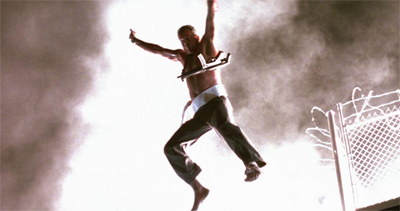
Jump-starting Bruce Willis' action career...

Jump-starting Bruce Willis’ action career…

Continue reading

My 12 for ’12: The Muppets & Everything You Need, Right In Front Of You

I’m counting down my top twelve films of the year between now and January, starting at #12 and heading to #1. I expect the list to be a little bit predictable, a little bit surprising, a little bit of everything. All films released in the UK and Ireland in 2012 qualify. Sound off below, and let me know if I’m on the money, or if I’m completely off the radar. And let me know your own picks or recommendations.

This is #3

I can’t help but feel that The Muppets probably aren’t quite as popular over here as they really should be. After all, we had to wait about three months for the eventual release of the film in Irish cinemas. Even later this year, following all the publicity around the recent revival, I was only able to find one cinema in Dublin doing three screening of The Muppets’ Christmas Carol, despite the highly-publicised re-release. However, perhaps I shouldn’t take their international publicity for granted either. After all, Jason Segal spent six or seven years trying to guide everybody’s favourite felt performers to the big screen again.

Still, The Muppets demonstrated that the gang had lost absolutely nothing in transitioning out of retirement and back to the screen, demonstrating that all these sorts of characters need is a bit of sincere love and affection.

muppets6

Continue reading