












The Ballad of Buster Scruggs is not so much a set of stories about the Old West, more a set of stories about the stories that are told about the Old West.
To be fair, the anthology film wears this premise on its sleeve. The Ballad of Buster Scruggs is by its nature an omnibus of short stories, drawing its audience’s attention to the format through the framing device of an anonymous hand leafing gently through an old hardcover book of short stories. Even within the individual stories, the Coen Brothers frequently nest smaller and more intricate narratives; whether stories shared at dinner, great works recited for an enchanted audience, or even just strangers in a stage coach making awkward conversation with one another.
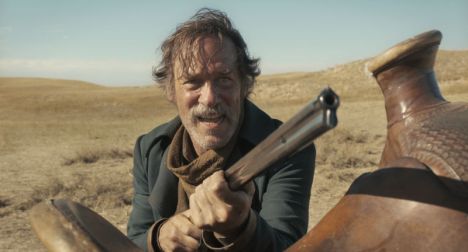
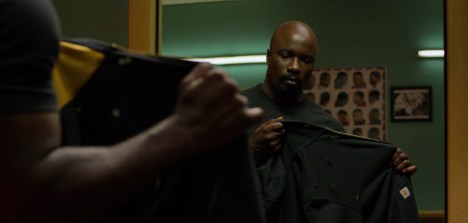
The rifle man.
In the film’s final segment, The Mortal Remains, the self-described “distractor” Thigpen explains that he distracts his quarry through stories. “People can’t get enough of them,” he assures his audience. “Because people connect the stories to themselves, I suppose. And we all love hearing about ourselves. So long as the people in the stories are us… but not us.” In its own weird way, positioned at the tail end of the narrative, Thigpen seems to offer something of a thesis statement for The Ballad of Buster Scruggs, a story about stories. In particular, a story about certain types of stories.
The Ballad of Buster Scruggs is decidedly uneven, as anthology films tend to be. That said, the quality is high enough (and the stories disparate enough) that it’s easy to imagine that each story of the six might be someone‘s favourite. The Coen Brothers very cannily and very astutely ensure a great variety in tone across the six installments, which range from gleefully nihilistic, to sombre and withdrawn, to eerie and uncanny. However, they are connected by a series of recurring preoccupations about life of the frontier and man’s awkward relationship to both that wilderness and his fellow man.

No need to make a song and dance about it.
The Ballad of Buster Scruggs is not consistent enough to rank among the Coens’ best work. While the movie maintains a consistent perspective and philosophical vantage point across its two-hour-and-ten-minute runtime, the individual stories vary so wildly in terms of aesthetic and rhythm that the film never quite coheres as well as it might. At the same time, The Ballad of Buster Scruggs contains enough delightful details in its smaller moments that linger, suggesting that the film might best be remembered as a collection of inspired moments rather than as a satisfying whole.
The Ballad of Buster Scruggs is not so much a ballad as a concept album.
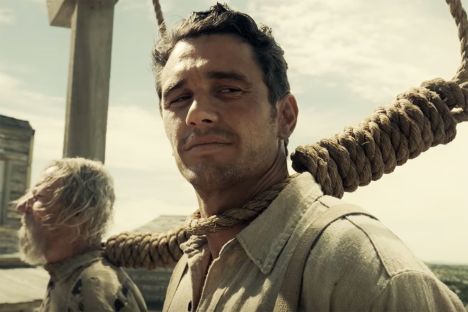
Don’t leave him hanging.
Filed under: Non-Review Reviews | Tagged: anthology, capitalism, coen brothers, film, frontier, individualism, Movie, narratives, netflix, non-review review, old west, review, stories, The Ballad of Buster Scruggs, western | 2 Comments »









 the m0vie blog
Star Trek: Voyager – Critical Care (Review)
Critical Care is the seventh season of Star Trek: Voyager attempting to be archetypal Star Trek.
To be fair, Voyager had done this before. When Jeri Taylor took over the show during its third season, she steered it away from the disaster of the Kazon arc and towards a more conventional style of Star Trek storytelling. Many of the episodes of the later seasons could easily have been repurposed for Star Trek: The Next Generation or Star Trek: Deep Space Nine or Star Trek: Enterprise without changing much beyond the characters’ names; think of Warlord, Scientific Method, Random Thoughts, Waking Moments.
What’s up, Doc?
This isn’t inherently a bad thing. Indeed, many of the best episodes of Voyager had this broad and generic quality to them, offering something resembling an archetypal distillation of Star Trek for audiences. Remember and Memorial were both stunning explorations of cultural memory and Holocaust denial that could arguably have worked with any Star Trek cast. Blink of an Eye was a beautiful science-fiction parable that was more about Star Trek itself than Voyager. Even Nemesis could have easily worked with Riker or O’Brien or Tucker as easily as it did with Chakotay.
However, there are also points when these attempts to create “archetypal Star Trek” feels cynical and exploitative, the writing staff very cynically offering audiences something that is designed to meet as many of the vaguely defined aesthetic qualities of Star Trek, but without any substance underneath it. This happens repeatedly during the seventh season of Voyager, when it seems like the production team understand what Star Trek looks and feels like enough to offer a passable approximation, but don’t understand the underlying mechanics enough to replicate that ineffable feeling.
“Don’t worry, we’re almost home.”
Like a lot of seventh season episodes, Critical Care is couched in the trappings of Star Trek but without any substance to group it. On the surface, Critical Care is classic “social commentary” storytelling, the type of allegorical narrative exemplified by stories like Let That Be Your Last Battlefield or The High Ground. It is an episode about the horrors of contemporary healthcare, transposed to a distant alien world where Voyager can draw some very broad parallels for the audience watching at home. This is, on a very superficial level, what Star Trek is to a large number of fans.
Unfortunately, these touches do not add up to anything particularly insightful or compelling, Critical Care providing observations on contemporary American healthcare that amount to “this is pretty bad, isn’t it?” without anything resembling actual engagement. The result is a shell of an episode, a missed opportunity, and a pale imitation of the franchise’s best social commentary.
“What is up, Doc?”
Continue reading →
Filed under: Voyager | Tagged: capitalism, critical care, death panels, emh, healthcare, hmos, nostalgia, obama care, social commentary, socialism, star trek, star trek: voyager, Television, topical | 9 Comments »