As a film blogger, I tend to write reviews of films that I have never seen before. I occasionally take the opportunity to share my thoughts on classic films I have seen countless times, but most of my writing covers films I’ve only seen once. In some cases, that will be the first and only time that I see a movie. I have, for example, no desire to ever site through This Means War again. However, I occasionally find the second viewing of a film to be a much more enlightening and inspiring film, whether it crystalises my original opinion or perhaps even prompts a re-evaluation of my earlier thoughts. It’s interesting how different and distinct a film can appear each time you happen to watch it.
With the second episode of the show, we can see things beginning to settle into place a bit. While David Chase did a phenomenal job with the pilot episode – introducing threads that would pay off years down the line – here we get a chance to see The Sopranos settle into its groove. The series has been praised, quite rightly, as one of the great and defining television series, and many writers have echoed the claim that the series is effectively a “televised novel”, wherein each episode could be considered a chapter as part of a greater whole, with small patterns becoming evident once the viewer pulls back far enough. I’m not sure I entirely agree – I think that each episode does a phenomenal story covering its own ground while playing into larger themes and that each fifty-five minute show is more than just an idle chapter.
London Classic Theatre have brought Sir Peter Shaffer’s classic 1973 play to the Mill Theatre in Dundrum, and I had the pleasure of attending on Friday night. I must admit that it was my first time to see Equus, although I couldn’t help but be aware of the headline-grabbing aspects of the play. I wonder exactly how much work Daniel Radcliffe has done to popularise the play, using a West End run as an attempt to divorce himself from his most iconic role, and the media revelling at the details of the show. While I was impressed with what London Classic Theatrebrought to the stage, I couldn’t help but be disappointed by the play itself.
The review was embargoed until the 5th March 2012.
The obvious point of comparison to Jonah Hill’s big-screen adaptation of 21 Jump Street is the Ben Stiller and Owen Wilson version of Starsky & Hutch. After all, both take classic cult television shows and recycle them for modern audiences, taking dramatic plot devices that seem hilarious and goofy in hindsight and playing them as straight comedy. There is, however, one very crucial difference between that adaptation of a seventies cop show and this adaptation of an eighties cop show: 21 Jump Street works. Mostly.
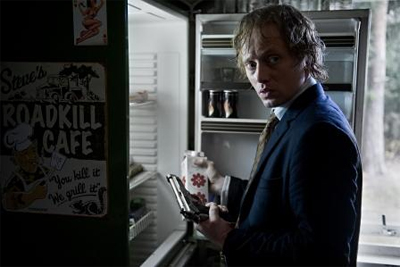
While Jo Nesbø’s Headhunters might get a little bit too crazy and twisty in its final third, but it’s a brilliantly dark Norwegian thriller/comedy, headlined with considerable style by Aksel Hennie as corporate recruitment expert Roger Brown, a sleazy yuppie living well beyond his means to keep his wife in the style two which she has become accustomed. As the movie puts Brown through a sequence of painful and humiliating encounters, it is consistently entertaining, managing to walk the fine line between making sure we dislike Roger enough to be amused by his misfortune, but invested enough that we want to see the little (“1.68 metres”) bugger manage to escape the movie relatively intact.
This film was seen as part of the Jameson Dublin International Film Festival 2012.
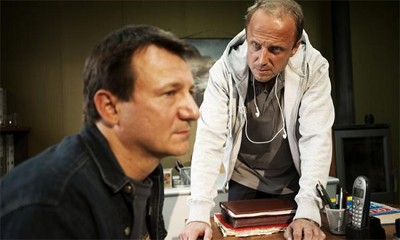
Courage is a fascinating little Polish film, with an interesting dramatic hook. Director Greg Zglinski offers a searing portrait of masculinity and impotence in the twenty-first century, where ever moment and action and decision seems to be documented for future use – our private failures of judgment ultimately become public spectacles, and in this era of globalisation and instant media connections, it’s impossible to escape the consequences of one bad split-second decision. While Zglinski’s film might overstay even its relatively short runtime, it does raise some interesting and challenging ideas about heroism in the twenty-first century.
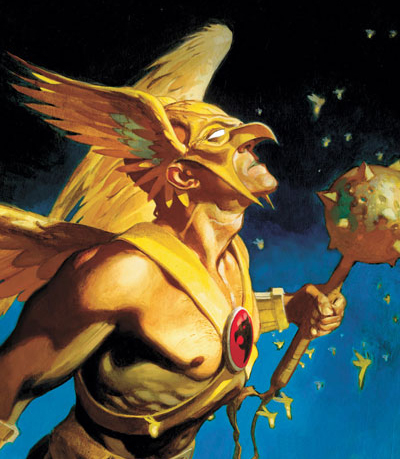
I’m always glad to see a nice, big and thick DC comics omnibus. Marvel have cornered the market in putting out over-sized gigantic collections of modern and classic runs on iconic characters, and I’m disappointed that it has taken DC so long to follow suit. After all, they have any number of long runs on iconic characters by acclaimed creators deserving some nice love. Geoff Johns’ Hawkman run is perhaps the writer’s run that I was least excited about, but it’s still nice to get the majority of Geoff Johns’ character-defining and continuity-clarifying run on the character handily collected in one gigantic package.
I am looking forward to Prometheus, as are most film geeks out there. Ridley Scott is returning to the shared fictional universe he created with the original Alien to tell an incredibly ambitious science-fiction epic, with a tremendous cast and a huge budget. We don’t know much about it at the moment, and that’s not a bad thing. I’m always a sucker for a clever piece of viral marketing, and this video appeared on-line today. it wasn’t leaked to film sites or geek news. It was published on TED.com, an on-line forum for “ideas worth spreading”, where today’s real-world luminaries share their thoughts on the problems of the day. Sir Peter Weyland, one half of the fictional mega-corporation Weyland-Yutani, has provided us with his own talk, from the year 2023.
Directed by Luke Scott and written by Damon Lindelof, this is a light piece, featuring Guy Pierce and some CGI. However, it very shrewdly does several things. It explains and contextualises the title, even if it wasn’t too much to guess that hubris and ambition would play a major role in a science-fiction film named for the guy who stole fire from the gods. It gives us a glimpse of the film’s universe, and provides connective tissue, explaining how we got from today to the gigantic futuristic universe. It even ties itself to Lawrence of Arabia, no mean feat.
It’s well worth a gander.
And here’s Sir Peter’s official biography, for those looking for a bit more context:
Sir Peter Weyland was born in Mumbai, India at the turn of the Millennium. The progeny of two brilliant parents; His mother, an Oxford Educated Professor of Comparative Mythology, his father, a self-taught software Engineer, it was clear from an early age that Sir Peter’s capabilities would only be eclipsed by his ambition to realize them. By the age of fourteen, he had already registered a dozen patents in a wide range of fields from biotech to robotics, but it would be his dynamic breakthroughs in generating synthetic atmosphere above the polar ice cap that gained him worldwide recognition and spawned an empire.
In less than a decade, Weyland Corporation became a worldwide leader in emerging technologies and launched the first privatized industrial mission to leave the planet Earth. “There are other worlds than this one,” Sir Peter boldly declared, “And if there is no air to breathe, we will simply have to make it.”
I’ve been a bit all over the place of late, recovering from the Jameson Dublin International Film Festival. I’m just finishing up the last of my reviews of films caught at the festival, which will be up this week. Anyway, in the mean time, I thought I’d share this delightful post-Oscars parody from Jimmy Kimmel. Sure, the clip might run a little bit too long for its own good, but it has some wonderful laughs, and displays an astute knowledge of movie tropes and clichés. Enjoy.
This film was seen as part of the Jameson Dublin International Film Festival 2012.
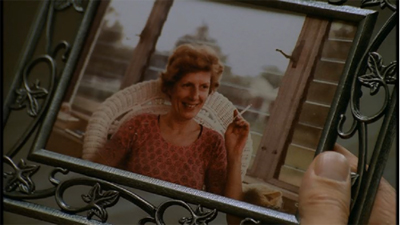
The problem with Hard Labour is that it doesn’t seem to know what it is? Is it a tough economic drama about a family struggling to survive in a harsh economic climate? Is it a horror story about the legacies of slavery and the beastly side of human nature? The problem isn’t just that the film can’t decide – the problem is that the film appears to have no interest in deciding. Or even on following through on either idea.



















 the m0vie blog