• Following Us

  • Categories

  • Check out the Archives


  • Awards & Nominations

Doctor Who: The Ribos Operation (Review)

To celebrate the fiftieth anniversary of the longest-running science-fiction show in the world, I’ll be taking weekly looks at some of my own personal favourite stories and arcs, from the old and new series, with a view to encapsulating the sublime, the clever and the fiendishly odd of the BBC’s Doctor Who.

The Ribos Operation originally aired in 1978. It was the first part of The Key to Time saga.

Your name!

What about my name?

It’s too long… by the time I’ve called out “Look out Romanadv…” – what’s your name again?

Romanadvoratrelundar!

By the time I’ve called that out you could be dead! I’ll call you Romana.

I don’t like Romana!

It’s either Romana or Fred!

All right, call me Fred!

Good! Come along Romana!

The Key to Time was a rather ambitious project for the time – the idea being that an entire series of the show would centre around one core arc, suggested in the first story, developed through the rest of the season, and tied up at the end of the year. It helps, when you’re doing something like that, to have an experienced hand at the reins. While The Ribos Operation doesn’t stand as Robert Holmes’ finest contribution to the series, it’s a suitable introduction to the adventure.

Time Lord and Lady...

Continue reading

Watch! New Only God Forgives Trailer!

Only God Forgives is probably my most anticipated movie of the year, even ranking ahead of various other geeky pleasures I look forward to savouring. Nicolas Winding Refn made quite an impression with Drive, and his follow-up looks just as rich and unsettling and stunningly produced. It really looks amazing, and I adore Refn’s neon aesthetic. It’s probably the best spiritual successor to the look that Michael Mann crafted for Miami Vice back in the eighties. Check out the latest trailer below.

Non-Review Review: Evil Dead (2013)

Evil Dead does has a bit of a quirky charm to it, serving as perhaps the best-made horror throwback I’ve seen in quite some time, much more effective than most of the recent splurge of exorcism movies. As far as competent execution of classic horror movie tropes go, complete with the sense of “something gruesome’s gonna happen” dread and a healthy amount of gore, Evil Dead succeeds admirably. There are some issues in the final act, but Evil Dead checks all the necessary boxes, and does so with a minimum amount of fuss or pretension, which makes it a surprising enjoyable watch for those looking to enjoy a good old-fashioned video nasty.

That said, it can’t help but feel a little awkward, through no fault of its own. Sam Raimi’s Evil Dead was a genre classic which worked in a large part because it eschewed all but the most basic tropes of horror storytelling, refusing to dress a video nasty in anything too fancy. The movie came to embody a particular subgenre of horror, and it wore its grotesqueness on its sleeve. Last year, Cabin in the Woods offered a fitting follow-up, a capstone to that approach to horror. As such, through no fault of its own, this version of Evil Dead feels like it arrived a little late.

Down the rabbit hole...

Down the rabbit hole…

Continue reading

Doctor Who: Frontier in Space (Review)

To celebrate the fiftieth anniversary of the longest-running science-fiction show in the world, I’ll be taking weekly looks at some of my own personal favourite stories and arcs, from the old and new series, with a view to encapsulating the sublime, the clever and the fiendishly odd of the BBC’s Doctor Who.

Frontier in Space originally aired in 1973.

To celebrate the tenth anniversary of the show, the four-part serial The Three Doctors was produced. However, it was also decided that Jon Pertwee’s fourth season in the role should also contain something quite a bit grander than the average Doctor Who serial. Clearly intended to rival the epic (and lost) Daleks’ Master Plan in terms of scale and scope, an epic twelve-part adventure was conceived that would run across two back-to-back serials. It would open with Frontier in Space, before easing gently into Terry Nation’s Planet of the Daleks.

Unfortunately the adventure was never quite able to measure up to the series’ earlier Dalek epic, primarily due to problems with the second serial. Still, though somewhat weakened by the necessity to dovetail into the story directly following, Frontier in Space remains a rather wonderful example of the series on its largest scale, offering epic space opera with large-scale consequences.

Lost in space…

Continue reading

Doctor Who: The Sound of Drums (Review)

To celebrate the fiftieth anniversary of the longest-running science-fiction show in the world, I’ll be taking weekly looks at some of my own personal favourite stories and arcs, from the old and new series, with a view to encapsulating the sublime, the clever and the fiendishly odd of the BBC’s Doctor Who.

The Sound of Drums originally aired in 2007.

Doctor.

Master.

I like it when you use my name.

You chose it. Psychiatrist’s field day.

As you chose yours. The man who makes people better. How sanctimonious is that?

– the Doctor and the Master

The Sound of Drums is really more interesting than it is successful. Building off Utopia as the second part of a three-part finalé, building the longest single story in the revived Doctor Who, The Sound of Drums does an excellent job moving the characters along and getting everything where it needs to be for the requisite cliffhanger. Unfortunately, Davies’ weaknesses when it comes to plotting are at play here. While Utopia took advantage of a leisurely pace and conventional plot in order to do some nice set-up, The Sound of Drums doesn’t have that luxury. Utopia came out of left-field, with the last ten minutes taking the audience by surprise. Now the audience knows the game is afoot, so the rules have changed.

The Sound of Drums kicks off with everything in full swing, and Davies has to ratchet up the tension from there. The result is that Davies does solid character work, but that the plot points and set-ups occasionally feel a bit forced. That’s especially true when it comes to the ideas that will be important to the resolution of The Last of the Time Lords.

The End of the World... oh, wait, we already did that one...

The End of the World… oh, wait, we already did that one…

Continue reading

Ultimate Comics: Divided We Fall, United We Stand – Ultimates (Review/Retrospective)

To get ready for Iron Man 3, we’ll be taking a look at some Iron Man and Avengers stories, both modern and classic. We hope to do two or three a week throughout the month, so check back regularly for the latest update.

There was a time when Marvel’s Ultimate Universe was the place to be. Ultimate Spider-Man, Ultimate X-Men and The Ultimates were among the best-reviewed and best-selling books published at Marvel in the early part of the last decade, offering a fresh new take on classic comic book characters, and offering readers an opportunity to engage with a continuity-free world just as the super-hero movie craze took off. I’ll always be fond of the Ultimate Universe, because without The Ultimates and Ultimate Spider-Man, I simply wouldn’t be a comic book fan today.

However, in the last number of years, for any number of reasons, the line has wavered a little bit. Despite attracting Mark Millar back to write Ultimate Comics: Avengers, and Brian Michael Bendis generating massive headlines by writing The Death of Spider-Man, it seemed like the publishing brand was fading a bit. There have been several attempts to re-energise the line. Divided We Fall is just the most recent one, a crossover between the three books currently making up the Ultimate imprint.

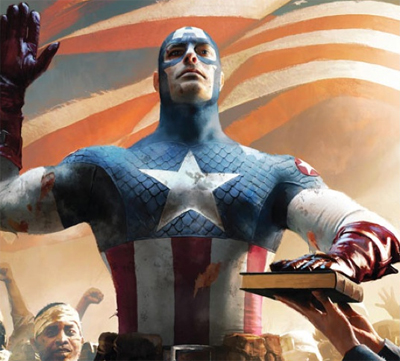
The story of America falling apart, told from three different perspectives, it’s certainly timely. And, as crossovers go, shrewdly constructed. While Divided We Fall suffers a bit from the fact that Marvel is no longer consistently collecting the books leading into it, it is still an interesting comic book story, and one that takes advantage of the Ultimate Universe setting to tell a story that would be impossible in the mainstream Marvel brand.

President Cap...

President Cap…

Continue reading

Doctor Who: Resurrection of the Daleks (Review)

To celebrate the fiftieth anniversary of the longest-running science-fiction show in the world, I’ll be taking weekly looks at some of my own personal favourite stories and arcs, from the old and new series, with a view to encapsulating the sublime, the clever and the fiendishly odd of the BBC’s Doctor Who.

Resurrection of the Daleks originally aired in 1984.

The universe is at war, Doctor. Name one planet whose history is not littered with atrocities and ambition for empire. It is a universal way of life.

Which I do not accept.

Then you deny what is real.

– yes, in case you’re wondering, the show did let Davros win a philosophical debate with the Doctor

It’s a bit of a cliché to suggest that writer and script editor Eric Saward didn’t actually like Doctor Who. It’s a bit of sensationalist nonsense that appears quite frequently in discussing his contributions to the series. The evidence most often cited in favour of this admittedly exaggerated position points out that Saward had a tendency to marginalise the Doctor within his stories, to portray the character as inefficient or ineffective within the context of an increasingly cynical universe. This characterisation of the Doctor as inherently weak really came to a head during the Colin Baker period of the show, but you can see traces of it during the Peter Davison era, most notably in Earthshock.

However, Resurrection of the Daleks also provides a pretty compelling case study, if only because it makes a compelling case for the Doctor as a massive hypocrite and a coward. You have to worry when the script seems to side more with Davros’ outlook on life than with that of the title character.

Putting the Fifth Doctor to the test...

Putting the Fifth Doctor to the test…

Continue reading

Doctor Who: Dalek (Review)

To celebrate the fiftieth anniversary of the longest-running science-fiction show in the world, I’ll be taking weekly looks at some of my own personal favourite stories and arcs, from the old and new series, with a view to encapsulating the sublime, the clever and the fiendishly odd of the BBC’s Doctor Who.

Dalek originally aired in 2005.

I’m sorry. I’m so sorry! I swear, I just wanted you to talk!

Then hear me talk now. Exterminate! Exterminate! Exterminate!

– Van Statten and the Dalek

Dalek is a pretty effective reintroduction of the show’s most iconic villain. It’s also something of a tour de force for lead actor Christopher Eccleston and Dalek vocal performer Nicholas Briggs. It’s full of interesting ideas, and perhaps the biggest swipe the show would make at “superfans” this side of Love & Monsters. That said, Rob Shearman’s script is occasionally a bit clumsy in its execution, never quite managing to convince the audience that the Doctor might be turning into a Dalek, no matter how firmly it labours to point. Still, minor quibble aside, it’s a wonderful way of welcoming the Daleks back to the fold.

The loneliest Dalek...

The loneliest Dalek…

Continue reading

Doctor Who: Revelation of the Daleks (Review)

To celebrate the fiftieth anniversary of the longest-running science-fiction show in the world, I’ll be taking weekly looks at some of my own personal favourite stories and arcs, from the old and new series, with a view to encapsulating the sublime, the clever and the fiendishly odd of the BBC’s Doctor Who.

Revelation of the Daleks originally aired in 1985.

There’s an argument to be made that Revelation of the Daleks is the only truly classic episode that Doctor Who produced during Colin Baker’s stint in the leading role. I’m not sure I agree – I’d argue that Vengeance on Varos, despite a misleading title, is surprisingly solid and clever – but I can see the logic. In fact, Revelation of the Dalekswas a fitting choice to close out Baker’s first season in the role, the last episode to air before BBC placed the series on hiatus, as it represents the very best of mid-eighties Doctor Who.

We can see right through the Daleks’ plan…

Continue reading

Doctor Who: Victory of the Daleks (Review)

To celebrate the fiftieth anniversary of the longest-running science-fiction show in the world, I’ll be taking weekly looks at some of my own personal favourite stories and arcs, from the old and new series, with a view to encapsulating the sublime, the clever and the fiendishly odd of the BBC’s Doctor Who.

Victory of the Daleks originally aired in 2010.

Would! you! care! for! some! TEA???!!!

– the Daleks

Ah, the Daleks. They tend to rise and fall. They get built up and then they fall back down. Like the show itself, they come and go in cycles. The Dalek Invasion of Earth has the psychotic pepperpots invade Earth, while The Chase reduces them to little more than comic foils. Destiny of the Daleks makes jokes about them being unable to climb stairs, while Remembrance of the Daleks then proves that they can. In 2005, both Dalek and The Parting of the Ways invested considerable effort in making them scary again. The show eroded that away over time, turning them into bitchy foils for the Cybermen in Doomsday for the Doctor to hover up and competing to create the most phallic monster ever in Evolution of the Daleks.

Steven Moffat took over the show in 2010, and that means that he also took over the Daleks. Tending to the Doctor also means tending to his worst enemies. And, to be fair, that’s a bit what Victory of the Daleks feels like. It feels like an obligation, a bit of business to get out of the way quickly (the first episode not penned by Moffat) so that the fun stuff can commence.

Exterminate the rainbow...

Exterminate the rainbow…

Continue reading