• Following Us

  • Categories

  • Check out the Archives


  • Awards & Nominations

Millennium – 19:19 (Review)

This May and June, we’re taking a trip back in time to review the fifth season of The X-Files and the second season of Millennium.

One of the interesting aspects of the second season of Millennium is just how carefully structured all the chaos actually is.

There is an endearing and infectious randomness to the plotting of episodes like Sense and Antisense or A Single Blade of Grass, with individual episodes often struggling to fit together on an act-by-act basis. However, things become a lot clearer from a distance. Pulling back, it appears quite clear that there is a method to the madness. The episodes in the season – particularly those positioned towards the beginning and the end – each serve a clear purpose in the larger arc of the second season.
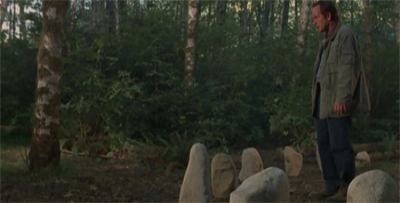
Will he die for our sins?

Will he die for our sins?

The first third of the season is very much about establishing concepts that will be of use later in the story. The Beginning and the End removes Frank from the yellow house and starts him on a new journey. Beware of the Dog introduces the Old Man and teases the mythology of the Millennium Group. Monster introduces Lara Means. The Curse of Frank Black gives Frank his long dark midnight of the soul. 19:19 and The Hand of St. Sebastian were the last two episodes in this opening act, and they exist to affirm the show’s cosmology.

Both 19:19 and The Hand of St. Sebastian firmly establish the show’s apocalyptic worldview in a Christian theological framework. 19:19 does this by exploring biblical prophecy and eschatology, while The Hand of St. Sebastian reveals the Millennium Group to be a secret Christian sect who have existed for over a thousand years. Although the show has always taken a lot of its imagery and iconography from Christianity, 19:19 engages explicitly with the idea of biblical prophecy and millennialism.
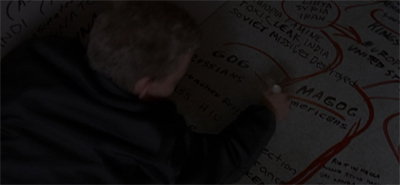
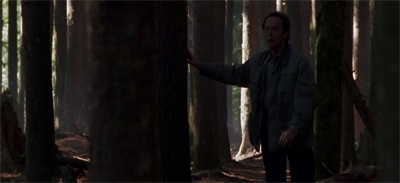
All part of the plan...

All part of the plan…

Continue reading

Millennium – The Curse of Frank Black (Review)

This May and June, we’re taking a trip back in time to review the fifth season of The X-Files and the second season of Millennium.

The Curse of Frank Black is a phenomenal piece of television, and an episode that demonstrates the raw potential of the approach that Glen Morgan and James Wong have adopted towards Millennium, making the show feel (simultaneously and paradoxically) more intimate and more epic. It is a show about the end of the world, but where the end of the world can be conveyed through the late night wandering of an old man on Halloween. It is a superb piece of work on just about every level.

The Curse of Frank Black is, in a many ways, the perfect encapsulation of many of the themes and ideas that Morgan and Wong have played with over the years. It is constructed in the style of a classic horror film, but is driven by character. As with Scully in Beyond the Sea, Mulder in One Breath, and McQueen in The Angriest Angel, Frank Black finds himself facing an existential crisis at the darkest moment of his life. What will Frank do when faced with the most horrific of possibilities?

millennium-thecurseoffrankblack22

What does anybody do when they are confronted with the end of their world? Morgan and Wong are fond of putting their characters through the metaphorical crucible, seeing what happens when the foundations are eroded and the support framework is taken away. The Curse of Frank Black suggests that there are only two possible options when the world falls to pieces: either you stand safely on your side of the line and watch it happen, or you pick up a bucket of water and start cleaning up.

It is a simple choice, an elegant metaphor, and it sits at the heart of The Curse of Frank Black.

millennium-thecurseoffrankblack15

Continue reading

Millennium – A Single Blade of Grass (Review)

This May and June, we’re taking a trip back in time to review the fifth season of The X-Files and the second season of Millennium.

A Single Blade of Grass is one of those episodes of television that skirts a line. It is very much a companion to “subculture” episodes of The X-Files, shows that would see our white heroes wading into the world of an ethnic minority – be the Haitian refugees in Fresh Bones, Chinatown in Hell Money, African immigrants in Teliko or Mexican-Americans in El Mundo Gira. In the case of A Single Blade of Grass, Frank Black is wandering into the world of Native Americans in New York.

It goes without saying that these sorts of episodes have to be very careful. Both Millennium and The X-Files are very white television shows – they have exclusively white primary casts, and the vast majority of their supporting cast are also white. (Also, most of the writers’ rooms.) As such, telling a story about a subculture can be very tricky – it is easy to seem shallow or condescending, trite or exploitative. It is worth noting that some of the biggest misfires on The X-Files occurred when the production team got this horribly wrong – Excelsis Dei, Teso Dos Bichos, El Mundo Gira, Badlaa.

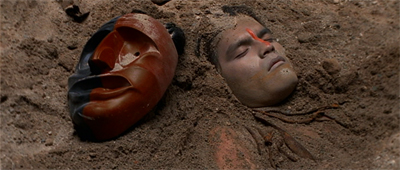
Burial mask...

Burial mask…

It is very easy to get caught up in mysticising and fetishising the Other, which can become quite problematic when “the Other” corresponds to a real-life minority that have – historically speaking – never been treated particularly well by those in authority. As such, A Single Blade of Grass feels like a very risky and very difficult story, particularly for a show that was already struggling in the ratings and trying to gain some traction with audiences. A Single Blade of Grass has the potential to go spectacularly wrong in places, and it is to the credit of all involved that it (mostly) doesn’t.

Then again, this is a large part of the appeal of the second season of Millennium – what makes even the year’s failures seem compelling in their own eccentric way. There is a sense that the second season of Millennium is completely unfazed by the possibility of failure, and so commits completely to what it wants to do. While A Single Blade of Grass might be a little muddled and unfocused in places, it retains a raw energy that makes for compelling viewing.

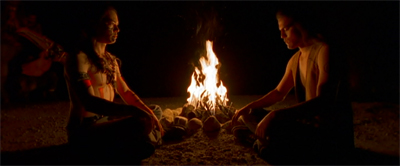
Let us sit upon the ground and tell sad stories about the death of worlds...

Let us sit upon the ground and tell sad stories about the death of worlds…

Continue reading

Millennium – Beware of the Dog (Review)

This May and June, we’re taking a trip back in time to review the fifth season of The X-Files and the second season of Millennium.

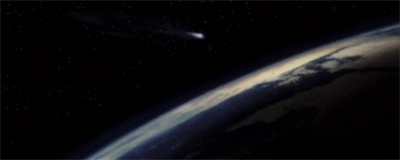
Beware of the Dog opens with the shot of the same comet discussed at the start of The Beginning and the End, just in case viewers thought that The Beginning and the End was somehow a fluke or a deviation. The Beginning and the End was not a freak occurrence, it was not some random divergence from the rest of Millennium. It was very much a new beginning for the series, harking in a bold new direction utterly unlike that marked out by The Pilot. The second season of Millennium was a new breed of animal.

And so a lot of Beware of the Dog is devoted to reinforcing this new direction – convincing the viewers at home that Millennium had reinvented itself from the ground up. Part of what is interesting about Beware of the Dog is the way that the basic structure and beats of the episode hark back to the formula and themes of the first season, but in a way that makes it quite clear that things have changed. Beware of the Dog embraces the pulpy absurdity of a show about millennial fears and anxieties, about the nature of good and evil in the world.

Call of the wild...

Call of the wild…

Beware of the Dog is a very weird piece of television. It is resoundingly and unapologetically odd. It is nowhere near as quirky and eccentric as the second season would become in episodes like The Curse of Frank Black or Jose Chung’s “Doomsday Defense” or The Time is Now, but decidedly more surreal than the first season had allowed itself to be – even in episodes like Force Majeure or Powers, Principalities, Thrones and Dominions. This is an episode which takes the first season’s “serial killer of the week” format, and substitutes in packs of wild dog.

The result is a piece of television that is quite difficult to classify and quantify, but which feels fresh and exciting. As with The Beginning and the End, there is a playfulness and fun to Beware the Dog that was sorely lacking from extended stretches of the first season. Indeed, it seemed unlikely during the first season that Millennium would ever be classed as “playful” or “fun.” That sense of energy and vibrance imbues the second season with life, helping to carry the show across some admittedly rough episodes later in the year.

Circle of trust...

Circle of trust…

Continue reading

Millennium – The Beginning and the End (Review)

This May and June, we’re taking a trip back in time to review the fifth season of The X-Files and the second season of Millennium.

The Beginning and the End manages the impressive and paradoxical feat of both rebooting Millennium and resolving the cliffhanger at the end of Paper Dove. These two contradictory impulses become part of the thematic fabric of The Beginning and the End, an episode fascinated by duality and opposition. Can the polaroid stalker be both a serial killer of the week and the herald of something so much greater? Can Catherine and Frank Black be both united and separated? Can Millennium be the same show it was last year and something completely new?

The Beginning and the End is the start of the show’s polarising and divisive second season. To critics, the second season completely branches off from the first season of the show, replacing a framework that had grown and developed over the course of the year with a bizarre and unwieldy approach that was gonzo and surreal. To fans, the second season was an ambitious and exciting piece of television utterly unlike anything that had been broadcast before or has been broadcast since.

Up in the sky...

Up in the sky…

With Chris Carter back focusing on the development of The X-Files and the looming release of The X-Files: Fight the Future, Fox drafted in Glen Morgan and James Wong to steer the second season of Millennium. The duo had helped to define the identity of The X-Files in its first year, and had produced the failed (but ambitious and prescient) series Space: Above and Beyond for the network. After working on the fourth season of The X-Files and the first season of Millennium, Fox allowed the pair to produce their own pilot – The Notorious Seven.

When Fox opted not to take The Notorious Seven to series, they asked Glen Morgan and James Wong to take charge of Millennium in its sophomore season. As The Beginning and the End demonstrates, Morgan and Wong promptly made the show their own.

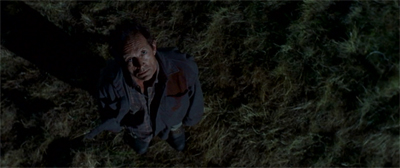
Looking up and wondering...

Looking up and wondering…

Continue reading

Non-Review Review: The Rover

The Rover isn’t quite a post-apocalyptic road movie. A title card places the story “ten years after the collapse”, but it’s never clear what exactly “the collapse” is. Buildings still stand. Trains still run. Telegraph polls are still connected. Cars still drive. Military units still offer some small semblance of law and order. This isn’t a world that has collapsed, it is the decaying structure of a world still struggling to stand.

The Rover is a starkly beautiful and haunting film, one that says a lot with only a few scattered words. It’s unsettling not in its portrayal of a world that is dead, but instead in its attempt to capture a world struggling to keep breathing.

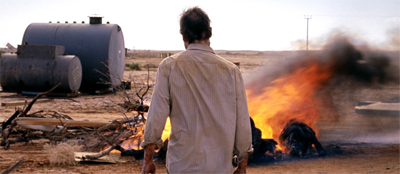
As the world burns...

As the world burns…

Continue reading

Non-Review Review: Dawn of the Planet of the Apes

Constructing a satisfying sequel is an artform unto itself. It is something that requires a great deal of skill. As with any aspect of filmmaking, building off an earlier film is a very difficult thing to do. Producing a sequel comes with its own set of artistic risks and challenges, its own obstacles and hurdles. Navigating those potential problems and finding a way to meet (and even surpass) expectations without straying too far from the framework of the original film is difficult.

As with making any movie, there are existing frameworks and structures that do a little help make navigating those problems a little easier. Perhaps the structure of Star Wars: The Empire Strikes Back is the most obvious example. Using the trust established by the first film, the ensemble are split up to carry different strands of the plot, revealing scattered pieces of a larger whole, before reuniting for an epic finalé. Bryan Singer used this approach for X-Men II and How to Train Your Dragon 2 also followed it.

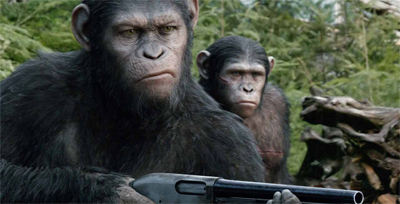
Playing him for a chimp, eh?

Playing him for a chimp, eh?

Dawn of the Planet of the Apes is in an interesting position. It is a sequel to a remake; a remake of a film franchise that was originally iconic and influential, before dying a slow and humiliating public death as the series diminished and collapsed. Not only does Dawn of the Planet of the Apes come with the expectations of Rise of the Planet of the Apes, it comes with the revived expectations of the entire Planet of the Apes franchise; expectations restored by Rise of the Planet of the Apes.

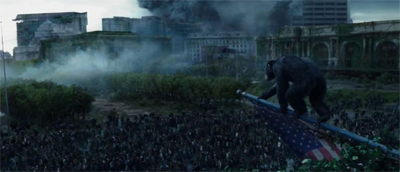
Dawn of the Planet of the Apes chooses a very clever structure for this sequel, loosely following the sequel framework typified by Christopher Nolan’s work on The Dark Knight. This is a very clever approach, and it pays dividends. Dawn of the Planet of the Apes is an ambitious and exciting sequel, a wonderful post-apocalyptic epic and an engaging moral parable.

Going ape for it...

Going ape for it…

Continue reading

X-Men: The End – Book Two: Heroes and Martyrs (Review/Retrospective)

This May, to celebrate the release of X-Men: Days of Future Past, we’re taking a look at some classic and modern X-Men (and X-Men-related) comics. Check back daily for the latest review.

To describe Chris Claremont’s three six-part miniseries that comprise X-Men: The End as “convoluted” is to miss the point. Of course they are convoluted. Claremont is essentially writing a gigantic epilogue to his work on Uncanny X-Men. He is tidying away decades of continuity and offering a sense of closure to his work on these characters and their world. Claremont is an exceptional storyteller when it comes to long-form serialised storytelling.

As a writer, Claremont tends to layer interesting twists on top of interesting twists, with every resolution opening up more avenues for future stories to explore. He has demonstrated an ability to string along plots for decades, revisiting characters and situations years after most readers had forgotten about them. These are the qualities that make his Uncanny X-Men run so deeply fascinating, but they are also the qualities that make him a bit of an awkward fit for a concept like The End, an epic miniseries built around the idea of wrapping up the entire X-Men mythos.

Some things never go into fashion...

Some things never go into fashion…

However, what is so fascinating about X-Men: The End is that all of the elements that Claremont uses are the same elements that he has been playing with since he took over Uncanny X-Men. The story beats have a familiar pattern to them, the themes are familiar, the characters speak as they did in the years that Claremont wrote them. What is fascinating about X-Men: The End is the way that it serves to really set Claremont’s take on the X-Men in stone, treating the elements associated with Claremont as a truly inexorable part of the comic’s mythology.

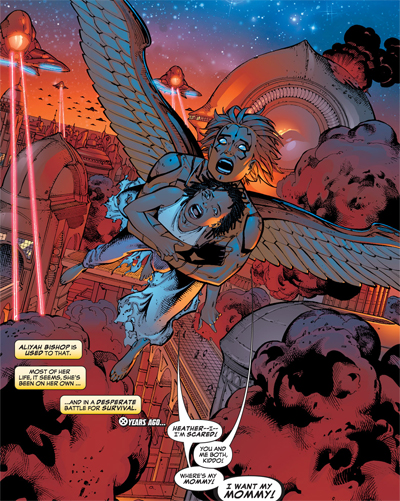
X-Men: The End is very much a Chris Claremont comic, through-and-through. That’s what makes it feel like such a perfect fit.

A wing and a prayer...

A wing and a prayer…

Continue reading

X-Men: The Age of Apocalypse Omnibus (Review/Retrospective)

With our month looking at Avengers comics officially over, we thought it might be fun to dig into that other iconic Marvel property, the X-Men. Join us for a month of X-Men related reviews and discussion.

The nineties represent a contentious time for fans of the X-Men franchise. The decade saw comic books explode into a huge market, with ridiculous sales and publicity, and the entire X-Men franchise rode that wave perfectly. Chris Claremont and Jim Lee’s adjectiveless X-Men #1 remains the biggest-selling comic book of all time, after all, and the franchise quickly secured itself as Marvel’s premiere comic book franchise. On the other hand, the line had been thrown into disarray by the departure of long-term steward Chris Claremont and its era-defining artist Jim Lee. The family of titles had struggled to find a footing through some uneven crossovers and events like X-Cutioner’s Song and Fatal Attractions. However, I think the decade produced one gem that can be considered as a true classic, along with the best of Claremont’s tenure and the work of Grant Morrison. The Age of Apocalypse might seem an odd choice to identify as one of the highlights of the X-Men saga, but I think it deserves very serious consideration.

Apocalypse now…

Continue reading

Acts of Vengeance: X-Factor – Apocalypse vs. Loki (Review/Retrospective)

April (and a little bit of May) are “Avengers month” at the m0vie blog. In anticipation of Joss Whedon’s superhero epic, we’ll have a variety of articles and reviews published looking at various aspects of “Earth’s Mightiest Heroes.”

In celebration of the release of The Avengers, this weekend we’re taking a look at the massive 1989-90 crossover “Acts of Vengeance”, which pitted various villains against some unlikely heroes. I’ll be looking at some of the most fun match-ups. This arc is collected in the companion omnibus.

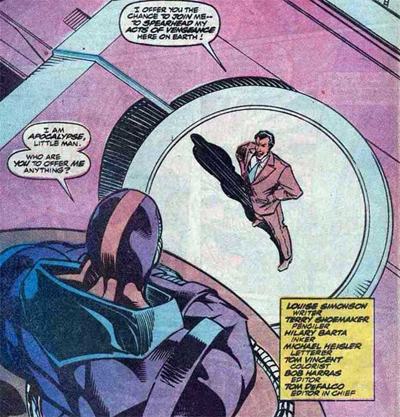
It is very clear, reading some of the issues connected to John Byrne’s Acts of Vengeance, that some writers weren’t entirely on board with the crossover. After all, it was a giant line-wide event that existed purely to pit heroes against villains who traditionally faced other heroes – there was no more rhyme or reason than that. In many cases, that meant derailing whatever was happening in the book at the time, or even reversing or setting back characterisation. Magneto, in particular, found himself reverted back to little more than a villain. While a lot of books were implicitly critical of the event, Louise Simonson’s X-Factor seems particularly bothered by the intrusion, to the point that the only real tie-in to Acts of Vengeance sees the big villain Apocalypse effectively booting Loki out of his book.

I’m not sure Loki’s enthusiasm will crossover quite well…

Continue reading