• Following Us

  • Categories

  • Check out the Archives


  • Awards & Nominations

Infinite Crisis (Review/Retrospective)

This month I’m taking a look at DC’s massive “Infinite Crisis” Event. Although it was all published in one massive omnibus, I’ll be breaking down the lead-in to the series to tackle each thread individually, culminating in a review of the event itself. Check back for more.

Infinite Crisis is a fantastic concept with a somewhat muddled execution. The idea of reflecting on the way the DC Universe has evolved since Crisis on Infinite Earths is a fascinating hook for an event miniseries, and writer Geoff Johns does an effective job of exploring how times have changed. However, the original Crisis on Infinite Earths had a tendency to seem too vast and too all-encompassing for its own good, randomly jumping between a cast of hundreds lost in a maelstrom. Given that Marv Wolfman had twelve issues to tell that story, and still occasionally ended up a little confused, it seems a little unfair for Geoff Johns to attempt a similar effort in only seven issues.

There are times when Infinite Crisis feels less like one cohesive story and more like a series of vignettes based around a theme. That doesn’t mean there isn’t a lot of interesting stuff going on here – or that Johns doesn’t have something compelling to say about modern superhero comics – it just means that Infinite Crisis is a bit of a mess. A bold and ambitious mess, but a mess nevertheless.

A smashing success?

Continue reading

Infinite Crisis: Day of Vengeance (Review)

This month I’m taking a look at DC’s massive “Infinite Crisis” Event. Although it was all published in one massive omnibus, I’ll be breaking down the lead-in to the series to tackle each thread individually, culminating in a review of the event itself. Check back for more.

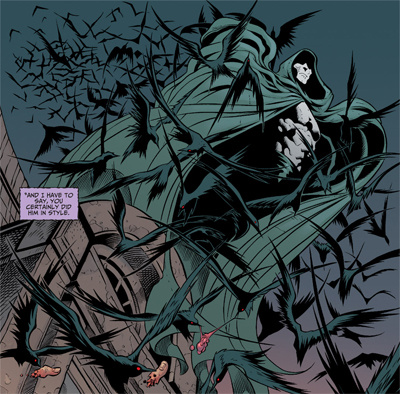
It seems like, within the last decade or so, DC has had a great deal of difficulty organising its “magic and mystic” books. DC generally provided a nice home for books like Alan Moore’s Swamp Thing or John Ostrander’s Spectre, but it seemed like there wasn’t really an abundance of successful magic-themed books in the early part of the new millennium. DC would consciously attempt to remedy this with their “dark” line as part of the “new 52” relaunch, but Day of Vengeance feels like something of an awkward earlier attempt to streamline that corner of the shared universe and to prepare it for some sort of creative relaunch.

One for sorrow, two for joy… What for a few dozen?

Continue reading

Non-Review Review: Super

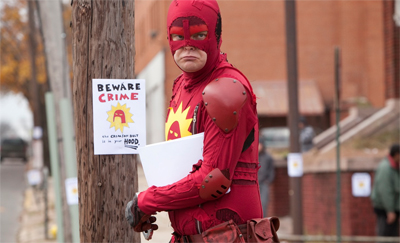
Super is pretty much one joke, extended over a movie runtime. It’s a funny joke, and it’s told well by a great cast and a witty director, but it feels a little stretched, even at under a hundred minutes. It also suffered a bit from being released in the same year as Kick-Ass, a movie that dealt with similar themes in a much more compelling manner, but Super remains an interesting examination of geek power fantasy, and some of the more sinister undertones of the conventional superhero narrative.

Not so super, hero…

Continue reading

Infinite Crisis: The OMAC Project (Review)

This month I’m taking a look at DC’s massive “Infinite Crisis” Event. Although it was all published in one massive omnibus, I’ll be breaking down the lead-in to the series to tackle each thread individually, culminating in a review of the event itself. Check back for more.

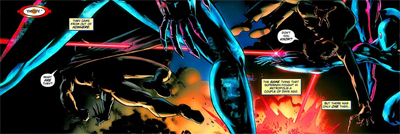
Infinite Crisis was certainly an ambitious project in scope. With the bulk of the major tie-ins collected in a gigantic 1,500-page omnibus, you really get a sense of just how expansive this gigantic crossover was. It’s remarkable how thematically consistent (and yet tonally distinct) so many of these tie-ins were, but The O.M.A.C. Project makes for a suitably grand opening to this gigantic epic crisis crossover, perfectly encapsulating a lot of the core themes that DC seem to have been striving for, while setting up an interesting central conflict.

What do you call a Corps of One-Man-Army-Corps?

Continue reading

DC Comics Classics Library: Roots of the Swamp Thing (Review)

Sometimes a creator leaves such a massive impression on a character that it’s almost hard to believe that the character ever existed before the writer in question began their run. Alan Moore’s Swamp Thing is one such run, a modern day comic book classic which still reads as one of the best continuous runs by an author on any serial publication, ever. However, despite the fact that Alan Moore effectively defined the monster, Swamp Thing actually enjoyed a long publication history even before Moore began writing the title.

Roots of the Swamp Thing only collects the first thirteen issues of the first Swamp Thing title, but it’s enough to get a flavour for the title under Len Wein and artist Bernie Wrightson. While it still remains in the shadow of an author who took over later, it’s not a bad monster book in its own right. It still struggles a bit to find its own identity, but there’s some interesting ideas – and it’s easy enough to find some of the ideas Moore would develop to great success gestating between the lines.

It’s alive!

Continue reading

A View to a Bond Baddie: Dr. Julius No

‘To celebrate James Bond’s 50th birthday on screen, we’re going to take a look at the character and his films. We’ve already reviewed all the classic movies, so we’ll be looking at his iconic baddies, and even at the character himself.

In many ways, Dr. No feels like a rather strange first instalment for a franchise that has managed to persist from half a century. Many of the trademarks we associate with the series are absent. There’s no pre-credits sequence. No powerful theme song involving the title of the film. Even the music playing over that iconic gun barrel shot sounds weird. There are no gadgets and gizmos, save for a Geiger Counter. The movie’s iconic Bond girl, Honey Rider, only shows up past the mid-point of the film.

As such, it’s amazing that the Bond villain emerged almost fully formed, with Dr. No providing perhaps the archetypal James Bond baddie.

He didn’t spend 6 years in evil physics school to be called “Mister”…

Continue reading

Justice League Unlimited – Divided We Fall (Review)

This September marks the twentieth anniversary of Batman: The Animated Series, and the birth of the shared DC animated universe that would eventually expand to present one of the most comprehensive and thorough explorations of a comic book mythology in any medium. To celebrate, we’re going back into the past and looking at some classic episodes.

Divided We Fall makes for a fond farewell to the Justice League and Justice League Unlimited. At the time the show was produced, the creators did not know that they’d get another season, and the season finale that followed Divided We Fall was dedicated to wrapping up the entire DC animated universe from Batman: The Animated Series through to Batman Beyond. So, appropriately, Divided We Fall focuses on the “original seven” members of the Justice League, offering one final climactic confrontation between the Justice League and combined forces of Lex Luthor and Brainiac.

Heroes for higher purposes?

Continue reading

Justice League Unlimited – Flashpoint (Review)

This September marks the twentieth anniversary of Batman: The Animated Series, and the birth of the shared DC animated universe that would eventually expand to present one of the most comprehensive and thorough explorations of a comic book mythology in any medium. To celebrate, we’re going back into the past and looking at some classic episodes.

While Question Authority kicked off this four-part climax to the arc that had been building through the first season of Justice League Unlimited, it’s Flashpoint that really serves to bring things into focus. Question Authority had been told mostly from the point of view of the Question, an outsider looking in – but Flashpoint explores the consequences of this inevitable conflict for the core of the Justice League. It’s amazing just how thoroughly and carefully writer Dwayne McDuffie was able to explore the concept of the superhero in this cynical post-9/11 world. While Divided We Fall would sidestep quite a few of the issues raised, I’m quite impressed to see them even broached in a half-hour cartoon action series.

All fired up…

Continue reading

Batman: Vampire Trilogy – Red Rain, Bloodstorm & Crimson Mist (Review/Retrospective)

To celebrate the release of The Dark Knight Rises, July is “Batman month” here at the m0vie blog. Check back daily for comics, movies and television reviews and discussion of the Caped Crusader.

I’m going to be entirely honest. I’m not completely sure what to make of Doug Moench and Kelley Jones’ Batman: Vampire trilogy. A collection of three Elseworlds stories, all following a Batman who confronted Dracula early in his career, they initially seem like grim and dark comics from the nihilistic nineties. There’s a lot of violence, a lot of cynicism, and a lot of gore. As with a lot of Batman written around that time (and arguably beyond), The Dark Knight Returns seems like a major influence, presenting a progressively darker and unhinged Dark Knight and an increasingly brutal war on Gotham’s crime. However, there were times, reading the trilogy, that I couldn’t help but read it as a sort of an implicit criticism of these sorts of excessively dark and edgy comics.

Streets run red…

Continue reading

Batman: Birth of the Demon (Review/Retrospective)

To celebrate the release of The Dark Knight Rises, July is “Batman month” here at the m0vie blog. Check back daily for comics, movies and television reviews and discussion of the Caped Crusader.

To celebrate the release of The Dark Knight Rises this week, today we’ll be reviewing the complete “Demon” trilogy, exploring the relationship between Batman and Ra’s Al Ghul.

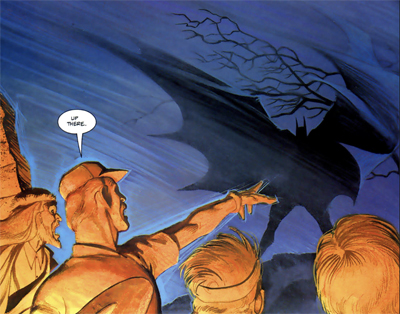
Birth of the Demon is very much the odd one out of the Demon trilogy. Of the three stories, it is the only one not written by Mike W. Barr. It also is arguably the most reflective of the three stories in the series, focusing on the origin of Ra’s Al Ghul more than in any modern conflict with Bruce Wayne. Still, it all feels strangely appropriate that, more than a decade after his creation, Denny O’Neil should return to tell the back story of his most iconic addition to the Batman mythos.

Shadow of the bat…

Continue reading