You might have noticed that I haven’t quite been able to keep up with things around here of late. Everything’s a bit all over the place at the moment – more responsibility at work, longer hours, that sort of thing. Anyway, until things die down again, I’m afraid that things might be slowing down around here (temporarily). For example, this week it’s just reviews being published (one a day – in my defense) as I didn’t have time to do any commentary or gossip or opinion or such (“thank god!” comes a loud sigh from the audience).
Anyway, like that most iconic of killer robots, I’ll be back. Until then things should keep ticking over. I plan to use the shorter spells of time I have to do some tidying up, updating the “Reviews” section and stuff.
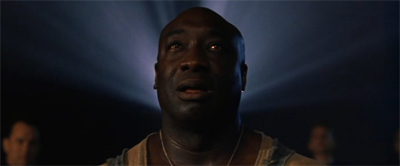
I never really responded to The Shawshank Redemption. I’ll go into why exactly if I ever get around to writing a review of it, but perhaps the fact that I never really embraced the film as strongly as most film fans (or even just, y’know, people) is the reason that I am somewhat fonder of The Green Mile than most. The Green Mile is admittedly as guilty as Frank Darabont’s early Stephen King adaptation set in a prison when it comes to emotional manipulation of its audience (look at us humanise the prison guards by having the three of them tackle a mouse in a borderline comedic fashion!), but I find it a lot more honest about its inherent darkness than that tale of redemption in Shawshank.
Hey, there was meant to be something way more impressive and cool going on here, but it turns out I wasn’t nearly swanky enough to pull it off. Anyway, the guys over at Universal Studios Ireland want to give away tickets to the Irish premiere of Scott Pilgrim vs. The World. Check out their facebook or click the picture below.
I love it when movies make an effort to embrace new technology. It can be something as careful and precise as the carefully orchestrated internet campaign of The Dark Knight (“I believe in Harvey Dent”) or the slow and steady burn of Tron Legacy over two years, or it can even be more direct than that. I thought I might share two of the more wonderfully internet-specific trailers I’ve ever seen, released within a week of each other. These are pretty much ways of publicising a movie that could only work on-line. The first is the interactive Scott Pilgrim trailer. As if we needed more reason to get excited about Scott Pilgrim vs. The World.
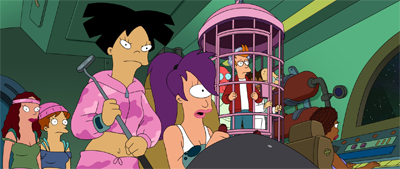
Interesting. It seems that Futurama has somehow (presumably unconsciously) incorporated one of the central features from its key sources, the Star Trek franchise. It’s frequently asserted by fans of that series that the television show spawned a rather inconsistent movies series. Some, such as Star Trek II: The Wrath of Khan, could stand tall and be measured along the best movies that science-fiction could offer; while others, notable Star Trek V: The Final Frontier (in which Kirk kills God in a story pitched and directed by William Shatner), were actually terrible. The consensus emerged that the even numbered sequels were great and the odd numbered movies were terrible. This is just a run of thumb, and it’s possible it has been reversed (the tenth movie, Star Trek: Nemesis, was pretty disappointing; the eleventh, Star Trek, was a blast of fresh air) or even completely deconstructed. While none of the four Futurama movies are “terrible” or even “bad”, the distinction between the “okay” and the “great” seems to fall on similar lines. The first and third, Bender’s Big Score and Bender’s Game, weren’t great, while the second and fourth, The Beast With A Billion Backs and Into the Wild Green Yonder, perfectly capture all that was great about the show.
I had the misfortune of sitting through Batman Forever a few weeks ago. I also stumbled upon it at the weekend with the better half, who was curious to know what a “terrible” Batman film looked like. We got as far as the intimate “Bat-ass shot” before we simply gave up and tried to wipe our short-term memories. However, I found myself sticking up for a most unlikely part of the production: Jim Carrey as the Riddler.
Surprise! Something's that not that terrible about Batman Forever!
Somebody sent this on and I thought it might be worth a gander. To promote Step Up 3D, Universal have put together an Irish dance troupe to celebrate the movie’s release over here. Check out them performing below.
You could make the arguement that the first two Futurama movies – Bender’s Big Score and The Beast With A Billion Backs – cast their nets particularly widely in charting the universe the show had been cultivating for four years before it went off the air, perhaps drawing in more threads than it was fair to assume that an hour-and-a-half movie could handle. So Bender’s Game might seem a relief in that regard. It’s a relatively tightly-focused tale, involving a small subset of the show’s many, many characters. However, in doing so, it never really seems to justify why it’s a bigger and longer tale. Indeed, it could just as easily have been two shorter ones.
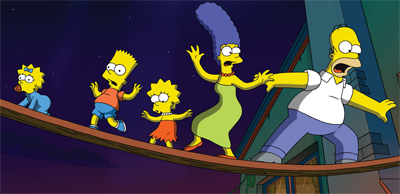
It’s one of those things that, repeated often enough, becomes the truth. The Simpsons were funnier in the old days. In fact, limping into its twenty-first season, there are probably die-hard fans out there looking for what they might deem a “mercy killing” from Fox, and the vast majority of us have just really stopped watching. However, as I went back this week and re-evaluated all the Futurama movies, it got me thinking: is it really fair to make the argument that The Simpsons aren’t as good as they once were?
The nineties were a tough decade for the comic book medium. Violence sold. “Grim and gritty” represented the direction for most major comic books. Superman died. Batman was crippled. Green Lantern became a genocidal maniac. The Flash had long since abandoned the comic book universe. This was the era back-to-back Venom miniseries, the rise of Rob Liefeld and the lethal vigilante. A lot of people trace back this trend to the success of groundbreaking series like Watchmen or The Dark Knight Returns, which demonstrated that darker imaginings of conventional superhero comics could sell. Of course, that wasn’t the point of the comics at all, but such complexity is not the speciality of managers and executives. However, if the birth of that so-called “Dark Age” of comic books could be traced back to those roots, then perhaps Kingdom Come can be identified as the birth of a counter-movement against such trends.





















 the m0vie blog