• Following Us

  • Categories

  • Check out the Archives


  • Awards & Nominations

Non-Review Review: Snake Eyes

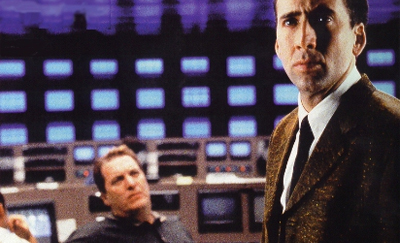
Snake Eyes could have been a much better movie than it ultimately turned out be. Brian De Palma can be a frustratingly uneven filmmaker, but the basic premise of the movie isn’t sort of promise. A murder mystery and conspiracy thriller in a crowded auditorium, with the investigating officer a corrupt cop? That’s a fairly interesting hook right there, even before you add Nicolas Cage and Gary Sinise to the mix. Unfortunately, the movie never seems entirely sure what it wants to be, ultimately serving as a random mish-mash of different elements that never add up to a conclusive whole.

In the Nic of time...

Continue reading

Tintin: Cigars of the Pharaoh (Review)

In the lead-up to the release of The Adventures of Tintin: The Secret of the Unicorn, I’m going to be taking a look at Hergé’s celebrated comic book character, from his humble beginnings through to the incomplete post-modern finale. I hope you enjoy the ride.

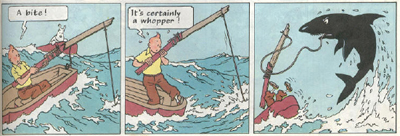
This is more like it. I think Cigars of the Pharaoh is the first quintessential Tintin story. It really feels like Hergé has figured out the kind of stories he wants to tell, with a weird blend of various pulp genres from crime to mystery to horror, all mixed with a healthy dose of comedy. It’s also the first adventure in the series (and I’m including Tintin in the Congo) that feels truly exotic as our hero travels the world to unearth the central mystery.

Tintin's first glimpse of a Red Sea Shark...

Continue reading

Best Indecision Ever! Movie Reviewers & Fear of Absolutes…

I had the pleasure of catching Midnight in Paris at the weekend, and I liked it. I really liked it. I confessed in my review that I thought it was Woody Allen’s best film of the past decade, and – as I left the cinema – I found myself wondering if perhaps it was the best of Allen’s films that I’ve seen. I’ll freely concede that I have yet to work my way through the director’s extensive filmography, but I have been a lot of his more famous and celebrated films like Annie Hall or Manhattan. Still, I feel reluctant to say that, which is admittedly quite strange. I am a movie reviewer (or, if you’ll allow me a hint of pretension, a “critic”) why am I so scared of superlatives?

Simply the best?

Continue reading

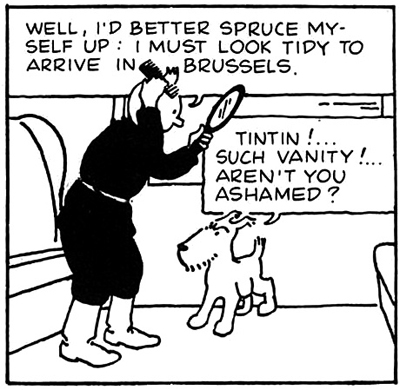
Tintin: Tintin in America (Review)

In the lead-up to the release of The Adventures of Tintin: The Secret of the Unicorn, I’m going to be taking a look at Hergé’s celebrated comic book character, from his humble beginnings through to the incomplete post-modern finale. I hope you enjoy the ride.

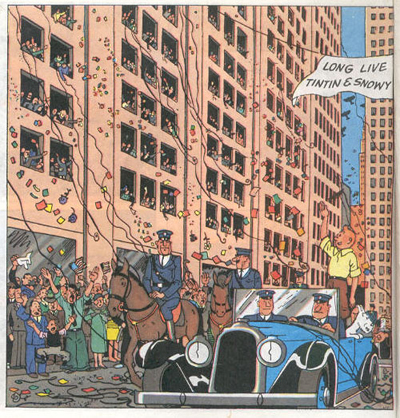
Tintin in America was the earliest Adventures of Tintin book I read as a child, and I owned the entire collection from this point on (for obvious reasons, Tintin in the Land of the Soviets and Tintin in the Congo were not recommended childhood reading). That said, I’ve always regarded Tintin in America as one of the weaker entries in the series, perhaps because my childhood imagination yearned for something relatively more exotic than a trip to North America, or perhaps because the saturation of American pop culture made all the elements Hergé was spoofing seem like old hat. I’m not entirely sure, but I have to admit that the story hasn’t improved too much on re-reading.

America, %&#! Yeah!

Continue reading

Non-Review Review: The Inbetweeners

In fairness to The Inbetweeners, it’s relatively smartly written, well-acted by the cast involved, and entertaining – if incredibly predictable. However, I can’t help but wonder if it feels already outdated – the concept of a bunch of young British males heading to an exotic Mediterranean island as a hedonistic paradise is the kind of thing that already felt old-fashioned when shows like Ibiza Uncovered were all the rage in the late nineties, and we’ve already seen any number of movies on the topic, with Kevin and Perry Go Largeeven adapted from another British television show. The Inbetweeners has enough charm to make it almost to the end, but it just feels much more generic than it really ought to.

Not so fab four...

Continue reading

Tintin: Tintin in the Congo (Review)

In the lead-up to the release of The Adventures of Tintin: The Secret of the Unicorn, I’m going to be taking a look at Hergé’s celebrated comic book character, from his humble beginnings through to the incomplete post-modern finale. I hope you enjoy the ride.

“Unfortunate,” is probably a word that gets tossed around quite frequently about Tintin in the Congo. The second adventure in the series, it was omitted from the list of books on the back of my old Tintin collection, for reasons that aren’t too hard to fathom. Apparently, like Tintin in the Land of the Soviets, the book was driven by editorial edict – to encourage Belgians to move to the colonies in the Congo, rather than to drum up fear and mistrust of communist Russia – though, to be frank, I really can’t see much here stirring a desire to emigrate. Tintin in the Congo is very mush a product of its time, filled with casual racism and awkward portrayals. That doesn’t make it any better, and it’s genuinely quite difficult to look past that fact.

Fur and loathing in the Belgian Congo...

Continue reading

Non-Review Review: Midnight in Paris

A special thanks to the IFI for sneaking us into an advance screening. If you’re interested, they’re hosting a season of actors-turned-directors through October, with Woody Allen’s Purple Rose of Cairo among those screening.

“You inhabit two worlds. So far, I see nothing strange.”

“Of course, you’re a Surrealist.”

– Man Ray takes Gil’s time-traveling confession quite well

Woody Allen has, to a greater or lesser extent, been heavily influenced by Europe in the past few years. Ignoring Whatever Works, he’s clearly been inspired by the great European cities. Vicky Christina Barcelona is perhaps the most obvious, if only because it was perhaps the most critically and commercially successful, but London has also produced works as diverse as Match Point and You Will Meet A Tall Dark Stranger. Still, if you’re going to work with the major European cities, it seems pointless to avoid Paris, the city of lights and lovers, home to generations of artists for decades upon decades, it has earned a reputation as one of the most powerful and inspiring locations on the face of the planet. Allen does his subject proud, producing what is certainly his best film since his trip to Barcelona, and one I’d rank considerably higher in my own estimation. It seems that even the cynical Woody Allen can become something of a romantic in Paris.

The importance of being Ernest...

Continue reading

Doctor Who: The Wedding of River Song (Review)

To celebrate the fiftieth anniversary of the longest-running science-fiction show in the world, I’ll be taking weekly looks at some of my own personal favourite stories and arcs, from the old and new series, with a view to encapsulating the sublime, the clever and the fiendishly odd of the BBC’s Doctor Who.

The Wedding of River Song originally aired in 2011.

“I had to die. I didn’t have to die alone.”

– The Doctor

That was a really crammed 45 minutes. If I’m ever looking for an example of how much plotting Steven Moffat can fit into a single regular-sized episode of Doctor Who, I think I only need to look back at The Wedding of River Song. It’s a piece of very smart science-fiction writing, bristling with ideas and tying up quite a lot of the questions that Moffat raised over the course of the last two years, while raising even more.

It’s something that Moffat’s Doctor Who seems to struggle with, balancing the show’s appeal and accessibility with long-term arc-based story telling. It’s a conflict that’s playing out across a variety of television shows, building off the massive success of Lost, and demonstrating that television shows with serialised plot elements can draw (and, for the most part, keep) large audiences.

It’s still a risky gambit for any television show, particularly one like Moffat’s Doctor Who, where the episodes are so few and so far spaced across the television season. Arcs like this run the risk of extending some of the problems with the season as a whole, rather than playing up the individual strengths of the episodes.

Death of the Doctor…

Continue reading

Tintin: Tintin in the Land of the Soviets (Review)

In the lead-up to the release of The Adventures of Tintin: The Secret of the Unicorn, I’m going to be taking a look at Hergé’s celebrated comic book character, from his humble beginnings through to the incomplete post-modern finale. I hope you enjoy the ride.

The two earliest Tintin adventures, Tintin in the Land of the Soviets and Tintin in the Congo, are looked back upon as the black sheep of the Tintin novels produced by Hergé. While Tintin in the Land of the Soviets is shameless anti-Communist propaganda (and does contain a hint of the foul racism we’d see a lot more of in Tintin in the Congo), one can detect a lot of the charm that Hergé brought to his iconic creations, scattered throughout the work, from the surreal sense of humour to the writing style to the love of ridiculous suspense, seemingly for the sake of suspense. The best was definitely yet to come, but it all started here.

The collection isn't Tintin at his finest...

Continue reading

Donka: A Letter to Chekhov at the Gaiety (Review)

Donka: A Letter to Chekhov is a rather wonderful addition to the Ulster Bank Dublin Theatre Festival. Between this and the Absolut Fringe, theatre-lovers have been quite spoilt of late – I’m still looking forward to checking out Peer Gynt by Rough Magic in the next week or so. Donka: A Letter to Chekhov is a rather wonderful and imaginative little show loosely connected by vignettes inspired by or related to the works of Anton Chekhov, as written and directed by Daniele Finzi Pasca, who also wrote and directed Corteo for Cirque de Soliel. It’ really rather wonderful and magical.

All going accordian to plan...

Continue reading