To celebrate the twenty-fifth anniversary of Star Trek: The Next Generation, and also next year’s release of Star Trek: Into Darkness, I’m taking a look at the recent blu ray release of the first season, episode-by-episode. Check back daily for the latest review.
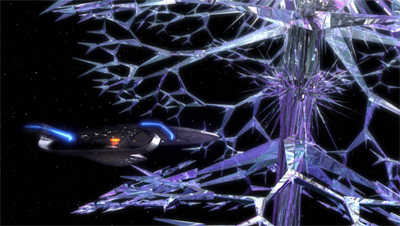
Maybe it’s just because I’m delirious coming out of Angel One, an episode that managed to make Datalore look almost reasonable by comparison, but I quite like 11001001. Part of that comes down to the fact that it’s one of the few episodes in this troubled first season that manages to take the restrictions imposed on the show by Roddenberry and make them work. It helps that the aliens of the week – the Bynars – are among the more interesting creatures to appear on the show so far. And it finally makes for a nice Riker episode, finding a way to team up Riker and Picard, a duo that haven’t spent enough time together at this point in the series.
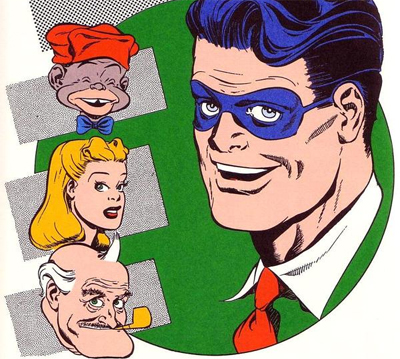
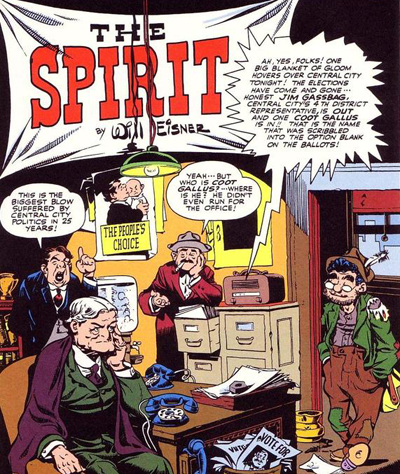
The Spirit Archives, Vol. 14 finds Will Eisner back in full swing. The Spirit is truly firing on all cylinders, after taking about a year just to get everything lined up after the creator returned from military service. The success of this volume isn’t so much that Eisner is doing anything especially new or innovative. Rather, it seems like The Spirit has made a note of the aspects of the strip that work and has decided to concentrate on those stronger elements. This six-month stretch on newspaper strips doesn’t necessarily contain a record-breaking number of stand-out stories, but there are far fewer duds that we’ve seen before. There’s still a couple of Ebony-centred stories, but they’re few and far between. The other annoying kid sidekicks are mostly demoted to black-and-white one-line “P.S.” strips at the bottom of the page, and don’t intrude on the narrative.
The Spirit Archives, Vol. 14 isn’t so much about doing things better, as doing them more consistently.
“They’ll call you the quickest gun in the South,” bounty hunter Dr. King Schultz remarks to the freed slave Django Freeman. The cliché would suggest that he meant to say “West”, but Django Unchained has its mind firmly on the Southern United States. Producing the film, writer-director Quentin Tarantino argued that he wanted to produce a “Southern” rather than a “Western”, and he has done an admirable job. However, what’s really remarkable about Django Unchained is the way that it balances Tarantino’s trademark grindhouse aesthetic with considerable mature nuance. Django Unchained is the story about two bounty hunters tracking down wanted men dead or alive, but it that doesn’t mean that it is afraid to tackle more substantive and challenging aspects of American history.
If you’d asked me whether I thought that Tarantino could produce a powerful and insightful exploration of slavery in the Deep South before I saw Inglourious Basterds, I would have hesitated before answering. Django Unchained is smart, sophisticated and thoughtful, but never pretentious, never pandering, never dull. In a rather unlikely way, it is the most mature film Tarantino has ever produced.
To celebrate the twenty-fifth anniversary of Star Trek: The Next Generation, and also next year’s release of Star Trek: Into Darkness, I’m taking a look at the recent blu ray release of the first season, episode-by-episode. Check back daily for the latest review.
Any time I worry that I might have been too kind on Datalore, watching Angel One tends to set me straight relatively quickly. Watching Angel One feels like somebody in the writers’ room said, “I really liked the racism in Code of Honour! Can we do that again, but with sexism?” It’s very difficult to imagine to imagine how the script got into production without somebody raising red flags about it. While a lot of the racism of Code of Honour arose from the decision to cast the Ligonian characters as black, sexism in hardwired into the DNA of Angel One, making it one of the most unfortunate scripts in a long line of unfortunate scripts.
I believe in Angel One… something crappy in every season of TNG…
With Eisner now back on the strip for over half-a-year, The Spirit is forging ahead into the middle part of its run. Many commentators and pundits would argue that the few years following Eisner’s return from military service were among the best in the strip’s history, and it’s hard to disagree. While Eisner took the time in his first six months to tidy up loose ends – killing the Squid, sending Satin home with a daughter – here we see the creator building up the world he has created. This collection includes the strips introducing (and a number of subsequent appearances from) both P’Gell and the Octopus, arguably two of the most important characters introduced into the strip following the Second World War. There’s also a sign that Eisner is branching out a bit, and pushing the strip out from the shadow of the Second World War. After all, a new era of prosperity and a Cold War were both just around the corner, very fertile ground for the creator to explore.
Life of Pi is visually stunning. It is an amazing accomplishment. I’ll be the first to admit that I am skeptical of 3D, but in the hands of the right director – Martin Scorsese, James Cameron and, now, Ang Lee – it is a fascinating storytelling tool. The computer-generated imagery is magical, as are the compositions and scene transitions. There’s no doubt that Ang Lee is a superb craftsman. Indeed, the visual majesty of the film is enough to make you dismiss some of the lighter narrative elements, accepting some of the incongruities as expressions of “magical realism” or simply a function of allegorical storytelling. It’s not the densest, or the most insightful, story you will see, but it’s well-told.
Unfortunately, then you reach the end, and Life of Pi tries to get considerably smarter than it actually is. It pulls a clumsy narrative trick that leaves the audience feeling a bit disoriented and more than a little manipulated. Life of Pi finds itself torn between trying to be a beautiful allegorical story of survival and a deeper commentary on the stories that we tell. Forcing one undermines the other. While Life of Pi might convince you that a boy and a tiger can share a lifeboat, the two competing aspects of Life of Pi sink the story.
To celebrate the twenty-fifth anniversary of Star Trek: The Next Generation, and also next year’s release of Star Trek: Into Darkness, I’m taking a look at the recent blu ray release of the first season, episode-by-episode. Check back daily for the latest review.
If you absolutely, positively, positronically have to do an evil twin story, then I guess that Data is the best character to use. Datalore is hardly the finest or strongest episode of the first season. It’s riddled with plot holes, it feels overly contrived, it punishes the viewer for actually paying attention to the set-ups and plot devices, and it is awkwardly paced and sluggishly delivered. That said, it does offer some real stakes and an opportunity for Brent Spiner to ham it up a notch. So, while we’re not in “classic” (or even “good”) territory here, it’s certainly more watchable than a lot of the episodes around it.
The Spirit Archives, Vol. 12 marks Will Eisner’s return to the strip. To be fair, the writer and artist had returned for the last two entries in the previous volume, but this is the first book entirely composed of Eisner’s post-war Spirit stories. While I don’t think Eisner had quite found his groove yet – the best was still yet to come – it’s amazing how dynamic the comic feels after reading the non-Eisner material. It’s easy enough to point to the Eisner-esque tropes and tricks, the techniques and the plot devices and the philosophy that faded from the strip in has absence, but there’s also something much less tangible here. There’s certain energy, a je ne sais que, that had been absent for the previous couple of years, returning in force.
The new trailer for Man of Steel has arrived and… I’m actually pretty excited about it. I’m a pretty big Superman fan, although I’ll admit that the character can be very tough to adapt. While Batman lends himself to all manner of interpretations, the Man of Steel is a lot harder to get a handle on. Batman is – despite being an orphan billionaire – much easier to relate to than an alien from another world. It’s hard to write a character who can do almost anything, and tough to emotionally invest in a hero who can shrug off bullets.
And, yet, despite that, I am cautiously optimistic about this Man of Steel, if only because it seems to grasp something about the character – something that Christopher Nolan’s Dark Knight trilogy understood about Batman. These truly iconic characters are important for what they say about us, and our culture. It’s fun to watch Superman smash alien ships and fly into the sun, but what does his appearance suggest about the world he inhabits. Can we trust him? Can he trust us? Nolan grasped that Batman was about hope in the face of despair – the notion that one man could make a difference and ascend to the status of myth. It seems, based on this trailer, that Man of Steel is about optimism and faith.
The CGI looks grand, but it’s the personal stuff that I responded to. The moment where Clark confesses that his father worries about him. He’s the strongest man in the world, impervious to bullets, and yet Jonathan Kent fears what the world will do to his son – that somehow they might “reject” him, and that would be worse than any physical harm that could befall the child he raised. That’s a fascinating (and strangely natural) hook. There’s something very human about a father’s selfish desire to put his child ahead of the greater good.
When Clark flat out asks his father if he should have allowed those kids to die, Jonathan Kent selfishly replies, “Maybe.” It’s a strangely natural moment, and it feels organic for a father to place the security of his family above the greater good. It doesn’t make Jonathan seem shallow or cynical. It just makes him seem a bit more real. And, naturally, Superman is about transcending that sort of understandable selfishness. With great power, to quote another iconic hero, comes great responsibility, and the heart of Superman suggests that if a man were to find himself gifted these incredible powers, he would use them for the betterment of mankind rather than keep them locked away for personal gain.
There’s another nice moment where Clark asks Lois if she thinks the world is ready – because Superman is a concept that can’t work without absolute trust. If the character can’t be trusted by the world at large, then he loses any moral authority. Unlike Batman who exists as an underdog and can work outside the establishment, the nigh-all-powerful Superman has to be wary of being portrayed as an alien fascist imposing his will on a less powerful mankind.
Superman Returns didn’t realise this and eroded away Superman’s moral high ground, turning the character into a spoilt and entitled teenager with the power of a god. Superman Returns was a disaster and more of a horror movie than a superhero film. It’s not about creating a world that immediately accepts Superman, but in recognising that he has to convince it of his worth. Superman’s real victory isn’t pounding Zod into a skyscraper, it’s convincing people to believe in him. After all, Superman is the very embodiment of optimism, the notion that – were a man suddenly able to fly and deflect bullets – he would use his powers to make the world a better place. If we can believe in the basic goodness of Superman, we can believe in our own capacity to do the impossible.
If Man of Steel can embrace the character without a hint of irony, I think we might be on to something.
To celebrate the twenty-fifth anniversary of Star Trek: The Next Generation, and also next year’s release of Star Trek: Into Darkness, I’m taking a look at the recent blu ray release of the first season, episode-by-episode. Check back daily for the latest review.
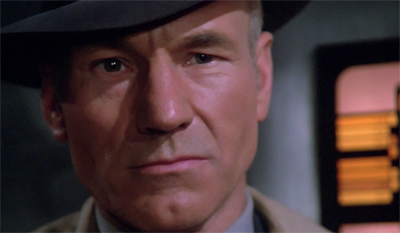
I actually enjoyed The Big Goodbye on a lot of levels. It’s not a greatStar Trek episode, but I don’t think that the first season of Star Trek: The Next Generation produced a great episode. Even those episodes I do not actively hate are still significantly flawed. The Big Goodbye has more than its fair share of problems, but it does several things right. It never pretends to be more than it is, and it allows Patrick Stewart to do a lot of the heavy-lifting. Stewart is effectively charged with selling the episode to the audience, and he does a tremendous job. The result is something quite similar to the eponymous holonovel – something diverting and entertaining, but hardly profound or essential. Given the quality of the surrounding episodes, “diverting and entertaining” seems like just what the doctor ordered.





















 the m0vie blog