• Following Us

  • Categories

  • Check out the Archives


  • Awards & Nominations

Star Trek: Deep Space Nine – Empok Nor (Review)

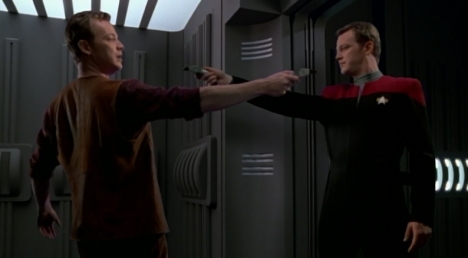
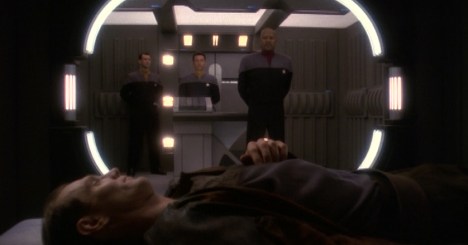
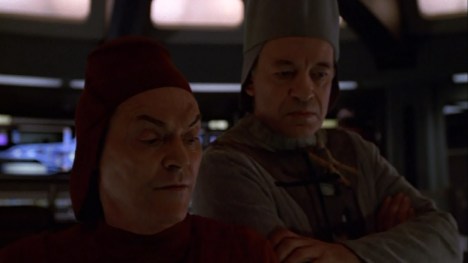
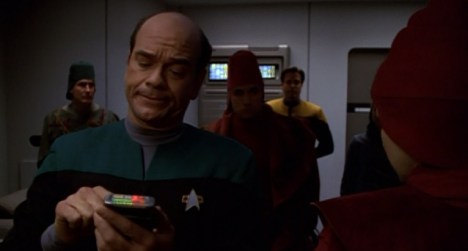
Empok Nor is effectively a slasher movie.

It is Bryan Fuller’s second story credit for Star Trek: Deep Space Nine, and it shares a number of tonal and thematic similarities with his story for The Darkness and the Light. Both episodes are essentially pitched as serial killer horror movies, in which monsters from the past stalk our lead characters. These are fascinating tonal departures for the Rick Berman era of the Star Trek franchise, even if they feel like the logical extension of early horror-tinged episodes like The Man Trap or Charlie X or The Enemy Within.
The great game.

The great game.

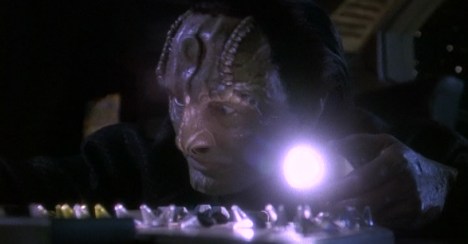
Empok Nor is not as well developed or as effective as The Darkness and the Light. It lacks the thematic and character-driven punch of that earlier episode, even suffering as a little derivative. While Kira’s efforts to reconcile her past as a terrorist with her current status quo was the driving force of The Darkness and the Light, the contrast between O’Brien as a soldier and O’Brien as an engineer feels a little underdeveloped in Empok Nor. More than that, Empok Nor suffers from casually transforming Garak into a gloating nineties serial killer.

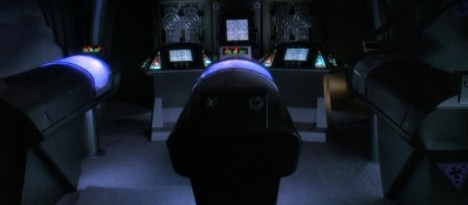
At the same time, there is a cheeky thrill to watching the Deep Space Nine production team try their hand at a particularly trashy and visceral genre, offering jump scares and atmosphere on familiar sets with the lighting turned way down low. Empok Nor is not a standout of this most spectacular of television seasons, but it had its charms.
Sleeping beauties.

Sleeping beauties.

Continue reading →

Doctor Who – The Return of Doctor Mysterio (Review)

What is that?

Well, in terms you would understand…

… sorry, there aren’t any.

The Return of Doctor Mysterio feels very much like a return to the aesthetic of the Doctor Who Christmas Specials of the Russell T. Davies era.

Russell T. Davies tended to build his Christmas Specials as blockbuster events, stories featuring gigantic invasions and the end of the world. In some ways, the perfect fodder for a family sitting down after Christmas dinner, half paying attention to the television and very much in need of a plot that was packed with spectacle while moving a mile-a-minute. As a rule, the Russell T. Davies specials did not demand the complete and devoted attention of the best episode, instead feeling more like a lavish desert than a hearty main course.

Here comes a hero.

Here comes a hero.

For Davies, Christmas entertainment itself seemed to be the genre to which he wrote, with his specials very consciously intended to evoke a general mood or feeling of Christmas television. Indeed, Davies would even extend the tone of his specials beyond stereotypical Christmas concerns as in The Christmas Invasion or The Runaway Bride. Voyage of the Damned is the most obvious example, a riff on The Poseidon Adventure and other maritime disaster films that have little directly to do with Christmas but air in constant rotation during the season.

Steven Moffat has tended to use his Christmas Specials as part of larger emotional and story arcs. A Christmas Carol involved some light “timey wimey” stuff. The Doctor, the Widow and the Wardrobe built to a big emotional reunion with the Pond family. The Snowmen was all about the Doctor’s angst over the loss of River and the Ponds. The Time of the Doctor was a subversion of the “thirteenth regeneration” story. Last Christmas was very much about Clara. The Husbands of River Song was about saying farewell to River.

No escape.

No escape.

In contrast, the big emotional beats of the Davies Christmas Specials tended to be drawn in broader terms. The departure of Christopher Eccleston meant that The Christmas Invasion had to deal rather directly with the arrival of David Tennant, but the Tenth Doctor’s heartbreak over the loss of Rose played out in the background of The Runaway Bride paying off in one big moment where he repeated her name. The continuity elements in The End of Time, Part I were largely superfluous to the broad storytelling.

The Return of Doctor Mysterio very much evokes to the storytelling sensibilities of the earlier Davies era. Even the story beats harken back to Christmases past. Nardole’s brief closing acknowledgement of River Song evokes the Tenth Doctor’s brief closing acknowledgement of Rose in The Christmas Invasion. The action climax of the Doctor on the bridge of a crashing alien ship hurdling towards a major metropolis feels lifted from Voyage of the Damned. However, there is also the fact that The Return of Doctor Mysterio is a broadly-drawn superhero film.

Damned if you do, damned if you don't...

Damned if you do, damned if you don’t…

Continue reading →

12. It’s a Wonderful Life – Christmas 2016 (#24)

Hosted by Andrew Quinn and Darren Mooney, The 250 is a fortnightly trip through some of the best (and worst) movies ever made, as voted for by Internet Movie Database Users.

This time, a Christmas treat. Frank Capra’s It’s a Wonderful Life.

The iconic American fable about George Bailey and his time in Bedford Falls, It’s a Wonderful Life is a heartwarming Christmas classic about how no man is poor who has friends.

At time of recording, it was ranked the 24th best movie of all time on the Internet Movie Database.

podcast-itsawonderfullife

Continue reading →

Podcast! Scannain Podcast – End of Year 2016!

The boys are back in town.

Just in time for Christmas, and at the end of what has been a divisive year, the Scannain crew re-team to talk through the best and worst of film in 2016. Niall Murphy, Phil Bagnell, Jay Coyle and I chat through our top tens of the year, bicker over the relative merits and strengths of the various seasons, and list our biggest disappointments. With thirty films across the four top tens, the Scannain – End of Year 2016! has everything you’re looking for a cinematic retrospective on the year that’s been.

What were the best films released in 2016? What constitutes a “film” for the purpose of an end of year list? Was the summer really that bad? Will Niall, Phil, Jay and I agree on anything? Tune in and find out. Click here (or the picture below) to listen.

podcast-2016

Star Trek: Voyager – Worst Case Scenario (Review)

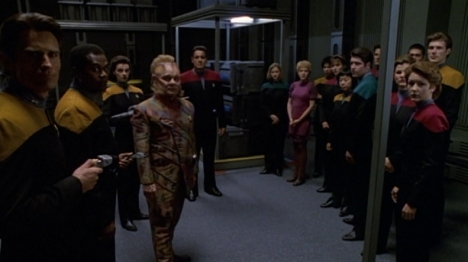
Worst Case Scenario is a flawed episode of Star Trek: Voyager. It is also breathtakingly ambitious.

There is a strong argument to be made that Worst Case Scenario is the strongest Star Trek script ever written by Kenneth Biller. It is a story about storytelling, using the holodeck as a jumping off point for all sorts of self-reflective commentary on the sort of creative compromises necessary to get an episode of television (and in particular an episode of Voyager) on the air. It also benefits from a cracking starting premise, a wonderful opening act, and some playful direction from Alexander Singer. All of these elements help to distract from obvious weaknesses.

Rebel, rebel.

Rebel, rebel.

Worst Case Scenario has a number of serious flaws. It makes very little sense from a logical perspective, with the script guilty of many of the criticisms that Tuvok makes of Paris’ approach to the craft of writing. The ending is rushed. The episode owes a sizable debt to Our Man Bashir, a much stronger episode of Star Trek: Deep Space Nine that used the holodeck to make similar (and more convincing) arguments about the nature of storytelling. Like many good-but-not-great Voyager episodes, Worst Case Scenario refuses to follow its ideas to their conclusions.

And yet, in spite of all of these issues, Worst Case Scenario is an endearing and playful piece of television. It is far too chaotic and unfocused to rank with the best of the franchise, but it is distinctive enough to stick in the memory without ever being embarrassing.

It's all up to you.

It’s all up to you.

Continue reading →

Star Trek: Deep Space Nine – Blaze of Glory (Review)

Blaze of Glory is a spectacular piece of television.

It is an episode that serves a very clear plot function in the larger context of Star Trek: Deep Space Nine. It is clearly designed to tidy away some of the dangling loose ends before the show transitions into the Dominion War. Much like Children of Time was really the last “strange Gamma Quadrant phenomenon” episode, Blaze of Glory is the last Maquis episode. It also marks the last appearance of Michael Eddington, a character who has come a long way since his first appearance as the station’s new security officer in The Search, Part I.

Michael Eddington, Noted Brigand.

Michael Eddington, Noted Brigand.

However, even ignoring the fact that Blaze of Glory fulfils these larger obligations in terms of the show’s long-running plot threads, the episode is an engaging and exciting buddy action film that finds Benjamin Sisko paired with one of his most hated adversaries on a dangerous mission into the heart of enemy territory. Ira Steven Behr and Robert Hewitt Wolfe prepare a script laced with wry banter for unlikely action heroes Avery Brooks and Ken Marshall, while Kim Friedman directs the episode as if it were a lost Reagan era Shane Black script.

However, Blaze of Glory also feels very much like Deep Space Nine at its best. It is an episode that celebrates how much these characters can grow and change, while also revelling in the diversity of perspectives that make Deep Space Nine such a compelling show. It is an episode that understands Sisko and Eddington are perhaps more alike than either would concede, but which explores those parallels in a way that never obscures their key differences or their mutual mistrust.

Disarming conversation.

Disarming conversation.

Continue reading →

Non-Review Review: Assassin’s Creed

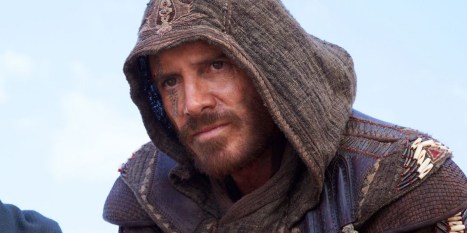
“What the f%$k is going on?” asks Michael Fassbender about halfway through the film.

It is not the first time that Cal Lynch has asked this question. Earlier on, the character wondered out loud “what’s happening?” after waking up following his state-sanctioned execution and being hooked up to a gigantic robotic claw that yanking him into the air mid-sentence. The audience is probably asking the same questions as Assassin’s Creed bounces across time and space with mountains of exposition (occasionally helpfully subtitled) about rival societies conspiring to find an artefact that can harness (and eliminate) mankind’s free will.

The Fass and the Furious.

The Fass and the Furious.

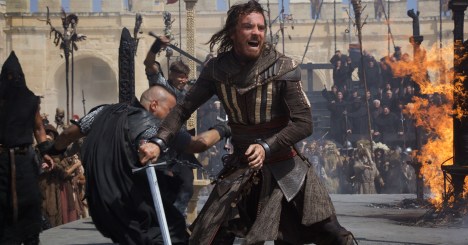
To be fair, incoherence is not the real problem with this disjointed video game adaptation. In fact, there is a certain weird charm to watching the amazing cast and the game director react to the crazed concepts that they have been dealt. For the first hour or so, the sheer weirdness of the film proves compelling, drawing in audience members willing to resist the tonal whiplash and laboured exposition as the film rockets along. What ultimately kills Assassin’s Creed is not its lack of sense, but the stubborn insistence that it must make sense.

Assassin’s Creed would be a stronger film were it willing to revel in its incoherence instead of trying to impose order upon it. The gonzo plotting and zany high concepts give the film a strange texture, but the problems do not really kick in until Assassin’s Creed starts awkwardly and painfully trying to construct a rational framework around this bizarre cavalcade. The result is to wed a visually hyper-kinetic and tonally unruly film to an incredibly tired generic plot that winds transforming the film into a plodding mess.

He's so hot right now.

He’s so hot right now.

Continue reading →

Non-Review Review: Passengers

Passengers is a super creepy tale of male entitlement.

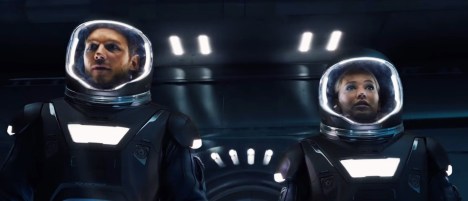
The movie has an intriguing science-fiction premise. On a sleeper ship intended to ferry passengers to the colony world of Homestead II, a freak accident awakens James Preston. The only problem is that Preston awoke far too early. Preston awoke approximately thirty years into a one-hundred-and-twenty-year voyage. The engineer is now destined to spend the rest of his life as the only waking inhabitant of a gigantic city ship, living and dying completely alone. It is a horrifying thought.

"We need a little space."

“We need a little space.”

There are suggestions of a powerful science-fiction epic to be found in the film. Jim finds his every physical need has been anticipated. He can live a life of material luxury. He will never want for food or space or activity. He effectively has a gigantic space craft all to himself. And therein lies the rub. Feeling almost like a sadistic episode of The Twilight Zone, Jim grapples with the question of what he will or will not do in order to end his loneliness. In his desperation, Jim makes a horrifying (if entirely understandable) decision.

The biggest problem with Passengers is that it strains too hard to make that decision palatable instead of terrifying. It is a super creepy tale of male entitlement that brushes aside any of this issues in favour of a much more conventional action romance.

Peace in a pod.

Peace in a pod.

Note: Very minor spoilers for Passengers follow. If you know the cast list, you can probably deduce where the movie is going from the opening ten minutes.

Continue reading →

Star Trek: Voyager – Displaced (Review)

The Star Trek franchise has a reputation for being liberal and open-minded.

After all, the franchise is very much rooted in an extension of Kennedy-era liberalism, with the “final frontier” very much an extension of Kennedy’s “new frontier.” It is a franchise that is supposed to celebrate “new lifeforms and new civilisations” that it meets on “strange new worlds”, embracing the alien and celebrating diversity. The franchise is rooted in a utopian version of the future that has been portrayed as at least mostly socialist dating back to Star Trek: The Motion Picture at the latest.

The end is Nyrian.

The end is Nyrian.

However, there are also points at which Star Trek could be considered to be reactionary and conservative. The original Star Trek was nowhere near as progressive on matters of race and gender as many would claim. The first two seasons of Star Trek: Enterprise frequently played as endorsements of politics of the Bush era and the fear of the unknown. The third season of Star Trek: Voyager has been particularly conservative in its outlook; consider the treatment of sex in Blood Fever or Darkling, of the traditional family in Real Life, of globalisation in Unity.

Displaced is perhaps the most striking example, an episode that is essentially a forty-five minute treatise on the risk posed by immigration.

Damn space immigrants, clogging up our space hospitals.

Damn space immigrants, clogging up our space hospitals.

Continue reading →

11. Rogue One: A Star Wars Story – This Just In (#152)

Hosted by Andrew Quinn and Darren Mooney, This Just In is a subset of the fortnightly The 250 podcast, looking at notable new arrivals on the list of the 250 best movies of all-time, as voted for by Internet Movie Database Users.

This time, Gareth Edwards’ Rogue One: A Star Wars Story.

podcast-rogueone1

Continue reading →