• Following Us

  • Categories

  • Check out the Archives


  • Awards & Nominations

New Podcast! The X-Cast – Season 7, Episode 22 (“Requiem”)

The X-Cast is covering the seventh season of The X-Files. It is a season that arrives at an interesting point in the larger arc of the series, with the creative team trying to both prepare for the end of the show without actually committing to it. I joined Carl Sweeney, Cathy Glinski and Kurt North to discuss the season finale, which perfectly encapsulates this tension.

Requiem is an episode that existed in a variety of contexts between production and airing. When it was filmed, there was every possibility that it could be the last episode of The X-Files ever. Chris Carter wanted to use it as a launching pad to a series of spin-off movies. However, between filming and broadcast, its meaning shifted dramatically. Following a disastrous season, Fox had no choice but to greenlight an eighth season of The X-Files, and David Duchovny reached a settlement in his lawsuit against Fox. Requiem went from being a series finale to a season finale, without changing a single shot.

You can listen to the episode here, or click the link below.

Continue reading

Doctor Who: Flux – Chapter Six: The Vanquishers (Review)

“Not like we don’t have enough to do.”

And, like that, Doctor Who: Flux collapses into itself, in a season finale that manages to combine the worst aspects of both The Battle of Ranskoor av Kolos and The Timeless Children.

To be fair, this was always the risk. It was obvious from The Halloween Apocalypse that the season would be putting a lot of weight on the finale to determine whether it all worked or not. Particularly in episodes like Once, Upon Time and Survivors of the Flux, Chibnall was effectively able to structure the season so that the finale would make or break the season as a whole. Given Chris Chibnall’s track record with season finales, this was always a gamble. However, it was an approach that allowed the entire season to buttress itself with the audience’s good faith and hope. With The Vanquishers, it all comes down like a deck of cards.

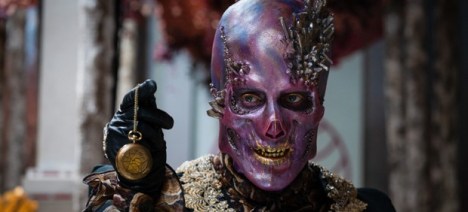
Watch yourself.

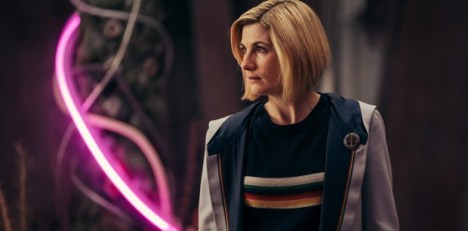
The Vanquishers is in many ways a very typical Chris Chibnall episode, indicative of his approach to showrunning Doctor Who dating back to The Woman Who Fell to Earth. It’s an episode that is powered by plot, based on the assumption that more plot makes the episode better, and that the episode is more engaging whenever Chibnall has something else that he can cut to. In some ways, the splitting of the Doctor into three versions of herself “split across three realities” feels perfectly suited to Chibnall’s sensibility, effectively allowing Jodie Whittaker to star in three separate episodes that the series can keep cutting across.

The problem is that none of the three episodes are any good, and none are in anyway satisfying as a conclusion to this epic saga.

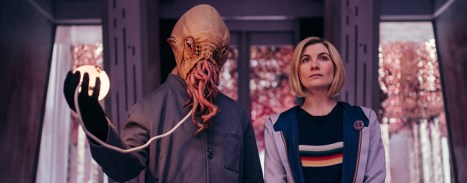
Ood one out.

Continue reading

New Escapist Column! On The Genre Dissonance of “Hawkeye”…

I published a new column at The Escapist at the weekend. With the release of Hawkeye on streaming, it seemed worth an opportunity to take a look at the show.

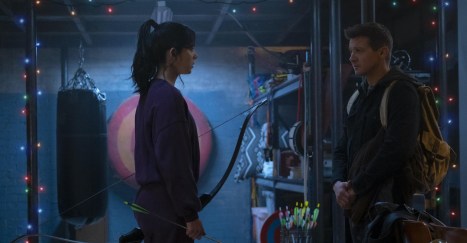
In particular, there’s a fascinating genre dissonance between what Hawkeye is trying to be and what it actually is. The show positions itself as a feel-good holiday buddy comedy, but it also inherits the weight of a film noir. It is essentially a six-episode series rooted in the title character’s attempts to recover the one piece of evidence that links him to mass murder, but the show absolutely refuses to let any of these considerations get in the way of its desire to be “fun” and “chirpy.” The result is an interesting tonal clash between what Hawkeye wants to be, and what it actually is.

You can read the piece here, or click the picture below.

Doctor Who: Flux – Chapter Five: Survivors of the Flux (Review)

“We’re not in the universe.”

Survivors of the Flux marks a return to the narrative style of both The Halloween Apocalypse and Once, Upon Time.

It’s not so much an individual episode of television so much as it’s a space in which the larger narrative threads of the season advance itself. While it’s not as scattershot as Once, Upon Time, it lacks the clarity of focus and momentum that held The Halloween Apocalypse together as a season premiere. Surivivors of the Flux often feels like things happening, which is particularly noticeable in the two story threads focusing on the Great Serpent and the separated companion crew, which are largely a series of disconnected vignettes jumping through time and space respectively to provide a sense of scale to the adventure.

Tomb to manoeuvre.

Even more than The Halloween Apocalypse, Survivors of the Flux is an episode that hinges heavily on the looming series finale. The nature of Doctor Who: Flux places a lot of weight on The Vanquishers. If the season finale is suitably compelling, any earlier missteps will either be retroactively justified or easily excused. However, if the last episode of the set collapses into itself, it may erase a lot of the more interesting ideas leading into it. It is best to travel hopefully, but The Battle of Ranskoor Av Kolos and The Timeless Children are perhaps cause for concern.

Survivors of the Flux is not only a heavily serialised instalment, it’s also recognisable as the first half of the season finale. It is comparable to something like The Stolen Earth or Dark Water. The best of these penultimate seasonal episodes manage to balance a compelling self-contained narrative, or at least engaging character work, with the necessity of setting up larger plot arcs to pay off the following episode. Survivors of the Flux feels a lot more like homework than episodes like Heaven Sent or World Enough and Time.

Glowing concern.

Continue reading

New Podcast! Rarely Going – “Star Trek: Prodigy 1×05 – Terror Firma”

Rarely Going is a podcast looking at the animated corner of the Star Trek franchise. I was thrilled to be invited to join guest host Tony Black for a discussion of the fifth episode of Star Trek: Prodigy, the latest animated spin-off.

I had not had a chance to watch Prodigy before Tony invited me on the show, so it was fun to catch up with the series. Tony and I have a broad discussion about animated Star Trek, about the current state of the larger Star Trek franchise, about whether Star Trek could be seen as “children’s television for grown-ups.” We talk about the importance of serving multiple audiences, and the nostalgic affection for Star Trek: Voyager within modern fandom, and what that might mean for the future of modern iterations.

You can listen to the episode here, or click the link below.

Doctor Who: Flux – Chapter Four: Village of the Angels (Review)

“Doctor, there are angels in the wall here.”

“Of course there are! Why wouldn’t there be?”

Village of the Angels largely works.

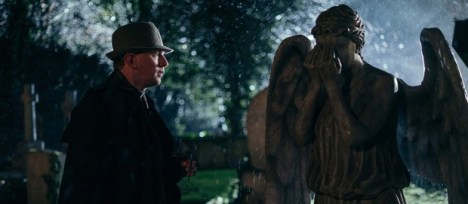
It is the best episode of Doctor Who: Flux to this point, and certainly the best episode of Doctor Who since Maxine Alderton’s last credit on The Haunting of the Villa Diodati. Like The Haunting of the Villa Diodati, Village of the Angels is an interesting high-concept cocktail: it is a period-piece base-under-siege story with a classic monster and simmering occult undertones. It is an illustration of how sturdy some of these Doctor Who templates can be, and how there’s room for novelty and ambition to be found even when playing the old standards.

Angels of the Mourning.

That said, Village of the Angels does run into a couple of problems. Like The Haunting of the Villa Diodati, it is a narrative that feels somewhat undercut by the decision to use it as a launching pad into the two-part season finale. There are enough interesting characters and concepts at play in Village of the Angels that the episode feels like it deserves to function as more than just an extended trailer for the epic closing story of the season around it. Village of the Angels is a story that has markedly less internal resolution than War of the Sontarans, and it almost feels like both episodes would be better served by swapping places.

Still, that’s a relatively minor complaint about one of the most impressive episodes of the Chibnall and Whittaker era.

Grave danger.

Continue reading

New Escapist Column! On What We Talk About When We Talk About Looking for “the next Game of Thrones”…

I published a new In the Frame piece at The Escapist this evening. With the release of Wheel of Time this week, there’s been a lot of publicity describing the show as potentially “the next Game of Thrones.”

It’s interesting to ponder what people actually mean when they talk about “the next Game of Thrones.” After all, Game of Thrones existed in a category unto itself. If anything, it answered the question of what “the next Lostor “the next Sopranosmight look like, with those perhaps answering the question of “what the next E.R.or “the next Twin Peaksmight look like, and so on. Game of Thrones was a smashing success that nobody saw coming, and which looked utterly unlike anything on television. That means that “the next Game of Thrones” probably won’t look anything like Game of Thrones.

You can read the piece here, or click the picture below.

New Escapist Review! “Wheel of Time”…

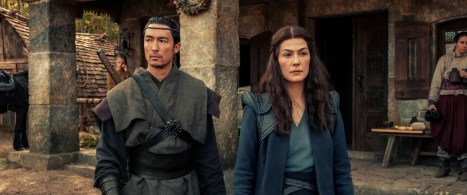
I published a new review at The Escapist today. Wheel of Time is premiering on Amazon on Friday, and I was lucky enough to see the first six episodes.

Publicity around Wheel of Time has mostly focused on comparisons to Game of Thrones. This is reductive, and not just because Robert Jordan’s fantasy epic predates that of G.R.R. Martin. In reality, Wheel of Time often feels like a warm-up for Amazon’s upcoming adaptation of Lord of the Rings. As one might expect, given the source material, Wheel of Time offers a detailed and compelling fantasy world, but the series gets a little bit too preoccupied with setting all of its balls in motion rather than engaging with the story that it is telling.

You can read the piece here, or click the picture below.

Doctor Who: Flux – Chapter Three: Once, Upon Time (Review)

“Love is the only mission.”

Once, Upon Time is equal parts ambitious and frustrating.

It feels like an attempt to adopt the approach that Chris Chibnall took to The Halloween Apocalypse and apply it to a mid-season episode. Allowing for the tertiary plot involving Yaz, War of the Sontarans was recognisable as a fairly straightforward Chibnall era episode, albeit one tied to the season arc. It was a historical epic about a marginalised female hero like Rosa or Spyfall, Part II and it was also a modern-day invasion story like Arachnids in the U.K. or Revolution of the Daleks. Sure, the plot mechanics where governed by the larger concerns of Doctor Who: Flux, but it was recognisable as an episode of Doctor Who.

Blaster from the… future?

In contrast, Once, Upon Time is a radically different approach to Doctor Who on television, one that feels like an extension of the style of The Halloween Apocalypse. On some level, it recalls another of the bolder scripts of the Chibnall era, The Timeless Children, in that it really feels like Chris Chibnall is driving Doctor Who like he stole it. He is trying to do something new with a nearly sixty-year-old franchise. That is genuinely admirable, particularly given how traditionalist the rest of the era around it can feel. For Doctor Who to grow and evolve, it needs to be able to try new things.

However, that’s a very qualified comparison. Like The Timeless Children before it, Once, Upon Time is an episode that doesn’t necessarily work on its own terms. It demonstrates that an episode like The Halloween Apocalypse – an episode with multiple seemingly disconnected threads constantly pushing the narrative forward – only really worked as a season premiere. The Halloween Apocalypse worked because it started with a bang. The audience were oriented coming into the episode, which made the chaos somewhat compelling.
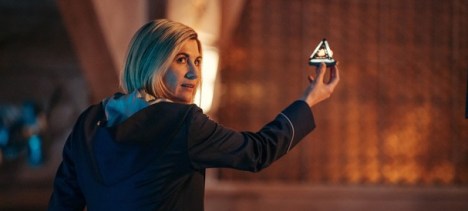
Time, pyramided.

In contrast, Once, Upon Time is too disjointed. It never provides the audience with enough to hold on to as it jumps from one concept to another. It is an episode that should theoretically have a set of clear emotional hearts – Dan and Diane, Vinder and Bel, the Doctor and her past – but gets too tied up in scale and speed to really ground anything that is happening. Once, Upon Time feels like a more dynamic version of The Timeless Children, a lot of exposition in place of what should be a compelling and engaging emotional narrative.

Once, Upon Time feels like it is trying for something new, but it isn’t quite succeeding.

Back up.

Continue reading

Doctor Who: Flux – Chapter Two: War of the Sontarans (Review)

“I have Queen and Country on my side. That is all that I need.”

“She here with you right now, the Queen?”

War of the Sontarans is a basically functional episode of Doctor Who, even if it feels like a rough draft of a more interesting premise that moves quickly enough to dance over the more obvious cracks.

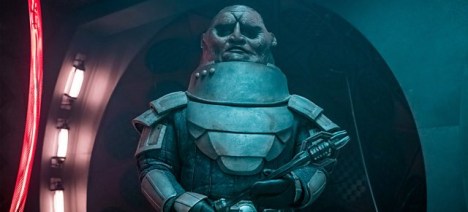
In some ways, War of the Sontarans feels very much like a proof of concept for Doctor Who: Flux, a demonstration of how exactly Chibnall is going to turn that frantic season-opener into a sustainable six-episode miniseries. War of the Sontarans settles down, severely trimming down the number of plot threads in play at the end of The Halloween Apocalypse. Diane and Claire are nowhere to be found. The Weeping Angels are entirely absent. Joseph Williamson only makes a minor appearance, serving primarily to remind audience members that he still exists.

“Queuing for petrol,
Queuing for petrol.
Queuing for petrol.
And I’m on a horse.”

So War of the Sontarans feels very much like a conventional episode of Doctor Who, albeit with considerably more plot crammed into comparatively less space, and with a secondary subplot that more directly ties into the larger arc. It’s not the most elegant way of structuring an event story like this, but it is a more workable model for six weeks of Doctor Who. This is an episode of television that will be easy enough for casual audience members to follow, even if they haven’t seen The Halloween Apocalypse. Indeed, it’s possible to argue that this is easier to follow than The Halloween Apocalypse.

For all the plot and narrative hijinks at work in War of the Sontarans, the episode is remarkably straightforward. This is both its greatest strength and its greatest weakness. War of the Sontarans touches on a variety of interesting ideas, but never lingering on any of them or pushing them too far into their more compelling implications.

Sontaring into battle.

Continue reading