• Following Us

  • Categories

  • Check out the Archives


  • Awards & Nominations

Doctor Who: Day of the Daleks – Special Edition (Review)

To celebrate the fiftieth anniversary of the longest-running science-fiction show in the world, I’ll be taking weekly looks at some of my own personal favourite stories and arcs, from the old and new series, with a view to encapsulating the sublime, the clever and the fiendishly odd of the BBC’s Doctor Who.

Day of the Daleks originally aired in 1972.

Day of the Daleks is a rather wonderful little story that’s been tucked away and forgotten about due its fairly lousy execution. After all, it’s hard to take a story particularly seriously when it suggests that the fate of the world will be decided by an assault on an old country house by three Daleks and a handful of extras. The wonderful people on the Doctor Who Restoration Team have done a wonderful job putting together a special edition of the adventure, using enhanced CGI effects and new footage to give the story the scale that it really deserves. After all, Day of the Daleksrepresents a bold attempt to do something new with the time travel at the very heart of the series.
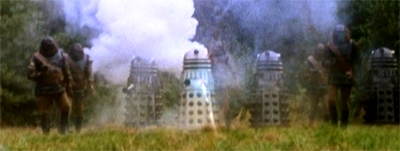
Dawn of the Daleks...

Continue reading

Hannibal – Aperitif (Review)

I’ll admit to being a bit sceptical about Hannibal as a concept. I am quite fond of all three of the Anthony Hopkins films, although I realise that both Red Dragon and Hannibal are flawed pieces of work at best. I also have a soft spot for Michael Mann’s Manhunter, even if I am not as firm a devotee as others. However, there’s a point where you reach saturation even with an especially interesting character.

There was something increasingly frustrating about watching Thomas Harris and various writers and directors delve beneath the surface of “Hannibal the Cannibal” to offer trite explanations and rationalisations for a character who was originally a force of nature. A television series seems to be the perfect way to over-saturate the market even further. If the character of Hannibal could seem trite and mundane after four films released years apart, how do you make a weekly television series exciting?

Surely you’ll either resort to explaining away all the mystery of the character, or you’ll simply wind up with a particularly shallow and generic serial killer show. There is a middle ground to be found, but it will be hard to strike that balance. With that in mind, I will confess that I am quite impressed with the pilot for Bryan Fuller’s Hannibal. Although it’s too early to form a definitive judgement, Aperitif is quite appetising.

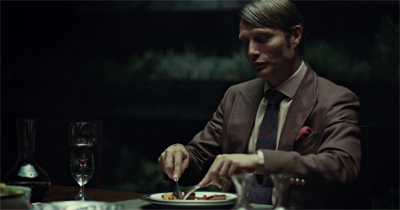
The meat of the matter...

The meat of the matter…

Continue reading

Star Trek – Ex Machina by Christopher L. Bennett (Review)

This August, to celebrate the upcoming release of Star Trek: Into Darkness on DVD and blu ray, we’re taking a look at the Star Trek movies featuring the original cast. Movie reviews are every Tuesday and Thursday.

We’ll be supplementing our coverage of the movies with tie-ins around (and related to) the films. We’ll be doing one of these every week day. This is one such article.

Ex Machina is really an astoundingly clever piece of work. On the surface, a lot of reads like a fan’s wishlist, a collection of “snags” made while watching the classic Star Trek films and making a conscious effort to fix them up a bit. There’s a lot of effort into explaining the changes between Star Trek: The Motion Picture and Star Trek II: The Wrath of Khan, with character-centric subplots focusing on Kirk’s ego or Chekov’s growing disenfranchisement.

Indeed, Bennett even provides an entirely unnecessary but quite-enjoyable-nonetheless set of annotations for Ex Machina, explaining where and how he’s tying his story into a rake of continuity. He describes Ex Machina as probing “an unexplored gap” in the franchise’s chronology. Ex Machina exists as both a sequel to a rather bland third-season episode of the show (For the World is Hollow and I Have Touched the Sky) and The Motion Picture. Neither is especially loved among fans.

However, what’s fascinating about Ex Machina is the way that none of this prevents Bennett from crafting a compelling and intriguing narrative. It’s clear that he’s enjoying attempts to fill in various gaps, but Ex Machina works incredibly well as a piece of Star Trek which stands on its own two feet.

st-exmachina

Continue reading

The Sopranos: Guy Walks Into A Psychiatrist’s Office…

Guy Walks Into a Psychiatrist’s Office gets the second season of The Sopranos off to a strong start. We’re immediately informed that time has elapsed and that everything has sorted itself out. We get a montage to assure us that it’s business as usual, and the early part of the episode features Tony tying off the last possible lose end in the feud between himself and Junior. However, there’s also a sense that things are changing, both in the lives of our characters and also in the way the show is structured.

The first season of the show is a damn fine piece of television, but it’s also somewhat misleading. It’s a beautifully structured thirteen-episode mob epic which manages to satisfactorily tie up all its loose ends by the time the credits role on I Dream of Jeannie Cusamano. It’s understandable that so many people were frustrated by the show’s non-resolution after the first season wrapped up so elegantly.

With the success of that first season, there’s a sense of earned confidence to Guy Walks Into a Psychiatrist’s Office, as if Chase feels like he has a bit more freedom to work with in telling his great American novel.

Something's not quite right here...

Something’s not quite right here…

Continue reading

Stan Lee & Jack Kirby’s X-Men – X-Men Omnibus, Vol. 1 (Review/Retrospective)

To celebrate the release of The Wolverine later in the month, we’re taking a look at some classic X-Men and Wolverine comics every Monday, Wednesday and Friday here. I’m also writing a series of reviews of the classic X-Men television show at comicbuzz every weekday, so feel free to check those out.

Stan Lee and Jack Kirby are the architects of the shared Marvel Universe. The pair collaborated on titles like The Fantastic Four, The Avengers and Thor – helping reinvent American comic books during the sixties. The comics redefined what superheroes could be, honing in on the changing sensibilities of the era. However, not every series was a run-away success. Not every idea worked from the very first issue.

The X-Men are one of the most iconic bunch of superheroes in existence. They have had everything from blockbuster films to celebrated cartoon shows. However, they had a rocky start. The book limped along through its first years of publication, never quite connecting with its audience. Indeed, the book almost died a quiet death in the early seventies, before writer Len Wein and artist Dave Cockrum revived the team for a relaunched Giant-Sized X-Men. After that, Wein handed the book over to Chris Claremont, who really defined the book and its characters during an extended run on the title.

Reading these early issues, from Lee and Kirby, it’s quite clear that the X-Men aren’t working. There’s a lot of stilted awkwardness to the stories, as Lee and Kirby try to find a compelling hook for the team. They come quite close – it’s surprising how close at times – but it’s easy to see why the premise took so long to catch on.

To me, my X-Men!

To me, my X-Men!

Continue reading

Beware the Batman – Hunted (Review)

Batman is a character who thrives on reinvention and reimagining. The character has over second decades of interpretations behind him, covering a wide range of portrayals. He has been Adam West’s camp crusader, Tim Burton’s gothic outsider and Christopher Nolan’s urban warrior. In the comics, he’s undergone an even more diverse series of changes and reworkings. Beware the Batman is the latest animated series to focus on the Dark Knight, offering a take quite distinct from the variety of animated interpretations we’ve seen in the recent past.

A running start...

A running start…

Continue reading

The Sopranos: I Dream of Jeannie Cusamano (Review)

From pretty much the opening scene, I Dream of Jeannie Cusamano begins wrapping up loose ends with a ruthless efficiency. Jimmy, the rat identified in Nobody Knows Anything, is murdered less than five minutes into the episode. All the various plot threads seeded throughout the show’s first year come to a head. The feud between Junior and Tony is resolved. The FBI swoop in. Tony and Melfi talk it out and figure out exactly what their relationship is. Even Artie’s restaurant becomes a focal point, providing a direct link back to the very first episode.

For all the talk of randomness and inconsistency in The Legend of Tennessee Moltisanti, everything here seems to come a full circle. It’s absolutely stunningly executed, and one of the best things that can be said about I Dream of Jeannie Cusamano (and one of the best things that could be said about any piece of television drama ever) is the fact that it feels so much deeper and richer than its runtime. We know that it’s an hour-long, but it really feels so much meatier and more substantial than that.

It’s a beautiful culmination to a year’s worth of television.

Lights out...

Lights out…

Continue reading

Doctor Who: Doomsday (Review)

To celebrate the fiftieth anniversary of the longest-running science-fiction show in the world, I’ll be taking weekly looks at some of my own personal favourite stories and arcs, from the old and new series, with a view to encapsulating the sublime, the clever and the fiendishly odd of the BBC’s Doctor Who.

Doomsday originally aired in 2006.

Daleks, be warned. You have declared war upon the Cybermen.

This is not war. This is pest control.

We have five million Cybermen. How many are you?

Four.

You would destroy the Cybermen with four Daleks?

We would destroy the Cybermen with one Dalek. You are superior in only one respect.

What is that?

You are better at dying.

– the Cyberleader and Dalek Sec compete for the title of “bitchiest Doctor Who villain”

Part of my frustration with Doomsday is the same problem that I have with the rest of the second season’s weaker episodes. Like Fear Her or Rise of the Cybermen, the second season finalé lacks ambition. It feels complacent, it feels comfortable. It feels like putting the Daleks and the Cybermen together in one episode is enough to merit attention, without anything more than exchanging pithy one-liners. It feels like the separation of the Doctor and his companion is the biggest and most important thing in the universe, without really convincing us that this isn’t the best possible outcome. It feels like the easiest way to make these threats palpable is to set them in modern London, without any real sense of consequence or scale.

The tears of a Time Lord...

The tears of a Time Lord…

Continue reading

Doctor Who: The Green Death (Review)

To celebrate the fiftieth anniversary of the longest-running science-fiction show in the world, I’ll be taking weekly looks at some of my own personal favourite stories and arcs, from the old and new series, with a view to encapsulating the sublime, the clever and the fiendishly odd of the BBC’s Doctor Who.

The Green Death originally aired in 1973.

Where are you off to?

To pack a suitcase.

Oh, good. Give me a couple of minutes and we’ll be off.

Off? Off where?

Well, Metebelis III, of course.

I’m not going to Metebelis III.

Why? Where are you thinking of going to?

Well, South Wales, of course. Llanfairfach.

– the Doctor and Jo discuss travel plans… why would you want to go to Metebels III when you can visit South Wales?

The Green Death is a great example of the Jon Pertwee era. It offers a pretty solid showcase of the best of the era, along with the glaring structural and thematic weaknesses that the show never really tackled head-on. It’s a great yarn, an affectionate run-around. There is a reason, after all, that the overgrown maggots have managed to wedge themselves in British popular consciousness. There’s a conscious sense that The Green Death is a season finalé, in the biggest and boldest terms possible.

In an era where television wasn’t really structured in that way, you can trace a pretty clear line between The Green Death and the big epic series finalés of the Russell T. Davies era of Doctor Who.

And the Beatz go on...

And the Beatz go on…

Continue reading

The Sopranos: Isabella (Review)

With Isabella, the first season of The Sopranos comes to a head. It’s all been building and building since the pilot, and the penultimate episode is the point where things really start to pay off. It’s amazing how structured the first season of The Sopranos is, dedicated to build-up and pay-off. Despite the show is about the randomness of life and how stuff just sort of happens, there’s a very clear internal structure and logic to the first season.

Those frustrated by the ending (or arguable non-ending) of Made in America may have missed the point of the larger show, but it’s not an unreasonable expectation when the first season was so careful about paying off all of its plot points and thread. Isabella is the point where things go wrong for Tony in a big way. It’s the episode where Junior and Livia’s scheming puts a bullet in him (and – in one of the show’s countless references to The Godfather – through his orange juice).

At the same time, it remains a story driven by Tony, focused on his character and his own psychology.

Let sleeping mobsters lie...

Let sleeping mobsters lie…

Continue reading